Pages

Monday, December 12, 2011

Dead End in Norvelt - a review

Gantos, Jack. 2011. Dead End in Norvelt. New York: Macmillan.

I don't know how much of Dead End in Norvelt, featuring the fictionalized Jack Gantos, is true and how much is not, but I'll venture that the author Jack Gantos had a secure (albeit austere) childhood with two well-meaning, working-class parents, a tendency for nosebleeds, and a few very quirky neighbors. 

Bomb shelters, WWII surplus equipment, a dying town, the Hell's Angels, a local newspaper, the sharp-tongued elderly neighbor, Miss Volker, and of course, Jack Gantos and his family are the foils for a very funny, yet affecting book of life in rural, post-war America.

The story begins as young Jack is grounded for the summer due to an unfortunate incident involving a loaded firearm and the drive-in theater. Things get progressively worse as Jack, following his father's orders, mows down the cornfield to make room for a bomb-shelter, which in actuality is merely cover for a private airstrip. The usually kindly and practical Mrs. Gantos quickly takes charge of her two wayward men,

"Well, mister," she informed me with no trace of sympathy in her voice, "I'm going to march your father into this room and make him cut you down to size. And when he finishes with you I'll make him wish he had already built that bomb shelter because he might be living in it."   ...  It took two days for Dad to march into my room and cut me down to size.  He knew he had gotten me in trouble with Mom and so he quickly wrangled a construction job in West Virginia for a couple days of paid work.  He thought Mom might cool down, but he could have been away for two years and she would still have been just as angry.  It was as if she could preserve her anger and store it in a glass jar next to the hot horseradish and yellow beans and corn chowchow she kept in the dank basement pantry.  And when she needed some anger she could just go into the basement and open a jar and get worked up all over again.
 Throughout the long, hot summer, Jack's only respite from digging the bomb shelter and reading in his room are the frequent calls from the elderly Miss Volker, the town medical examiner and writer of obituaries for the local paper.  Her arthritic hands prevent her from typing and Mrs. Gantos, ever solicitous of neighbor's needs, sends Jack to help. In doing so, Jack learns much more than the history of his town, founded by Eleanor Roosevelt.

Realistic fiction with a humorous and historical twist, Dead End in Norvelt is one of the year's best novels. 

Best for grades 6 and up.

It's interesting that many of the best books in recent memory, including Dead End in Norvelt, prominently feature a wise, older or elderly non-relatives (Moon Over Manifest, Okay for Now, Wendy Mass' Birthday series, I'm sure there are more).  Unfortunately, although these books are realistic fiction, there are far too few of these older, helpful, non-relatives in reality.  If you are in a position to be one, please do!

There is an abundance of resources available for Dead End in Norvelt.  Enjoy!
  • An audio excerpt is available here.
  • Read an excerpt here.
  • Teacher's Guide here.


Other reviews @

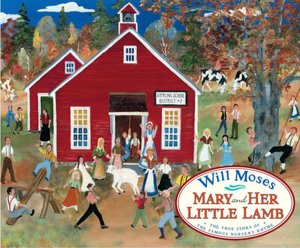
Mary and Her Little Lamb: The True Story of the Famous Nursery Rhyme - a review

Moses, Will. 2011. Mary and Her Little Lamb: The True Story of the Famous Nursery Rhyme. New York: Philomel.

Most children in America will grow up learning the rhyme or the song about Mary and her little lamb, but few will give it any serious thought. We may similarly prattle about Old King Cole, Wee Willie Winkie, or Jack Sprat, but we don't expect to know anything more about them than their propensities for pipe smoking and music, late night excursions in inappropriate clothing and a distaste for high-fat diets.

 Luckily for children, however, we can know a little more about Mary and her little lamb.  Will Moses' detailed folkart paintings (many double-spreads), are a perfect accompaniment to the true story of Mary Sawyer of Sterling, Massachusetts, circa 1810.  The pastoral images of 19th century Sterling and the simple features of the one-room schoolhouse are beautifully rendered in colorful oils. The story is somewhat lengthy, but Moses employs artistic license to add story enriching details that create a fast-paced, enjoyable read-aloud story.  Delightful in words and pictures!


Note:
Earlier this year on the KidLit Celebrates Women's History Month blog, I highlighted Laurie Halse Anderson's book, Thank You, Sarah: The Woman Who Saved Thanksgiving. Sarah Josepha Hale (1788-1879) was a fascinating woman.  Not only did she almost single-handedly create the national Thanksgiving Holiday, she was also a writer, editor and a poet.  I noted that she penned the ditty, "Mary Had a Little Lamb," which I learned from the back matter in Thank You, Sarah. However, there is apparently more to the story.  According to the afterword in Mary and Her Little Lamb, John Roulstone wrote the first stanza of the now-famous poem in the 1810s.  Sarah Hale published the poem in 1930, apparently adding three more stanzas.   Later, musician Lowell Mason, set the rhyme to music, adding the repetitive lines that we all sing today. Regardless of its evolutionary process, it's amazing that a  4-line ditty about a girl and her lamb could  so enchant the schoolhouse visitor John Roulstone, the accomplished writer Sarah Hale, and the famous musician, Lowell Mason. How much more simple life must have been in the early 1800s!  There is no end to the things one can learn from picture books.

Today's Nonfiction Monday roundup is at Geo Librarian.

Note: If you're a regular Nonfiction Monday contributor, you'll want to make note of the roundup schedule's new location.

Thursday, December 8, 2011

Thursday news


I’m blogging at ALSC today about one of my favorite storytime props.
Please join me for “It’s a Wonderful World."
Globus
By Stefan Kühn (Own work) [GFDL
(www.gnu.org/copyleft/fdl.html),
CC-BY-SA-3.0 (www.creativecommons.org/licenses/by-sa/3.0/),
 CC-BY-SA-2.5-2.0-1.0 (www.creativecommons.org/licenses/by-sa/2.5-2.0-1.0)
or GFDL (www.gnu.org/copyleft/fdl.html)], via Wikimedia Commons
In other Thursday news, time is running out to nominate works for consideration for the 2012 ALSC Notables lists for books and DVDs. December 15th is the deadline, so click on over if you’re interested.

If you’re a book blogger, you might want to check out this recent article from the LA Times. At least one publisher thinks we’re not doing enough.  Mr. Morrow forgets, perhaps, that book bloggers do not work for publishers.  In most cases, book blogging is a labor of love - done in our spare time because we enjoy sharing books.  If I don’t review a book that a publisher provided for me, it may be that I’ve been busy, or that I didn’t like it, and I’m being kind. Why waste my time (and yours) writing a review of a bad book?  Many publishers are happy to send out advance copies of their books for review.  If they’re not,  I just wait for the book to arrive at the library.  Either way works for me.  I’ll keep blogging.


Monday, December 5, 2011

Books that will change your world view

My posts have been few in the last week or so.  We are in the midst of renovations and the house is in chaos.  Without cabinets or counter tops, I have been without water in the kitchen since last Friday.  Even now, with the new cabinets in place, I am still without water, waiting for the counter top installers and plumber to install my new sink and dishwasher.  It’s a hassle.  I’ve been complaining.  I’m washing dishes in the bathroom.   Why am I sharing this?  Because as I make my “best of” lists for 2011, I am reminded of the two books that I read this year that will remain with me throughout my life.  Both concern water.


So here they are, my 2011 choices for


"Books that will Change your World View”

(One children’s book and one adult book)

Park, Linda Sue. 2010. A Long Walk to Water. New York: Clarion. 

Fishman, Charles, 2011. The Big Thirst: The Secret Life and Turbulent Future of Water. New York: Free Press. 

The book titles are linked to my earlier reviews.  I sincerely hope that if you haven’t read either of these books, you will consider it.  A Long Walk to Water, in particular, is a book that will stay in your mind for years to come - both haunting and hopeful.  Both will change the way you think of water forever.  Shame on me for complaining about my sink. 


It’s Nonfiction Monday again.  Today’s round-up is at Gathering Books.  Please stop by.


Friday, December 2, 2011

Frog and Friends

Favorite Easy Reader for 2011

 Bunting, Eve. 2011. Frog and Friends. Ill. by Josée Masse. Ann Arbor, MI: Sleeping Bear Press.


I don't like too many easy readers.  This one's great!

Beneath the Waves - a review

As we read disturbing news accounts of dying manatees , environmental disasters caused by toxic waste, and ocean pollution on the scale of ...