Pages

Showing posts with label easy reader. Show all posts

Tuesday, May 5, 2020

I Think I Can - a review

I Think I Can

By Karen S. Robbins
Illustrations by Rachael Brunson
Schiffer Publishing, 2019

Below is my review as it appeared in the June, 2019 edition of School Library Journal.

PreS-Gr 1-An aardvark and a mouse share a silly conversation that begins with a simple and positive pronouncement: "I think I can." In this easy reader designed for a shared reading experience, the aardvark's dialogue consists mainly of single sentence declarations. Mouse's responses are a bit longer and serve to further the story line, "You think you can what?" The book's layout and Brunson's illustrations make it easy to focus on reading. Aardvark's words are in a large, blue font, and Mouse's words are black. Aardvark always appears on the left page against a plain white background, and Mouse always appears on the right. Both are simple cartoon characters in soft, pleasing colors with expressive, happy faces. The story culminates in a song set to the tune of "Row, Row, Row Your Boat." The rhythm of the song is a bit forced, but the joy of singing and reading a song will overcome any shortcomings in meter. Unlike other, wordier, "you read—I read" stories, this one is sweet and super short, leaving no excuse to forgo a quick, shared story. VERDICT Librarians can hand-sell this book to busy parents, grandparents, and caregivers. Teachers can use it to pair confident and emerging readers for a shared experience.


Thursday, August 22, 2019

Hi, Jack! - a review


Hi, Jack! (A Jack Book)
by Mac Barnett & Greg Pizzoli
Penguin Random House, 2019

I don't usually review "easy readers" because I don't like many of them. However, it's hard to resist reviewing an easy reader by the writer and illustrator duo of Mac Barnett and Greg Pizzoli. I admire both of them for their quirky and irreverent sense of humor.

Hi, Jack! is the first in a series of easy reader books featuring Jack—a trouble-making rabbit, Rex—an adorable dog, and The Lady. In the promo materials, Jack is described as mischievous, and The Lady is described as cranky and old, however, that will be up to the reader to decide. With Jack's thievery, graffiti, and trickstering, you may find that The Lady has due cause to be cranky—the old can't be helped.  While it's unusual to have an easy reader protagonist that is decidedly naughty, he also is quite capable of contrition and affability. In short, he's just like every kid.

The illustrations are simple and bright and are integral to the story's three chapters, "Jack," "Rex," and "The Lady." In the first chapter, Jack steals a purse from The Lady.  Although he gives the purse back, he has purloined the lipstick. In the second chapter, we see Rex with bright red, curvaceous lips, and then discover Jack hiding behind him with a devilish grin.

Rex has red lips.
Rex! Why are your lips red?
Your lips are bright red! Who did that to your lips?
Jack!
Bad Jack!
 Parents will love him or hate him.  Kids will definitely "get" him.  Grab your sense of humor and enjoy the rascally humor of Jack. 😄


Other related Shelf-employed reviews:


My copy of Hi, Jack! was provided by the publisher.

Monday, February 11, 2019

Fox the Tiger - a review


Fox the Tiger
By Corey R. Tabor
Harper Collins, 2018

Below is my review of Fox the Tiger as it appeared in School Library Journal.

PreS-Gr 1--Fox yearns to be a tiger. "Tigers are big. Tigers are fast ... Tigers are the best." Fox and his friends, Turtle and Rabbit, spend the day pretending until a rainstorm washes away their disguises. Tabor uses pencil, watercolor, and crayon in a bright, but earthy palette. Most pages have a single illustration which provides context for one or two sentences. After Fox paints himself to look like a tiger, he admires his new stripes in a full-length mirror, can of paint nearby: "There. Now I am a tiger," says Tiger." The three friends have simple, but expressive cartoon features that add emotion to the story. Limited background details, creamy white pages, and an uncomplicated font are a perfect combination for an emerging reader. A humorous ending provides a positive message of self-acceptance that would have more power if Fox's epiphany came from within, rather than from the affirmation of others. VERDICT This is Fox's first appearance in an easy reader and it will surely be popular with children who enjoyed him in picture book format.

Read a sample of Fox the Tiger here. 


School Library Journal. Aug2018, p63.
Copyright © 2018 School Library Journal, the property of Media Source, Inc.  Reprinted here with permission.


My copy of Fox the Tiger was provided by School Library Journal.

Thursday, October 12, 2017

Under-the-Bed Fred - a review


Under-the-Bed-Fred
By Linda Bailey
Illustrated by Colin Jack
Penguin Random House, 2017


Under-the-Bed-Fred is the first in a new chapter book series. Like many young kids, Leo is convinced there is a monster under his bed. He is right. Tired of leaping to/from the bathroom, Leo decides to confront the monster. Leo soon realizes that Fred is just doing his job—scaring kids is what he does. 

In Chapter 2, "The Monster Gets a Name," the author hits her stride and gives the reader a taste of Fred and Leo's personalities,

"What's your name?" asked Leo.
"I don't have one," said the monster.
"Everyone should have a name," said Leo.
"I know," said the monster. "I like Fred."
Leo blinked. "You want to be called Fred?"
"Could I?"
"I don't see why not," said Leo.
"Then say it," said the monster. "Say Fred. Say it nicely."
"Okay," said Leo. "Hi Fred. How are you doing, Fred? How's life, Fred?"
"Oh," said Fred. "That feels good!"
 And Fred, tickled pink with his new name, goes on to keep Leo up all night,

"Fred. Fred. Fred."
"Oh for Pete's sake," said Leo. He rolled over. He put his pillow over his head.
"Fred, Fred, Fred, Fred, Fred ..." said Fred.

The story continues with a requisite bully, Fred's visit to school, and a satisfactory conclusion. The vocabulary is simple enough for independent reading, but presented with humor and personality. The images are mixed media, but appear to be primarily watercolor. They are funny in a style that is reminiscent of a Nickelodeon cartoon. All of this is packaged in an attractive small-sized book with sturdy, glossy pages that will stand up in public and school libraries.

Although monsters under the bed are a trope in children's literature, Fred has charming tendencies that set him apart from the rest and he's worthy of investigation. It will be interesting to see the follow-up books. Kids should like this one!


Take a "look inside" Under the Bed Fred at the publisher's website.


My copy of Under the Bed Fred was provided by LibraryThing Early Reviewers

Thursday, May 19, 2016

Big Dog and Little Dog Making a Mistake - a review

Big Dog and Little Dog: Making a Mistake
by Dav Pilkey
HMH Books for Young Readers

With two dogs and a skunk's tail on the cover, you know how this one is going to end!  Still, Dav Pilkey knows exactly how to engage young readers, and despite the foregone conclusion of two dogs meeting a skunk, Big Dog & Little Dog Making a Mistake is fresh and funny.  I seldom enjoy early readers.  I love this one.   This is a great series.


With Mo Willems' Elephant and Piggie celebrating a great decade with their final installment, The Thank You Book, it's comforting to know that we've still got a great humorist to entertain our littlest readers.

Tuesday, November 10, 2015

What Does Otis See - thoughts on beginning readers

What Does Otis See? - Thoughts on beginning readers and a roundabout recommendation for a very "beginning reader."

I don't usually review beginning reader books, because I don't like many, and I'm frustrated by the lack of publisher consensus on what constitutes the levels.*  I've seen harried parents grab a selection of "Level 2" books off the shelf and assume that their second grade child will be able to read them (not a totally unreasonable assumption). However, aside from the obvious fact that not all children in a particular grade read at the same level, not all "Level 2" books are the same level of difficulty.  I intervene with assistance whenever possible, but pity the poor child whose parent doesn't receive assistance and returns home with insistence that the child slog through a book that doesn't match her ability. This is not the recipe for an enthusiastic reader!

Choosing books for Kindergarten children can be even more frustrating.  "Pre-level 1," "Emergent reader," "Ready to read," "Level 1" -- the choices are endless and the books often much too difficult for the earliest of readers. I love David Milgrim's Pip and Otto books, but ours are coming out of circulation due to age-related wear and tear.  BOB Books are wonderful, but too flimsy for library circulation.

Aggravated is an understatement for my feelings about the whole easy reader situation.

And then along comes What Does Otis See?

What Does Otis See? by Loren Long
Penguin Young Readers, 2015
Level 1, Guided Reading Level C (for those of you keeping score - I'm not)

What Does Otis See? features Otis the tractor exploring the farm. Here's what I like about it:
  • There are only three or four simple words to each double-spread illustration, "Otis sees a calf."
  • The illustrations are detailed, but simply presented with ample use of white space - not busy or distracting.
  • The illustrations offer foreshadowing and invite examination. The page preceding "Otis sees a calf," depicts Otis examining a flowery meadow with the calf partially obscured by grass and flowers.
  • Otis and the dog are adorable.

 
That Otis is an old tractor might make him unfamiliar to urban and suburban kids, but any child who has watched Disney/Pixar's Cars will certainly remember the tractor tipping scene.

Until publishers come to an agreement on a standard of leveling, I will continue to ignore the numbers on the book jacket.  I'll look on the inside and find the right book for each reader.  It takes more time, but it's what needs to be done.  If you're looking for a very easy, "easy reader," What Does Otis See? is worth checking out.


Note:
*In 2010, I wrote a piece for Children & Libraries titled "The Conundrum of Choosing Book Levels." My frustration level hasn't changed much.

Wednesday, October 7, 2015

Picture Book Roundup - October 2015 edition

This edition of the Picture Book Roundup features three funny books, a hilarious cautionary tale, and a sweet bookish story to melt your heart. Enjoy!

Review copies of Night Animals by Gianna Marino (Viking, 2015) and In! Over! and On! by Ethan Long (Penguin, 2015) were provided by the publishers at my request. The Good Little Book by Kyo Maclear (Tundra, 2015), Everyone Loves Bacon by Kelly DiPucchio (Farrar, Straus, & Giroux, 2015), and Ragweed's Farm Dog Handbook by Anne Vittur Kennedy (Candlewick, 2015)

If you can't access the slide show with reviews below, you can see it on RiffleBooks at this link. [https://read.rifflebooks.com/list/185319]

Wednesday, September 18, 2013

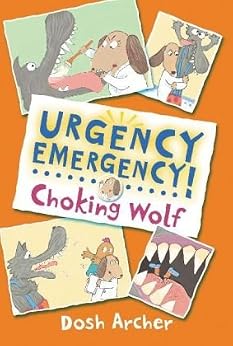
Urgency Emergency! Easy reader fun!

If you've read my blog for any length of time, you'll know that I'm not a fan of many beginning readers.  I am constantly frustrated by the lack of consistency in the labeling of beginning readers (the difficulty variation in similarly labeled levels is maddening), and discouraged by the insistence of some adults that children must choose a particularly numbered or labeled book regardless of whether or not it appeals to him.  That's why I so seldom review beginning readers. Of late, however, I do like many of Toon Books' offerings, Holiday House's I Like to Read series, and Eve Bunting's Frog and Friends series).

Now I have another series that makes me happy because it's funny in that dry sort of way in which the Brits are so accomplished - and it's leveled (see below), but not labeled.

Urgency Emergency! Big Bad Wolf
Urgency Emergency! Itsy Bitsy Spider
Dosh Archer, 2013
Albert Whitman & Company

The Urgency Emergency! series follows Doctor Glenda, Nurse Percy, and the patients they see each day in the emergency room.  Patients are the inhabitants of fractured folktales and nursery rhymes that should be familiar to most readers.

In Itsy Bitsy Spider, Itsy has a gash on her head that requires stitches.  How did it happen? We hear the report of a bystander,

"I don't know what happened," cried Miss Muffet. "I was just walking along when I found the spider lying in a puddle of water at the bottom of the waterspout." 
And the patient relates,
"The last thing I remember is a big whoosh of water rushing toward me."

But fear not! Everything turns out fine - even the weather,

Outside the sun had come out and dried up all the rain.

Nurse Percy and Doctor Glenda are the anchor characters of the series, and the straight man and woman in this fun and silly series.

48 pages, brightly-colored illustrations and limited text on each page, many double-spread paintings
Looking for reading levels?  Here they are:

Age Levels: 5-8, Grades: Kindergarten-3
CCR-RL.K,1,3.1,2,3,4,5,6,7,9,10
RL.2.1,2,3,4,5,6,7,10

UK version, Bloomsbury
Publishing, 2009


These are new to the US, but apparently at least one was published under a different title in the UK, Choking Wolf (Urgency Emergency).

Monday, January 28, 2013

Play Ball! Baseball books for the very young

"People ask me what I do in winter when there's no baseball. I'll tell you what I do. I stare out the window and wait for spring."
Jay Schyler Raadt CC-BY-SA-3.0
Baseball Hall of Fame baseball player, Rogers Hornsby
Source: Baseball Almanac

Yes, it's January and the temperatures have been in the teens, but soon catchers and pitchers will report to spring training, and on February 21, Spring Training games will begin.

Here are two new books for the littlest of fans:
  • Kawa, Katie. 2013. My First Trip to a Baseball Game. New York: Gareth Stevens.  (part of the My First Adventures series)
In three very simple chapters, this little book introduces children to a baseball game, offering information on the park, the food and the game.  From the chapter, "At the Baseball Park,"
My dad holds our tickets.  They tell us where to sit. We get food to eat. My mom and dad get hot dogs.
The illustrations are simple cartoon-style depictions of a family's trip to the game with a heavy focus on the family's activities.  If just a little bit of baseball is what you're seeking, this will do fine.
A Table of Contents, Index, and Words to Know make this one perfect for school use, however, it's also suitable for adding a little nonfiction to storytime.

Reading Level: Grade K 
Fountas & Pinell: C 
Dewey: 796.357 
Specifications: 7 5/8" x 7 1/8", 24 pages 
Lexile Level: 130

Less perfunctory and more enjoyable is Goodnight Baseball.

  • Dahl, Michael. 2013. Goodnight Baseball. N. Mankato, MN: Capstone. (Illustrated by Christina Forshay)
(Advance copy provided by NetGalley)

Beginning with a sing-song rhythm,
The great big stadium is outside of town.
Fans and friends come from miles around.
and ending with a nod to Margaret Wise Brown's Goodnight Moon,
Goodnight, popcorn boxes under the stands
Goodnight, mascot and goodnight, fans!
Goodnight, friends. Goodnight, cars.
Goodnight, stadium, under the stars ...
Goodnight Baseball takes the reader on a baseball outing with a small boy and his father. Snacks, caps, and even a foul ball are part of a winning day. Brightly colored full-bleed illustrations offer a broad view of the game, the fans, and the park with a focus not on the boy and his dad, but rather, on their place in the larger context of the day.  Expressive faces show the myriad expressions seen during a day at the park - excitement, determination, surprise (no sadness here - the home town wins). Creative endpapers evoke the Green Monster, the boy's favorite team, and tickets stuffed in the pocket of denim jeans.  Goodnight Baseball is a hit.
(Due on shelves March 1, 2013)


Today's Nonfiction Monday roundup is at author Laura Purdie Salas' blog, laurasalas.

Monday, October 8, 2012

A Day with Librarians - a review


It's been a while since I've seen a new book about my profession.  When I learned that Scholastic was putting out a new book, I asked to see a copy, and they obliged.

Shepherd. Jodie. 2013. A Day with Librarians. New York: Scholastic.

Part of the Rookie Read-About Community series, this small (roughly 7"x7") "easy reader" contains basic facts about librarians, their varied duties, and their workplaces. Information is conveyed in simple black font on a white background with a photograph on the facing page.

The "front desk librarian," the one described as using a scanner to check out books and noting when they need to be returned, isn't too common in the public library system in which I work, but I imagine she may be more common in school media centers or smaller libraries.

Statistically, the photos depict a greater diversity in our profession than actually exists, but reflect the change that librarians (and other forward-thinking professions) are striving to create - a more diverse membership. Hopefully, young readers will see themselves in these pages and think about librarianship as a career (no, we're not becoming obsolete).

In addition to five small "chapters," A Day with Librarians includes tips on being a community helper, an index, additional facts, and an "about the author" section.

From the "Meet a Librarian" chapter,
 
Librarians have important jobs.  They can help you find a good book to read or some information about almost anything.

That about sums it up.  I'm good with that.

Other professions featured in the series are doctors, firefighters, mail carriers, paramedics and police officers.
 
Today's Nonfiction Monday roundup is at Wendie's Wanderings.

Monday, May 28, 2012

My Body - a review

Pinnington, Andrea and Penny Lamprell. 2012. My Body. New York: Scholastic.

This isn't the usual type of book that I would read aloud to kids at the library, but here's why I like it. The children featured in the photographs are adorable (toothless, toothy, bespectacled, goofy, sweet and culturally diverse), but more intriguing are the cartoon depictions of the body's internal structures, superimposed over previously mentioned adorable children.  The concept of ear canals, nasal passages and the like are easier to grasp when they can be seen in the familiar setting of a friendly face.  Additionally, the very simple, large-print text makes this a book that one might even excerpt during storytime.  The pages thick and sturdy. There's an index and a glossary.


My Body comes with a free digital companion book, that may or may not be useful to you, depending on your circumstances.  The book is part of Scholastic's Discover More series.  On the one hand, I really like it.  On the other hand, it's one more in a constantly expanding realm of beginning readers with ambiguous designations (Emergent Reader 4+, Confident Reader 6+, Expert Reader 9+).  For the record, My Body is an "Emergent Reader." Thankfully, the age suggestions are not written on the book itself. 

Overall, it's fresh.  It's new, and it's eye-catching.  I like it.


Today's Nonfiction Monday roundup is at Perogies & Gyoza.
(I'll be hosting on June 11)


 I sincerely hope that you enjoy your Memorial Day holiday and that you are able to take some time out to remember those who died in the service of our country.  

Friday, December 2, 2011

Frog and Friends

Favorite Easy Reader for 2011

 Bunting, Eve. 2011. Frog and Friends. Ill. by Josée Masse. Ann Arbor, MI: Sleeping Bear Press.


I don't like too many easy readers.  This one's great!

Thursday, October 6, 2011

Easy readers ... are they getting deeper?

I'm blogging at ALSC today, but I hope you'll head over and join in the conversation about easy readers,


And oh yes, Go Phillies!

Wednesday, September 15, 2010

Can we all get on the same page, please?

On September 8, I received an email from Toon Books announcing its upcoming partnership with Candlewick Press.

TOON Books Partners with
Candlewick Press

I read it with mixed emotions.  Two great publishers joining together.  That’s good, right?   But I was (am) a bit apprehensive that Toon might be overshadowed by its new owner.  And why my concern for Toon Books?  Well, because they’re so darned good at easy readers.  I attended a graphic novel webinar which included comments and booktalks from Toon’s director, Françoise Mouly.  As you know if  read my blog regularly, I am often frustrated by the nonconformity of easy reader leveling “systems.”  I questioned Ms. Mouly about the readability levels of Toon Books. She contacted me after the webinar with complete, thorough, and accurate information about Toon’s graphic easy readers.

The “mystery" book
Can you guess its reading level?
Just take a look at how Toon books differentiates their easy reading graphic titles.
Like many beginning reader series, they’re divided into three levels.  But here’s the difference - we’re not left to wonder what criteria was used to derive those levels.  Surprise, surprise!  Toon Books tells us! Each book has a listed Lexile Level, Guided Reading Level, and Reading Recovery Level.  Now I’m not a teacher, so I don’t specifically need those items, but surely all librarians can appreciate having the tools needed to appropriately shelve, catalog, and recommend our easy reader collections!  This is how it should be done, folks!

A visit to Toon in the Classroom  features teachers’ resources, online books, cartoon makers, reader’s theatre, book lists.  What more can you ask for? There are other publishers who get it right (Peachtree’s reading levels are also readily available), but it’s the exception rather than the rule.

Let’s hope Candlewick follows the tune of Toon Books and begins a movement to make this basic (and much appreciated information) an industry standard in beginning readers.  Kudos to Françoise Mouly for leading the way.

If you agree with me, please, leave a comment, start a discussion on your own blog, send an email to someone, tweet, digg, whatever.  But this, I think, is a conversation that we should have.


Share |

Tuesday, September 14, 2010

Ling & Ting

Lin, Grace. 2010. Ling & Ting: Not Exactly the Same. New York: Little Brown.

Twins Ling and Ting are not exactly the same, but they're close - at least, that is, until you get to know them. Ting is more fanciful. Ling, more disciplined.  In "Making Dumplings," Ling remarks that dumplings look like old Chinese money. 
"We should make a lot of dumplings," Ting says.  "Then we will have a lot of money." So, Ling rolls and Ting mixes. "I will close my dumplings tight," Ling says. "Then our money will not get away." 
 Ting stuffs her dumplings until they're fat and lumpy.
"I will put a lot of meat in my dumplings," Ting says.  "So we will be very rich."
In the end, it doesn't matter.  The girls laugh.  They have made "dump-Lings" and "dump-Tings!"

The delightful illustrations have Grace Lin's distinctive combination of simplicity and joy. Each page of this  easy reader contains a half-page illustration and minimal text.  Each chapter is printed on different, complementary colored pages, helping newly independent readers to an easy transition between chapters.  Also aiding the reader is the bad haircut that Ting receives in the first chapter!  Her botched (but still cute) bangs make the twins easily distinguishable from one another throughout the rest of the book.

Readers of this early chapter book will be treated to six short stories in which they will get to know Ting and Ling, and receive a small taste of Chinese American culture.  They will see that Chinese Americans are the same, but not exactly the same, as any other Americans. And they will see that though they are twins, Ling and Ting are as different as any other two sisters! 

Ling & Ting - they're twins, they're sisters, and they're funny.  I hope we see more of them.


Grace Lin's site offers a wealth of useful information - recipes, coloring pages, lesson plans and more. Her publisher's site offers a downloadable Educator's Guide specifically for Ling & Ting.

The only thing lacking for Ling & Ting? Leveling information - Lexile, Flesch-Kincaid, please, give us something to work with, Little Brown.  Oh how I wish publishers would all get on the same page when it comes to Easy Readers!

A question I'd like to ask Grace Lin:
Is there any significance to the giant cupcake?

Grace Lin's jacket flap author photos are just plain fun. And here's a fun little trailer for Ling & Ting: Not Exactly the Same.


Friday, October 23, 2009

Easy Readers for people of color?

During the summer when the branch was full of young children and parents looking for summer reading titles, I noticed something. There were very few "easy-reader" type books on my shelves that featured children of color. Late in August, when I took a course in Reading Instruction and Children's Books, I discovered from that my colleagues from around the country had noticed the same thing; while there are great children's authors in every culture, many cultures and ethnicities are underrepresented in the "easy reader" market.

I mentioned this to our collections department. Our children's selector got on the job immediately - and found that the choices are not great; however, she was able to quickly provide me with several titles from Picture Window Books, a division of Capstone Press. The books are part of a Read-It! Readers series, The Life of Max, beginning readers featuring a young African American boy, Max. The books don't have the stellar story lines of other series, like Cork and Fuzz or Elephant and Piggie, but they're an alternative. I particularly liked Max Goes to the Library because it also busts a gender myth - the librarian is a man. :)

I'm going to check out the offerings of Lee and Low's, Bebop Books. They might be just what I'm looking for. In the meantime, children in my diverse community can now find Max on my easy reader shelves.

Of course, any book can be enjoyed by any person of any race or ethnicity, but I believe that it's probably nice to see a familiar face on the shelves of your local library.

Wednesday, August 19, 2009

An open rap to the publishers of "easy readers"


I just finished taking a great ALSC online class, Reading Instruction and Children's Books, taught by Kate Todd.


While I learned a lot about reading and "leveling" methods, I also learned that librarians across the country are frustrated with the publishers of "easy reader" books. Not only do they use widely different methods of classifying the "level" of each book, they neglect to tell us which method they use (Lexile, Flesch-Kincaid, whim?)!


Why is one publisher's Level 1 book so different from another's? I vented my frustration in this open rap to the the publishers of easy readers...


An open rap to easy reader publishers

Librarians –
we’re a scientific bunch.
We need more to go on
than just a hunch.

We help children find books.
Some use the 5-finger rule.
We help teachers and parents
and we work with school.

“This Level 2 is too easy?
Well, this one’s just right!
Here’s another Level 2 -
Too hard! Not quite.”

Is it Lexile? Is it ATOS?
Is it Flesch-Kincaid?
Please don’t keep us guessing,
‘cause we need your aid!

Tell us how the books are leveled
all across these lands,
and we’ll make sure they end up
in just the right hands!

Friday, May 2, 2008

The Littlest Leaguer

Hoff, Syd. 1976, 2008. The Littlest Leaguer. New York: Harper Collins.

A reprint of an older book, The Littlest Leaguer, shows how constant the sport of baseball has remained over the years. The book is still relevant today, which is a blessing and a curse.

I am usually a fan of all things baseball and I love baseball titles to share with children. This book recounts the all-too-familiar story of Harold, the little little leaguer who spends his days "sitting the bench." Many children will likely identify with poor Harold.

I had great hopes for the ending. Harold realizes that if he crouches down, the pitcher has trouble finding the strike zone. In his one and only at bat for the season, with 2 strikes, Harold manages to get 3 balls called. In my mind, the greatest ending would be for Harold to get a base on balls - showing that his small size is a strong point, rather than a handicap. But alas, Harold closes his eyes and accidentally connects with the ball and scores a home run. An ending that emphasizes sports prowess over sports acumen. I would have liked the walk.

Friday, April 11, 2008

Cork & Fuzz: The Collectors

Chaconas, Dori. 2008. Cork & Fuzz: The Collectors. Ill. by Lisa McCue. New York: Viking.

This book is apparently 4th in the Cork & Fuzz series, but it's the first that I've read. Cork and Fuzz are best friends in the tradition of Frog and Toad. They may have their differences, but they know that they can count on each other. In this latest installment, Cork and Fuzz are collecting shiny stones, but a mother duck decides to collect Cork!

Veteran illustrator, Lisa McCue, has created endearing characters in Cork, the muskrat, and Fuzz the possum. This Level 3 Viking Easy to Read series is a winner.

Thursday, March 13, 2008

Tae Kwon Do

Pierce, Terry. 2006. Tae Kwon Do. New York: Random House.

For kids enrolled in martial arts and learning to read, this book is a winner. Short and very easy!

"We dress.
We go...
...to Tae Kwon Do.
We stand.
We bow.
We step in now."
....
Very cute.

Beneath the Waves - a review

As we read disturbing news accounts of dying manatees , environmental disasters caused by toxic waste, and ocean pollution on the scale of ...