Pages

Showing posts with label Chinese American. Show all posts

Thursday, December 10, 2015

Under a Painted Sky - an audiobook review


Under a Painted Sky, a debut YA novel set in 1849,, was recommended to me by an adult library customer who said his mother enjoyed it.  I was happy to receive an opportunity to review this unique historical fiction, adventure, romance novel for AudioFile Magazine.  A link to my review is below, as well as the official book trailer. The review contains an audio excerpt.  Enjoy.

Under a Painted Sky by Stacey Lee.  Read by Emily Woo Zeller.
Tantor Audio, 2015.  10.25 hrs.

A link to my review for AudioFile Magazine:  http://www.audiofilemagazine.com/reviews/read/102637/

Wednesday, January 4, 2012

Dumpling Days - a review (redux)

Lin, Grace. 2012. Dumpling Days. New York: Little Brown

I very seldom, if at all, repeat reviews, however, today I make an exception of sorts.  I was fortunate to receive an advance copy of Grace Lin's Dumpling Days, more than six months ago.  There is some debate within the kidlitosphere about when is the best time to post reviews of Advance Reader Copies.  Most would agree that mine was too early.

In any case, when the publisher mentioned that I had posted my review a tad early (6 months - can I help it?  I liked the book!), I offered to re-post it at a later date. 

Well, the time is now.  Dumpling Days is due out on January 21.  However, rather than re-post my review, I offer you a booktalk, a link to my previous review, and a look at Grace Lin's book trailer.

So without further ado ...

a booktalk
In Dumpling Days, Pacy Lin, her parents and two sisters (one older, one younger) are going to Taiwan for Pacy's grandmother's 60th birthday - for 28 days! Twenty-eight days?! What is Pacy supposed to do for 28 days without her friends in a country where she may look like everyone else, but inside, she's definitely not. At least there will be dumplings!

my review

the trailer


and, just for fun, a photo of me and Grace Lin


 She was ever so gracious at her book signings in New Orleans.

Enjoy Dumpling Days!

Monday, June 13, 2011

Dumpling Days

Lin, Grace. 2011. Dumpling Days. New York: Little Brown.

(Advance Reader Copy supplied by publisher - artwork not final)

(a booktalk)
In Dumpling Days, Pacy Lin, her parents and two sisters (one older, one younger) are going to Taiwan for Pacy's grandmother's 60th birthday - for 28 days! Twenty-eight days?!  What is Pacy supposed to do for 28 days without her friends in a country where she may look like everyone else, but inside, she's definitely not. At least there will be dumplings!

Pacy Lin is Grace Lin's semi-autobiographical character from her previous books, The Year of the Dog and the Year of the Rat.  In Dumpling Days, Grace Lin has made a departure from her earlier books.  Breaking out of "The Year of the" formula, with its limited page numbers, Dumpling Days is a longer book (approximately 265 pages), that offers Lin a chance to explore many facets of Chinese art, food, and culture,  as well as offer deeper glimpses into the lives of Pacy's sisters, Lissy and Ki-Ki, and even their parents,
Mom and Dad had told us about how they had moved to the United States, but I hadn't thought about their not understanding TV commercials, not being able to order food, being ignored because you didn't speak the language - all the things I found hard here in Taiwan.  Maybe when Mom ad Dad were first in America, everything was just as strange and confusing to them as Taiwan was to me now. It was surprising to think about.

A beautifully concise thought channeled through the voice of a young girl, easily undertood and profoundly important. In addition to offering cultural perspective, through the family's travels and activities, the reader learns much about the Chinese/Taiwanese culture.

Thursday, January 27, 2011

Just in time for Chinese New Year: The Runaway Wok and Fortune Cookies

February 3, 2011 will usher in the Year of the Rabbit.  Chinese New Year is the first day of the first month in the lunar calendar.  The celebration lasts 15 days and includes the Lantern Festival.  If you were born in 1939, 1951, 1963, 1975, 1987, 1999, or 2011, you were born in the Year of the Rabbit.

Here are two timely new books that just crossed my desk: 

Compestine, Ying Chang. 2011. The Runaway Wok. Ill. by Sebastia Serra. New York: Dutton.

Based on the Danish folktale, The Talking Pot, The Runaway Wok is a new Chinese folktale about old Beijing and a magic wok,  a wok determined to right the wrongs committed by the greedy Mr. Li and his family.  It is the eve of the Chinese New Year and the poor Zhang family sends its son, Ming, to trade eggs for rice at the market.  In a move reminiscent of Jack and the Beanstalk, Ming trades his eggs not for rice, but for a wok that sings out to him,
Boy, Boy, trade for me, I am more than what you see!
And so it is!  But this wok has greater plans than residing with the Zhangs.  Ming's mother barely gets the wok cleaned up before it rolls out the door singing,
Skippity-hoppity-ho! To the rich man's wife I go,
And so the wok, like an Asian Robin Hood, travels back and forth, taking from the rich and delivering to the poor,
Skippity-hoppity-ho! To the poor man's house I go,
much to the delight of the Zhangs and all their friends. The Runaway Wok pays tribute to classic tales in a manner that is still wholly original. Kids will love hearing the wok's rhyming songs and exploring the book's detailed, folk art illustrations full of colorful parasols, foods, flowers, lanterns, and brocade garments. 

An author’s note explains the Chinese New Year holiday (with an emphasis on the culinary aspects), and concludes with a recipe for Festive Stir-Fried Rice. Yum!


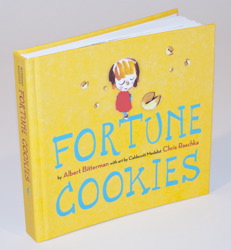
Bitterman, Albert. 2011. Fortune Cookies. Ill. by Chris Raschka. New York: Simon & Schuster.

Fortune Cookies isn't a Chinese New Year book, but it's a

Tuesday, September 14, 2010

Ling & Ting

Lin, Grace. 2010. Ling & Ting: Not Exactly the Same. New York: Little Brown.

Twins Ling and Ting are not exactly the same, but they're close - at least, that is, until you get to know them. Ting is more fanciful. Ling, more disciplined.  In "Making Dumplings," Ling remarks that dumplings look like old Chinese money. 
"We should make a lot of dumplings," Ting says.  "Then we will have a lot of money." So, Ling rolls and Ting mixes. "I will close my dumplings tight," Ling says. "Then our money will not get away." 
 Ting stuffs her dumplings until they're fat and lumpy.
"I will put a lot of meat in my dumplings," Ting says.  "So we will be very rich."
In the end, it doesn't matter.  The girls laugh.  They have made "dump-Lings" and "dump-Tings!"

The delightful illustrations have Grace Lin's distinctive combination of simplicity and joy. Each page of this  easy reader contains a half-page illustration and minimal text.  Each chapter is printed on different, complementary colored pages, helping newly independent readers to an easy transition between chapters.  Also aiding the reader is the bad haircut that Ting receives in the first chapter!  Her botched (but still cute) bangs make the twins easily distinguishable from one another throughout the rest of the book.

Readers of this early chapter book will be treated to six short stories in which they will get to know Ting and Ling, and receive a small taste of Chinese American culture.  They will see that Chinese Americans are the same, but not exactly the same, as any other Americans. And they will see that though they are twins, Ling and Ting are as different as any other two sisters! 

Ling & Ting - they're twins, they're sisters, and they're funny.  I hope we see more of them.


Grace Lin's site offers a wealth of useful information - recipes, coloring pages, lesson plans and more. Her publisher's site offers a downloadable Educator's Guide specifically for Ling & Ting.

The only thing lacking for Ling & Ting? Leveling information - Lexile, Flesch-Kincaid, please, give us something to work with, Little Brown.  Oh how I wish publishers would all get on the same page when it comes to Easy Readers!

A question I'd like to ask Grace Lin:
Is there any significance to the giant cupcake?

Grace Lin's jacket flap author photos are just plain fun. And here's a fun little trailer for Ling & Ting: Not Exactly the Same.


Friday, January 16, 2009

Alvin Ho Booktalk

Second grader, Alvin Ho doesn’t speak at school. Not one word. Of course, that’s not to say that he can’t speak at all. He can! In fact, thanks to his Dad, he can even swear like Shakespeare, “Get thee gone, thou beshibbering onion-eyed flap-dragon! THY MOTHER WEARS ARMOR!” Of course, swearing can get a person into trouble. And Alvin’s got enough trouble already. He’s having trouble learning to be a gentleman, he’s afraid of just about everything, and now, a bully wants to be his friend! Find out how Alvin Ho makes it through second grade with the help of his trusty Personal Disaster Kit and a friend named Flea in this great new chapter book titled, Alvin Ho: Allergic to Girls, School, and Other Scary Things by Lenore Look, with pictures by LeUyn Pham.

Tuesday, August 12, 2008

The Dragon's Child: A Story of Angel Island

2008. Yep, Laurence. The dragon’s child: A story of Angel Island. New York: Harper Collins.

Prolific writer, Laurence Yep and his niece, Dr. Kathleen S. Yep, are fortunate to have uncovered over 500 pages of historical documents relating to their family’s immigration records. Children are fortunate that they have chosen to share this information in The Dragon’s Child: A Story of Angel Island. The Dragon's Child, is written in the form of an interview of Yep Gim Lew, by the author, Laurence Yep. Each answer is followed by a first-person "flashback" to young Yep Gim Lew's past in 1922.


QUESTION: Did you want to go to America?

POP: Sure. I didn't have a choice. My father said I had to go. So I went.


"I had always known I would have to leave home. Our villages land was so poor that men in my clan always had to work elsewhere. My grandfather had been one of the first to cross the ocean to the Golden Mountain. Others went to different countries. For generations my clan had been like rice chaff, scattered in the wind all over the world."

The book follows Yep Gim Lew's journey from his rural village in China to San Francisco, where he will become a Guest of the Golden Mountain. Full of documented information on the difficult path to immigration faced by Chinese immigrants in the era of "Chinese exclusion" laws, this is a wonderful resource for children learning about immigration. The immigration stories of Angel Island, "The Ellis Island of the West," are markedly different from the stories of those greeted by the Statue of Liberty.

A stuttering, 10-year-old, Yep Gim Lew must make the long journey to San Francisco and study for the grueling interrogation at Angel Island as he prepares to make the transition from Chinese farm boy to grown-up, Guest of the Golden Mountain, as travelers to the American West were called. His father, Yep Lung Gon, uncomfortable as a wealthy Chinese "lord" during his visits back to China, instructs Yep Gim Lew in the ways of the west.

In addition to the novel, there is an extensive Author's Note, a chapter on Chinese Immigration , as well as period photographs, web resources, and a bibliography. At under 150 pages including extras, this book is a quick and interesting read. There are not many light-hearted moments in the story, but the voice is authentic, and the story offers a great insight into Chinese and Chinese-American culture.

Coincidentally, according to immigration documents, the author's grandfather, Yep Lung Gon arrived in San Francisco on one of his many voyages, the day after the devastating San Francisco earthquake and fire of 1906. He writes about this period in history in The Earth Dragon Awakes. (see earlier post)

Friday, July 11, 2008

The Earth Dragon Awakes

Yep, Laurence. 2006. The Earth Dragon Awakes: The San Francisco Earthquake of 1906. New York: Harper Collins. ISBN 13: 9780060275242.

PLOT SUMMARY
It is Tuesday, April 17, 1906, and two boys separate for the evening. Chin heads for home in his Chinatown tenement building, riding the cable car with his father, Chinese "houseboy", Ah Sing. Henry settles in the for the night at his Nob Hill home, now that his parents are home from the opera. Neither is aware of the earthquake that will strike within hours. The Earth Dragon Awakes chronicles the story of the great San Francisco earthquake and fire through the parallel stories of Henry and Chin.

CRITICAL ANALYSIS
The Earth Dragon Awakes: The San Francisco Earthquake of 1906 is a historical fiction novel for young readers, by Newbery Honor winner, Laurence Yep. The short chapters are titled with a time, date, and location stamp, “5:12 A.M., Wednesday, April 18, 1906, Chin and Ah Sing’s tenement, Chinatown.” The story line is clear and linear, beginning on the eve of the great quake, and ending ten days later.
Yep’s genius is in telling parallel stories of the two friends, Henry Travis, son of a White banker, and Chin, the son of Henry’s houseboy, Ah Sing. When the story begins, Ah Sing and Chin are watching Henry while his parents attend the opera. As the Chinese pair leaves Nob Hill, their tale begins to diverge from the Travis’. Chin and his father travel by streetcar to Chinatown, where, although it is now midnight, the streets are still bustling as Chinese workers attend to their errands after a long day’s work. Chin and Ah Sing purchase Chinese newspapers and buy apples. Ah Quon, their neighbor, is leaving the temple. Authentic Chinese names are used throughout. Other cultural markers are less obvious, but no less authentic.

In the tenement, Chin can hear “the clacking of mahjong tiles,” and “twisted cable-car tracks look like the strokes of a mysterious, dreadful word.” (A footnote explains that a Chinese character is representative of a word)

The book’s title, The Earth Dragon Awakes, is suggestive of this culture’s historical usage of folkloric creatures. When Ah Quon warns that the Earth Dragon is upset, Ah Sing notes, “The Earth Dragon has shaken the city before,” “We’re still holding on to his back.” Chin silently asks the “Earth Dragon to keep his temper.” A dragon symbol denotes each new chapter. In another instance of personification, “fear twists inside Chin like a snake.”

A perfect example of the dichotomy of the American and Chinese American cultures lies within the story itself. Western literature is typically conflict and resolution. The Travis family’s story in the face of the disaster is one of resoluteness. At first they attempt to stay in their destroyed neighborhood, willing to suffer deprivation and hardship. Only when their situation becomes untenable, do they begin moving – vowing to rebuild and return. The focus of their resolution is to conquer their hardship. Ah Sing and Chin’s goal, however, is to adapt and to continue. As soon as the disaster befalls, they immediately decide to press on to safety, placing survival and continuance foremost. They are decidedly adaptable in their quest – even taking on a short job as wagon loaders to earn money for their ship passage to safety. Conquering the Earth Dragon would not be a culturally authentic outlook for Ah Sing and Chin.

A modernizing aside to the text is the addition of a small footnote in the last chapter. After reading that twenty thousand people have fled San Francisco by boat, and 225,000 more by train, the reader is directed to a footnote, “Never before have so many people left an American city in peacetime – until Hurricane Katrina struck New Orleans.” The addition of this small footnote serves as a reminder of the huge proportions of both tragedies, but also of the possibility for recovery.

As one reviewer noted, the book’s theme of “ordinary heroes” is a bit didactic, “These are ordinary people Henry sees every day. “They’re acting just like heroes,’ he says to his mother.” This is a minor flaw, however, and children will likely ignore the heavy handedness. Scientific explanations of the earthquake and resulting firestorm may be very interesting to some readers, but are so neatly woven into the story, that they are not distracting to those less scientifically inclined.

Yep’s Afterword is especially interesting, placing the Great Earthquake and Fire in terms that modern youngsters can understand, explaining that in 1906, “fourteen dollars could comfortably feed for people for a week,” then outlining the cost of the disaster in 1906 and current year dollars. He also notes which of the story’s anecdotes are factual, including people stopping “a runaway horse by flapping umbrellas at it.” Yep personalizes the book by relating that his own grandfather was a Chinese houseboy who was returning to San Francisco from China on the day following the earthquake. His grandfather was detained at the immigration center for seven days. A suggested reading list and six photographs of the quake’s aftermath (sure to interest young readers) close out the book.

With its focus on the two boys, the earthquake and the fire, The Earth Dragon Awakes is an excellent choice for middle-school aged boys (or girls) who may otherwise be disinterested in multicultural literature. The vocabulary is simple; and the uncomplicated story of one of the nation’s most famous disasters will be sure to hold the interest of the less sophisticated reader.

CONNECTIONS
Bring in a mahjong set to show. Use it as an opportunity to introduce this piece of Chinese culture and its motif of Chinese characters.

The Earth Dragon Awakes is particularly well suited for cross curricular use - in language arts as a reluctant reader novel, in Social Studies to complement immigration history, and in Science to aid in the study of plate tectonics.

Readers interested in Chinatown may enjoy Yep's series, Chinatown Mysteries.

Thursday, March 27, 2008

The Year of the Dog

Lin, Grace. 2006. The Year of the Dog. New York: Little Brown.

The Year of the Dog is a short chapter book for younger J readers. Loosely autobiographical, Lin tells the story of one year in Pacy (Grace, to her schoolmates) Lin's life, the Chinese Year of the Dog. Lin's year begins appropriately on the Chinese New Year holiday, the lucky year of the dog. And indeed, the years begins with luck as another Chinese American girl moves into Pacy's upstate New York neighborhood, and the two girls become fast friends.

At first, I read the book waiting for the "big event," the problem moment, the other shoe to drop. But the other shoe doesn't drop; instead, the book is a largely upbeat and realistic look at the everyday issues facing a middle-school aged girl. There is one incident in which Pacy is called a "Twinkie," yellow on the outside/white on the inside, too American to be Chinese/too Chinese to be American. Even Pacy isn't sure if she should call herself Taiwanese or Chinese. It's confusing, but not overwhelming. By and large, the book is a positive look at the life of a young Taiwanese American with a loving family and a good friend. Sprinkled throughout are stories within a story; Grace's mother relates memories from her own childhood as a first generation immigrant. Also adding interest are Lin's numerous pen and ink sketches.

Interesting facts about Chinese culture are interspersed throughout the book and the reader will learn a great deal about life as a Chinese American. The melding of the two cultures is dealt with in a humorous manner. When Grace has a sharp pain in her neck, her mother tells her grandmother.

"'Ah,' Grandma nodded her head at me wisely, 'I know. I fix!'" Grandma takes out a silk box with paints and brush and paints Chinese characters on Grace's neck. "'Leave and tiger will chase pig,' she told me. 'Running will help neck.'"

Grandma has painted the Chinese characters for "tiger" and "pig" on the back of Grace's neck.

She later asks her mother, "'Will the paint come off? ... I don't want to go to school with 'pig' written on my neck!' 'I'm sure it will,' Mom said, 'but does your neck feel better?'"

She thinks for a moment. "'Well, yeah,' I nodded, 'it does!'"

The Lin's fill their New Year's candy bowl with Chinese candy mixed with M&Ms; and for Thanksgiving, Mom relents and cooks a small turkey to go alongside the glassy rice noodles, fried shrimp, and meaty dumplings.

The book concludes with a Reader's Guide (questions appropriate for a book discussion), and a sneak peek at the next book in the series, Year of the Rat (Jan 2008).

Beneath the Waves - a review

As we read disturbing news accounts of dying manatees , environmental disasters caused by toxic waste, and ocean pollution on the scale of ...