Pages

Showing posts with label historical fiction. Show all posts

Wednesday, April 3, 2019

Queen of the Sea - a graphic novel review

Queen of the Sea
By author/illustrator Dylan Meconis

Candlewick, 2019


Queen of the Sea is a 400-page historical fiction, graphic novel adventure set in a time and place reminiscent of the sixteenth century British Empire. A prologue introduces a queen in mortal danger, and the story then shifts to Margaret, an orphan who lives on a remote island in the Silver Sea. She has been raised in a convent. The nuns, a few servants, a priest, and Margaret are the island's only inhabitants, and life for Margaret is peaceful, pious, and predictable. A ship with supplies arrives twice a year to bring supplies. However, one day, the ship brings a boy and a lady, and life on the island will never be the same.

Queen of the Sea is a rousing adventure, but it's also an education in sixteenth century politics and the lifestyle of a religious order in the early days of modern Western history. Though the destiny of women was often determined by men, Queen of the Sea offers strong, but believable, female protagonists in young Margaret, Lady Cameron, and the nuns. A sequel will be most welcome!


Read a sample chapter of Queen of the Sea.
Inside spread from Queen of the Sea by author/illustrator: Dylan Meconis ©


Note:
My advance copy of Queen of the Sea was in black and white with only a sample page in color.  The first 3/4 of the book were finished black and white drawings, the latter portion of the book was comprised of sketches.  I almost wish that everyone had an opportunity to see a graphic novel is this format. It makes one so much more aware of the work that goes into every aspect of a book.

My copy of Queen of the Sea was provided by the publisher.

Thursday, January 31, 2019

Sweep: The Story of Girl and Her Monster - an audiobook review

Sweep: The Story of a Girl and Her Monster
By Jonathan Auxier
Read by Sarah Coomes
Brilliance Audio, 2018
8 hours, 14 minutes

Enter the world of Nan Sparrow, an indentured child laborer in the soot-filled chimneys of Victorian London.

Coomes's voice and Auxier's prose combine to create an immersive experience. 

 Read my complete review of Sweep for AudioFile Magazine and hear a sample of the book here.

Sweep swept the journals, receiving starred reviews in Horn Book, SLJ, PW, Booklist, Kirkus, and School Library Connection

In addition to AudioFile Magazine's Earphones Award for "truly exceptional titles that excel in narrative voice and style, characterizations, suitability to audio, and enhancement of the text," Sweep recently won the Sydney Taylor Book Award in the Older Readers category. award honors "outstanding books for children and teens that authentically portray the Jewish experience."


This Publishers Weekly article has a #booktalk for Sweep by the author, Jonathan Auxier.

My copy of Sweep was provided by AudioFile Magazine.

Thursday, November 30, 2017

My Brigadista Year - an audiobook review

My Brigadista Year
by Katherine Paterson
Read by Frankie Corzo
Brilliance Audio, 2017

In 1961, following the Cuban Revolution, Cuba was largely populated by illiterate, rural farmers. Whatever may be your thoughts on Fidel Castro and the often brutal results of the revolution, it is difficult to be unimpressed by Castro's Literacy Campaign, one of his first initiatives. Using hundreds of thousands of young volunteers, he embarked on a one-year plan to bring literacy to the entire country.  Most of the volunteers were young, teenage girls from Havana and other large cities, who traveled to rural areas to live and work with farming families by day, and educate them by night. Amazingly, he succeeded. My Brigadista Year is a fictionalized, epistolary account of one volunteer.


Note: The current literacy rate in Cuba is 99.8%, according to the CIA World Factbook, and Cuba continues to have one of the highest literacy rates in the world. Reliable, current statistics on the US literacy rates are not readily available.


Below, author Katherine Paterson discusses her book.

My copy of My Brigadista Year was provided by AudioFile Magazine. *Edited to add video(oops).

Saturday, July 1, 2017

A Fugitive in Walden Woods - a review

A Fugitive in Walden Woods
by Norman Lock
Bellevue Literary Press, 2017

A Fugitive in Walden Woods is historical fiction, a revisionist history featuring some of the greatest American minds of 1845. The book is part of The American Novels series.

At the cost of his shackled hand, the enslaved Samuel Long escapes via the Underground Railroad to relative freedom in Massachusetts. His benefactor, Ralph Waldo Emerson, gives him a job of sorts—monitoring the well-being of Emerson’s friend, Henry David Thoreau, who is in the midst of his famous sojourn in Walden Woods. In the occasional company of these men, Samuel becomes acquainted with Nathaniel Hawthorne, Louisa May Alcott, William Lloyd Garrison, and other Transcendentalists. A Fugitive in Walden Woods is Samuel Long’s memoir of his year in Walden Woods, written through the lens of his later experiences.

So thoroughly does Lock set the mood that it is impossible to tell which words of Thoreau, Emerson, and Hawthorne are ones actually spoken or ones created by Lock. Though these men pondered the great questions of their age (and our own), the insertion of Samuel into the story, forces a more practical rendering of their great ideals. 

Samuel writes,

"Emerson had asked me what it meant to be human. I should have told him that a person cannot be human if his life is perpetually in the grip of terror and uncertainty. Just as cities are built by people unafraid of marauding barbarians and the caprices of a hostile universe, so will we become human when we no longer live in fear for our lives."


A Fugitive in Walden Woods does not shrink from the difficult questions of our time, including racism. It succeeds in its goal of nudging us to become deeper thinkers.


"It is easy to misjudge others—a commonplace remark, but nonetheless true. We close our minds to the completeness of others, striking from the portraits we draw of them in our imaginations all contradiction."


My copy of A Fugitive in Walden Woods was provided by LibraryThing Early Reviewers.

Wednesday, June 7, 2017

Picture book audiobook reviews

Here are two audio books that I reviewed recently for AudioFile Magazine.  Both are historical fiction, picture books for older readers/listeners and are based on real events.


Flowers for Sarajevo by John McCutcheon is a child-centered look at living in a war-torn city. Though difficult to do, John McCutcheon coaxes optimism from misery. Read the full review for Flowers for Sarajevo at AudioFile Magazine.  

 Read an excerpt here: [http://peachtree-online.com/…/Flowers-for-Sarajevo-Excerpt.…]


The Cellist of Venice by Kim Maerkl with music by Bach, is a brief historical fiction audio book. Music and narration are combined to tell a magical, melancholy, musical, and mysterious story.  My full review of The Cellist of Venice is available from AudioFile in print or online.


Don't forget to check out Audiobook SYNC free audio books all summer! There are two titles available every Thursday.  One is a classic and one is a modern YA book with a similar theme to the classic.  Books are free and yours to keep!  Spread the word! You can find SYNC on Facebook.

[http://www.audiobooksync.com/]

Friday, May 5, 2017

A comparison of Rules of Civility and A Gentleman in Moscow

I recently read A Gentleman in Moscow by Amor Towles
(Penguin, 2016) which I consider the best, new adult novel I have read in years. I followed it up with his first book, Rules of Civility.

Here is my take on both.

First - the most basic differences:

Rules - spans one year
Gentleman - spans one adult lifetime
Rules - social climber
Gentleman - social outcast
Rules - Manhattan
Gentleman - Metropol Hotel, Moscow
Rules - female protagonist
Gentleman - male protagonist

My takeaway: Become the master of your circumstances or they will master you.

The protagonists in Rules of Civility and A Gentleman in Moscow manage their circumstances with aplomb, however, the characters could not be more different. One's fortunes are ascendant, the other's—quite the opposite. Both protagonists are smart, well-read, and appreciative of life's finer things.

Rules of Civility spans a single year—1938 in New York City. The young secretary, Katherine Kontent, can recognize a custom-made suit, an expensive lighter, or a fine glass of liquor because she aspires to have fine things. A Gentleman in Moscow spans a tumultuous period in Russian history—from the Bolshevik Revolution to the Cold War. It takes place within the confines of the fictionalized Metropol Hotel in Moscow, where Count Alexander Rostov has been sentenced to a lifetime of house arrest. He, too, can easily recognize a custom-made suit or a fine glass of liquor—not because he aspires to have them, but because he had always had them.

Katherine (Katey) is a woman who enjoy life's smaller pleasures. She enjoys people-watching, a well-written book, a well-timed phrase or gesture. But her enjoyment is fleeting—a moment marked in time, appreciated, and discarded without sentimentality.

The Count enjoys similar simple pleasures—but he savors them, appreciating that it is these small joys that make a life worth living. Although his fortunes literally and figuratively spiral downward, his spirit and joie de vivre are rarely diminished. At the worst of times, he finds pleasure in the most basic events.

 The Count has deep, genuine, and lasting connections with those people he counts among his friends—be they cook, revolutionary, poet or child. Katey, too, appreciates her friends, but in a more offhand manner—seeking or eschewing their company as it suits her mood or needs. Still, each has an ethic that suits his/her particular place and time.

Amor Towles' writing is replete with short literary passages that are worth reading on their own. That he has filled two historical fiction novels with thought-provoking commentary of literary quality is impressive. The words of a young girl in pre-WWII Manhattan and a disgraced aristocrat in post-revolutionary Russia jump off the page and insert themselves in the modern world in a way that is urgent and immediate, and not without surprises.

I know that I am late to the party and both books have garnered numerous awards, but I would like to add my hearty recommendation of Rules of Civility and A Gentleman in Moscow. I cannot wait to see what Amor Towles will offer next!

Thursday, April 20, 2017

Monticello - a review

Monticello: A Daughter and Her Father; A Novel
by Sally Cabot Gunning
Harper Collins, 2016
ISBN 9780062320438

No one can ever recount with certainty the conversations and events that transpired within Thomas Jefferson's sphere of influence at his famous Virginia plantation, Monticello.  However, because of his status as, arguably, the most famous of the nation's founding fathers, the particulars of his business dealings, his ownership of enslaved people, and other financial matters are as well known today as they were in his own time.  Also well-documented are his periods of travel to/from Monticello and the important life events (births, deaths, marriages, etc.) of his legal family members.

Armed with this information, Sally Cabot Gunning has crafted a thoughtful piece of historical fiction that explores the relationships of Martha Jefferson, the former President's eldest child, with her father, her siblings, her large family through marriage, and the people enslaved by her family—particularly Sally Hemmings.

The story unfolds in three parts, arranged by date and the plantation at which Martha lived. It begins with the years 1789-1800, and her residence at the Varina planation with her husband Thomas Randolph, whom she married shortly after returning from France.

Martha had decried the decadence and filth of Paris to Tom Randolph, but in truth, there was something as decadent about Monticello, although in a different way—the slower pace of life, perhaps, or the way her father's French wines and more elaborate French furniture, just now beginning to arrive from France, seemed out of place.  And then Negroes.  They crept about in an unnerving, pantherlike silence that Martha hadn't noticed before she left for France.  What did they hear as they moved about? And why hadn't Martha ever before wondered about that?  Martha puzzled over what seemed such a great change, either in her or in life at Monticello, she truly didn't know which.  She asked Maria, pointing as Sallys' sister Critta whispered out of the room after stirring up the fire, "Were they always so quiet?"
(from page 20)

This finely crafted work of historical fiction gently forces the reader to view history through a variety of lenses, none of which are rose-colored. Wishing for an end to the family's dependence on slavery, Martha nevertheless becomes embroiled in a lifelong conflicted existence - constrained to the restrictions and social mores of a Virginia planter's wife and daughter of a President, which render her often helpless yet still complicit in her family's continued connection to enslaved people. The political upheavals of the new nation provides the backdrop of the story, but politics is not the story.  This is a story of a woman's struggle to be a good wife, to be a good mother, to honor her father, and to help shape his legacy.


Resources:

My copy of Monticello was an Advance Reader Copy supplied by the publisher.

Tuesday, April 11, 2017

Hell and High Water - a review

Hell and High Water
by Tanya Landman
Candlewick Press, 2017

Many, many years ago, I was a waitress working the graveyard shift at a diner.  When the annual change to Standard Time came rolling around, I thought nothing of it–until I went to work that night.  Standard Time means an extra hour of sleep for most people.  For a waitress working the graveyard shift, the switch to Standard Time means a 9-hour shift with no overtime pay. Why do I mention this? Because this experience helped me to see with great clarity the relevance in a story that takes place more than 250 years ago.

Tanya Landman's publisher notes that author  "explores the lives of history’s dispossessed and disenfranchised."  Not only is this true, but her depiction of 1750s England also has a message and a relevancy to our own era.  When we read of something momentous in a history book, it does not have the same urgency or immediacy that it can have in the a work of historical fiction. If you read in a history book of the change from the Julian to the Gregorian calendar, it would have little meaning to you if you had not had a similar experience. However, consider this scenario from Hell and High Water,

The village went to sleep on the evening of Wednesday, September 2nd, and woke on the morning of Thursday the 14th, yet this was no enchanted sleep or supernatural occurrence.  A year earlier an Act of Parliament had decreed that England's calendar must be synchronized with those of other nations.  In order to do so, eleven full days must be struck from the year.  Drinking coffee in Porlock's, Pa had explained the matter of the Gregorian and Julian calendars in great detail, but Caleb had paid little attention.  It involved politicians. Foreign nations.  Who cared about numbering the days?  It could make no difference to him and Pa.

He had given it no further thought at all until Letty returned from Tawpuddle with a rumor that William Benson would be collecting rent for the whole month of September as usual.  No concession was to made for the changing calendar.  Every tenant had lost eleven days of work and consequently eleven days of pay, but Sir Robert would not lose eleven days of rent.
The news made Anne dizzy with panic. "How can we manage? We will be turned out!"
"It can't be true!" Caleb scoffed.  "No man could be so unfair."
...
"Word of advice, boy . . ." The steward leaned toward him until his face was an inch from Caleb's.  Raising his voice so that the men who were unloading the boat could hear, Benson said, "If you want to keep a roof over that miserable hide of yours, you keep your head down and your mouth shut.  And you pay your rent when it's due, the same as everyone else."

The fact that Caleb is a person of color in 1750s England only makes his situation more difficult. His father is accused and convicted of a crime he did not commit, and Caleb is left to fend for himself in a world where birthright equals power and power equals money. Hell and High Water is a work of historical fiction, but it is also a murder mystery, and a story of race, class and privilege.  Sadly,  it has great relevance in our modern age.


Hell and High Water will be on a shelf near you in June, 2017.


My copy of Hell and High Water was provided by LibraryThing Early Reviewers.

Tuesday, January 3, 2017

Father's Road - a review

Father's Road

by Ji-yun Hang. Translation from Korean by Joy Cowley.
Eerdmans Books for Young Readers, 2017


Young Wong Chung is old enough to take part in his father's caravan from Chang'an (Xi'an) to Constantinople (Istanbul). He heeds his kindly father's advice and pays attention to everything he sees along the way as they travel the Silk Road from east to West.

We arrived at a place called Turpan where I could smell a sweet aroma. "That's the smell of grapes," said Father.

"Grapes?" I asked. "In a desert?"
"See that white mountain over there? The ice from Tian Shan melts into the soil, and these delicious grapes grow." Father traded some silk for a bunch of grapes that tasted sweet as honey.

I gave two grapes to my camel. He liked them too.

Illustrator Tan Jung creates delicate ink drawings on paper that is flecked and textured to mimic sand. Its color also serves to represent the skin tone of the travelers and the coats of their many camels. Only the silks and featured geographical or commercial highlights are rendered in colors outside a muted palette of tans and grays.  Wong Chung, however, is readily discernible from the rest of the caravan by the pompom atop his cloth hat and his simple, yet endearing facial expressions.

Entertaining, educational, and culturally respectful,  Father's Road is part of the Trade Winds series.


Front and endpapers combine to create a map of the ancient Silk Road.
Back matter contains the following sections:

  •     The Silk Road (a discussion of its commercial and historical significance)
  •     Key Terms and Concepts (definitions of terms related to cultural and economic globalization)
  •     Global Exchange (a discussion of "non-commodities" exchanged on the Silk Road, e.g., religion, inventions, disease)
  •     Goods from Around the World (India, Rome, Europe, Eastern Mediterranean, Central Asia, China - a list of the main trading groups and their products)
  •     Geography of the Silk Road (a list of major Silk Road cities, their ancient and modern names, significance)
  •     A Timeline of Events ( 3000 BCE - 2013 )

On sale 1/30/17.
My Advance Review Copy of Father's Road was provided by LibraryThing Early Reviewers program. 

Friday, December 30, 2016

Unposted #audiobook reviews of 2016

As the year draws to a close, I realized that I've never posted several audio books that I've reviewed for AudioFile Magazine.

Here they are in no particular order (all titles are linked to my full reviews on AudioFile Magazine)


The Last Execution

by Jesper Wung-Sung 
 
A short YA title based on a true story.
"Surreal would be the best description of this book if only it were not based on truth. In 1853, Denmark exercised the death penalty for a final time, cleaving the head from 15-year-old Niels Nelson."  


by Joan Aiken
"This collection of eight short stories contains gentle tales of fantasy and magic--not the magic of wizards and wands, but of wishing mats and enormous cats and gifts brought by the winds."


by Ridley Pearson 
 
"This audiobook is a prequel to the Lock and Key series, a contemporary revision of the Sherlock Holmes canon. "
 
by Carrie Jones
 The first in a YA series.
"Kate Reinders narrates this campy story about Mana, a high school cheerleader who finds herself battling aliens in a quest to find her missing mom." 
 
 
by Nanci Turner Steveson
 "Narrator Tara Sands realistically interprets a well-off teen's wry observations of her dysfunctional family and their friends.
 
by Martha Jocelyn 
YA series
"Part of the high-interest series Secrets, this audiobook includes support for reluctant readers through narrator Kelly Pruner's clear diction, easy pacing, and decidedly conversational tone."

Wednesday, May 25, 2016

Sweet Home Alaska - a book for librarians

Sweet Home Alaska
by Carole Estby Dagg
Read by Susan Denaker

I reviewed Sweet Home Alaska for AudioFile Magazine. It's historical fiction set during the Great Depression with particular interest to librarians. Though the main storyline is a family's struggles to homestead in Alaska, there is a library-related subplot. 

In an attempt to create a fledgling library for an impoverished population with scare resources, the protagonist (and later, the entire settlement), struggles with collection development and circulation issues. What should the library acquire and why? How will it be funded? Who will have access and how? Sound familiar? Of course, author Carole Estby Dagg is - you guessed it - a librarian!


Read my AudioFile Magazine review of Sweet Home Alaska here


Note:
I had a very brief conversation with the author via Twitter here .  Follow the conversation links if you're interested in commentary on Sweet Home Alaska from a Native American's perspective and the author's response.

Thursday, December 10, 2015

Under a Painted Sky - an audiobook review


Under a Painted Sky, a debut YA novel set in 1849,, was recommended to me by an adult library customer who said his mother enjoyed it.  I was happy to receive an opportunity to review this unique historical fiction, adventure, romance novel for AudioFile Magazine.  A link to my review is below, as well as the official book trailer. The review contains an audio excerpt.  Enjoy.

Under a Painted Sky by Stacey Lee.  Read by Emily Woo Zeller.
Tantor Audio, 2015.  10.25 hrs.

A link to my review for AudioFile Magazinehttp://www.audiofilemagazine.com/reviews/read/102637/

Friday, October 9, 2015

A Night Divided

As a child, I remember the Olympics mainly as an opportunity to root against the Eastern Bloc countries.  That may seem petty, but my family has/had relatives in the former Czechoslovakia, and that's what we did.  In our family, a loss by an Eastern Bloc country was a win for democracy - as if beating East Germany in pole vaulting could somehow make things better.  In reality, for the people of the Eastern Bloc, losing likely made their miserable lives worse - if they even knew about it at all.

There are many historical fiction books about wartime Germany.  A Night Divided deposits the reader in post-WWII Germany — in Berlin, on the wrong side of the wall.

A Night Divided by Jennifer A. Nielsen
(Scholastic, 2015)


In A Night Divided, 12-year-old Gerta, narrates the dangerously oppressive lifestyle into which she was unwilling thrust,

It was Sunday, August 13, 1961, a day I would remember for the rest of my life.  When a prison had been built around us as we slept.

Erected without warning, the fence (and later, the wall) that separated East Germany from West Germany sprang up overnight - a night when Gerta's father and brother had been visiting the West.  Gerta is trapped in the East with her resigned mother, and her rebellious older brother, Fritz.  Rebellion in East Germany is costly, and the price can be your life.

     "We will never be able to leave," Mama said. "The sooner you both accept that, the happier you will be."
     I nodded back at her. But I new I could never again be happy here. And I refused to accept my life inside a prison."
This is a deeply affecting novel that does not gloss over the reality of living under the constant watchful eyes of the police, the Grentztruppen or border police, and the brutal secret police, the Stasi.  In 1960s, East Germany, even a casual comment to a neighbor can be life-threatening.

Each chapter is introduced with a quote or German proverb that sets up the rationale for Gerta's continued, secretive resistance. "The only way to deal with an unfree world is to become so absolutely free that your very existence is an act of rebellion. — Albert Camus, French novelist"

Gerta Lowe is a character that the reader will cheer and remember.  A Night Divided is a chilling and riveting book, balanced by the hope of one family's love and courage.


Note: My copy of this book was provided by the publisher.

Thursday, July 16, 2015

The Lightning Queen - a review


When I was a small child, I read and sang folksongs like other children read books. One of my favorite songs to sing was "The Wraggle-Taggle Gypsies, O."  I was enthralled with my idea of gypsy culture. The images in my family's book of folksongs were of music and dancing and cards and horses.  It all looked so wonderful. And so it was that I was thrilled to receive the story of The Lightning Queen from Scholastic.  It was as enchanting as I'd hoped it might be.  Middle grade readers will enjoy this finely crafted story of two outsider cultures - Mexico's indigenous people and the Roma, or gypsies.  Look for it on shelves in October.


The Lightning Queen  by Laura Resau. (2015, Scholastic)

Advance Reader Copy supplied by the publisher.  Final version subject to changes.


Mateo travels with his mother every summer to visit his relatives on the Hill of Dust in Oaxaca, Mexico.  This year, his grandfather Teo says that he needs young Mateo's help;  he begins to tell Mateo a fascinating story of his youth,

     As he speaks, his words somehow beam light onto an imagined screen, flooding the room with people and places from long, long ago.  "Mijo, you are about to embark on a journey of marvels.  Of impossible fortunes.  Of a lost duck, three-legged skunk, and a blind goa - all bravely loyal.  Of a girl who gathered power from storms and sang back the dead.  Of an enchanted friendship that lifted souls above brutality.
     He pauses, tilts his head, "Perhaps there will even be an itermission or two.  But as of yet, there is no end.  That, mijo, will be up to you."  He winks, clears his throat, and begins.
     "There once was a girl called the Queen of Lightning ..."
The story then retreats to the Oaxaca of the mid-1900s, a time when Mexico's indigenous Mixteco people crossed paths with the mysterious Roma in the hills outside Oaxaca.

Grandfather put his hand on my shoulder and said, "They are like us, outsiders in Mexico.  Both our people have little voice in the government.  City folk consider us backward.  We live on the fringes, the wilds of our country.  So it is with the Rom." 

...

I looked at Esma and her grandparents, who were admiring the sawdust mosaic of the flowered caravan.  And I wondered if the key to her people surviving had been separating themselves from outsiders -  gadjés. Maybe that's what bonded them together as they danced around their bonfires, night after night for hundreds of years.

     As was foretold by the fortune teller and against impossible odds, young Teo becomes "friends for life" with Esma, the young Romani singer.  It is as if they are bound to each other by magic and music and the power of lightning - their destinies tied inexplicably to one another.

Teo reminisces to his grandson Mateo,

She could work magic.  One moment, I'd felt hurt and angry.  The next honored that she'd confided in me.  And now, inspired, as though anything were possible, if I believed it enough.
     She climbed onto the rock, raised her arms. "If you believe you're weak, you'll be weak.  You're cursing yourself.  Yet if you believe you're strong, you'll be strong.  Give yourself a fortune and make it come true."
   
There is definitely magic between Teo and Esma, the indio boy and the Roma girl, and there is magic in the pages of The Lightning Queen.

Wednesday, April 22, 2015

Audiobook reviews

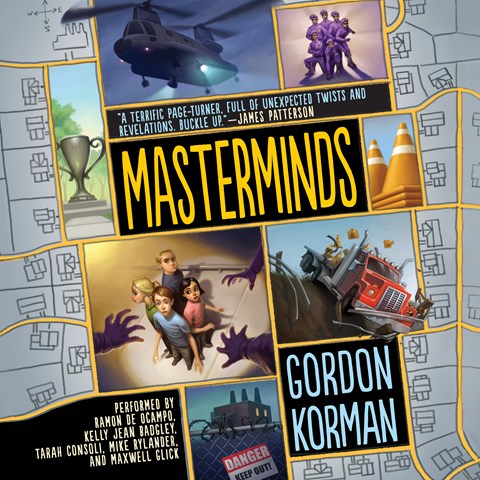
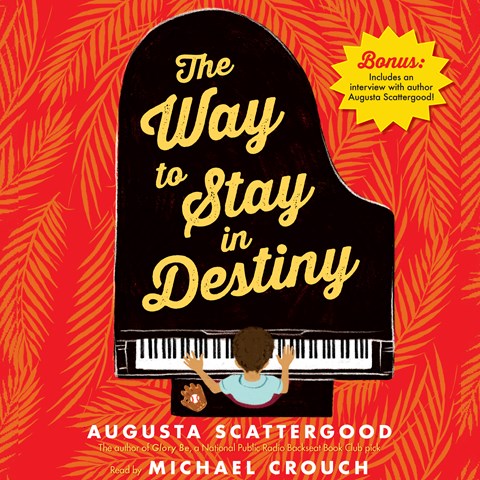
I recently reviewed two audiobooks with a peculiar connection.  Masterminds is a thriller set in the seemingly perfect town of Serenity, New Mexico.  The Way to Stay in Destiny is a character-driven novel set in the woefully imperfect town of Destiny, Florida.  Neither town is quite what it seems.  Click the links to read the complete reviews.

Masterminds by Gordon Korman.  Read by a cast of five(2015) 

[http://www.audiofilemagazine.com/reviews/read/98783/]
A contemporary science thriller set in New Mexico - a real page-turner!  This is the first in a planned series.  I'm not sure how he can top this one!


 [http://www.audiofilemagazine.com/reviews/read/99246/]
Historical fiction set in 1970s Florida by the author of Glory Be. Another paean to the power of music.  (Try Echo by Pam Muñoz Ryan, too!)


I'm confident that either of these is great in print as well.

Wednesday, March 25, 2015

The Sittin' Up - a review

I would never think of "North Carolina fiction" as a genre in children's literature, but I seem to have read quite a bit of it lately. I picked up Three Times Lucky  because my daughter is attending college in North Carolina.  I loved it!!  Later, I had the good fortune of reviewing The Ghosts of Tupelo Landing (also by Sheila Turnage) for AudioFile Magazine.  I can't say enough how quirky and wonderful and timeless these books are!

Another North Carolina book caught my eye last year (I love the cover art!) but I just got around to reading it.

The Sittin' Up by Sheila P. Moses (Putnam, 2014).

The premise for The Sittin' Up is an interesting one.  The year is 1940, and former slave, Mr. Bro. Wiley has died.  Stanbury "Bean" Jones is 12 years old, finally old enough to attend his first "sittin' up," an area tradition with similarities to an "Irish wake" or Judaism's "sitting shiva."  There is not a lot of action in The Sittin' Up - something I've seen it knocked for in other reviews.  I, however, loved the opportunity to take my time and get to know the rich personalities of the Low Meadows community, where they treat death with sorrow, remembrance, practicality, and humor.

Mr. Bro. Wiley lived with Bean and his parents, Stanbury and Magnolia Jones, and was revered by the everyone in the closely-knit African American community. Bean's father, a stutterer, is generally accepted as a leader of the community and is a foreman on the tobacco farm where many of the Low Country men work for the white, wealthy, Mr. Thomas. Bean's mother is Magnolia, a kind, commonsense woman with a baby on the way.

Other characters include Miss Florenza (the bootlegging sinner who dares wear red to a sittin' up) and Miss Lottie Pearl (Pole's busybody mother and Magnolia's best friend),

"Yes, Lord. Please help us," Miss Florenza said.  Miss Lottie Pearl rolled her eyes at Miss Florenza.  Poor Miss Florenza can't even talk to Jesus without Miss Lottie Pearl putting her two cents in.  

Bean's best friend is Pole (they go together like a bean to a pole), and there's the preacher (who is more concerned with fancy clothes, cars, and women, than his parishioners),

"I thought we were in a Depression," Pole whispered to me.
"We are." I whispered back.
"Look like to me Reverend Hornbuckle should have been thinking about how the folk at Sandy Branch Baptist Church are gonna eat come winter instead of buying a new car," Pole said.  Wasn't sure if the preacher heard my sassy friend, but she didn't seem to care.  She got a whole of Miss Lottie Pearl in her as sho' as Mr. Bro. Wiley was dead in the house.
There's also Uncle Goat the liar,
Ma swears Uncle Goat is the biggest liar in Northampton County.  Papa said that ain't so.  He said Uncle Goat is the biggest liar in the state of North Carolina. That's how he got the nickname Goat.  Ma says he eats the truth up faster than a goat eats grass.

Even Mule Bennett has a personality,
"I will never forget Mr. Bro. Wiley," I thought as we headed to town.  Mule Bennett must have felt the same way.  He was slowing down and barely lifted his head.  Papa kept saying, "Get-get, get up, mule, get up." But Mule Bennett took his own sweet time.
Mr. Bro. Wiley,the reader gets to know through the remembrances of the living.

Yes, this is a story about segregation and how a great catastrophe serves as a catalyst for change, but that is the backdrop for a story that is mostly about people - wonderfully flawed people - people who sometimes do the wrong thing, but choose the right one when it matters - people who know the value of dignity and community - people who find sorrow and joy and humor in the small occurrences of daily life  - people - just plain people - just like us.

I may have nothing in common with North Carolina sharecroppers of 1940, but these people "spoke" to me, nonetheless.  If you enjoy historical fiction with a character-driven plot, you'll love The Sittin' Up.


Next on my list of North Carolina fiction: Stella by Starlight. More on that one later.

Friday, February 20, 2015

Echo: A Novel - a review

If this is how the year is starting out, it's going to be a banner year for middle-grade books.  First, Gordon Korman's Masterminds (more on that fantastic new thriller another day) and now Echo: A Novel.

Ryan, Pam Muñoz. 2015. Echo: A Novel. New York: Scholastic.

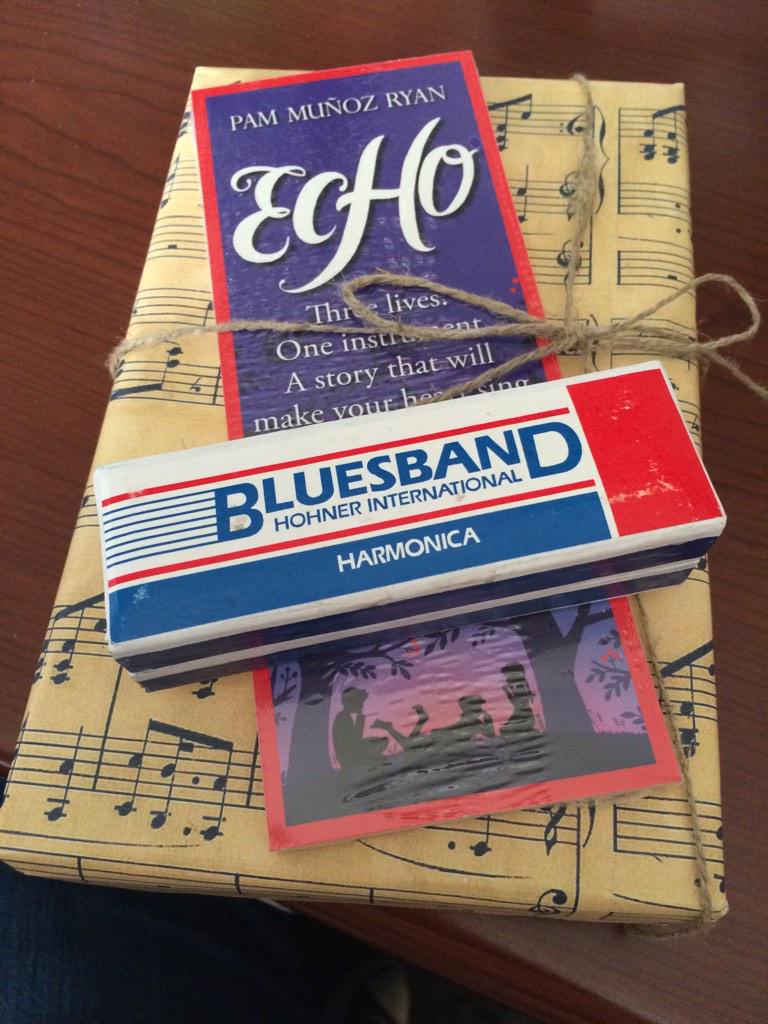
I received an Advance Reader Copy of Echo from Scholastic and was intrigued that it was wrapped in musical notation paper and had a smartly-boxed Hohner Blues Band harmonica tied to it.


I was happy to see an apparently music-related book, and was somewhat surprised to find that Echo begins with a fairytale, "The Thirteenth Harmonica of Otto Messenger," a fairytale replete with abandoned princesses, a magical forest, a mean-spirited witch, and a prophecy,

"Your fate is not yet sealed.  Even in the darkest night, a star will shine, a bell will chime, a path will be revealed."

Though brief, I became enthralled with the tale and was surprised and taken aback when I reached Part One and found myself not in the fairytale forest, but in

Trossingen, Baden-Württemberg, Germany, 1933, home to the world's oldest harmonica manufacturer.  I couldn't wait to find out what became of the abandoned princesses, but soon found myself wrapped up in the story of young Friedrich Schmidt, a German Jew during Hitler's ascendance to power.  This kind-hearted, young boy of a musical family was surely destined to be gathered up in the anti-Semitic wave sweeping through Germany. I became engrossed in Friedrich's story, anxiously hoping that things would work out for him and his family, and was again surprised when I reached Part Two and found myself in

Philadelphia, 1935, home of the then-famous Albert Hoxie and the Philadelphia Harmonica Band, and of the Bishop's Home for Friendless and Destitute Children, where I found myself in the company of piano-playing orphans, Mike and Frankie Flannery.  Their story was no less heart-wrenching than Friedrich's, and I found myself desperately rooting for the young boys when I suddenly arrived

in a migrant worker's community in Southern California, 1942, where young Ivy Maria Lopez was about to play her harmonica on the Colgate Family Hour radio show, but her excitement was short-lived.  I fell in with this hard-working, American family and hoped, along with Ivy, for her brother's safe return from the war.

Of course, there's more, but this is where I will leave off.

Pam Muñoz Ryan has written a positively masterful story that will take the reader from the realm of magic through the historical travails of the oppressed and the poor in the midst of the 20th century.  Through it all, music gathers the stories together in a symphony of hope and possibility.  In music, and in Echo, there is a magic that will fill your soul.

It may only be February, but I predict that praise for Echo will continue throughout the year.


On a library shelf near you - February 24, 2015.

Wednesday, February 4, 2015

The Last Song - a review

Wiseman, Eva. 2012. The Last Song. Plattsburgh, NY: Tundra.

Some locations and eras appear regularly in historical fiction  - the US during the Civil War, the Midwest during the Dust Bowl Era, the British Isles in the medieval period, Europe during the Holocaust, the list goes on ... but seldom does it include Spain during the Inquisition.

In this first-person, chronological account, teenager Doña Isabel learns her family's deepest secret - her parents are not devout Catholics as she was raised to be.  Secretly, they practice the Jewish faith - a practice punishable by death under the rule of Ferdinand and Isabella, and their Grand Inquisitor, Tomás de Torquemada.  Set in Toledo, Spain, 1491, Isabel is the daughter of the King's physician, a position that has always kept the family in wealth and privilege.  As the Inquisition grows more brutal, suspected heretics are forced to wear sambenitos (sackcloth), they are beaten, tortured, murdered, and burned alive at autos-da-fé.

I looked around to keep awake.  The church's walls were festooned with the sambenitos of the heretics who had been burned alive at the stake during different autos-de-fé. 

"So many sambenitos," I whispered to Mama.  "They should take them off the wall."

She rolled her eyes. "They are supposed to be reminders to the families of the condemned heretics.  They are warnings to them not to follow in the footsteps of their relatives," she whispered.  "They are a warning to us all."

 Her words filled me with fear.

Her parents decide that to keep Isabel safe from the Inquisition, they will promise her in marriage to the son of the King and Queen's most trusted advisor. Luis is loathsome, however, and instead of Luis, Isabel falls in love with Yonah, a young Jewish silversmith, Soon the lives of the entire family are in danger.

If Isabel abandons her lifelong faith a little too easily and if Eva Wiseman paints Isabel's future a little too brightly, this is a small price to pay for a book suits an older, middle-grade audience and draws attention to a terrible period of religious persecution that is not often covered for this age group, grades 6 and up.


Spoiler:
Ironically (in light of today's current political, social and religious climate), Isabel and her family leave Spain counting Moorish refugees as their friends.  Together they head to Morocco in search of freedom and a better life. How much has changed; and yet, how much remains the same.  We learn so little.


Note:
My copy of The Last Song was provided by LibraryThing Early Reviewers. I'm sorry that I did not get to it sooner.

Friday, January 30, 2015

The Accidental Highwayman - an audiobook review

Tripp, Ben. 2014. The Accidental Highwayman: Being the Tale of Kit Bristol, His Horse Midnight, a Mysterious Princess, and Sundry Magical Persons Besides. New York: Tor Teen.

Can I tell you how much I like this book?  I reviewed it several months ago for AudioFile Magazine and could hardly wait until they published my review so that I could freely blog about my affinity for it!  Although "swashbuckling" is the term I've seen most often in reviews of The Accidental Highwayman, I would characterize it as a mix of daring deeds and derring-do, of historical fiction and magical conviction.  You can read my official review here, I listened to the audio version, but would guess that the printed copy is equally enjoyable.

To summarize:

Amidst a grim 18th century English setting arises the accidental highwayman, Whistling Jack.  Teenager Kit Bristol makes the unlikely yet unavoidable transformation from circus performer to manservant to famous highwayman tasked with the rescue of a mysterious princess from an enchanted coach.  Narrator Steve West employs the English "standard accent" for his presentation of the gallant robber.  He delivers non-stop action and suspense while maintaining an air of wise contemplation suited to this retrospective narrative of daring deeds from a magical past.

This is the first in an expected series. Judging from the effort expended on the series' official website, http://kitbristol.com , they knew right out of the gate that this one would be popular!  Enjoy the goofy trailer (there are two more on the site).


Note:
As a fledgling ukulele player myself, I love that Ben Tripp plays the ukulele in this trailer.

Monday, November 17, 2014

The Paper Cowboy

Levine, Kristin. 2014. The Paper Cowboy. New York: Putnam.

In the seemingly idyllic, 1950s, town of Downers Grove, Illinois, handsome and popular 12-year-old Tommy Roberts appears to be a typical kid.  He lives with his parents, older sister Mary Lou, younger sisters Pinky and Susie, and a devoted family dog. He and his older sister attend Catholic school, his father works for Western Electric, and his mother stays at home with the younger girls.

Amidst the backdrop of the Red Scare and McCarthyism, Tommy's discovery of a Communist newspaper in the town's paper drive truck, and a horrific burn accident to Mary Lou, begin a chain of events that uncovers secrets, truths, and lies in his small town populated with many Eastern European immigrants.

Perhaps the biggest lie is Tommy's own life.  Though he never gets caught, Tommy is a bully, picking on kids at school, especially Little Skinny. When he plants the Communist newspaper in a store owned by Little Skinny's immigrant father, he's gone too far - and he knows it.  Now it's time to act like his cowboy hero, The Lone Ranger, and make everything right, but where can he turn for help?  His mother is "moody" and beats him relentlessly while his father turns a blind eye. His older sister will be hospitalized for months. He has his chores and schoolwork to do, and Mary Lou's paper route, and if Mom's in a mood, he's caretaker for Pinky and Susie as well.

It's hard to understand a bully, even harder to like one, but readers will come to understand Tommy and root for redemption for him and his family.  He will find help where he least expects it.

     I couldn't tell Mrs. Glazov about the dinner party. Or planting the paper.  But maybe I could tell her about taking the candy.  Maybe that would help.  "There's this boy at school, I said slowly, "Little Skinny."
.....
     "I didn't like him.  I don't like him.  Sometimes, Eddie and I and the choirboys, we tease him."
     "Ahh," she said again.  "He laugh too?"
     I shook my head.  I knew what Mary Lou would say.  Shame on you, Tommy! Picking on that poor boy.  And now she would have scars just like him.  How would I feel if someone picked on her?
     "What did you do?" Mrs. Glazov asked, her voice soft, like a priest at confession.  It surprised me. I'd never heard her sound so gentle.
     "I took some candy from him," I admitted.
     "You stole it."
     I shrugged.
     "Ahh."
     "It's not my fault! If Mary Lou had been there, I never would have done it!"
     Mrs. Glazov laughed.  "You don't need sister.  You need conscience."
     I had the horrible feeling that she was right.  I wasn't a cowboy at all. I was an outlaw.
Author Kristin Levine gives credit to her father and many 1950s residents of Downers Grove who shared their personal stories with her for The Paper Cowboy. Armed with their honesty and openness, she has crafted an intensely personal story that accurately reflects the mores of the 1950s.  We seldom have the opportunity (or the desire) to know everything that goes on behind the doors of our neighbors' houses.  Levine opens the doors of Downers Grove to reveal alcoholism, mental illness, abuse, disease, sorrow, and loneliness. It is this stark realism that makes the conclusion so satisfying.  This is not a breezy read with a tidy and miraculous wrap-up.  It is instead, a tribute to community, to ordinary people faced with extraordinary problems, to the human ability to survive and overcome and change.

Give this book to your good readers - the ones who want a book to stay with them a while after they've finished it.


Kristin Levine is also the author of The Lions of Little Rock (2012, Putnam) which I reviewed here.

Beneath the Waves - a review

As we read disturbing news accounts of dying manatees , environmental disasters caused by toxic waste, and ocean pollution on the scale of ...