A Fire Story
by Brian Fies
Abrams Books, 2019
In graphic novel format,Brian Fies tells his own personal story as well as those of others who lost everything in the devastating Northern California fires of 2017. Their stories highlight the more mundane aspects of a living through a natural disaster—the bureaucratic red tape, the small things that trigger immense emotion, the weird sense of living as a displaced person in your own environs. Having experienced two devastating hurricanes myself, I can attest that Fies has accurately captured the moods and experiences of survivors of catastrophe. Some photos are also incorporated into the dramatic illustrations. This affecting book will stay with you much longer that the short time it will take to read it.
Originally published online, A Fire Story was recreated (the original web comic is included in the print version) and enhanced for print publication.
Read the original web-based version here.
Book reviews (and news) you can use. A librarian's opinion on books and media for children and young adults
Showing posts with label California. Show all posts
Thursday, January 2, 2020
Friday, February 20, 2015
Echo: A Novel - a review
If this is how the year is starting out, it's going to be a banner year for middle-grade books. First, Gordon Korman's Masterminds (more on that fantastic new thriller another day) and now Echo: A Novel.Ryan, Pam Muñoz. 2015. Echo: A Novel. New York: Scholastic.
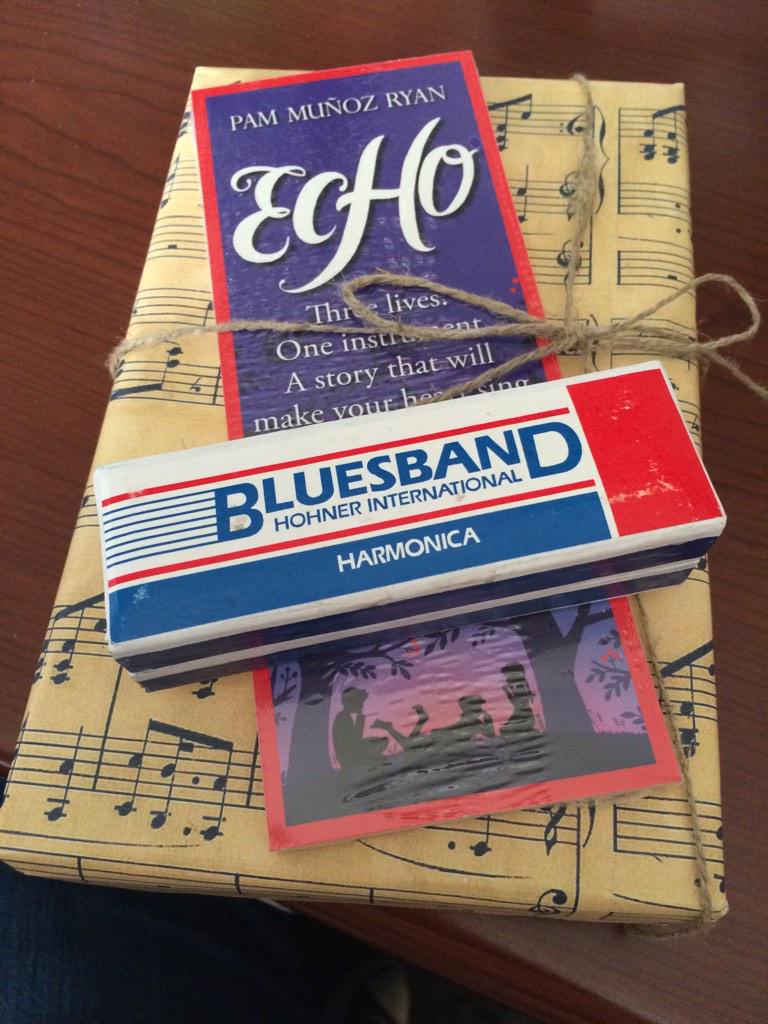
I received an Advance Reader Copy of Echo from Scholastic and was intrigued that it was wrapped in musical notation paper and had a smartly-boxed Hohner Blues Band harmonica tied to it.
I was happy to see an apparently music-related book, and was somewhat surprised to find that Echo begins with a fairytale, "The Thirteenth Harmonica of Otto Messenger," a fairytale replete with abandoned princesses, a magical forest, a mean-spirited witch, and a prophecy,
"Your fate is not yet sealed. Even in the darkest night, a star will shine, a bell will chime, a path will be revealed."
Though brief, I became enthralled with the tale and was surprised and taken aback when I reached Part One and found myself not in the fairytale forest, but in
Trossingen, Baden-Württemberg, Germany, 1933, home to the world's oldest harmonica manufacturer. I couldn't wait to find out what became of the abandoned princesses, but soon found myself wrapped up in the story of young Friedrich Schmidt, a German Jew during Hitler's ascendance to power. This kind-hearted, young boy of a musical family was surely destined to be gathered up in the anti-Semitic wave sweeping through Germany. I became engrossed in Friedrich's story, anxiously hoping that things would work out for him and his family, and was again surprised when I reached Part Two and found myself in
Philadelphia, 1935, home of the then-famous Albert Hoxie and the Philadelphia Harmonica Band, and of the Bishop's Home for Friendless and Destitute Children, where I found myself in the company of piano-playing orphans, Mike and Frankie Flannery. Their story was no less heart-wrenching than Friedrich's, and I found myself desperately rooting for the young boys when I suddenly arrived
in a migrant worker's community in Southern California, 1942, where young Ivy Maria Lopez was about to play her harmonica on the Colgate Family Hour radio show, but her excitement was short-lived. I fell in with this hard-working, American family and hoped, along with Ivy, for her brother's safe return from the war.
Of course, there's more, but this is where I will leave off.
Pam Muñoz Ryan has written a positively masterful story that will take the reader from the realm of magic through the historical travails of the oppressed and the poor in the midst of the 20th century. Through it all, music gathers the stories together in a symphony of hope and possibility. In music, and in Echo, there is a magic that will fill your soul.
It may only be February, but I predict that praise for Echo will continue throughout the year.
On a library shelf near you - February 24, 2015.
Monday, October 14, 2013
The Tree Lady - a review
Hopkins, H. Joseph. 2013. The Tree Lady: The True Story of How One Tree-Loving Woman Changed a City Forever. Ill. by Jill McElmurry.
From her school, Kate could see City Park in the hills above town. It was called a park, but it didn't look like one. It was where people grazed cattle and dumped garbage.
Most San Diegans didn't think trees could ever grow there.
But Kate did.
With a recurring theme of "but Kate did," The Tree Lady recounts how Kate Sessions (1857-1940), defied all expectations by enjoying the outdoors as a young girl, obtaining a science degree from a prestigious university (unheard of for a woman in 1881!), and resolutely turning a barren, desert park into a green and leafy oasis that remains a jewel of the City of San Diego to this day. McElmurry's painted, double-spread illustrations get the colors just right and project an "old-timey" feeling that kids will immediately recognize. Katherine Olivia Sessions' story, The Tree Lady, is an inspiring and informative book for anyone, but should most definitely be in every elementary school in San Diego, where she is known as "The Mother of Balboa Park," the name given to City Park in 1915.
Having lived for many years in the Northern reaches of San Diego County, I was thrilled to learn the history behind one of my favorite places. Balboa Park is the larges urban park in North America, containing more than 1200 acres of land. By comparison, Central Park in New York consists of about 778 acres.
In addition to Kate Sessions' trees, the park houses the world famous San Diego Zoo, the San Diego Museum of Art and more than ten other museums, the Old Globe theater, the Starlight Bowl, more than fifteen individual gardens, restaurants, trails, a Spanish village, a United Nations Building, a carousel (circa 1910), and more. Located in the heart of town, it is open and accessible to all, with many roads running through it. No trip to San Diego is complete without a visit to Balboa Park. I'm wistful just thinking of it.
Food for thought:
Kate Sessions imported trees and plants from around the globe that she knew would prosper in San Diego's unique climate. Given the current focus on sustainability and native plantings, I wonder if such a project would or could ever be undertaken today. This would be an interesting topic to explore in the higher grades.
Nonfiction Monday is hosted today by Perogies & Gyoza. All of today's nonfiction posts will be featured there.
For those of us in the U.S. (our meme host today is in Japan), enjoy your Columbus Day! Hopefully, for you, it is a holiday from work.
Saturday, June 26, 2010
One Crazy Summer
Williams-Garcia, Rita. 2010. One Crazy Summer. New York: Harper Collins.
If you haven't heard of One Crazy Summer, you will. Rita Williams-Garcia's latest middle grade fiction is getting a lot of buzz, and justifiably so.
One Crazy Summer is set in a poor neighborhood of Oakland, California, 1968. Delphine, Vonetta, and Fern (three African-American girls, aged 11, 9 and 7) travel on their own from Brooklyn to Oakland. Their father, against the judgment of the girls' grandmother and caretaker, Big Mama, has decided that it's time for the girls to meet Cecile, the mother that deserted them. With visions of Disneyland, movie stars, and Tinkerbell dancing in their heads, they set off on the plane determined not to make, as Big Mama says, "Negro spectacles" of themselves. This is advice that Delphine, the oldest, has heard often. She is smart and savvy with a good head on her shoulders, and she knows how to keep her sisters in line. Not much can throw her for a loop, but then, she hasn't met crazy Cecile yet. Cecile, or Nzila, as she is known among the Black Panthers, is consumed by her passion - poetry. She writes powerful and moving poems for "the people" - important work, and she is not about to be disturbed by three young girls and their constant needs for food and attention. She operates a one-woman printing press in her kitchen - no children allowed. Instead of Disneyland and the beach, she shoos the girls off daily to the local center run by the Black Panthers. There, in the midst of an impoverished, minority neighborhood, the girls receive free breakfast, kind words, and an education the likes of which they would never have gotten in Brooklyn. Slowly, they begin to understand the plight of "the people" - the Blacks, the poor, the immigrants, even Cecile.
Although this book has several great themes (Civil Rights, sisterhood, community) and well-rounded strong-willed characters, you can read about them in any number of reviews. As for me, with my teenage daughter preparing to take a trip to Europe next month with the Girl Scouts, one thing from One Crazy Summer jumped out at me - the mind-opening, positive power of travel. Had Delphine, Vonetta and Fern stayed in their quiet, stable Brooklyn home, they would have been safe and well-cared for, however, they would have missed many experiences (both good and bad) that would likely shape their lives, their attitudes, their opinions, forever. Visiting new places and seeing the world through the eyes of people different from ourselves is a powerful experience. Delphine's wise father recognized that. So do I.
A heavy topic made light by the hearts of three winning sisters, smart and practical Delphine, carefree and adaptable Vonetta, and Fern, small, but determined Highly recommended.
A detailed review of the book is at Fuse #8 and another at Dog Ear.
An excerpt read by the author is available at teachingbooks.net.
Jacket Knack offers an interesting post about the inviting cover art by Sally Wern Comport.An excerpt read by the author is available at teachingbooks.net.
Subscribe to:
Posts (Atom)
Beneath the Waves - a review
As we read disturbing news accounts of dying manatees , environmental disasters caused by toxic waste, and ocean pollution on the scale of ...
-
I'm delighted to host today's Nonfiction Monday. My contribution for today is Marc Aronson's If Stones Could Speak: Unlocking th...
-
Welcome to Shelf-employed! I'm the host of this week's Nonfiction Monday . Grubman, Steve and Jill Davis. 2010. Orangutans are Tic...
-
Gutman, Dan. 2012. Election! A Kid's Guide to Picking our President. New York: Open Road Media. Advance copy provided by NetGall...