Pages

Showing posts with label mothers. Show all posts

Wednesday, December 5, 2018

The Ugly Five - a review


The Ugly Five
By Julia Donaldson
Illustrated by Axel Scheffler
Scholastic, 2018

Below is my review of The Ugly Five as it appeared in School Library Journal. Enjoy!

DONALDSON, Julia. The Ugly Five. illus. by Axel Scheffler. 32p. Scholastic. Jul. 2018. Tr $17.99. ISBN 9781338249538. PreS-Gr 2—This rhyming book takes place on the African plain and introduces a collection of animals not known for attractiveness, but beloved by their children nonetheless. It begins with an introduction to the wildebeest, and she soon sings a song that is repeated with variations throughout the book, “I’m the ugly one, I’m the ugly one. I’m the ugliest animal under the sun. My ungainly appearance is second to none. I’m the ugly one, I’m the ugly one.” Wildebeest meets up with spotted hyena, lappet-faced vulture, warthog, and marabou stork, and the song reflects each addition. Scheffler is a frequent artist for Donaldson and has the perfect approach for her lighthearted prose. The “ugly” beasts are not ugly at all, but endearing, with wide-eyed faces expressing playfulness while picking through garbage, crunching bones, shredding carrion, and wallowing in mud. Comical illustrations in bright, but natural colors, are unadorned by text or borders. Each features a natural habitat with plenty of creatures and small details for observant eyes to seek. The satisfying and happy ending for the actually “lovely five” is depicted in a richly hued spread. Safari notes follow the story, which is prefaced by an author’s note. VERDICT Playful and positive, this book is an introduction to creatures of the African plain and a reminder that beauty is in the eye of the beholder. 


School Library Journal. Jul2018 Copyright © 2018 School Library Journal, the property of Media Source, Inc.  Reprinted here with permission.

My copy of The Ugly Five was provided by School Library Journal.

Tuesday, December 19, 2017

Clayton Byrd Goes Underground - a review

Clayton Byrd Goes Underground
by Rita Williams-Garcia
Harper Collins, 2017

Cool Papa Byrd was Clayton's grandfather, his best friend, his musical muse, and the coolest electric blues guitar player in Washington Square Park.  Without him, Clayton was a discordant jumble of sorrow and loneliness.

"Everyone saw Clayton leave the school with his mother.  Some had even laughed at him and teased him about the whipping he had coming.

Clayton wasn't worried about a whipping.  His mother wasn't the whipping kind.  She'd take away his treasures first, the things he loved, and the things he loved to do.  But she didn't believe in whipping.  She did, however, believe in scolding.

Clayton's mother scolded from the time they left the school to the time she drove home to the time they got in the house.  Even when she wasn't out-and-out scolding, she spoke in scolding tones, In you-know-betters, what's-gotten-into-yous.  She said over and over, 'Your grandfather's passing is no excuse for this behavior.'

Clayton remained silent through the scolding. He couldn't tell her what was wrong even if he wanted to. He didn't understand it all himself. Even if he could tell her, she would only blame Cool Papa, and Clayton was tired of her being angry at the person he loved the most. He said nothing.'
Clayton Byrd Goes Underground is Clayton's journey through the blues.  Rita Williams-Garcia infuses this story of family grief, anger, and reconciliation with the bluesy notes of Clayton's harmonica, the smooth sounds of Cool Papa Byrd and his group, the Bluesmen, and a ragtag band of hip-hop street performers who ply their trade in New York's subway system.  No slow-starter here—Clayton Byrd Goes Underground grabs the reader from the pickup note.

I read this in one sitting.  Because of its brevity and musical connection, this would be a perfect middle-grade book for an in-school project collaboration between music and language arts teachers.  Queue some blues on your favorite music streaming service and get yourself in the mood for this award-winning book.


Awards for Clayton Byrd Goes Underground include:
National Book Award Finalist * Kirkus Best Books of 2017 * Horn Book Best Books of 2017 * Publishers Weekly Best Books of 2017 * School Library Journal Best Books of 2017 * NAACP Image Awards Nominee * Chicago Public Library Best Books * A Boston Globe Best Book of 2017


Note: If you want to hear some awesome blues harp, listen to the Led Zeppelin version of "When the Levee Breaks." (originally recorded in 1929 by Kansas Joe McCoy and Memphis Minnie)

Monday, October 28, 2013

The Man with the Violin - a review

Stinson, Kathy. 2013. The Man with the Violin. Toronto: Annick Press.  Ill. by Dušan Petričić.

Kathy Stinson's story of a boy who is interested in his surroundings and captivated by the music of a performing violinist is perfectly complemented by the illustrations of Dušan Petričić. Targeted use of watercolors highlight the flow of music and joy emanating from the violinist and the spirited observations of the child. Wanting to linger, the boy is instead pulled along, forced to adhere to the busy schedule of his mother who hurries obliviously through the crowd.  In a satisfying conclusion, the mother later finds the time to appreciate and savor the music that so captivated her young son in the transit station.

Sure to be counted among one of 2013's best picture books, The Man with the Violin is a reminder that the world is often seen and heard best through the eyes and ears of a child.

While this is not actually a nonfiction book, it is based on a true story, an experiment done by the Washington Post.  Read the Washington Post article by Gene Weingarten and watch the actual footage of violin virtuoso Joshua Bell playing in the L'Enfant Metro Station in Washington, DC.  For almost 45 minutes, harried commuters passed by, barely noticing the music of Joshua Bell. There was indeed, a young boy who wanted so badly to watch the performance, but his mother was too pressed for time.  It's a lesson for us all.


For today's roundup of children's nonfiction book reviews, visit Booktalking, where author Anastasia Suen is hosting today's Nonfiction Monday.


Wednesday, May 9, 2012

This and that - 3 reviews

A little of this and a little of that, as I'm ahead in reading and behind in writing!

(short stories, novel, audiobook)

Kibuishi, Kazu. 2012.  Explorer: The Mystery Boxes. New York: Amulet.

This book is an unexpected little gem, something of a mystery itself. From the cover, I was expecting a graphic novel mystery, a la The Box Car Children infused with a bit of magic.  What I found instead, was a themed, graphic, short story collection.  Mystery Boxes contains seven stories by noted graphic artists including Raina Telgemeier (Smile).  What ties these disparate illustrators and authors together is that each story features a mysterious box, contents unknown.  The stories range from amusing ("Spring Cleaning by Dave Roman and Telgemeier) to profound (Jason Caffoe's, "The Keeper's Treasure") to social commentary on war (Stuart Livingston and Stephanie Ramirez', "The Soldier's Daughter").

Judging from the way  my Advance Reader Copy was scooped up by a child in my book club, I'd guess this will be popular if it can find the right audience.  I'm also assuming that we can look forward to more collections in the Explorer series. I, for one, would like to see more interest in short stories.  They don't seem to be required reading for middle schoolers - a pity.  (Another good short story series, though not in graphic novel format, is Jon Scieszka's Guys Read Library)

Doyle, Roddy. 2012. A Greyhound of a Girl. New York: Amulet.

Advance Reader Copy

I chose to read this one because it features a multi-generational Irish family.  It's hard not to like Ireland - a beautiful country full of "lovely" people.  In fact, you will hear people in Ireland describe nearly anything as "lovely" --friendly people they are in general, but I digress.

This is the first Roddy Doyle book that I've read and I wasn't sure what to expect. I thoroughly enjoyed it once I stopped looking for some artificial contrivance or tricky plot twist and settled in to enjoy a simple yet touching story of 12-year-old Mary O'Hara, and three of her female relatives, one of whom happens to be dead.  A Greyhound of a Girl covers a short span of time in a short book (208 small pages)  about life and death and family. Being of Ireland, of course it is not without humor.

Riordan, Rick. 2011. The Son of Neptune, The Heroes of Olympus Series, Book 2. Read by Joshua Swanson. Listening Library.
12 hours, 27 minutes.

As much as I enjoyed The Lost Hero, I'd be lying if I didn't say that it's good to have Percy back in the story.  Lost no more, but without his memories, Percy finds himself in the midst of the Roman demigod stronghold, Camp Jupiter.  In this installment, the listener learns little of Camp Half-Blood's activities, but is thrust into the militaristic world of the Roman demigods.  Before the story ends on a culture-colliding cliffhanger, a clear picture of the identities of "the seven" is unfolding,

Seven half-bloods shall answer the call,
To storm or fire the world must fall.
An oath to keep with a final breath,
And foes bear arms to the Doors of Death.
 
 The narration by Joshua Swanson is beginning to grow on me (but perhaps that's because Leo doesn't appear much in The Son of Neptune).  My favorite new character in the series?  Hands down, it's Bella the Harpy, voiced perfectly by Mr. Swanson.

Sadly, we've got to wait until the fall for The Mark of Athena (book 3).

Enjoy an audio excerpt.

Wednesday, October 19, 2011

Waiting for the Magic

MacLachlan, Patricia. 2011. Waiting for the Magic. New York: Atheneum.

Fifth-grader, William's, father doesn't like dogs. When Papa deserts the family, going off "to write," one summer morning, Mama loads William and 4-year-old Elinor into the car and heads for the local animal shelter.
"What kind of dog are we getting? I asked.
"Whatever they have," said Mama.
"Can we get a cat?" asked Elinor from the back.
"Yes," said Mama.
For a moment I thought about asking for a horse, but I didn't think Mama's mood about animals would last that long.
At the shelter, Mama makes another impulsive decision,

"We'll take them all," Mama said crisply,

the protective Bryn, high-energy Bitty, peaceful Grace, friendly Neo and Lulu, the very patient cat. It is Elinor who first understands the nature of their new pets.  She waves her toy magic wand above them, and they sit patiently, orderly, and they talk - but only Elinor can hear them, because the only
ones who know magic are:
The young
The old
The brave
The honest
The joyful

What will it take for the rest of the family, including Papa, to "know the magic?" It will take love and bravery and honesty and time.

Waiting for the Magic is a short (143 pages) chapter book peppered with simple and attractive penciled sketches by Amy June Bates, perfect for young readers, ages 9-12.  It has some similarities with Kate Feiffer's delightful book, The Problem with the Puddles. Both feature endearing, talking dogs as fully developed characters.

Though Waiting for the Magic is told in William's voice, the dogs often interrupt,

Neo
He misses his father.

Bitty
Yes, he does.

Neo
Can you move over, Bitty?

Bitty
The cat's there.

Neo
The cat's name is Lula, Bitty.  Lula.

Bitty
Okay, Lula.
I know you like her. You ask her to move over.
Printed in italics and placed in the center of the page, readers will have no trouble distinguishing the canine dialogue, and will enjoy the dogs' sometimes silly and sometimes profound commentary.

Newbery winner Patricia MacLachlan's gentle treatment of a difficult topic is laced with humor, magic, and a happy ending.  An enjoyable read.

Read an excerpt here.

© Amy June Bates
This cover image is taken from Amy June Bates' website,
where it is just so precious, that it deserves a visit.

Tuesday, June 21, 2011

A Monster Calls

Ness, Patrick. 2011. A Monster Calls. Somerville, MA: Candlewick.
 (Advance Reader Copy, courtesy of NetGalley.)

(booktalk)
There is not always a good guy. Nor is there always a bad one. Most people are somewhere in between.
When the monster calls, Conor is not afraid. For this monster, this powerful, all-seeing monster, born of the earth, the trees and all the ages is not nearly as frightening as the monster that lurks within his nightmare.
... it does not matter what you think, the monster said, because your mind will contradict itself a hundred times each day.
You do not write your life with words, the monster said. You write it with actions. What you think is not important. It is only important what you do.

Thursday, May 19, 2011

May picture book roundup

I am in the midst of transferring from one branch to another, and I now have two desks overflowing with great new books!  Here are a few:
Gibbs, Edward. 2011. I Spy with my Little Eye. Somerville, MA: Templar. (Candlewick)

That big (almost 2.5"), yellow, circular eye on the cover is actually a hole - an oh, the things we can spy through that hole!  On a predominantly white spread with an eye on the left page and a circle of blue on the right, we read,
I spy with my little eye  ... something that is blue. "I am the biggest animal in the world."
Turn the page to find a richly colored blue whale, which due to some artfully placed curlicues, manages to appear realistic and at the same time, fanciful.

I'm a BLUE WHALE.
Each featured animal unfolds in the same manner.  The rear cover of the book features a hole for your own little eye to go spying! Colors, animals, guessing - this book has it all!
Edward Gibbs is listed as a "debut artist."  What a debut! This one's dynamite!

Tusa, Tricia. 2011. Follow Me. Boston: Harcourt.

From the book jacket, here is the description of the art,
The illustrations in this book were done using an etching process with monoprinted color.  The text type was set in Prin.  The display type was set in Rats and Carrotflower.
(Rats and Carrotflower? - love that one!)  What this means to me is a softly-colored book with fanciful drawings outlined in etched brown lines.  The color sometimes spills out of its intended (?) perimeter in much the same way that the young protagonist spills out of her swing and floats and flies through the breezes, "lost in small, green, happy music."  She invites the reader to follow her through all of nature's colors, "deep into brown, into the bright white of yellow, into orange that slips into red."   From the illustrator of In a Blue Room, another beautiful book!


Johnson, Lindsay Lee. 2011. Ten Moonstruck Piglets. Ill. by Carll Cneut. Boston: Clarion.

All in a scramble,
all ready to gambol,
ten moonstruck piglets
on a midnight ramble.

Through the mud wallow,
beyond the wide hollow,
leapfrogging piglets
in turns lead and follow.
It's all fun and games until the moon goes behind a cloud!  But not to worry - Mama's coming.  These sleepy-eyed, wrinkly little runts are irresistible!

Where Ten Little Piglets is filled with amusing detail, this next book features uncomplicated simplicity ... (but in both books, you can count on mom to the rescue!)

Saturday, June 26, 2010

One Crazy Summer

Williams-Garcia, Rita. 2010. One Crazy Summer. New York: Harper Collins.


If you haven't heard of One Crazy Summer, you will.  Rita Williams-Garcia's latest middle grade fiction is getting a lot of buzz, and justifiably so.

One Crazy Summer is set in a poor neighborhood of Oakland, California, 1968.  Delphine, Vonetta, and Fern (three African-American girls, aged 11, 9 and 7) travel on their own from Brooklyn to Oakland.  Their father, against the judgment of the girls' grandmother and caretaker, Big Mama, has decided that it's time for the girls to meet Cecile, the mother that deserted them.  With visions of Disneyland, movie stars, and Tinkerbell dancing in their heads, they set off on the plane determined not to make, as Big Mama says, "Negro spectacles" of themselves.  This is advice that Delphine, the oldest, has heard often.  She is smart and savvy with a good head on her shoulders, and she knows how to keep her sisters in line.  Not much can throw her for a loop, but then, she hasn't met crazy Cecile yet.  Cecile, or Nzila, as she is known among the Black Panthers, is consumed by her passion - poetry.  She writes powerful and moving poems for "the people" - important work, and she is not about to be disturbed by three young girls and their constant needs for food and attention. She operates a one-woman printing press in her kitchen - no children allowed. Instead of Disneyland and the beach, she shoos the girls off daily to the local center run by the Black Panthers.  There, in the midst of an impoverished, minority neighborhood, the girls receive free breakfast, kind words, and an education the likes of which they would never have gotten in Brooklyn.  Slowly, they begin to understand the plight of "the people" - the Blacks, the poor, the immigrants, even Cecile.

Although this book has several great themes (Civil Rights, sisterhood, community) and well-rounded strong-willed characters, you can read about them in any number of reviews.  As for me, with my teenage daughter preparing to take a trip to Europe next month with the Girl Scouts, one thing from One Crazy Summer jumped out at me - the mind-opening, positive power of travel.  Had Delphine, Vonetta and Fern stayed in their quiet, stable Brooklyn home, they would have been safe and well-cared for, however, they would have missed many experiences (both good and bad) that would likely shape their lives, their attitudes, their opinions, forever.  Visiting new places and seeing the world through the eyes of people different from ourselves is a powerful experience.  Delphine's wise father recognized that. So do I.

A heavy topic made light by the hearts of three winning sisters, smart and practical Delphine, carefree and adaptable Vonetta, and Fern, small, but determined  Highly recommended.

A detailed review of the book is at Fuse #8 and another at Dog Ear.

An excerpt read by the author is available at teachingbooks.net.
Jacket Knack offers an interesting post about the inviting cover art by Sally Wern Comport.


Thursday, May 13, 2010

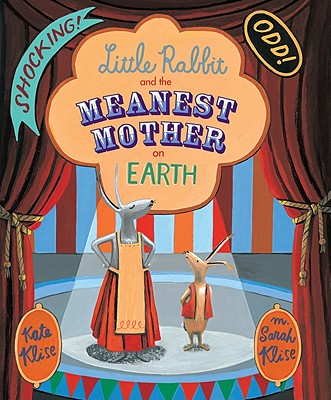
Little Rabbit and the Meanest Mother on Earth

Klise, Kate. 2010. Little Rabbit and the Meanest Mother on Earth. Illustrated by M. Sarah Klise. New York: Harcourt.

This is another of those books that jumps out and yells "Read me!"  I hate to admit that I'm so affected by cover art, but I am.  I read the book (and loved it!) before looking at the author and illustrator; now I'm firmly convinced that the Klise sisters  know the exact location of my funny bone.  From the Regarding the... series to the Dying to Meet You series, they are consistently funny and inventive.

Little Rabbit and the Meanest Mother on Earth is the Klise sisters' latest picture book featuring Little Rabbit, and Little Rabbit's room is a MESS!  He would love to attend the circus that has arrived in town, but mom has decreed that he must first clean the playroom. How mean is mom?  She's the meanest mother on earth, and she's about to become the newest circus sideshow!
Only 5 cents! Odd! Shocking! The Amazing Rabbit and the Meanest Mother on Earth! 
 Will Little Rabbit's mother satisfy the 100 animals who have purchased tickets to see the Meanest Mother on Earth?  Or is there something even more shocking than the Meanest Mother on Earth?

Delightfully funny with humorously detailed paintings (don't miss the "mold-o-meter"), often featuring the "ring" motif of the circus.

Share |

Wednesday, April 14, 2010

The Very Little Princess

Bauer, Marion Dane. 2010. The Very Little Princess. New York: Random House.

"All books are judged by their covers until they are read."
from The Incorrigible Children of Ashton Place: The Mysterious Howling, by Maryrose Wood.


I try to read across a broad spectrum of children's literature, to help me in my job as a children's librarian.  I take Reader's Advisory seriously and try hard to match each child with the perfect book. Towards that end, I picked up The Very Little Princess, thinking that I have been neglecting, (for lack of a better term) "girly-girl" books. The delightful pink cover with Elizabeth Sayles' fanciful artwork attracted my attention and sealed the deal.

I could not have been more wrong, however, in classifying this short tale as a lighthearted story for girls. (spoiler alert)

One fine June morning, Zoey is surprised by her mother's off-hand remark that they will be leaving soon for her grandmother's house.
Of course, visiting your grandmother probably is natural for you.  But it wasn't for Zoey.  The truth is she had never met her grandmother.  Until that moment, she hadn't even known she had a grandmother!
Zoey dutifully packs a cardboard suitcase (she is by nature a dutiful girl) and goes off to her grandmother's rural home where she is again surprised to find that her mother and grandmother do not appear to be on good terms.  In fact, they argue heatedly, prompting Zoey to go exploring, and thereupon to find a most beautiful three and one-quarter inch tall doll.  She is further surprised when the tiny doll sits upright and sneezes!

What child has not dreamed of a doll that comes to life?  But this is not the doll of dreams.  Princess Regina, (as she likes to be called), is a self-centered, bossy doll, a doll that treats Zoey as a servant.  But Zoey, being by nature a dutiful girl, is not particularly bothered by Regina's selfish, narcissistic behavior.  In fact, she comes to love the diminutive princess, and in her fashion, the princess loves Zoey, too.  As the book jacket declares in similar terms, this is an expertly crafted story of family, friendship, love and loss.  It is.  It also, however,  the story of a loss so profound that the dust jacket's cheery countenance might leave a young reader bereft, as she reads that Zoey's mother leaves her, with nothing more than a cheerful, "Be good," with a woman that a day ago, she never even knew existed.  Zoey is left with her grandmother because her mother needs to be alone. Does this really happen?  I'm sure that it does.  Should it happen in a short, cheerful, small-sized book that is suggested for ages 6-9?  I'm not sure.  In the final chapter, the reader finds that the grandmother turns out to be a kind, wise, and loving woman, but the loss is still great. Place this book in the hands of a child who is capable of understanding and appreciating the story.

Read it as a well-told story, a unique story, even an enchanting story; but don't judge this book by its cover.


Thursday, September 11, 2008

Waiting for Normal

Connor, Leslie. 2008. Waiting for normal. New York: Harper Collins.

“Truth was I never really liked dinnertime. Breakfast was our best meal because it was the only meal that was normal. What I mean by that is we had either toast or cereal. That’s normal for breakfast – everyone eats those things for breakfast. But we often had cereal or toast for dinner, too. … So, toast dinners became my specialty.”

Addie and Mommers live in a dilapidated trailer, sitting on cinder blocks on a busy street corner in Schenectady. The corner, not in Schenectady’s best part of town, has a vacant lot, a Laundromat, and thankfully, a mini mart and gas station. The trailer is a parting gesture from Addie’s ex-stepfather. After Mommers fritters away the mortgage money on another Internet scheme and abandons Addie and her half-sisters while Dwight is out of town on a job, Dwight really has no other choice but to take his daughters (whom Addie affectionately calls, The Littles) and move on. But despite his love for her, Addie is not his daughter. Addie belongs to Mommers, and Mommers is what Addie describes as "all or nothing." The problem is, Addie often gets nothing, while business schemes, boyfriends, and Internet chat rooms, get all.

In spite of all this, Addie displays remarkable courage, self-sufficiency, adaptability, honesty and humor. She becomes friends with Soula, the sickly and overweight owner of the mini mart and and her employee, Elliot. She makes new friends at her new school. She waits for normal.

This first person account of a young girl's triumph over adversity is reminiscent of Susan Patron's Newbery winner, The Higher Power of Lucky, however, Connor's protagonist is more hopeful, more believable. Even the dismal Schenectady street corner trailer seems to offer more promise than Lucky's trailer in a remote California desert town.

Both a coming-of-age and a triumph over adversity story, Waiting for Normal is a winner.

Rumor has Waiting for Normal as a possible Newbery contender. If chosen, it will be the second choice in as many years of a young adult (YA) or teen title. As a children's librarian, I hope that juvenile (J) title is chosen instead. There are many good choices this year.

Beneath the Waves - a review

As we read disturbing news accounts of dying manatees , environmental disasters caused by toxic waste, and ocean pollution on the scale of ...