Pages

Showing posts with label girls. Show all posts

Monday, December 10, 2018

Strong is the New Pretty - a review

Strong is the New Pretty-A Guided Journal for Girls
By Kate T. Parker
Workman, 2018


The children's publishing industry is responding to  recent societal changes with a much-needed shift towards diversity—racial, religious, ethnic, physical, and gender. This book reflects that change.

Strong is the New Pretty is a tween book that celebrates the power of girls from ages 7-14.  The book combines activity, writing, and drawing prompts with photos, quotes, and challenges. The pages are colorfully decorated and invite doodling and note-taking. The blue elastic cord is attached with grommets and keeps the book from flapping open, and a colorful orange ribbon is sewn into the binding to mark the reader's page.  Strong is the New Pretty is for princesses, athletes, bookworms, and dreamers.

If you're looking for a holiday gift for a young girl, Strong is the New Pretty is inspirational and a perfect gift for a strong young girl in your life.  If you can purchase it from an independent bookstore, so much the better.


Though I usually review library books, this is definitely not a library book.  It is intended to be a celebration of one special girl, and used until it's frayed and tattered.


My copy of Strong is the New Pretty was provided by the publisher.


Monday, April 25, 2016

Sticks and Stones - a review

Sticks and Stones by Abby Cooper
Farrar, Straus, & Giroux, 2016
(Advance Reader Copy provided by NetGalley)

  "Sticks and stones may break my bones, but words will never hurt me."

This adage has been told to innumerable children, but in Elyse's case, words do hurt. Elyse has a rare condition called cognadjvisiblitis, or CAV. When she hears nouns or adjectives describing her, they appear as black words on her arms and legs.

In elementary school, Elyse could count on her best friend Jeg, the kindness of young children, and the assistance of teachers and school administrators to ensure that only positive words would appear on her skin, HAPPY, CUTE, SMART. These words were not only complimentary, they were non-irritating. Unkind words surfaced dark, large, and bold - causing extreme itching and discomfort.

Middle school behaviors cannot be controlled so easily. First, she is dumped by her boyfriend, and then she loses Jeg to the cool girls clique. No one can ensure that only positive adjectives find their way to Elyse's ears. It's no wonder that she takes to wearing long sleeves and pants, regardless of the season.

Things begin getting both better and worse as Elyse follows the advice she finds written on mysterious, but mostly encouraging, blue notes. The notes exhort her to compete for the school's coveted position of class trip Explorer Leader, but the contest exposes her to social situations that aggravate her CAV. Her nervous mother takes her, yet again, to the doctor renowned for, but mostly ineffective in treating CAV,

     "People go to meetings, I said. "And take walks. It's not that crazy."

     Dr. Patel scooted closer to get a better look at my words. DUMB was still there. So were IDIOT, LOSER, STUPID, UNLOVABLE, WORTHLESS, and FREAK, the whole crew. They were going in all different directions, and some were bigger than others, but they were all thick, dark, mean, and itchy, and felt like ridiculously scratchy clothes-the ones that also have ridiculously scratchy tags-I couldn't ever take off. 

While the postulate of a school choosing a class trip leader in reality-TV-style, seems a bit far-fetched, the underlying middle school drama rings true, and the book's unique premise of CAV will give readers pause for thought.

Sticks and Stones offers more than just middle-school angst and coming-of-age experiences. Similar to the lives of real children who deal with name-calling everyday, Elyse's story is not one of overcoming this adversity, but of living with it. Elyse's story is a reminder that not all things can be made "right," but we should all take care that we do not contribute to making things "wrong."

(An added bonus: it's a mystery - who is writing those blue notes?)

This is a debut novel for former teacher and school librarian, Abby Cooper.  She's off to a great start.  Look for this one in July, or pre-order a copy.

Monday, November 16, 2015

The Green Bicycle - a review

The Green Bicycle by Haifaa Al Mansour
(Dial Books for Young Readers, 2015)

Eleven-year-old Wadjda lives with her parents in Saudi Arabia.  Lately, however, she's seen very little of her father. Rumor has it that he is seeking a second wife.  Because money is scarce and women are not permitted to drive, Wadjda's mother takes an hours-long cab ride each day to a remote village to teach school.  Covered in black from head to toe, she shares the ride (without air-conditioning) with other teachers - crammed in a dilapidated cab in the sweltering desert heat.  Wadjda, due to her young age and family's financial circumstances, has a special note that allows her to walk alone to school each day—but she longs to ride a bike like Abdullah.  She and Abdullah were once friends, but now that she is older, she is not permitted to fraternize with boys.

Wadjda, however, does not easily take "no" for an answer.  She rebels against the tedious rules of her girls-only school. Why shouldn't she be able to sell mix-tapes of Western musicians? She rebels against her mother and father. Why can't she play video games in her living room designated for men only. She rebels against the constraints of her culture. Why can't she talk to Abdullah if she wants to? And why can't a girl have a bicycle?  Despite the obstacles and consequences, Wadjda is determined to have her way.

     A lecture she'd heard in science class tickled her memory.  Again and again, her teacher had told them that dark colors absorb heat, while lighter colors reflect it back.  She ended the lesson my stating that this phenomenon was one of the miracles of the universe.  It proved there was one almighty God, Allah, and that he had created everything for a purpose.
     Beneath her hot black veil, Wadjda twisted her lips.  She wondered if people knew this scientific secret when the tribal code assigned black to women and white to men.  Maybe the real miracle of the universe was that she was able to walk home in Riyadh's sweltering afternoon sun without passing out!
     The boys were gone now.  Their bicycles moved like a flash around the corner.  Wadjda squinted into the dusty afternoon and continued slowly on her way.  As she walked, she pitched the stone Father had given her at various targets— a can, a stick, a funny-colored brick on the side of a building—thinking all the while about the different miracles of the universe.  It had taken so much to get her to this exact spot, at this exact moment.  So what was her purpose, now that she was here?
Wadjda is an endearing protagonist because, despite a setting that is foreign to the American reader, Wadjda is familiar to us.  She is just a girl like most girls—sometimes obedient, sometimes rebellious, sometimes remorseful, sometimes not.  To women and girls of the West, life as a female in Saudi Arabia seems oppressive, cruel, unfathomable. To a girl like Wadjda, it is just life—a life in which she must eke out moments of hope, happiness, and laughter.  Along with heartache, Haifaa Al Mansour has showed us those moments.

I've heard that the movie is phenomenal.  Whether by book or by movie, I urge you to know Wadjda's story, The Green Bicycle. I think you will love this spirited young girl.

Below is the trailer for the movie Wadjda, on which The Green Bicycle is based.
What makes this even more inspiring is that this movie, made in Saudi Arabia was written and directed by a woman, Haifaa Al Mansour, in a country without movie theaters and where women are not even supposed to be outside without a male relative. You can read highlights of an interview with Haifaa Al Mansour here: [http://www.npr.org/2013/09/22/224437165/wadjda-director-haifaa-al-mansour-it-is-time-to-open-up]

My copy of The Green Bicycle was provided by the publisher at my request.

Thursday, April 19, 2012

Remarkable - a review

Foley, Lizzie K. 2012. Remarkable. New York: Dial.

I often seek for a passage from a book that sums up its mood, purpose or theme. Lizzie K. Foley’s generally light-hearted writing style in Remarkable does not lend itself to finding this insightful quote. However, as I neared the end of this madcap romp through the remarkable days of the remarkable town of Remarkable, I found the passage I was seeking in the wise words of John Doe to his granddaughter, Jane, the only two unremarkable people in town,


“The world is a wonderfully rich place, especially when you’re not trapped by thinking that you’re only as worthwhile as your best attribute.”

Remarkably wise advice for brilliant people everywhere, which slyly points out the converse advice for a world full of John and Jane Does - just being ordinary can be extraordinary. That Lizzie K. Foley can deliver this important message while humorously entertaining us with a peg leg pirate, the delightfully evil Grimlet Twins, a cryptozoological lake creature named Lucky, a "townful" of positively remarkable characters, and of course, unremarkable Jane Doe, is, in itself, remarkable.

This is a debut novel for New Jerseyan, Lizzie K. Foley. Visit her website at http://www.lizziekfoley.com/.


Advance Reading Copy

Wednesday, August 31, 2011

The Girl Who Circumnavigated Fairyland in a Ship of her own Making: A review

Valente, Catherynne M. 2011. The Girl Who Circumnavigated Fairyland in a Ship of her own Making. New York: Feiwel and Friends.
"Tell me the rules," said September firmly.  Her mother had taught her chess when she was quite small, and she felt that if she could remember which way knights ought to go, she could certainly remember Fairy rules.
"First, no iron of any kind is allowed.  Customs is quite strict on this point.  Any bullets, knives, maces, or jacks you might have on your person will be confiscated and smelted.  Second, the practice of alchemy is forbidden to all except young ladies born on Tuesdays --"
"I was born on a Tuesday!"
"It is certainly possible that I knew that," the Green Wind said with a wink.  "Third, aviary locomotion is permitted only by means of Leopard or licensed Ragwort Stalk.  If you find yourself not in possession of one of these, kindly confine yourself to the ground.  Fourth, all traffic travels widdershins.  Fifth, rubbish takeaway occurs on second Fridays.  Sixth, all changelings are required to wear identifying footwear.  Seventh, and most important, you may in no fashion cross the borders of the Worsted Wood, or you will either perish most painfully or be forced to sit through a very tedious tea service with several spinster hamadryads.  These laws are sacrosanct, except for visiting dignitaries and spriggans.  Do you understand?

And to her credit, the 10-year-old and wiser-than-her-years, September, does understand the rules; and leaves her humdrum life in Omaha to enter Fairyland - without so much as a wave to her hard-working mother, a thought for her off-to-war father, and sadly, a shoe.

Evoking obvious comparisons to Alice's Adventures in Wonderland and the Chronicles of Narnia, September wonders, will it be "a marvelous adventure, with funny rhymes and somersaults and a grand party with red laterns at the end"? Or will it be a serious tale, in which, "she might have to do something important, something involving, with snow and arrows and enemies"?  September does not know, but the narrator gives the reader a clue,
Of course, we would like to tell her which.  But no one may know the shape of the tale in which they move.  And, perhaps, we do not truly know what sort of beast it is, either.  Stories have a way of changing faces.  They are unruly things, undisciplined, given to delinquency and the throwing of erasers.  This is why we must close them up into thick, solid books, so they cannot get out and cause trouble.
But thankfully, we as readers, can get in, and well we should! This is a fabulous debut novel.  A Dramatis Personae preceding the story helps us to identify the many inhabitants of Fairyland, including, but not limited to, September's sometimes traveling companions, A-Through-L, a Wyverary (part Wyvern, part library), Gleam, a Lamp, and Saturday, a blue Marid.

And while September does not fathom the depth of the story into which she has been deposited, she nevertheless has an innate sense of purpose, and a willingness to create her own destiny.  Unlike Alice, who passes through Wonderland in random fashion, September charts her own course.  Much like a narrative computer game, September is presented with a series of quests, problems, and puzzles, each one requiring foresight, courage, and personal choice.  (Would you rather lose your way, your life, your mind, or your heart?)  In each instance, the brave little September is suprisingly resilient and equal to the challenge.

Each delightfully titled chapter, "Shadows in the Water: In Which September Crosses a River, Receives a Lesson in Evolution, and Loses Something Precious but Saves a Pooka," tells the reader what will happen, but Catherynne Valente manages to surprise us anyway. The black and white illustrations are a perfect addition to the story and offer just enough detail while leaving room for imagination.

This is a rich, complex, and thoughtful story, yet it reads as a delightful and enchanting romp through a bizarre Fairyland, where we may be frightened, but not terrified, and joyously giddy, but on guard nonetheless. Don't wait for an invitation from the Green Wind.  Read The Girl Who Circumnavigated Fairyland in a Ship of her own Making today.  You will not be disappointed! A fabulous debut fantasy for children, young adults and adult fantasy fans!
Click here for the link to hear Catherynne M. Valente read Chapter I.


Chapters I - VIII are available for preview at the author's site.

More reviews @
Fuse #8
Publishers Weekly
DogEar
and many other blogs.

Wednesday, January 19, 2011

Hereville: How Mirka Got Her Sword

Deutsch, Barry. 2010. Hereville: How Mirka Got Her Sword. New York: Amulet.

I wasn't sure what to expect when I placed a hold on Hereville:  How Mirka Got Her Sword (tagline: "Yet Another Troll-Fighting 11-Year-Old Orthodox Jewish Girl") in anticipation of hosting an author or illustrator on the Sydney Taylor Book Awards blog tour. (I don't know yet whom it will be, but I'm excited and trying to be prepared!)

Hereville is the 2011 gold medal winner in the Sydney Taylor Awards "older readers" (think middle school) category, and it is anything but what I thought it might be.  I expected a heavy, perhaps historical fiction, story of the Jewish experience.  What I found instead, was a modern, graphic novel,  fairytale adventure, offering a prolonged peek into a very insular community - that of the Orthodox Jew.  Through Mirka, the book's lively and determined protagonist, the reader sees a young girl who, despite the tenets of her faith that keep her apart from secular and non-Orthodox society, is much like any other young girl - willful and curious, tempered with love for her family and friends, and a grudging respect for her elders.

Of course, the fact that Mirka is an Orthodox Jewish girl cannot be missed.  The clothing,  religious observances, frequent use of Yiddish words (defined in footnotes), gender segregation, large families and dietary restrictions of the faith are all on display in Hereville, an apropos name, as "here," within the community, is the only place that an Orthodox child is likely to be.  But Mirka longs to fight dragons and isn't afraid to occasionally disobey her stepmother, Fruma, in search of adventure.  Mirka doesn't ever find dragons, but she does find a witch, a talking pig, and eventually, a way to win her sword - even if it doesn't involve slaying dragons.

Most of the interactions take place between Mirka and her younger brother Zindel, her closest companion in the family, and Fruma, a very wise woman, well-versed in turning both sides of any argument to her own favor, much to Mirka's consternation. The pig serves as a bridge of sorts between the Orthodox world and the world-at-large. It is unclear whether the witch is a fairy tale convention or a metaphor for the larger world, a sometimes dangerous place full of the strange and unfamiliar. Mirka must navigate the magical world of the witch in the wood while managing the growing discontent of  family and friends with her occasional decidedly unorthodox behavior.

The illustrations are easy to follow, usually in neatly-defined rectangular panels. Dialogue and text are in white bubbles or boxes in an easy-to-read font.  The artwork was created in pen and ink by the author; a colorist later added a tan palette for daytime scenes, and purple hues for Mirka's forays into the night. The faces are simple, yet expressive. There is enough action to satisfy regular graphic novel fans.

In my state of New Jersey, Orthodox Jews are not uncommon.  Knowing anyone who truly understands much about their lifestyle is. Hereville: How Mirka Got Her Sword, has opened a window into the Orthodox culture.  In Hereville, Barry Deutsch manages to promote cultural understanding (and knitting!) in a graphic novel adventure.  It's no wonder that Hereville is this year's winner. A truly unique concept.


A fifteen-page preview of Hereville, the graphic novel, is available hereHereville began as a web comic in 2008, and may still be found online at Hereville.com.

Think you've got what it takes to be a graphic artist?  Check out this video of author/artist, Barry Deutsch, drawing Mirka at 20x normal speed.


About the Sydney Taylor Book Awards:
The Sydney Taylor Book Award is presented annually to outstanding books for children and teens that authentically portray the Jewish experience. Presented by the Association of Jewish Libraries (AJL) since 1968, the Award encourages the publication and widespread use of quality Judaic literature. Gold medals are presented in three categories: Younger Readers, Older Readers, and Teen Readers. Honor Books are awarded silver medals, and Notable Books are named in each category.

Tuesday, December 14, 2010

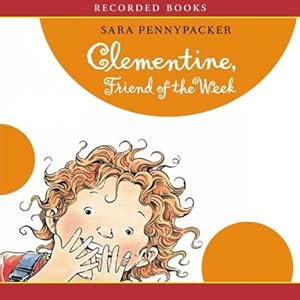
Clementine, Friend of the Week

Pennypacker, Sara. 2010. Clementine, Friend of the Week.  Read by Jessica Almasy. Recorded Books.
(about 2 hours - also available on Playaway)

A while back I was complaining about a lack of good audiobooks in the early chapter book field.  Helpful librarian, Jana, suggested that I might enjoy Clementine, narrated by Jessica Almasy. She was right!  I borrowed the newest Clementine book on CD, Friend of the Week, from my library. (It wasn't available in my preferred form as a digital download from my library's consortium). This was my first encounter with the irrepressible Clementine.

In Friend of the Week, Clementine is fearful that her friends might not write nice things in the memory book that she will receive at school for her turn as "Friend of the Week."  Adding to the week's drama is a fight with her best friend Margaret and a missing cat, her kitten, Moisturizer.  With plenty of inspired ideas, Clementine has a solution for everything - she hopes!

Third-grader Clementine is a delightful character with depth.  She isn't the brightest child in school and sometimes finds herself in trouble, but she's kind and positive and funny too - just the type of girl one would like for a friend.   Her parents' characters are also well-developed, and it's refreshing that they are an agreeable, caring couple - with always enough time to spare for Clementine, in spite of the fact that her father is a busy apartment building manager and her mother has the three-year-old "green bean," to look after as well!  (Clementine feels that since she was named after a fruit, she has license to call her brother by any number of vegetable names - turnip, broccoli, even mung bean!)

Jessica Almasay's narration is perfect for the cheerful Clementine.  She has an infectious quality to her voice that makes Clementine's character immediately likable.  Her boys' voices are soft and monotone, much like a typical young boy's tone when confronted with questions from a spunky girl of his own age.  She switches easily in and out of character; and the story moves along in an upbeat and seamless manner.

Highly recommended.  Thanks for the tip, Jana. 
Listen to a sample here.

Next in the series: Clementine and the Family Meeting.

Share |

Friday, June 4, 2010

Another Picture Book Roundup

I've fallen behind in all the great new books that I'd like to review - so here's a quick take on a few of my new picture book favorites.

Waddell, Martin. 2010. Captain Small Pig. Illustrated by Susan Varley. Atlanta: Peachtree. (first published in the U.K., 2009)

This book had me from page one.
One day Old Goat and Turkey took Small Pig down to Blue Lake. They found a little red boat. "I want to go for a row!" Small Pig said, dancing about. "Turkeys don't go in boats," Turkey said. "Neither do goats," said old Goat, but he climbed into the boat, and they rowed off onto Blue Lake.
It doesn't matter that one cannot catch a whale in the lake, that Little Pig is too small to row, or that he is too small to steer, Turkey and Old Goat let him try. And when Little Pig is done trying, he's tired out... and he dreams, dreams 
of a lovely day out in a boat with good friends on Blue Lake...the day that he was Captain Small Pig.


And what could be better than that? The only lesson in this book is one for grownups - Let children try. It may aggravate you today, but it gives gives the lifelong gift of confidence and remembered joy.
A perfect pairing of cheerfully painted ink drawings and an enchanting story! Love it!


Yolen, Jane. 2010. All Star! Honus Wagner and the Most Famous Baseball Card Ever. Ill. by Jim Burke. New York: Philomel.

Paintings evocative of a bygone era grace this non-fiction, picture book for older readers and help to tell the story of baseball great, Honus Wagner, and his rare baseball card, last sold for nearly three million dollars.

Stories from his childhood (he worked in a coal mine for 79 cents a day) and his early career (to try out for his first professional job, he hopped a freight train and then ran to the field without uniform, glove or spikes), offer a glimpse into both his personality and the time period.  A great baseball story for independent readers or as a read-aloud for school-age baseball fans.

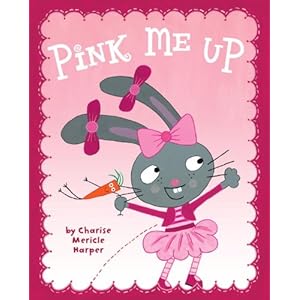
Harper, Charise Mericle. 2010. Pink Me Up. New York: Knopf.
What's a little bunny to do when she's got a "pink-nic" to attend and Mama's sick?  What else can she do but "pink up" Daddy?! 
I hold Daddy's hand because he is not used to being pink. "Don't worry, Daddy.  Being pink will be fun," I tell him.
Pink Me Up is pure pinkish fun.

Kimmel, Eric A. 2010. Joha Makes a Wish: A Middle Eastern Tale. Illustrated by Omar Rayyan. Tarrytown, NY: Marshall Cavendish.

According to the author's note, Joha is a recurring character throughout the Arabic-speaking world."  He is what is sometimes termed a wise or divine fool.  In this humorous retelling of a classic folktale, Joha finds a magical wishing stick.  The stick, however, does not do what he wishes - in fact, quite the opposite!  After wishing for new red slippers to replace his old sandals,
He opened his eyes.  He looked down at his feet.  He did not have a pair of red leather slippers.  He did not have a pair of worn-out sandals, either.  His sandals had disappeared!
Can it get much worse?  Oh yes!  It can!  Delightfully told by Eric Kimmel and hilariously illustrated by Omar Rayyan.  Don't miss this one!


Wednesday, April 14, 2010

The Very Little Princess

Bauer, Marion Dane. 2010. The Very Little Princess. New York: Random House.

"All books are judged by their covers until they are read."
from The Incorrigible Children of Ashton Place: The Mysterious Howling, by Maryrose Wood.


I try to read across a broad spectrum of children's literature, to help me in my job as a children's librarian.  I take Reader's Advisory seriously and try hard to match each child with the perfect book. Towards that end, I picked up The Very Little Princess, thinking that I have been neglecting, (for lack of a better term) "girly-girl" books. The delightful pink cover with Elizabeth Sayles' fanciful artwork attracted my attention and sealed the deal.

I could not have been more wrong, however, in classifying this short tale as a lighthearted story for girls. (spoiler alert)

One fine June morning, Zoey is surprised by her mother's off-hand remark that they will be leaving soon for her grandmother's house.
Of course, visiting your grandmother probably is natural for you.  But it wasn't for Zoey.  The truth is she had never met her grandmother.  Until that moment, she hadn't even known she had a grandmother!
Zoey dutifully packs a cardboard suitcase (she is by nature a dutiful girl) and goes off to her grandmother's rural home where she is again surprised to find that her mother and grandmother do not appear to be on good terms.  In fact, they argue heatedly, prompting Zoey to go exploring, and thereupon to find a most beautiful three and one-quarter inch tall doll.  She is further surprised when the tiny doll sits upright and sneezes!

What child has not dreamed of a doll that comes to life?  But this is not the doll of dreams.  Princess Regina, (as she likes to be called), is a self-centered, bossy doll, a doll that treats Zoey as a servant.  But Zoey, being by nature a dutiful girl, is not particularly bothered by Regina's selfish, narcissistic behavior.  In fact, she comes to love the diminutive princess, and in her fashion, the princess loves Zoey, too.  As the book jacket declares in similar terms, this is an expertly crafted story of family, friendship, love and loss.  It is.  It also, however,  the story of a loss so profound that the dust jacket's cheery countenance might leave a young reader bereft, as she reads that Zoey's mother leaves her, with nothing more than a cheerful, "Be good," with a woman that a day ago, she never even knew existed.  Zoey is left with her grandmother because her mother needs to be alone. Does this really happen?  I'm sure that it does.  Should it happen in a short, cheerful, small-sized book that is suggested for ages 6-9?  I'm not sure.  In the final chapter, the reader finds that the grandmother turns out to be a kind, wise, and loving woman, but the loss is still great. Place this book in the hands of a child who is capable of understanding and appreciating the story.

Read it as a well-told story, a unique story, even an enchanting story; but don't judge this book by its cover.


Wednesday, July 29, 2009

The Zoey Zone

Palatini, Margie. 2008. Geek Chic: The Zoey Zone. New York: Harper Collins.

(Booktalk)


Zoey Zinevich needs an FG (Fairy Godmother) - quick! There are only 198 days until sixth grade and Zoey is a geek, seriously in need of a major fashion makeover. Everyone knows Fairy Godmothers are specialists in instant makeovers, and


"If you're not cool by sixth grade, you are not going to live happily ever after ... The Cool Police are taking notes." (and they're using a lot of paper!)


Of course, Zoey is not without a sense of humor, despite her dire circumstances,


and she's happy to share her thoughts with you in this book of her life.
"Bring a box of tissues - or some of that pink stuff for your stomach. You're going to need it."


Full of ...BREAKING NEWS ...


"Almost-eleven-year-old now spotted outside elementary school looking like a poofy pumpkin. No fairy godmother in sight. Story at six..."


"Note to fairy godmother: Are you watching any of this?"


photos,

collages,

cartoons,

game shows
("Come on Down! It's time to play ....
"10 seconds before your Mother asks U a gazillion Questions!")

and

the heartbreaking 3-act play,
"The Lunchroom Life of Zoey Zinevich,"


Geek Chic will have you laughing out loud.


Read the book and be sure to check out the great companion website http://www.geekchicthezoeyzone.com/

Friday, May 22, 2009

Just Grace Goes Green


Harper. Charise Mericle. 2009. Just Grace Goes Green. Boston: Houghton Mifflin.

Just Grace Goes Green continues the adventures of elementary schooler, Just Grace, so named because of the multiple Graces in her class. In this 4th installment of the series, Grace’s class is learning about recycling, and her best friend, Mimi, has a cousin coming to visit.

While there are some amusing parts, such as when Grace goes shopping for a birthday present for cousin, Gwen,

“Mom said that she liked the present I picked out for Gwen so much that she thought I should have one too. Mom said it wasn’t fair for both Gwen and me to have one and not give one to Mimi. Then on the way home from the store Mom stopped at a bakery and we bought cupcakes. WHO IS THIS MOM? It was like a shopping alien had taken over her body or something,”

other humorous attempts fall flat, or appear to be targeted at adults. What elementary school reader will understand this reference to the Vapors 1980 hit, “Turning Japanese?”

“I could tell what we were going to have for dinner the minute I walked into the house. Mom has this silly way of asking Dad to order sushi for dinner. … When Mom wants sushi she plays her special sushi song on the CD player. I don’t really know what’s called but the main part of the song say, ‘I’m turning Japanese oh yes I’m turning Japanese I really think so.’ It’s kind of like their secret code.”

While a laudable attempt, much of the recycling message comes across as too academic. In several instances, the author uses Just Grace’s recycling or endangered species lessons to itemize factual information,

“6. Red pandas are endangered because their homes are disappearing. People are cutting down their trees to use the wood and then building farms and towns where the trees used to be.”

A final criticism is the author’s choice of Just Grace’s final recycling project – promoting the continuous use of disposable water bottles, decorating them to make them more attractive for re-use. I realize that there is no firm scientific backup for the claim that toxic chemicals may leach from disposable water bottles, however, there is certainly a suggestion that it may be possible. Given the fact that so many other recycling projects are possible, why did she choose this controversial one? Additionally, by having the characters decorate their bottles with glitter and glue; one can only assume that they won’t be well-washed before re-use.

Perhaps if I had read the earlier books, I would have formed a better bond with the main character and been slower to find fault. Overall, I think that the Just Grace series is popular (the many sketches and graphics interspersed throughout the story are simple and cute!) and has great potential for finding a loyal following of third and fourth grade readers; but for me, this particular title falls flat.

Friday, January 30, 2009

Diamond Willow

Frost, Helen. 2008. Diamond Willow. New York: Frances Foster. ISBN: 978-0-374-317768

Like a diamond, the concept for Diamond Willow is brilliant. Twelve-year-old Willow is named after a stick, a diamond willow stick, to be precise. When branches are cut from the willow, a diamond shaped scar is left on the branch. Written mostly in first person verse, each page of Willow's thoughts is a diamond-shaped poem; but the brilliance is not in the shape of the poem, it lies in the gem within. Nestled within each poem is a small truth - a truth that resides within Willow but cannot be seen from without,

"What
I love
about dogs;
They don't talk
behind your back.
If they're mad at you,
they bark a couple times
and get it over with. It's true
they slobber on you sometimes.
(I'm glad people don't do that.) They
jump out and scare you in the dark. (I know,
I should say me, not "you" - some people aren't'
afraid of anything.) But dogs don't make fun
of you. They don't hit you in the back
of your neck with an ice-covered
snowball, and if they did, and
it made you cry, all their
friends wouldn't stand
there laughing
at you.
(Me.)"
Diamond Willow takes place in a remote Alaskan town where dogs and snowmobiles are the most common form of transportation. Willow is most comfortable with her family and her dogs, especially now, since her closest friend has a boyfriend. When an accident occurs while Willow is mushing the dogs, Willow uncovers the truth within, as well as a closely-held family secret.
More than just a coming-of-age story, Diamond Willow is a mystical tale of Native American spirits that reside within the creatures of the Alaskan wild.
I was unable to find reviews of this book on sites dedicated to Native American literature (Oyate, American Indian Library Association, American Indians in Children's Literature), and am curious if those within the Athabascan community find Diamond Willow to be in keeping with native philosophy. I was pleased to see that the author, Helen Frost, spent much time in Alaska and consulted with an Athabascan elder while writing Diamond Willow.
A thoughtful look at the meaning of family, loss, friendship and love.

Beneath the Waves - a review

As we read disturbing news accounts of dying manatees , environmental disasters caused by toxic waste, and ocean pollution on the scale of ...