Pages

Showing posts with label bullying. Show all posts

Thursday, October 12, 2017

Under-the-Bed Fred - a review


Under-the-Bed-Fred
By Linda Bailey
Illustrated by Colin Jack
Penguin Random House, 2017


Under-the-Bed-Fred is the first in a new chapter book series. Like many young kids, Leo is convinced there is a monster under his bed. He is right. Tired of leaping to/from the bathroom, Leo decides to confront the monster. Leo soon realizes that Fred is just doing his job—scaring kids is what he does. 

In Chapter 2, "The Monster Gets a Name," the author hits her stride and gives the reader a taste of Fred and Leo's personalities,

"What's your name?" asked Leo.
"I don't have one," said the monster.
"Everyone should have a name," said Leo.
"I know," said the monster. "I like Fred."
Leo blinked. "You want to be called Fred?"
"Could I?"
"I don't see why not," said Leo.
"Then say it," said the monster. "Say Fred. Say it nicely."
"Okay," said Leo. "Hi Fred. How are you doing, Fred? How's life, Fred?"
"Oh," said Fred. "That feels good!"
 And Fred, tickled pink with his new name, goes on to keep Leo up all night,

"Fred. Fred. Fred."
"Oh for Pete's sake," said Leo. He rolled over. He put his pillow over his head.
"Fred, Fred, Fred, Fred, Fred ..." said Fred.

The story continues with a requisite bully, Fred's visit to school, and a satisfactory conclusion. The vocabulary is simple enough for independent reading, but presented with humor and personality. The images are mixed media, but appear to be primarily watercolor. They are funny in a style that is reminiscent of a Nickelodeon cartoon. All of this is packaged in an attractive small-sized book with sturdy, glossy pages that will stand up in public and school libraries.

Although monsters under the bed are a trope in children's literature, Fred has charming tendencies that set him apart from the rest and he's worthy of investigation. It will be interesting to see the follow-up books. Kids should like this one!


Take a "look inside" Under the Bed Fred at the publisher's website.


My copy of Under the Bed Fred was provided by LibraryThing Early Reviewers

Saturday, August 6, 2016

The Best Man - a review

The Best Man
by Richard Peck
Dial Books, 2016

Richard Peck is a phenomenal writer, and his intent here was write a novel,

" ... addressed to grade-school and middle-school readers. A novel to spark discussion and to open a door to world suddenly living in a whole different era."

He has succeeded in introducing the topic of same-sex marriage in a kind and thoughtful way to his intended audience. Written in the first-person perspective of a rising sixth grader, The Best Man follows young Archer Magill from the end of fifth grade through the beginning of sixth -- through two weddings, bullying, friendship, death, the beginnings of puberty, and wonderful times with his quirky and lovable family. Along the way, he will be the best man in two unforgettable weddings, each of a very different sort. The Best Man is funny and also features Archer's best friend, Lynn,

She was never going to do a lot of peer-grouping with girls. It wasn't her.
"What's that you're drinking?" I inquired.
" A wheat grass smoothie." She wiped off a mustache.
"What's it taste like?"
"Like an open field," she said, "with cow pies."
Then out of nowhere she said, "I'll probably marry Raymond Petrovich. It crossed my mind when he was canceling our absences on e-mail this morning. He's a take-charge guy."
"I thought you weren't ever going to get married," I said, "end of story."
"I was in elementary school when I said that. I've moved on. ..."

This is a story of male role models. You'll love them all. No one tells a story quite like Richard Peck.

Note: 
This review is of an uncorrected Advance Reader Copy of the book.

Tuesday, July 5, 2016

Save Me A Seat - an audiobook review

Save Me a Seat
by Sarah Weeks and Gita Varadarajan
Read by Josh Hurley and Vikas Adam

This is a perfect middle grade novel for highlighting how easily one can mischaracterize another's words or actions.  It's also an inside look at the immigrant and disability experience.  Teachers, you should read this one and share it with your students!

I reviewed Save Me a Seat for AudioFile Magazine.  The book spans only five days in fifth grade, the first week of school at Einstein Elementary School in Hamilton, NJ.  Its sections are titled with the school lunch of the day —Chicken Fingers, Hamburgers, etc., and chapters alternate between Joe, a boy with auditory processing disorder (APD) and Ravi, a recent immigrant from India.  Both boys are targets of the school bully—Joe, because of his disability, and Ravi because of his heavily accented English (which he himself cannot hear) and his family's style of food, dress, and manners.

Although Ravi was a favored, top-ranked student in his native Bangalore, India, his accent and lack of knowledge about his new country land him in the resource room at Einstein Elementary.  Joe also visits the resource room to learn coping skills for his APD. Initially, Ravi views Joe with disdain —mistaking the outward signs of his disability for stupidity.

In each chapter, the boys recount the same scene, allowing the reader or listener to fully understand how our perception of an event is shaped by our cultural, family, and personal background.  I'm sure that the printed book is wonderful as well, but the use of dual narrators in the audiobook really hammers home the differing perspectives.


Read my complete review of Save Me a Seat for AudioFile Magazine here. (An audio excerpt is also available at the same link, however, it only features the character Ravi, read by Vikas Adam.)

Read other reviews of Save Me a Seat and an interview with the authors at Sarah Weeks' website. 

I recently began working in a library with many new Indian-American families, and reading Save Me a Seat was enlightening. The challenges involved in adapting to a new country are many and cannot be overlooked. I'm so glad I listened to this one!


http://weneeddiversebooks.org/

Monday, April 25, 2016

Sticks and Stones - a review

Sticks and Stones by Abby Cooper
Farrar, Straus, & Giroux, 2016
(Advance Reader Copy provided by NetGalley)

  "Sticks and stones may break my bones, but words will never hurt me."

This adage has been told to innumerable children, but in Elyse's case, words do hurt. Elyse has a rare condition called cognadjvisiblitis, or CAV. When she hears nouns or adjectives describing her, they appear as black words on her arms and legs.

In elementary school, Elyse could count on her best friend Jeg, the kindness of young children, and the assistance of teachers and school administrators to ensure that only positive words would appear on her skin, HAPPY, CUTE, SMART. These words were not only complimentary, they were non-irritating. Unkind words surfaced dark, large, and bold - causing extreme itching and discomfort.

Middle school behaviors cannot be controlled so easily. First, she is dumped by her boyfriend, and then she loses Jeg to the cool girls clique. No one can ensure that only positive adjectives find their way to Elyse's ears. It's no wonder that she takes to wearing long sleeves and pants, regardless of the season.

Things begin getting both better and worse as Elyse follows the advice she finds written on mysterious, but mostly encouraging, blue notes. The notes exhort her to compete for the school's coveted position of class trip Explorer Leader, but the contest exposes her to social situations that aggravate her CAV. Her nervous mother takes her, yet again, to the doctor renowned for, but mostly ineffective in treating CAV,

     "People go to meetings, I said. "And take walks. It's not that crazy."

     Dr. Patel scooted closer to get a better look at my words. DUMB was still there. So were IDIOT, LOSER, STUPID, UNLOVABLE, WORTHLESS, and FREAK, the whole crew. They were going in all different directions, and some were bigger than others, but they were all thick, dark, mean, and itchy, and felt like ridiculously scratchy clothes-the ones that also have ridiculously scratchy tags-I couldn't ever take off. 

While the postulate of a school choosing a class trip leader in reality-TV-style, seems a bit far-fetched, the underlying middle school drama rings true, and the book's unique premise of CAV will give readers pause for thought.

Sticks and Stones offers more than just middle-school angst and coming-of-age experiences. Similar to the lives of real children who deal with name-calling everyday, Elyse's story is not one of overcoming this adversity, but of living with it. Elyse's story is a reminder that not all things can be made "right," but we should all take care that we do not contribute to making things "wrong."

(An added bonus: it's a mystery - who is writing those blue notes?)

This is a debut novel for former teacher and school librarian, Abby Cooper.  She's off to a great start.  Look for this one in July, or pre-order a copy.

Monday, October 19, 2015

Fuzzy Mud - a review

Fuzzy Mud by Louis Sachar, winner of the Newbery Medal and National Book Award for Holes.  Narrated by Kathleen McInerny with a full cast and an author's note read by Sachar himself. (Listening Library, 2015)
4 hours
Target audience: Grades 5 and up

I reviewed Fuzzy Mud for AudioFile Magazine, and loved it. As I should have expected from Louis Sachar, there is much more to it than I first expected.  It's a sci-fi, adventure thriller,that focuses on the very broad concept of ecology as well as the more intimate problem of bullying. A link to my review for AudioFile Magazine is here. [http://www.audiofilemagazine.com/reviews/read/104469/]

I highly recommend it.

Thursday, April 16, 2015

Thoughts for a Thursday

I'm blogging at the ALSC blog today with a post on "Putting it all together" - books, technology, creative space, diversity, and kids.  Please hop over and check it out. 

In other news, if you haven't checked out the new lineup yet, SYNC will  be returning on May 7th.  As they do every summer, they will offer free downloads of classic books paired with current books with a similar theme.  Each week features a different pairing. Week #1 begins with Rebecca by Daphne Du Maurier, paired with Beautiful Creatures by Kami Garcia and Margaret Stohl.

And finally, here's a link to an audio book review that I wrote for AudioFile Magazine.  I don't think I ever posted it here. The Julian Chapter: A Wonder Story by R.J. Palacio, read by Mike Chamberlain.  Brilliance Audio, 2014. 

Monday, November 17, 2014

The Paper Cowboy

Levine, Kristin. 2014. The Paper Cowboy. New York: Putnam.

In the seemingly idyllic, 1950s, town of Downers Grove, Illinois, handsome and popular 12-year-old Tommy Roberts appears to be a typical kid.  He lives with his parents, older sister Mary Lou, younger sisters Pinky and Susie, and a devoted family dog. He and his older sister attend Catholic school, his father works for Western Electric, and his mother stays at home with the younger girls.

Amidst the backdrop of the Red Scare and McCarthyism, Tommy's discovery of a Communist newspaper in the town's paper drive truck, and a horrific burn accident to Mary Lou, begin a chain of events that uncovers secrets, truths, and lies in his small town populated with many Eastern European immigrants.

Perhaps the biggest lie is Tommy's own life.  Though he never gets caught, Tommy is a bully, picking on kids at school, especially Little Skinny. When he plants the Communist newspaper in a store owned by Little Skinny's immigrant father, he's gone too far - and he knows it.  Now it's time to act like his cowboy hero, The Lone Ranger, and make everything right, but where can he turn for help?  His mother is "moody" and beats him relentlessly while his father turns a blind eye. His older sister will be hospitalized for months. He has his chores and schoolwork to do, and Mary Lou's paper route, and if Mom's in a mood, he's caretaker for Pinky and Susie as well.

It's hard to understand a bully, even harder to like one, but readers will come to understand Tommy and root for redemption for him and his family.  He will find help where he least expects it.

     I couldn't tell Mrs. Glazov about the dinner party. Or planting the paper.  But maybe I could tell her about taking the candy.  Maybe that would help.  "There's this boy at school, I said slowly, "Little Skinny."
.....
     "I didn't like him.  I don't like him.  Sometimes, Eddie and I and the choirboys, we tease him."
     "Ahh," she said again.  "He laugh too?"
     I shook my head.  I knew what Mary Lou would say.  Shame on you, Tommy! Picking on that poor boy.  And now she would have scars just like him.  How would I feel if someone picked on her?
     "What did you do?" Mrs. Glazov asked, her voice soft, like a priest at confession.  It surprised me. I'd never heard her sound so gentle.
     "I took some candy from him," I admitted.
     "You stole it."
     I shrugged.
     "Ahh."
     "It's not my fault! If Mary Lou had been there, I never would have done it!"
     Mrs. Glazov laughed.  "You don't need sister.  You need conscience."
     I had the horrible feeling that she was right.  I wasn't a cowboy at all. I was an outlaw.
Author Kristin Levine gives credit to her father and many 1950s residents of Downers Grove who shared their personal stories with her for The Paper Cowboy. Armed with their honesty and openness, she has crafted an intensely personal story that accurately reflects the mores of the 1950s.  We seldom have the opportunity (or the desire) to know everything that goes on behind the doors of our neighbors' houses.  Levine opens the doors of Downers Grove to reveal alcoholism, mental illness, abuse, disease, sorrow, and loneliness. It is this stark realism that makes the conclusion so satisfying.  This is not a breezy read with a tidy and miraculous wrap-up.  It is instead, a tribute to community, to ordinary people faced with extraordinary problems, to the human ability to survive and overcome and change.

Give this book to your good readers - the ones who want a book to stay with them a while after they've finished it.


Kristin Levine is also the author of The Lions of Little Rock (2012, Putnam) which I reviewed here.

Friday, August 29, 2014

The Badger Knight - a review

Erskine, Kathryn. 2014. The Badger Knight. New York: Scholastic.
(Advance Reader Copy)

After the great plague, Adrian's father is overly protective. Having lost his wife and daughter, he is determined to protect his12-year-old son, Adrian.  Small and weak, Adrian has what we now call asthma and albinism. In the rural England of the 1300s, however, his condition is more often considered an unlucky and unholy affliction - rendering him only slightly more popular than Thomas the leper. Though he is quick of mind, skillful with a bow, and able to scribe, he is nonetheless treated as useless and dim-witted.

When the Middle March is threatened by war with the Scots, Adrian sees a chance to prove his mettle,

"Soon I hear the blacksmith's voice in my head: Nock! Mark! Draw! Loose! I spread some dirt under my eyes to counteract the bright sun, close my left eye, ready  my bow, and take aim at a single leaf fifty feet away.  On my second shot I split the leaf in two.  As I practice more, I can hit a leaf on my first try, even when it sways in the breeze.  I lose all sense of time and feel like I'm in another world.
Until I hear someone approach through the woods, and I grab my arrows, stowing them quickly with my bow inside the tree trunk.  For years I haven't been discovered and I don't intend for anyone to find me out now.  When the time is right, I will shock them all.  So I stand and look up at the branches to divert attention away from the trunk and to show that I'm simply addlepated Adrian looking at birds."

The Badger Knight is a historical fiction adventure that touches upon many common themes (bullying, friendship, gender bias, coming of age, survival, the nature of good and evil) as Adrian goes off to war and becomes a man - not by might, but by right.

 "... I'm reminded of Nigel and his search for the truth.  I think of what I always believed to be truths — Scots are pagans, thieves are bad, knights are noble, girls are weak, war is glorious — and how these "truths" aren't real at all.  They're things I was taught or everyone believes, just as all people who look like me are supposedly angels or, more often, devils.  I didn't believe Nigel when he said that scribing was power, that seeking the truth and sharing it is mightier than being a soldier.
     Now I see what he means."

The Knight Badger is rich in historical details - from the minor particulars of everyday life and the societal hierarchy of medieval England to the gruesome manner of medieval warfare. Erskine offers an unvarnished look into the lives of serfs, tradesmen, religious leaders, free lances, city street urchins, and robber barons. The author's thoughts on the nature of war are on display throughout, but readers are encouraged to come to their own conclusions and examine their own biases.

A solid adventure story that should appeal to boys and girls.  There is room for a sequel.

On shelves 8/26/14.   Target audience: ages 8-12, Gr 3-7
352 pages

Thursday, August 28, 2014

The Time of the Fireflies - a review

I was actually searching for a fantasy book, but stumbled upon a good old-fashioned ghost story instead.

Little, Kimberly Griffiths. 2014. The Time of the Fireflies.  New York: Scholastic.

Larissa Renaud doesn't live in a regular house. As she tells it,
"My parents moved us into the Bayou Bridge Antique Store—a fact I do not brag about. It's embarrassing to admit I share the same space as musty, mothball-smelly furniture, dusty books, and teacups that dead people once drank from."
Sometimes she wishes they had never come back here from Baton Rouge, but her family has a long history in the bayou town, much of it is tragic.

When Larissa receives  a mysterious call on a broken antique phone, she's got a real mystery on her hands.
"Trust the fireflies," 
the ghostly girl tells her, setting Larissa on  a strange and eerie path of discovery. Can Larissa right the wrongs of the past to save her family's future?

Though it highlights rural poverty, bullying, and new sibling issues, The Time of the Fireflies is at heart, a ghost story with a remarkably likable and resourceful protagonist.

To avoid giving away too much, I'll merely mention that readers may see some similarities to Rebecca Stead's Newbery Medal-winning, When You Reach Me. The spunky Larissa and author Kimberly Griffiths Little will draw you into the rich world of the Louisiana bayou until you too, are carried away by the fireflies.

A link to The Time of the Fireflies trailer is here.  I'm not posting the trailer here because, honestly, I think the book is better than its trailer.

(My copy of the book was provided by the publisher as an Advance Reader Copy.)

Wednesday, April 16, 2014

The QwikPick Papers: Poop Fountain - a review

Angleberger, Tom. 2014. The QwikPick Papers: Poop Fountain! New York: Abrams.

(Advance Reader Copy supplied by publisher)

A bi-racial, Jehovah's Witness girl; a poor boy from the trailer park; a nerdy Jewish boyall victims of school bullying.

Sounds like a perfect trio of protagonists for a serious book of realistic fiction, doesn't it? But it's notnot really. These are the founding members of Tom Angleberger's hilarious new creation, the QwikPick Adventure Society, which makes its debut in a new series, The QwikPick Papers.

So, what do this Jehovah's Witness, Jew, and very poor kid have in common? At first, only that each has nothing to do on Christmas Day.  Marilla and Dave don't celebrate Christmas and don't enjoy spending time at home.  Lyle's parents have to work at the QwikPick convenience store all day. But don't feel sorry for them.  It's the perfect day for a secret mission to visit the Poop Fountain, an antiquated aeration device at the town's waste water treatment plant.

Written as an illustrated "report" by the QwikPick Adventure Society, this novel of only 135 pages, Poop Fountain! is stomach-churning disgusting at times, and hilariously funny at others.  That's why kids will love it, but it's not why you should.

You should love it because Angleberger has proved again (as in the Origami Yoda series) that he can tackle sensitive subjects with charm and  a good deal of humor.

     Everybody else was talking about the Super Bowl coming up that weekend, but we all agreed that it was stupid and football was stupid and the Redskins' mascot was stupid.
     Unfortunately, Jeremy heard me saying something and hollered down the table, "Hey, if we wanted any of your crap, I'd beat it out of you."
     "Shove it, Jeremy," said Dave, which was the nicest thing anyone had ever said in my honor.
     When it was time to go, Marilla said, "Hey, if you want, I'll save this seat for you tomorrow."
     That was when, without them even knowing it, Marilla and Dave became my best friends.

Other reasons for you to love Poop Fountain!, "shout-outs" to
  • The Hoboken Chicken Emergency
  • Fred Astaire
  • The Princess Bride (the movie)
  • the BBC
Coming to a bookshelf near you in May, 2014.  Can't wait 'til May?  It's on NetGalley now.

Tuesday, March 25, 2014

I Even Funnier - an audiobook review


Below is my review of I Even Funnier: A Middle School Story, as it appeared in the March, 2014, edition of School Library Journal. I loved it!


PATTERSON, James & Chris Grabenstein. I Even Funnier: A Middle School Story. (I Funny Series, Bk. 2). 3 CDs. 4 hrs. Hachette Audio. 2013. $18. ISBN 9781478925156.

Gr 3–7—Wheelchair-bound Jamie Grimm is working on new material for his upcoming entry in the regional finals of the Planet's Funniest Kid Comic Contest. Patterson and Grabenstein pay homage to the timeless comedy of Abbott and Costello, Groucho Marx, and other greats, while introducing new jokes that speak directly to the middle school experience. Though it will date the series more quickly, references to trendy Vegas casinos and comedians such as Ray Romano, Ellen DeGeneres, Steven Wright, and Chris Rock give the book an air of hip relevancy. Can Jamie find humor in his bullying cousin, Uncle Frankie's medical emergency, and confusing relationships with Gilda Gold and "Cool Girl?" Yes, he can. And if you're wondering if a heavily illustrated comedic novel can make it as an audiobook, that's a yes, too. Young Frankie Seratch is perfectly cast as the narrator of this heartfelt and very funny look at middle school and family relationships. Seratch ensures that the humor comes across as intended, without a hint of mockery or maliciousness. A PDF companion file of the book's illustrations is included on disc three.

##

Copyright © 2014 Library Journals, LLC, a wholly owned subsidiary of Media Source, Inc.
Reprinted with permission.


Note: I did not read or listen to the first book in the series, and had no trouble getting up to speed with the characters and story.

Thursday, March 13, 2014

Ricky Ricotta's Mighty Robot - in color!

Pilkey, Dav. 2014. Ricky Ricotta's Mighty Robot. New York: Scholastic. Illustrations by Dan Santat.

While at ALA Midwinter, I picked up an Advance Reader Copy of Ricky Ricotta's Mighty Robot. I know what you're thinking - that's not a new book, that was published ages ago!  Yes, but it's back again, and this time in full color, with glossy pages and new "mini-comics" inside.

All of the Ricky Ricotta books will be reissued with new illustrations, and two brand new books are planned for January and March of 2015.  A big campaign is in the works ... stay tuned.

Read an excerpt and see the new illustrations on Scholastic's new Ricky Ricotta web page.

Coming to a bookshelf near you on April 29, 2014.

BTW, my Advance Reader Copy went home with a very happy young boy, one of my best readers. He was looking for my library's "checked-out" copy of the original Ricky Ricotta's Giant Robot. Imagine the smile on his face when I gave him a new, as yet unpublished, full-color copy! (Luckily, I had read it at lunchtime.)

The original Ricky Ricotta artist, Martin Ontiveros deserves credit for helping to create a series that captured the imagination of a nearly a generation of children.  Dan Santat will refresh the series for the next generation.  Long live Dav Pilkey!


Monday, August 12, 2013

Twerp - an audiobook review

My review of Twerp, as it appeared in the August, 2013 edition of School Library Journal.

Twerp. By Mark Goldblatt. 5 CDs. 5:22 hrs. Prod. by Listening Library. Dist. by Listening Library/Books on Tape. 2013. ISBN 978-0-8041-2158-3. $40.

Gr 5-7--A terrible bullying incident involving fellow student, Danley Dimmel, prompted the week-long suspension of Julian Twerski (Twerp) and his friends from their sixth grade class. When he returns to school, in lieu of writing a report on William Shakespeare, Twerp's teacher, Mr. Selkirk, asks him to keep a journal. The teacher hopes that through the journal, the boy will reveal the untold truth about the incident. Like Holling Hoodhood's teacher in Gary Schmidt's The Wednesday Wars (Clarion, 2007), Mr. Selkirk is determined that Julian will learn something about life, himself, and maybe a bit of Shakespeare. Julian is funny, smart, and loyal to his friends, except perhaps when girls are involved. Though he doesn't always do the right thing, he's likeable and believable. Set in the 1960s, the themes of friendship, family, peer pressure, and bullying are timeless in Goldblatt's novel (Random, 2013), which is related in a first-person, confessional style. Everette Plen's portrayal of Julian's Spanish-speaking track rival, Eduardo, is forced; however, he does a stellar job of voicing Julian, his sister, and his friends. This novel delivers heavy themes with a light hand, and should be popular with middle-grade listeners.
###

Copyright © 2013 Library Journals, LLC, a wholly owned subsidiary of Media Source, Inc. Reprinted with permission.

Sunday, December 23, 2012

Hokey Pokey - a review

Spinelli, Jerry. 2013. Hokey Pokey. New York: Knopf.
Advance reader copy provided by NetGalley

In the world of Hokey Pokey, populated by Snotsnipppers, Newbies, and Gappergums, and others, The Kid is king. In fact, kids are its only human inhabitants.

For Big Kid, Jack, days pass in a comfortable rhythm of regularity - hanging out with his Amigos, LaJo and Dusty, and riding his bike Scramjet, the envy of every kid in Hokey Pokey.  The rules are simple.  Just remember the Four Nevers:
Never pass a puddle without stomping in it. Never go to sleep until the last minute. Never go near Forbidden Hut. Never kiss a girl.
It's a simple life, a good life.  Until one morning, when things are not the same.  His bike is gone, and
Jubilee
Rides!

Hokey Pokey is unusual fare for Jerry Spinelli.  It's an allegorical story of childhood delivered by a narrator following the escapades of several different children, and focusing primarily on Jack and his rival and antagonist - the girl, Jubilee.  It's recommended for ages 10 and up, but the beauty of  Hokey Pokey is that it may be read on several levels.  Though the symbolism may be somewhat obvious for older readers, younger readers may simply enjoy Hokey Pokey as a fantasy adventure in an alternate universe. Older readers will see beyond the obvious symbolism of the approaching train and will ponder the relationships between older kids and younger, boys and girls.  Short and thought-provoking. Recommended reading.

Hokey Pokey received starred reviews in School Library Journal and Kirkus Reviews.


 Preview the book here:


Interesting note: This is the second book that I've read that features living bicycles. Anyone know the other one?

Friday, November 16, 2012

Liar & Spy - a review

Stead, Rebecca. 2012. Liar & Spy. New York: Random House.

Georges, a seventh grader, and his parents, have just been downsized to apartment living due to financial difficulties. In his New York City apartment, just around the corner from his old home, Georges makes a curious friend in the watchful,  home-schooled, Safer.  Safer is obsessed with spying on the activities of the mysterious "Mr. X" who lives in the apartment building.  Georges joins Safer's spy club and eventually becomes quite fond of his quirky little friend -- until he uncovers some uncomfortable truths.

At only 192 pages and suitable for grades five and up, one might think that this small book is a quick read - easy contemporary fiction for middle-schoolers; but one must remember that it was written by Newbery Medal winner, Rebecca Stead.

Rebecca Stead requires you to be patient.  She requires you to be thoughtful.  She requires you to follow her wherever she may lead - even if she may be lying.  After all, what is a lie anyway?

Thought provoking and insightful, Liar & Spy touches many topics pertinent to middle school students - lying, bullying, economic downturn, friendship, illness, and family life.

Thursday, October 18, 2012

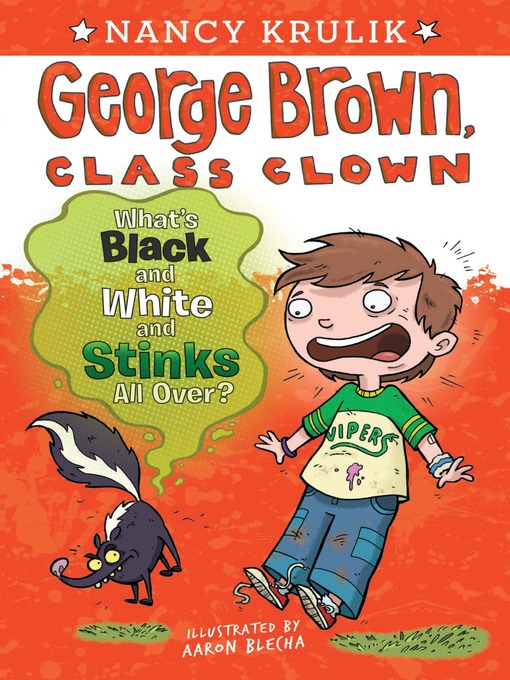
What's Black and White and Stinks All Over? a review

One of the best things about reviewing books for School Library Journal, is that I never know what book they will send me.  As a reviewer, I am obligated to read (or in my case, to listen to) books that I might not otherwise choose for myself, and that's a positive for me.  I try to read across all genres so that I may be more helpful to local kids, but I admit that easy readers and beginning chapter books are not usually my first choice when perusing a bag of new books.  Thanks to SLJ, here then, is a review of the chapter book, What's Black and White and Stinks All Over? Book 4 in the George Brown, Class Clown series, as it appeared in the October 2012 edition of SLJ. (typos corrected)


What’s Black and White and Stinks all Over?: George Brown, Class clown, Book 4. By Nancy Krulik. 1 cassette or 1 CD. 1 hr. Recorded Books. 2012. cassette: ISBN 978-1-4618-1855-7, CD:ISBN 978-1-4618-1856-4. $15.75.

Gr 2-4 - Falling somewhere between Megan McDonald’s Stink series and David Lubar’s Nathan Abercrombie, Accidental Zombie for both silliness and reading difficulty, George Brown, Class Clown is a beginning reader with an unusual twist - a magical “super burp” that erupts in wild behavior. With a father in the Army, George moves often; he’s determined to fit in at his new school without earning his usual reputation as the class clown. However, when George feels the burp coming on, there’s no telling what he might do - dance on the table, jump in the lake, even act like a dog! In What’s Black and Red and Stinks all Over, the burp causes havoc at Edith B. Sugarman School’s fourth grade Field Day events. George has high hopes of becoming the sportscaster for the school’s new WEBS TV, but Louie, the class bully, and George’s burp-inspired antics nearly spoil his chances. A stretch of the imagination is required to envision a 4th grade girl from Jonathan Todd Ross’s vocal rendition of George’s classmate, Sage, but his portrayal of George, his friends, and Louie is engaging and believable. Frequent “bookmarks” make it easy for readers following along with a print version. Kids already invested in the series will appreciate this fourth installment. New listeners will be up to speed in no time.

Copyright © 2012 Library Journals, LLC, a wholly owned subsidiary of Media Source, Inc. Reprinted with permission.
###

You can hear an audio clip of What's Black and White and Stinks All Over? at Amazon.

Tuesday, April 5, 2011

Hero

Lupica, Mike. Hero.  2010. Read by Dan Bittner.  Penguin Audio.
5.5 hours on CD or digital download

(booktalk)

On the day that Zach Harriman's dad dies in a plane crash, his life begins to change.  At first, he's not sure what is happening.  He has an intense sixth sense. He feels to compelled to do things but can't explain why. His eyesight has sharpened.  He can't get hurt. 

When he meets "Mr. Herbert" at the remote crash site on Long Island, he discovers the truth. With Tom Harriman's death, Zach has become the world's only hero.  There's no time to think about it.  He's got work to do.

This is sci-fi that reads like contemporary fiction, and although it’s somewhat of a departure from sports for best-selling author, Mike Lupica,  sports fans can rest assured that there are many sport analogies and references within Hero. This is a smartly written book - mixing political intrigue and adventure seamlessly with the school and family life of a wealthy, 14-year-old Manhattanite.

Only one person is listed as narrator, Dan Bittner, but it sounds as if there are two, so distinct are the adult voices from that of Zach Harriman's.  Chapter One opens with the voice of Zach's dad, Tom Harriman.  The listener is immediately enveloped in Tom Harriman's latest "mission,"  witness to his powers, privy to his thoughts. And then, Tom Harriman is gone. The mature voice of Tom Harriman makes the opening of Hero sound like an adult political thriller - a gripping and powerful beginning. Bittner switches effortlessly between the voices of Zach, best friend Kate, Mrs. Harriman, and the many adult males in the story. Although school features prominently in the story and Zach is the target of the school bully (obligatory for those with superpowers, no?), the real action takes place outside of school where Zach must navigate the dangerous adult world of politics, lies and evil.

There's sure to be a sequel and kids will be looking for it!
Listen to an audio excerpt or
Read Chapters 1 and 2


Monday, July 20, 2009

The Brooklyn Nine

Gratz, Alan. 2009. The Brooklyn Nine: A Novel in Nine Innings. New York: Dial.

Although populated by real and invented characters, The Brooklyn Nine has only one main character - baseball. Beginning with the earliest games of baseball, as played by the fictional German immigrant, Felix Schneider in 1845, through the war years, the modern era, and ending in 2002, baseball is the seam that holds this Novel in Nine Innings together.

Part Roots, part Forest Gump, each chapter in Gratz's novel follows the game of baseball through subsequent generations of Felix Schneider's young descendants. Each generation has its own chapter or "inning."

Along the way, baseball adapts to whatever history throws over the plate - the Civil War, the Vaudeville era, the Roaring Twenties, the Negro Leagues, the All-American Girls Professional Baseball League, Sputnik, and the departure of the Brooklyn Dodgers. Some pieces of baseball memorabilia pass through the generations or "innings", their significance fading over time.

The fictional characters in each chapter are, for the most part, wily and entertaining young baseball fans and players. "The Fourth Inning: The Way Things are Now, Coney Island 1908" features Walter Schneider, a batboy and feisty opponent of racism and anti-semitism, particularly when it's directed at him! "The Fifth Inning: The Numbers Game, Brooklyn, New York, 1926," features Frankie Snider, a quit-witted young girl, with a passion for the Brooklyn Robins and a soft spot for gamblers.

A few "innings" have a rather tenuous attachment to baseball, especially "The Seventh Inning: Duck and Cover, Brooklyn, New York, 1957," but overall, the book flows seamlessly. The Authors Notes for each inning, offer historical notes about events and real people featured in the book.

Because the main character of the Brooklyn Nine is our national pastime, character and plot development are experienced by the sport of baseball, rather than the individual "players" in the book. For this reason, it would make an excellent choice for some school assignments, but a poor choice for others.

The Brooklyn Nine is a fun and informative read, especially for fans of baseball or historical fiction. A winner.

The Brooklyn Nine: A Novel in Nine Innings was chosen as a Booklist Top 10 Historical Fiction for Youth 2009 book.

Note: And now that I've duly tried to review this book, I will quote one of my favorite passages from the story, taken from an exchange between Frankie Snider and the real-life, John Kiernan, sportswriter for the New York Times in the 1920s.
"Then why don't you write about what really happens?"
Kiernan searched the high blue sky for an explanation. "It's like -
it's like reading a book to review it. Somehow having to break a book down into
its parts to critique it sucks all the joy out for me. I greatly prefer to
write my story in advance, and then sit back and enjoy the sum total of the
afternoon. Besides, the truth is subjective."

Monday, July 21, 2008

Adam Canfield

Winerip, Michael. 2007. Adam Canfield: Watch your back!
Winerip, Michael. 2005. Adam Canfield of the Slash.

A quick post on these two titles...I have not read either of them, however, my now 13-year-old daughter has read them both and recommends them. Despite its small print and length, 329 pages, she finished the newest book in one weekend - in my opinion, a sure sign of a good book.

Adam Canfield is the co-editor of his Elementary/Middle School newspaper, The Slash. In the latest book, Adam Canfield does more than report the stories, he is the story, after he is mugged. My daughter's only complaint is that the plot formula for the two books is the same, but she enjoyed them nonetheless. I'll put these on my "to read" list.

Beneath the Waves - a review

As we read disturbing news accounts of dying manatees , environmental disasters caused by toxic waste, and ocean pollution on the scale of ...