Pages

Showing posts with label poverty. Show all posts

Thursday, August 28, 2014

The Time of the Fireflies - a review

I was actually searching for a fantasy book, but stumbled upon a good old-fashioned ghost story instead.

Little, Kimberly Griffiths. 2014. The Time of the Fireflies.  New York: Scholastic.

Larissa Renaud doesn't live in a regular house. As she tells it,
"My parents moved us into the Bayou Bridge Antique Store—a fact I do not brag about. It's embarrassing to admit I share the same space as musty, mothball-smelly furniture, dusty books, and teacups that dead people once drank from."
Sometimes she wishes they had never come back here from Baton Rouge, but her family has a long history in the bayou town, much of it is tragic.

When Larissa receives  a mysterious call on a broken antique phone, she's got a real mystery on her hands.
"Trust the fireflies," 
the ghostly girl tells her, setting Larissa on  a strange and eerie path of discovery. Can Larissa right the wrongs of the past to save her family's future?

Though it highlights rural poverty, bullying, and new sibling issues, The Time of the Fireflies is at heart, a ghost story with a remarkably likable and resourceful protagonist.

To avoid giving away too much, I'll merely mention that readers may see some similarities to Rebecca Stead's Newbery Medal-winning, When You Reach Me. The spunky Larissa and author Kimberly Griffiths Little will draw you into the rich world of the Louisiana bayou until you too, are carried away by the fireflies.

A link to The Time of the Fireflies trailer is here.  I'm not posting the trailer here because, honestly, I think the book is better than its trailer.

(My copy of the book was provided by the publisher as an Advance Reader Copy.)

Wednesday, April 16, 2014

The QwikPick Papers: Poop Fountain - a review

Angleberger, Tom. 2014. The QwikPick Papers: Poop Fountain! New York: Abrams.

(Advance Reader Copy supplied by publisher)

A bi-racial, Jehovah's Witness girl; a poor boy from the trailer park; a nerdy Jewish boyall victims of school bullying.

Sounds like a perfect trio of protagonists for a serious book of realistic fiction, doesn't it? But it's notnot really. These are the founding members of Tom Angleberger's hilarious new creation, the QwikPick Adventure Society, which makes its debut in a new series, The QwikPick Papers.

So, what do this Jehovah's Witness, Jew, and very poor kid have in common? At first, only that each has nothing to do on Christmas Day.  Marilla and Dave don't celebrate Christmas and don't enjoy spending time at home.  Lyle's parents have to work at the QwikPick convenience store all day. But don't feel sorry for them.  It's the perfect day for a secret mission to visit the Poop Fountain, an antiquated aeration device at the town's waste water treatment plant.

Written as an illustrated "report" by the QwikPick Adventure Society, this novel of only 135 pages, Poop Fountain! is stomach-churning disgusting at times, and hilariously funny at others.  That's why kids will love it, but it's not why you should.

You should love it because Angleberger has proved again (as in the Origami Yoda series) that he can tackle sensitive subjects with charm and  a good deal of humor.

     Everybody else was talking about the Super Bowl coming up that weekend, but we all agreed that it was stupid and football was stupid and the Redskins' mascot was stupid.
     Unfortunately, Jeremy heard me saying something and hollered down the table, "Hey, if we wanted any of your crap, I'd beat it out of you."
     "Shove it, Jeremy," said Dave, which was the nicest thing anyone had ever said in my honor.
     When it was time to go, Marilla said, "Hey, if you want, I'll save this seat for you tomorrow."
     That was when, without them even knowing it, Marilla and Dave became my best friends.

Other reasons for you to love Poop Fountain!, "shout-outs" to
  • The Hoboken Chicken Emergency
  • Fred Astaire
  • The Princess Bride (the movie)
  • the BBC
Coming to a bookshelf near you in May, 2014.  Can't wait 'til May?  It's on NetGalley now.

Wednesday, May 29, 2013

The Year of Shadows - a review


Let me begin by saying that it's very hard to review a book that has already been so spectacularly reviewed by none other than its own author and main character!  Check out Claire Legrand's review of The Year of Shadows here.

Below is my more feeble attempt.

Legrand, Claire. 2013. The Year of Shadows. New York: Simon & Schuster.

(Advance Reader Copy)

Twelve-year-old Olivia Stellatella is a loner.  Black is her color of choice, and she prefers the company of her ever-present sketchbook to that of her peers at school.  It's been a difficult year, what with "The Economy" and all.  Olivia doesn't know exactly what "The Economy" means, only that in her case, it means that she now shops at the "charity store" and the orchestra that her father conducts may go out of business, taking his job with it. And her mom has left, an occurrence she blames solely on the Maestro. If that sounds bad, just wait; it gets worse.  Having spent all the family funds on the Philharmonic, the family's new "home" is the backstage area of the crumbling Emerson Hall, home of the Philharmonic orchestra.

Initially, her only "friend" is the peculiarly intuitive and communicative cat, Igor.

The cat rolled over at looked at me upside down. "Who's the Maestro?" I rolled over on my back too. Staring at him like this made my head hurt, but it was kind of fun. "Well, technically, he's half my DNA. But I don't like to think about that."
The cat blinked slowly, like he was already half asleep.
"I mean, I guess, yeah, he's my father." I made quotation marks with my fingers. "On paper, maybe. But not to me. I've disowned him, I guess you could say. " I paused, tapping my feet together. "Everyone at school thinks I'm crazy these days, you know.  Because of my clothes and because I draw all the time instead of talking to people.  I guess by talking to a cat I'm proving them right." 
Until she makes an unlikely friend in Henry, the "perfect" kid from school.

"Hey, cool," a voice said from above.  "You found a cat."
I scrambled up into a sitting position and faced the voice: red hair, tons of freckles, stupid ears that stuck out.
Henry Page.
Ugh. 
Together, Olivia and Henry meet the other inhabitants of Emerson Hall - ghosts, or more specifically, the affable Frederick, the mysterious Mr. Worthington, and the close yet strangely disconnected pair, Tillie and Jax. Frederick and friends may be friendly, but they are desperate as well.  Desperate to move on to the world of Death. And there are other more dangerous things than these ghosts haunting Emerson Hall.

If the orchestra cannot make enough money, the hall will be demolished.  If the hall is demolished, Olivia and her ghostly friends will become homeless.   Olivia believes that perhaps by helping set the ghosts on their way, she can begin to find her own way.  In the process, she learns that sometimes, it is only by looking outward to the plights and concerns of others,  that we can begin to understand our own.

The Year of Shadows is a dark and gripping tale that is not without humor, supplied primarily by the wryly comedic cat, and the antics of  Joan, Olivia's classmate and resident intermediate school protest performer. Olivia has just the right amount of sass and sarcasm for a troubled, but ultimately good, young girl. Goth-lite for middle school readers.

The publisher's site suggests The Year of Shadows for Grades 3-7.  I would suggest Grades 4-8, depending on the reader.

Look closely at the cover art for The Year of Shadows and in addition to Olivia and Igor, you will see Frederick, Mr. Worthington, Tillie and Jax.

Coming to a shelf near you, August 27, 2013.

Note:
If you're a librarian or book blogger, you may request an Advance Reader Copy of The Year of Shadows on the author's website.  I did!

Friday, November 16, 2012

Liar & Spy - a review

Stead, Rebecca. 2012. Liar & Spy. New York: Random House.

Georges, a seventh grader, and his parents, have just been downsized to apartment living due to financial difficulties. In his New York City apartment, just around the corner from his old home, Georges makes a curious friend in the watchful,  home-schooled, Safer.  Safer is obsessed with spying on the activities of the mysterious "Mr. X" who lives in the apartment building.  Georges joins Safer's spy club and eventually becomes quite fond of his quirky little friend -- until he uncovers some uncomfortable truths.

At only 192 pages and suitable for grades five and up, one might think that this small book is a quick read - easy contemporary fiction for middle-schoolers; but one must remember that it was written by Newbery Medal winner, Rebecca Stead.

Rebecca Stead requires you to be patient.  She requires you to be thoughtful.  She requires you to follow her wherever she may lead - even if she may be lying.  After all, what is a lie anyway?

Thought provoking and insightful, Liar & Spy touches many topics pertinent to middle school students - lying, bullying, economic downturn, friendship, illness, and family life.

Thursday, April 26, 2012

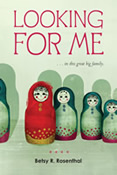
Looking for Me - a review

April is National Poetry Month, and I realize that I've almost let the month slip away without any poetry book reviews.  Just in time, I came across my Advance Reader Copy of Looking for Me, which went on sale April 17.


Rosenthal, Betsy R. 2012. Looking for Me. Boston: Houghton Mifflin Harcourt.

Based on the real stories of her mother and many aunts and uncles, Betsy Rosenthal tells a story in verse of her mother, Edith - the fourth child in a large, Jewish, Depression-era family in Baltimore,

Family Portrait, Baltimore, 1936

We're lined up:
girl boy, girl boy, girl boy, girl boy, girl boy

and in the middle of us all, Dad,
who ordered us to smile
right before the Brownie clicked,
standing stiff as a soldier
no smile on his face,

and Mom's beside him,
a baby in her arms
and in her rounded belly
another one,

just a trace.


Girl, boy, girl, boy, count them up - twelve children in a row house, sleeping three to a bed, always short of money, new clothes and food.  Edith's teacher asks her to write about her family, but she doesn't write about herself.  After all, who is she in this great big family?  Looking for Me chronicles Edith's quest to find individualism in a time when, seemingly, there was no time for such frivolous thoughts. Rosenthal's poetic style varies from free verse, to concrete to metered rhymes.  The subject matter varies as well - following the ups and downs of a year in Edith's life, which, while harsh and disciplined, also held moments of great joy and fun,

They're Lucky I Found Them

Lenny, Sol, and Jack
said Mom left them sleeping
on the sofa bed,
or so she thought,
and ran to the store.

But after she left,
they started to bounce
and bounce
and bounce some more.
Then the bed closed up

and they were stuck
until I came home
and changed their luck.

Some poems are heart-wrenching depictions of life as an 11-year-old Jewish girl who has been touched by death, poverty, meanness, bigotry, and indifference.  Others are uplifting,

Floating

I am a bubble
blown full
with Miss Connelly's words,

floating out of the classroom,
bobbing across the grassy lot,
drifting by Levin's Bakery,

letting the breeze carry me to the diner.
"WHERE HAVE YOU BEEN!?"
Dad yells when I come in,
but I just float right by him.

It's always said that it's best to write what you know.  This is Betsy Rosenthal's family, and she knows it well.  The poignant stories of her mother, aunts, uncles and grandmothers have lived on in her home, and she has done us the very great favor of inviting us in to hear them.

Monday, November 8, 2010

Rags and Riches: Kids in the Time of Charles Dickens

Welcome to Shelf-employed! I am today's Nonfiction Monday host!
Bloggers, please add your link below. Readers, I hope you visit all of today's posters.
Thanks!

Osborne, Mary Pope and Natalie Pope Boyce. 2010. Rags and Riches: Kids in the Time of Charles Dickens. (Magic Tree House Research Guide series #22)New York: Random House.

This is the companion book to A Ghost Tale for Christmas Time, a historical fantasy romp through Dickens' A Christmas Carol,which is why it has the subtitle, Kids in the Time of Charles Dickens, when "Kids in the Victorian Era" might seem more logical.

Charles Dickens lived from 1812 - 1870, largely in the Victoria Era.  Queen Victoria reigned from 1837- 1901. Rich or poor, life was difficult for Britain's children in those days.  Rich children suffered from serious diseases and were raised largely apart from their parents. Boys were sent away to strict schools while girls studied at home with a governess those subjects which were thought most likely to win them a suitable husband - French, dancing, drawing, music.  Of course, they were still much better off than the poor children and street children who filled the streets of London. They slept outside in rags or lived in debtors' prisons or squalid housing. They often worked in dangerous factories for long hours with little or no pay - beginning as young as five years old! Cholera and typhoid were epidemic. Life for a poor child in the time of Charles Dickens was wretched.  Rags to Riches explains all these facets of Victorian Era life and more, with liberal use of sketches and period photographs.

 It is doubtful that any child can read the accounts in the chapter, "Jobs for Poor Kids," and not be affected.  Imagine life as a climbing boy, often only five or six years old,
Since they were small, they could squeeze through narrow parts of the chimney.
     Climbing boys climbed to the top of the chimney and swept the coal dust out on their way back down. They got cuts and bruises from the jagged bricks.  To toughen up their skin, salt water was rubbed into it.
     If the boys got scared and stopped climbing, the chimney sweeps jabbed their feet with pins or lit fires to keep them moving.  At times climbing boys got burned or stuck in the chimneys and suffocated.
Quite a different reality from the friendly, Bert, of Mary Poppins fame!

A children's highlight from the Victoria Era?  The birth of the modern children's picture book - Beatrix Potter's illustrated Tales of Peter Rabbit.  Of course, without money, poor children likely only glimpsed the tiny little books through shop windows.

This is not an easy topic for which to create a research guide.  A chronological approach does not work well, and the many aspects of a child's life are almost too large in scope for a book of this small scale. Still, Pope has created a semblance of order, dividing the topic into six chapters: 'Hard Times for Kids," "What Charles Dickens Saw," "The London of Dickens," "Jobs for Poor Kids," Rich Kids," and "How Things Changed."

Avenues for further research and an index complete this guide book.


Share |

Saturday, June 26, 2010

One Crazy Summer

Williams-Garcia, Rita. 2010. One Crazy Summer. New York: Harper Collins.


If you haven't heard of One Crazy Summer, you will.  Rita Williams-Garcia's latest middle grade fiction is getting a lot of buzz, and justifiably so.

One Crazy Summer is set in a poor neighborhood of Oakland, California, 1968.  Delphine, Vonetta, and Fern (three African-American girls, aged 11, 9 and 7) travel on their own from Brooklyn to Oakland.  Their father, against the judgment of the girls' grandmother and caretaker, Big Mama, has decided that it's time for the girls to meet Cecile, the mother that deserted them.  With visions of Disneyland, movie stars, and Tinkerbell dancing in their heads, they set off on the plane determined not to make, as Big Mama says, "Negro spectacles" of themselves.  This is advice that Delphine, the oldest, has heard often.  She is smart and savvy with a good head on her shoulders, and she knows how to keep her sisters in line.  Not much can throw her for a loop, but then, she hasn't met crazy Cecile yet.  Cecile, or Nzila, as she is known among the Black Panthers, is consumed by her passion - poetry.  She writes powerful and moving poems for "the people" - important work, and she is not about to be disturbed by three young girls and their constant needs for food and attention. She operates a one-woman printing press in her kitchen - no children allowed. Instead of Disneyland and the beach, she shoos the girls off daily to the local center run by the Black Panthers.  There, in the midst of an impoverished, minority neighborhood, the girls receive free breakfast, kind words, and an education the likes of which they would never have gotten in Brooklyn.  Slowly, they begin to understand the plight of "the people" - the Blacks, the poor, the immigrants, even Cecile.

Although this book has several great themes (Civil Rights, sisterhood, community) and well-rounded strong-willed characters, you can read about them in any number of reviews.  As for me, with my teenage daughter preparing to take a trip to Europe next month with the Girl Scouts, one thing from One Crazy Summer jumped out at me - the mind-opening, positive power of travel.  Had Delphine, Vonetta and Fern stayed in their quiet, stable Brooklyn home, they would have been safe and well-cared for, however, they would have missed many experiences (both good and bad) that would likely shape their lives, their attitudes, their opinions, forever.  Visiting new places and seeing the world through the eyes of people different from ourselves is a powerful experience.  Delphine's wise father recognized that. So do I.

A heavy topic made light by the hearts of three winning sisters, smart and practical Delphine, carefree and adaptable Vonetta, and Fern, small, but determined  Highly recommended.

A detailed review of the book is at Fuse #8 and another at Dog Ear.

An excerpt read by the author is available at teachingbooks.net.
Jacket Knack offers an interesting post about the inviting cover art by Sally Wern Comport.


Wednesday, November 12, 2008

Little Audrey

White, Ruth. 2008. Little Audrey. New York: Farrar Strauss Giroux.

In Little Audrey, Ruth White does for 1940s coal miners, beholden to the "company store," what Karen Hesse did for the Dust Bowl farmers in Out of the Dust. Based on her own life (and including photos of her family), White brings life to both the pervasive hopelessness and the individual hopefulness of a Virginia coal mining town, through the voice of her older sister, Audrey. Highly recommended.

Beneath the Waves - a review

As we read disturbing news accounts of dying manatees , environmental disasters caused by toxic waste, and ocean pollution on the scale of ...