Pages

Showing posts with label Jews. Show all posts

Wednesday, February 4, 2015

The Last Song - a review

Wiseman, Eva. 2012. The Last Song. Plattsburgh, NY: Tundra.

Some locations and eras appear regularly in historical fiction  - the US during the Civil War, the Midwest during the Dust Bowl Era, the British Isles in the medieval period, Europe during the Holocaust, the list goes on ... but seldom does it include Spain during the Inquisition.

In this first-person, chronological account, teenager Doña Isabel learns her family's deepest secret - her parents are not devout Catholics as she was raised to be.  Secretly, they practice the Jewish faith - a practice punishable by death under the rule of Ferdinand and Isabella, and their Grand Inquisitor, Tomás de Torquemada.  Set in Toledo, Spain, 1491, Isabel is the daughter of the King's physician, a position that has always kept the family in wealth and privilege.  As the Inquisition grows more brutal, suspected heretics are forced to wear sambenitos (sackcloth), they are beaten, tortured, murdered, and burned alive at autos-da-fé.

I looked around to keep awake.  The church's walls were festooned with the sambenitos of the heretics who had been burned alive at the stake during different autos-de-fé. 

"So many sambenitos," I whispered to Mama.  "They should take them off the wall."

She rolled her eyes. "They are supposed to be reminders to the families of the condemned heretics.  They are warnings to them not to follow in the footsteps of their relatives," she whispered.  "They are a warning to us all."

 Her words filled me with fear.

Her parents decide that to keep Isabel safe from the Inquisition, they will promise her in marriage to the son of the King and Queen's most trusted advisor. Luis is loathsome, however, and instead of Luis, Isabel falls in love with Yonah, a young Jewish silversmith, Soon the lives of the entire family are in danger.

If Isabel abandons her lifelong faith a little too easily and if Eva Wiseman paints Isabel's future a little too brightly, this is a small price to pay for a book suits an older, middle-grade audience and draws attention to a terrible period of religious persecution that is not often covered for this age group, grades 6 and up.


Spoiler:
Ironically (in light of today's current political, social and religious climate), Isabel and her family leave Spain counting Moorish refugees as their friends.  Together they head to Morocco in search of freedom and a better life. How much has changed; and yet, how much remains the same.  We learn so little.


Note:
My copy of The Last Song was provided by LibraryThing Early Reviewers. I'm sorry that I did not get to it sooner.

Monday, February 24, 2014

The Boy on the Wooden Box - an audiobook review

Below is my starred review of The Boy on the Wooden Box: How the Impossible Became Possible on Schindler's List, as it appeared in the February, 2014, edition of School Library Journal.


LYESON, Leon. The Boy on the Wooden Box: How the Impossible Became Possible … on Schindler's List. 4 CDs. 4:15 hrs. Recorded Books. 2013. $46.75 ISBN 9781470369439. Playaway. Digital download.

Gr 4-9--In an intimate look at one family on Oskar Schindler's famous "list," Leyson's (born Leib Lezjon) memoir (S & S, 2013) begins with his earliest memories of his poor but idyllic life in a Polish village. His large Jewish family was short on money, but never on love or a sense of purpose and belonging. They eventually move to Krakow, a city that Leib finds enchanting. When the Nazis invade, however, life becomes desperate for the 10-year-old protagonist, his parents, sister, and three brothers. By sheer happenstance, Leib's father becomes a worker for Schindler, beginning a chain of improbable events that leads to Leib's survival, despite pogroms, ghettos, and Nazi work camps. Young Leib's feelings of fear, dread, and despondency are relayed simply. Narrator Danny Burstein speaks in decorous, measured tones, yet sounds conversational. The words have power, no embellishment is necessary. Despite the horrific subject, Burstein imparts Leyson's peaceable nature and even delivers a natural-sounding laugh or chuckle when relating the rare bright spots. Leyson here shares only his own memories and does not speculate or pontificate on the larger story. If he does not know the fate of a relative or friend, that uncertainty, too, is part of his story. Randomness, luck, and split-second actions that delineated life and death--these are the truths of the Holocaust, and of those on Schindler's list. A moving and heartfelt conveyance of Leyson's gratitude to his family and to Oskar Schindler.

Copyright © 2014 Library Journals, LLC, a wholly owned subsidiary of Media Source, Inc.
Reprinted with permission.

The Boy on the Wooden Box was recognized as an Honor Book for Older Readers in the 2014 Sydney Taylor Book Awards.

Visit today's roundup of nonfiction books for young people at the Nonfiction Monday blog.

Thursday, April 26, 2012

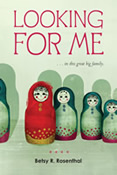
Looking for Me - a review

April is National Poetry Month, and I realize that I've almost let the month slip away without any poetry book reviews.  Just in time, I came across my Advance Reader Copy of Looking for Me, which went on sale April 17.


Rosenthal, Betsy R. 2012. Looking for Me. Boston: Houghton Mifflin Harcourt.

Based on the real stories of her mother and many aunts and uncles, Betsy Rosenthal tells a story in verse of her mother, Edith - the fourth child in a large, Jewish, Depression-era family in Baltimore,

Family Portrait, Baltimore, 1936

We're lined up:
girl boy, girl boy, girl boy, girl boy, girl boy

and in the middle of us all, Dad,
who ordered us to smile
right before the Brownie clicked,
standing stiff as a soldier
no smile on his face,

and Mom's beside him,
a baby in her arms
and in her rounded belly
another one,

just a trace.


Girl, boy, girl, boy, count them up - twelve children in a row house, sleeping three to a bed, always short of money, new clothes and food.  Edith's teacher asks her to write about her family, but she doesn't write about herself.  After all, who is she in this great big family?  Looking for Me chronicles Edith's quest to find individualism in a time when, seemingly, there was no time for such frivolous thoughts. Rosenthal's poetic style varies from free verse, to concrete to metered rhymes.  The subject matter varies as well - following the ups and downs of a year in Edith's life, which, while harsh and disciplined, also held moments of great joy and fun,

They're Lucky I Found Them

Lenny, Sol, and Jack
said Mom left them sleeping
on the sofa bed,
or so she thought,
and ran to the store.

But after she left,
they started to bounce
and bounce
and bounce some more.
Then the bed closed up

and they were stuck
until I came home
and changed their luck.

Some poems are heart-wrenching depictions of life as an 11-year-old Jewish girl who has been touched by death, poverty, meanness, bigotry, and indifference.  Others are uplifting,

Floating

I am a bubble
blown full
with Miss Connelly's words,

floating out of the classroom,
bobbing across the grassy lot,
drifting by Levin's Bakery,

letting the breeze carry me to the diner.
"WHERE HAVE YOU BEEN!?"
Dad yells when I come in,
but I just float right by him.

It's always said that it's best to write what you know.  This is Betsy Rosenthal's family, and she knows it well.  The poignant stories of her mother, aunts, uncles and grandmothers have lived on in her home, and she has done us the very great favor of inviting us in to hear them.

Monday, February 6, 2012

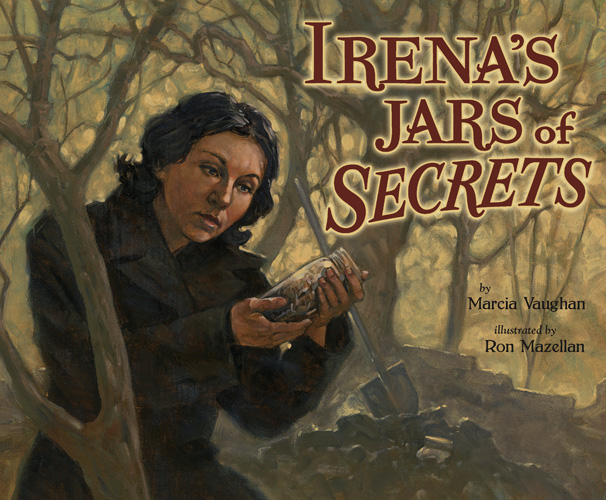
An interview with Marcia Vaughan - Irena's Jars of Secrets

Today I'm pleased to interview Marcia Vaughan, author of Irena's Jars of Secrets (2011 Lee & Low), a 2012 Sydney Taylor Honor Book in the  Older Readers category.  This interview is part of the official Sydney Taylor Book Award Blog Tour, sponsored by the Association of Jewish Libraries.

If you have not yet read Irena's Jars of Secrets, it is the true story of a courageous young Polish Catholic woman who saved the lives of more than two thousand children trapped in the Warsaw Ghetto, and destined for concentration camps during WWII.

Q. I had never heard the story of Irena Sendler prior to reading Irena’s Jars of Secrets. I understand from the Afterword that the Communist Polish government did not promote the heroism of Ms. Sendler. Can you share with us how you first discovered Irena’s story?

Marcia Vaughan
 © Marcia Vaughan
I came upon the story of Irena Sendler quite by accident. I was watching the Today Show three years ago when Matt Lauer announced he was about to read the obituary of a woman few people had ever heard of, a woman who helped rescue 2500 children from the Warsaw Ghetto during WWII. As I listened I could hardly believe what I was hearing. How could one woman and a small group of rescuers save so many lives! I had to know more and I knew young readers would be amazed by her courage and all the ingenious ways Irena Sendler and her team smuggled babies and young children out of the Ghetto past the German guards. I wanted to know about her life and what compelled a Polish Catholic woman to risk death time after time to save Jewish children. I felt young readers would want to know as well.

 Q. I am always interested in the collaboration (or lack thereof) between authors and illustrators. How did Ron Mazellan become your illustrator, and did you share any discussions over the artwork, which is, by the way, a fine complement to your story.

As author I am the storyteller. I’m not much of an artist at all. Publishing companies have editors and art directors who select artists to illustrate children’s picture books. While I researched the facts of Irena Sendler’s life, the illustrator researched the appearance of the characters and what Warsaw, Poland looked like during WWII. He used this information, his creative imagination and incredible talent to tell the story in pictures. Believe it or not, Rod Mazellan and I have never communicated directly about the story. He was free to interpret the story and bring the words to life as he wished. What a marvelous job he’s done!
Q.  Were you able to interview any survivors saved by Irena Sendler? And if not, how did you choose which particular rescues to highlight in the book?

While there were quite a few websites with reputable information on Irena Sendler, there were few books published when I was doing research. The most helpful book was written in German so I had it translated into English. I hope soon there will be many more books available for children, teens and adults about Irena Sendler’s incredible life. When selecting scenes for the book I tried to include examples of the variety of ways children were rescued. I was most impressed with the dog that was made to bark to cover the cries of frightened infants. I was also amazed that children were smuggled past guards in suitcases, tool chests, inside bundles of laundry,even under the floorboards of vehicles. For every child that was rescued, there was a story to tell. Yad Vasham was another excellent source and many emails were exchanged. I also contacted Stefanie Seltzer and other individuals who were extremely helpful. And my hat’s off to Louise May, VP and Editorial Director at Lee & Low Books for her invaluable help.

 Q. And finally, When ever I read a story of selfless heroism, I cannot help but think what I would do in a similar situation. Of course, this is somewhat of an imponderable, but after all of your research, do you have any thoughts on what compels some people to risk their own lives for the sake of others?

I’m not sure what compels some people to risk their lives to save the lives of strangers. Nor do I understand how others can sit back and do nothing when witnessing cruelty. When I read about people like Irena Sendler, or Abbie Burgess [Abbie Against the Storm, Beyond Words Publishing, 1999], who is left alone to care for her ailing mother and two little sisters while keeping the lighthouse running during a vicious winter storm, or the teacher who broke the law and taught a young slave to read and write before Emancipation [Up The Learning Tree, Lee & Low Books, 2003] it makes me wonder if I would have the courage to act as bravely. I do know that as I write about such people it inspires me to find my inner strength and be the best person I can. I hope in reading Irena’s Jars of Secrets children learn to look inside and find their own greatness.
Well said.  I hope so, too.  Thank you so much for sharing your thoughts with me and the readers of Shelf-employed.  Congratulations on your Sydney Taylor Honor Award.

Irena Sendler (1910-2008)
 Warsaw, February 13, 2005
Copyright: Mariusz Kubik

 About the Sydney Taylor Book Awards:

The Sydney Taylor Book Award is presented annually to outstanding books for children and teens that authentically portray the Jewish experience. Presented by the Association of Jewish Libraries since 1968, the award encourages the publication and widespread use of quality Judaic literature. Gold medals are presented in three categories: Younger Readers, Older Readers, and Teen Readers. Honor Books are awarded silver medals, and Notable Books are named in each category.

See the complete list of Sydney Taylor award, honor, and notable books for 2012.
The complete blog tour schedule is posted on the ALJ Blog.

Blog reviews of Irena's Jars of Secrets @
Today is Nonfiction Monday.  The roundup host is Capstone Connect.

Monday, March 7, 2011

Good Sports: Baseball Heroes

Stout, Glenn. 2011. Good Sports: Baseball Heroes. Boston: Houghton Mifflin Harcourt.

This book is not what I thought it would be!  When I saw it's small size and paperback format, I didn't give it much of a glance - instead, putting on the cart to be shelved.  Later, when searching for books on female athletes to display for Women's History Month, this book popped up in the catalog.  Huh?  I gave it a second look, and I'm glad I did.

Baseball Heroes contains the stories of four ball players who overcame enormous odds to rise to the top of the game they loved - Jackie Robinson, the first African American player in the major leagues, Hank Greenberg - who paved the way for Jewish ball players, Fernando Valenzuela - Mexico's first major league superstar, and Ila Borders.  Ila Borders?

No, I had never heard of Ila either, but her story is no less impressive than the rest. Born in 1975 to a baseball-loving family, Ila was as talented a baseball player as any of the boys her age.  Despite catcalls and complaints from parents and some coaches, she played Little League with the boys, pitching her way through elementary and junior high school.  When she enrolled in high school, however, the law said that she had to play on the school's girls' softball team.  But that didn't stop Ila.  With the support of her family, she enrolled in a private school where she earned a spot on the varsity team,
and when players from the opposition tried to show her up by blowing her kisses from the batter's box or acting disrespectful in other ways, Ila knew what to do. "I just brush them back," she later told a reporter, meaning she threw the ball close to them.  "It's my favorite pitch."
(I love this girl already!)  But high school was not the end of Ila's career.  She went on to pitch in college, and rebuffed by the major league teams, Ila Borders found a home playing professional baseball for an independent league, pitching for the Duluth-Superior Dukes, before retiring to finish college in 2000.
"You never know how far you're going to go," she said.  You just work your tail off and see what happens."
A truly inspirational chapter - perfect to share for Women's History Month.

Baseball Heroes is the first in a planned series, Good SportsGood Sports is a good idea. I wish Mr. Stout good luck and better copy editing with the rest of the series.  The cover contains two errors that will be corrected in future editions.  For the record, Glenn Stout's correct web address is http://www.goodsportsbyglennstout.com/.  Baseball Heroes is a good book that deserved a better kickoff.
A parent and teacher guide for baseball heroes is available from the author.

Look for a great post later this month from Audrey Vernick, author of She Loved Baseball: The Effa Manley Story on Kidlit Celebrates Women's History Month!


Today's Nonfiction Monday roundup is at Picture Book of the Day,

Sunday, February 6, 2011

An Interview with Leland Purvis

 The Sydney Taylor Book Award Blog Tour, sponsored by the Association of Jewish Libraries, kicks off today!  One of the Honor Award Winners for Older Readers is Resistance by Carla Jablonski with art by Leland Purvis (First Second, an imprint of Macmillan Children’s Publishing Group)

Today I'm pleased to be interviewing the artist, Leland Purvis

Congratulations on your Sydney Taylor Honor Award for the artwork in Resistance, and thanks so much for participating in the Sydney Taylor Book Award Blog Tour


SE: I’m always curious about the manner in which great books are created. In  graphic novels and nonfiction, is the story generally written in its entirety before the artwork is conceived, is it a collaborative effort, or something completely different?

LP: Not all graphic novels are made the same way. In the case where the writer and artist are different people, often the working method grows out of the creators themselves, and the skills they bring to the table. In this case Carla did a full script but (unusual in comics) no panel-by-panel descriptions. The page design, shot-choices, and character design were all on me. Also, Carla had never done comics before. There are peculiarities of visual storytelling unique to the medium. Carla was very collaborative when occasions arose where I thought things needed changing for clarity, and really open to suggestions of solutions, which made it very satisfying. 
 
SE:  In Resistance, you often use Paul’s sketchbook to portray people or events  in the story. I found it interesting that, in most cases, Paul’s sketchbook depicts events not through the filtered eye of the young boy, but as they are. In my mind, that tells a story in itself - that the behavior of Nazi  Germany was so horrific that exaggeration, even for an imaginative young boy, is impossible. Was that the point that you were trying to make, or does the sketchbook have another purpose in the story?

LP: The sketchbook serves a couple of purposes, which is why you were sensing a dual-role, essentially. On the one hand it was a narrative device by which Paul could be valuable to the Maquis resistance in a credible way. Also it does provide a look into Paul's head about his reaction to the town and people around him. We very much included panels that were strictly Paul's P.O.V. This has continued into the sequels.

Copyright 2010 Leland Purvis and Carla Jablonski

P.O.V. shots can alter perspective and focus without necessitating exaggeration. Horror exaggerates itself. In this case, though, most of those scenes that really depict some of that were not so much in the sketchbook as they were shown from overheard conversations, or witnessed by the characters themselves. I think it was best to give the emotional landscape through the eyes of the children in the story. Otherwise, as horrific as we might have displayed a context, the readers wouldn't have related as fully. Carla did a wonderful job with that and it made my work much more engaging. 


SE: Your Blogger profile states that you’re from Brooklyn, but I read an earlier interview in which you hailed from Portland, Oregon . Two drastically different cities - one brooding (no offense, NY) and one earnest (ditto, Portland); where are you now, and are you happy there?

LP: I've fixed that now! It's funny that you see these cities as so different. In fact Portland, Oregon and Brooklyn, NY are sister-cities in a lot of respects. I know quite a few people who have lived in both places. There's a lot of do-it-yourself creative energy, artists, writers, bicycle riders, musicians, a really vibrant cultural life going on in each. Brooklyn is more diverse, Portland less stressed, but there are many similarities. And there are more comics-artists in Portland than anywhere but Brooklyn. After six years there (sixteen for my wife) we moved to my hometown of Portland last Summer.
 
SE: Based on Vox, Suspended in Language, Resistance and other projects on which you’ve chosen to work, I take it that you are a very serious thinker. But then, there’s Pubo. So, I’m puzzled... is your stated interest in “fighting entropy to soften the dreams of reason,” lighthearted or serious? Do you care to elaborate?


LP: Art, or making anything, really, is an 'organizating' that soothes the mind and offers some defense against the slings and arrows. So in that sense it's serious. But if you're going to take your work seriously, I think it's important to not take your Self too seriously. It's never out of place to lighten up a little. PUBO, while on the surface looks like just a funny-animal comic, does yield more to a closer read. It has some things to say, or at least questions to ask, about trust, fear and survival, what it's okay to do to our fellow Man, and how there is a distinction between that and what's allowed in the natural world. At least I hope it does. I meant it to. The first idea with PUBO being that a character who is a physical map of how we feel, would be a metaphor all by himself.
 
SE: And finally, what’s next?

LP: Next I'll be finishing up the three-book Resistance series. So there's more to hear from Paul and Marie and their little town. After that, I'll be stepping out of YA but continuing with historical work with writer Jim Ottaviani on a book called The Imitation Game, a biography of Alan Turing the British WWII codebreaker.
 
Many thanks to Leland Purvis for his time and thoughtful answers,
and to the Association of Jewish Libraries for sponsoring this tour. 


Wednesday, January 19, 2011

Hereville: How Mirka Got Her Sword

Deutsch, Barry. 2010. Hereville: How Mirka Got Her Sword. New York: Amulet.

I wasn't sure what to expect when I placed a hold on Hereville:  How Mirka Got Her Sword (tagline: "Yet Another Troll-Fighting 11-Year-Old Orthodox Jewish Girl") in anticipation of hosting an author or illustrator on the Sydney Taylor Book Awards blog tour. (I don't know yet whom it will be, but I'm excited and trying to be prepared!)

Hereville is the 2011 gold medal winner in the Sydney Taylor Awards "older readers" (think middle school) category, and it is anything but what I thought it might be.  I expected a heavy, perhaps historical fiction, story of the Jewish experience.  What I found instead, was a modern, graphic novel,  fairytale adventure, offering a prolonged peek into a very insular community - that of the Orthodox Jew.  Through Mirka, the book's lively and determined protagonist, the reader sees a young girl who, despite the tenets of her faith that keep her apart from secular and non-Orthodox society, is much like any other young girl - willful and curious, tempered with love for her family and friends, and a grudging respect for her elders.

Of course, the fact that Mirka is an Orthodox Jewish girl cannot be missed.  The clothing,  religious observances, frequent use of Yiddish words (defined in footnotes), gender segregation, large families and dietary restrictions of the faith are all on display in Hereville, an apropos name, as "here," within the community, is the only place that an Orthodox child is likely to be.  But Mirka longs to fight dragons and isn't afraid to occasionally disobey her stepmother, Fruma, in search of adventure.  Mirka doesn't ever find dragons, but she does find a witch, a talking pig, and eventually, a way to win her sword - even if it doesn't involve slaying dragons.

Most of the interactions take place between Mirka and her younger brother Zindel, her closest companion in the family, and Fruma, a very wise woman, well-versed in turning both sides of any argument to her own favor, much to Mirka's consternation. The pig serves as a bridge of sorts between the Orthodox world and the world-at-large. It is unclear whether the witch is a fairy tale convention or a metaphor for the larger world, a sometimes dangerous place full of the strange and unfamiliar. Mirka must navigate the magical world of the witch in the wood while managing the growing discontent of  family and friends with her occasional decidedly unorthodox behavior.

The illustrations are easy to follow, usually in neatly-defined rectangular panels. Dialogue and text are in white bubbles or boxes in an easy-to-read font.  The artwork was created in pen and ink by the author; a colorist later added a tan palette for daytime scenes, and purple hues for Mirka's forays into the night. The faces are simple, yet expressive. There is enough action to satisfy regular graphic novel fans.

In my state of New Jersey, Orthodox Jews are not uncommon.  Knowing anyone who truly understands much about their lifestyle is. Hereville: How Mirka Got Her Sword, has opened a window into the Orthodox culture.  In Hereville, Barry Deutsch manages to promote cultural understanding (and knitting!) in a graphic novel adventure.  It's no wonder that Hereville is this year's winner. A truly unique concept.


A fifteen-page preview of Hereville, the graphic novel, is available hereHereville began as a web comic in 2008, and may still be found online at Hereville.com.

Think you've got what it takes to be a graphic artist?  Check out this video of author/artist, Barry Deutsch, drawing Mirka at 20x normal speed.


About the Sydney Taylor Book Awards:
The Sydney Taylor Book Award is presented annually to outstanding books for children and teens that authentically portray the Jewish experience. Presented by the Association of Jewish Libraries (AJL) since 1968, the Award encourages the publication and widespread use of quality Judaic literature. Gold medals are presented in three categories: Younger Readers, Older Readers, and Teen Readers. Honor Books are awarded silver medals, and Notable Books are named in each category.

Beneath the Waves - a review

As we read disturbing news accounts of dying manatees , environmental disasters caused by toxic waste, and ocean pollution on the scale of ...