Pages

Showing posts with label Holocaust. Show all posts

Friday, June 28, 2019

Voyages in the Underworld of Orpheus Black
By Marcus Sedgwick and Julian Sedgwick
Illustrated by Alexis Deacon
Walker Books, 2019

Voyages in the Underworld of Orpheus Black is a book that defies categorization, and is one of the most unique and affecting books that I've read this year.

Harry Black is a conscientious objector to the war; he is also an artist. His brother Ellis is a soldier; he is also a writer. They don't see eye-to-eye, however, both risk his their lives for his country. Harry is a firefighter—tasked with responding to the fires that break out during the devastating air raids on the city of London. In a rare wartime opportunity, Harry and his brother meet up for a beer at a London pub. Soon after they separate, the block where the pub stood is bombed to obliteration. Harry finds himself in the hospital in a hazy, surreal state of shock. Ellis' whereabouts are unknown. There is also a curious young German girl in the hospital—Agatha. 

It is in this otherworldly scenario that Harry draws and thinks, and digs to the tune of an unknown musician who plays with great beauty amidst the horrors. The reader has the benefit of understanding the musician's purpose. The story is told in prose, in Harry's sketches, and in the haunting speech of the musician, whose words turn often to song,

I've a story to tell of Harry Black,
who went to the Underworld and how he came back;
of the love for his brother, who'd pushed him away.
Of London by starlight, under attack,
of bombs falling, of people calling
   through darkened streets,
of sirens and wayfarers, of lost souls,
of vicious women and mindless dogs.
These are the things of which I'll sing.

There are many books about WWII, the Kindertransport, the bombing of London. None are like this one. Read it.


My copy of Voyages in the Underworld of Orpheus Black was provided by the publisher.

Thursday, December 15, 2016

The Nazi Hunters - an audiobook review

The Nazi Hunters: How a Team of Spies and Survivors Captured the World's Most Notorious Nazi
by Neal Bascomb
Read by Jason Culp
Scholastic Audiobooks, 2016

I reviewed this book for AudioFile Magazine, and it's the recipient of an Earphones Award.The Nazi Hunters chronicles the 16-year ordeal to capture the notorious Nazi, Adolf Eichmann. Narrator Jason Culp conveys a palpable sense of the fear and tension endured in dangerous and fraught circumstances.


My complete review of The Nazi Hunters for AudioFile Magazine is here.

Want to see the 2016 Best Audiobooks list as selected by AudioFile Magazine?  You can receive free access to the complete guide and enter their contest for 6 months of free audiobooks.  The guide is a great resource if you're in collection development with some budget money left over! Click here for details.  The contest ends tomorrow!

Monday, February 24, 2014

The Boy on the Wooden Box - an audiobook review

Below is my starred review of The Boy on the Wooden Box: How the Impossible Became Possible on Schindler's List, as it appeared in the February, 2014, edition of School Library Journal.


LYESON, Leon. The Boy on the Wooden Box: How the Impossible Became Possible … on Schindler's List. 4 CDs. 4:15 hrs. Recorded Books. 2013. $46.75 ISBN 9781470369439. Playaway. Digital download.

Gr 4-9--In an intimate look at one family on Oskar Schindler's famous "list," Leyson's (born Leib Lezjon) memoir (S & S, 2013) begins with his earliest memories of his poor but idyllic life in a Polish village. His large Jewish family was short on money, but never on love or a sense of purpose and belonging. They eventually move to Krakow, a city that Leib finds enchanting. When the Nazis invade, however, life becomes desperate for the 10-year-old protagonist, his parents, sister, and three brothers. By sheer happenstance, Leib's father becomes a worker for Schindler, beginning a chain of improbable events that leads to Leib's survival, despite pogroms, ghettos, and Nazi work camps. Young Leib's feelings of fear, dread, and despondency are relayed simply. Narrator Danny Burstein speaks in decorous, measured tones, yet sounds conversational. The words have power, no embellishment is necessary. Despite the horrific subject, Burstein imparts Leyson's peaceable nature and even delivers a natural-sounding laugh or chuckle when relating the rare bright spots. Leyson here shares only his own memories and does not speculate or pontificate on the larger story. If he does not know the fate of a relative or friend, that uncertainty, too, is part of his story. Randomness, luck, and split-second actions that delineated life and death--these are the truths of the Holocaust, and of those on Schindler's list. A moving and heartfelt conveyance of Leyson's gratitude to his family and to Oskar Schindler.

Copyright © 2014 Library Journals, LLC, a wholly owned subsidiary of Media Source, Inc.
Reprinted with permission.

The Boy on the Wooden Box was recognized as an Honor Book for Older Readers in the 2014 Sydney Taylor Book Awards.

Visit today's roundup of nonfiction books for young people at the Nonfiction Monday blog.

Monday, February 6, 2012

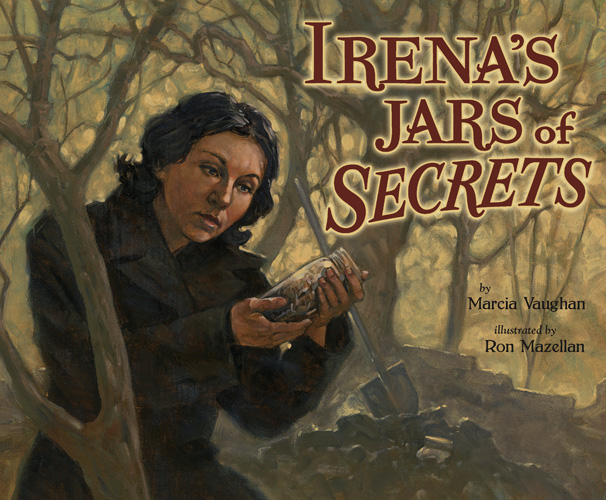
An interview with Marcia Vaughan - Irena's Jars of Secrets

Today I'm pleased to interview Marcia Vaughan, author of Irena's Jars of Secrets (2011 Lee & Low), a 2012 Sydney Taylor Honor Book in the  Older Readers category.  This interview is part of the official Sydney Taylor Book Award Blog Tour, sponsored by the Association of Jewish Libraries.

If you have not yet read Irena's Jars of Secrets, it is the true story of a courageous young Polish Catholic woman who saved the lives of more than two thousand children trapped in the Warsaw Ghetto, and destined for concentration camps during WWII.

Q. I had never heard the story of Irena Sendler prior to reading Irena’s Jars of Secrets. I understand from the Afterword that the Communist Polish government did not promote the heroism of Ms. Sendler. Can you share with us how you first discovered Irena’s story?

Marcia Vaughan
 © Marcia Vaughan
I came upon the story of Irena Sendler quite by accident. I was watching the Today Show three years ago when Matt Lauer announced he was about to read the obituary of a woman few people had ever heard of, a woman who helped rescue 2500 children from the Warsaw Ghetto during WWII. As I listened I could hardly believe what I was hearing. How could one woman and a small group of rescuers save so many lives! I had to know more and I knew young readers would be amazed by her courage and all the ingenious ways Irena Sendler and her team smuggled babies and young children out of the Ghetto past the German guards. I wanted to know about her life and what compelled a Polish Catholic woman to risk death time after time to save Jewish children. I felt young readers would want to know as well.

 Q. I am always interested in the collaboration (or lack thereof) between authors and illustrators. How did Ron Mazellan become your illustrator, and did you share any discussions over the artwork, which is, by the way, a fine complement to your story.

As author I am the storyteller. I’m not much of an artist at all. Publishing companies have editors and art directors who select artists to illustrate children’s picture books. While I researched the facts of Irena Sendler’s life, the illustrator researched the appearance of the characters and what Warsaw, Poland looked like during WWII. He used this information, his creative imagination and incredible talent to tell the story in pictures. Believe it or not, Rod Mazellan and I have never communicated directly about the story. He was free to interpret the story and bring the words to life as he wished. What a marvelous job he’s done!
Q.  Were you able to interview any survivors saved by Irena Sendler? And if not, how did you choose which particular rescues to highlight in the book?

While there were quite a few websites with reputable information on Irena Sendler, there were few books published when I was doing research. The most helpful book was written in German so I had it translated into English. I hope soon there will be many more books available for children, teens and adults about Irena Sendler’s incredible life. When selecting scenes for the book I tried to include examples of the variety of ways children were rescued. I was most impressed with the dog that was made to bark to cover the cries of frightened infants. I was also amazed that children were smuggled past guards in suitcases, tool chests, inside bundles of laundry,even under the floorboards of vehicles. For every child that was rescued, there was a story to tell. Yad Vasham was another excellent source and many emails were exchanged. I also contacted Stefanie Seltzer and other individuals who were extremely helpful. And my hat’s off to Louise May, VP and Editorial Director at Lee & Low Books for her invaluable help.

 Q. And finally, When ever I read a story of selfless heroism, I cannot help but think what I would do in a similar situation. Of course, this is somewhat of an imponderable, but after all of your research, do you have any thoughts on what compels some people to risk their own lives for the sake of others?

I’m not sure what compels some people to risk their lives to save the lives of strangers. Nor do I understand how others can sit back and do nothing when witnessing cruelty. When I read about people like Irena Sendler, or Abbie Burgess [Abbie Against the Storm, Beyond Words Publishing, 1999], who is left alone to care for her ailing mother and two little sisters while keeping the lighthouse running during a vicious winter storm, or the teacher who broke the law and taught a young slave to read and write before Emancipation [Up The Learning Tree, Lee & Low Books, 2003] it makes me wonder if I would have the courage to act as bravely. I do know that as I write about such people it inspires me to find my inner strength and be the best person I can. I hope in reading Irena’s Jars of Secrets children learn to look inside and find their own greatness.
Well said.  I hope so, too.  Thank you so much for sharing your thoughts with me and the readers of Shelf-employed.  Congratulations on your Sydney Taylor Honor Award.

Irena Sendler (1910-2008)
 Warsaw, February 13, 2005
Copyright: Mariusz Kubik

 About the Sydney Taylor Book Awards:

The Sydney Taylor Book Award is presented annually to outstanding books for children and teens that authentically portray the Jewish experience. Presented by the Association of Jewish Libraries since 1968, the award encourages the publication and widespread use of quality Judaic literature. Gold medals are presented in three categories: Younger Readers, Older Readers, and Teen Readers. Honor Books are awarded silver medals, and Notable Books are named in each category.

See the complete list of Sydney Taylor award, honor, and notable books for 2012.
The complete blog tour schedule is posted on the ALJ Blog.

Blog reviews of Irena's Jars of Secrets @
Today is Nonfiction Monday.  The roundup host is Capstone Connect.

Wednesday, May 12, 2010

The Boy Who Dared

Bartoletti, Susan Campbell. 2008. The Boy Who Dared. Read by David Ackroyd. Listening Library.


Based on the true story of Helmuth Hübener, The Boy Who Dared is told in a series of flashbacks by an imprisoned Helmuth as he awaits his sentence of death by guillotine. Helmuth revisits the events and decisions that drove him to defy the Nazi party and the Gestapo.

Many children's books have been written on Nazi atrocities, each with its own particular vantage point.  Milkweed looks at the plight of a young Gypsy.  Number the Stars tells of the Danish resistance. The Boy Who Dared focuses on what Helmuth Hübener would have known best - the experience of Germany's young, non-Jewish citizens. Forced to join the Hitler Youth and adhere to strict curfews, forbidden to attend school with their Jewish friends or shop at Jewish-owned stores, and particularly grievous to Helmuth, forbidden to read non-German books or listen to any radio other than The People's Radio.

This is a powerful story for middle-schoolers and is especially relevant because it highlights the impact that one single young person can have on his society.

However, as is often the case, the truth is a more compelling story.  Susan Campbell Bartoletti's earlier book, Hitler Youth: Growing up in Hitler's Shadow. It's a powerful and fascinating story that follows the lives of numerous young Germans and explores why some succumbed to the Nazi propaganda machine and others resisted. The outcome of their decisions is revealed as well. Katherin Kana's accent and "matter-of-fact" style of reading, is perfect for setting a chilling tone to a horrific period in history. Hitler Youth is the winner of over 10 major awards including a Newbery Honor and a Sibert Honor. Best for 7th grade and up.
Scholastic's video booktalk for The Boy Who Dared is available here.


An excerpt from Listening Library's Hitler Youth: Growing Up in Hitler's Shadow, also by Susan Campbell Bartoletti, and read by Katherin Kana. (2006)


Friday, October 16, 2009

Anne Frank: Her Life in Words and Pictures


Metsalaar, Menno. 2009. Anne Frank: Her Life in Words and Pictures from the Archives of the Anne Frank House. New York: Roaring Brook Press.


With a wealth of photographs, selected diary entries, and historical background information, Anne Frank: Her life in words and pictures is perfectly suited as a wonderful companion to Anne Frank: The diary of a young girl, or an alternative for more visual learners. To see photographs of her actual diary pages and her family's hiding place (in addition to hundreds of other photographs)is a compelling addition to Anne Frank's story. The book is arranged chronologically, and contains a glossary, but no index.


Coincidentally, I attended an excellent presentation yesterday by Kathe Pinchuck, Chair of the Sydney Taylor Book Award Committee. The purpose of the award is "to encourage the publication of outstanding books of Jewish content for children and teens, books that exemplify the highest literary standards while authentically portraying the Jewish experience." The site and Ms. Pinchuck are great sources of information.

Monday, October 20, 2008

The Mozart Question

Morpurgo, Michael. 2008. The Mozart Question. Ill. by Michael Foreman. Cambridge, MA: Candlewick.

This book, by British Children's Laureate (2003-2005), Michael Morpurgo, was first published in London in 2006. The Mozart Question is a small, short work of fiction that will leave a large and long-lasting impression on the reader.

Paolo Levi is a young boy in Venice. His parents are kind, working-class people; his father is a barber. The family lives in an apartment over the barbershop, where, hidden in a bedroom, is a broken violin. Paolo learns that his father used to play it, and he longs to hear him play; but there is a mystery. Mama tells Paolo that he must never mention the violin. He must not mention it to his father. He must pretend that it does not exist.

But Paolo is drawn by the mysterious violin and by the music of a street musician who plays near the bridge. Paolo becomes friends with Benjamin, the elderly musician. Paolo secrets the violin away from his apartment and Benjamin repairs it; then teaches him to play.

Paolo Levi becomes a famous musician, renowned as much for his musicianship as for his peculiar concert habits - no applause, no recordings, and no Mozart - ever.

Fast forward to today... a young reporter lands a plum assignment - an interview with the famously reticent, Paolo Levi. But the assignment comes with a warning - Don't ask the Mozart question. Young reporter, Lesley, does not ask the Mozart question, yet in a reflective mood, Paolo answers it; and in so doing, he draws the reader into the story of his parents, the Holocaust, and Mozart's role in their survival.

Morpurgo succeeds in conveying the horror of the Holocaust with the simple affecting tale of one family's survival. Both haunting and uplifting, The Mozart Question illustrates the power of music and love, and the indomitable nature of the human spirit. The watercolor illustrations of Michael Foreman are a beautiful addition to the story, muted colors and expressionless faces of Nazis in the concentration camps, contrasted with the beautiful scenery of modern Venice.

More a mystery than a Holocaust novel, this short (less than 70 pages) book is a perfect read-aloud or introduction to the Holocaust. For 5th grade and up.

Saturday, September 27, 2008

Milkweed

Spinelli, Jerry. 2003. Milkweed. Read by Ron Rifkin. Listening Library.

As soon as I began listening to this book on my mp3 player, I knew that the voice sounded familiar. Ron Rifkin's serious and recognizable voice also narrates the audiobook version of Lois Lowry's, The Giver.

Rifkin has the perfect voice for this haunting Holocaust story. He manages the seriousness that the book demands, without the graveness of an adult, for the protagonist in this book is a young child, possibly only 8 or so, when the Nazis march into Warsaw.

Thief, Gypsy, Stupid, Jew, Misha, Jack - the protagonist in Milkweed progresses through many names and identities. When the book begins in Warsaw, 1939, the boy identifies only by what he has been called as long as he can remember, "Stop! Thief!" He is small and quick - his greatest and most useful attributes. He has no name, no family and no history - although the listener comes to understand that he is an orphaned Gypsy. In time, he begins to identify with a band of orphaned Jewish boys living on the streets.

His tender age, lack of formal education, and status as a non-Jew, enables Misha (for so he becomes named) to offer a unique, insightful and unvarnished perspective on life in the Warsaw ghetto under the control of the Nazis. With childhood innocence he wonders why the other boys are not enthralled with the exciting "jackboot" parade, or why a Jewish man would be washing the sidewalk with his own beard. At first he announces, "I'm glad I am not a Jew," and wishes for the shiny boots of the Nazis. Later, however, he completely identifies with the Jews who have accepted him into their midst, and he chronicles the increasingly horrific conditions of the Warsaw ghetto.

What makes this story so compelling is the fact that Misha, due to his age and limited life experiences, is incapable of passing judgment on the events that unfold. He merely recounts the story and adapts to the downward spiral of human conditions. At first he steals loaves of bread and sausages and all manner of delicious foods. He later is forced to eat rats, spoiled cabbages and garbage. Finally, he scrounges for fat at the bottom of an empty garbage can. In all instances, he shares with his "adopted" Jewish family and a house of Jewish orphans - never losing his innate sense of fairness and responsibility to those who have treated him with decency.

He chronicles the increasing callousness with which the Ghetto inhabitants regard the dead - stripping them of their shoes and clothes, if they are lucky enough to have them. Death carts, flame-throwing guards, beatings, murders, deportations to "the ovens," Nazi soldiers with white-gloved girlfriends in Sunday dress tossing bread scraps and taking photos - Misha reports it all.

He is street-wise and contextually ignorant. He knows only what he has lived and lacks a framework in which he can process the atrocity of the Holocaust. It is this combination that provides a framework for explaining the Holocaust in terms that a child can understand. A very compelling book that highlights the depravities of human nature side by side with the indomitable human spirit.

About 5 hours on CD or mp3 download.

Beneath the Waves - a review

As we read disturbing news accounts of dying manatees , environmental disasters caused by toxic waste, and ocean pollution on the scale of ...