Pages

Showing posts with label WW II. Show all posts

Monday, January 22, 2018

Spy on History: Victor Dowd and the World War II Ghost Army - a review

Spy on History: Victor Dowd and  the World War II Ghost Army
by Engima Alberti and Scott Wegener
Workman Publishing, 2018

Perhaps you've heard of the "Quaker guns" used in Revolutionary and Civil War battles—wooden logs painted to look like cannons to fool enemy soldiers into thinking that they faced a superior force.  In the 1980s, the little-known history of the 23 Headquarters Special Troops (a.k.a. the Ghost Army) was declassified, and uncovered a WW II deception of epic proportions.

This second book in the Spy on History series is the true story of the Ghost Army's role in defeating the Nazis—how a battalion of artists, set designers, and similarly creative individuals used elaborate sound, visual, radio, and atmospheric effects to fool the German Army.

Persistent readers will find it chock full of coded messages and clues to discover.  An envelope marked "TOP SECRET" and "CONFIDENTIAL" contains the necessary spy craft tools to decode the book's secrets, but it will take a careful eye to find them.  Clues are within text, borders, images, maps—even the copyright page!

In this sample page from Victor Dowd and World War II Ghost Army, the included red acetate sheet would uncover a clue within the illustration.  Other images require use of the included cipher wheel, velum, or informational WW II "poop sheet."

It should be noted that this book may not be an appropriate purchase for public libraries because the spy craft materials included in the book's "Top Secret" folder may not withstand multiple uses.  If funds were available, however, it would make an excellent choice for a middle-grade book club.  Kids could work cooperatively to find all of the clues, crack the code, and decipher the secret letter from Victor Dowd.

Upon purchase, the final pages that reveal the answers are sealed to avoid premature peeking. I confess that although I found almost all of the clues, I did not fully crack the code before peeking.  I do think, it can be done, however, with a little bit of time and perseverance.  The story of the Ghost Army is fascinating and true, and the book is entertaining on many levels.

National Archives Identifier 292565 "Inflatable dummy weapons" Department of Defense. Department of the Army. Fort Leavenworth, Kansas


Note:
My copy of Spy on History: Victor Dowd and the World War II Ghost Army was provided by the publisher.

Tuesday, January 9, 2018

The Turnkey of Highgate Cemetery - a review

The Turnkey of Highgate Cemetery
By Allison Rushby
Candlewick Press,  2018

Despite her young age, Flossie Birdwhistle is the Turnkey of London's Highgate Cemetery.  Having died herself of rheumatic fever at the age of 12, Flossie is now in charge of the well-being of all the souls interred at Highgate.  This alone can be a daunting job, however, when Flossie discovers a mysterious man who is neither of the living nor the spirit world, her job becomes more difficult. Now she must consider the concerns of the living and the very fate of England in WW II,

"Flossie simply couldn't work it out.  Who was this man?  What was he doing in London? And why had he run away like that?

Maybe if she described him, one of the newly interred at Ada's cemetery might know of him.  He was obviously an officer of great importance. Perhaps he had been in the newspapers."
In a story that is more mysterious than horrific, Flossie rallies allies from the ranks of the dead to combat a threat to the living. The Turnkey of Highgate Cemetery is a genre-bending mix of middle-grade historical fiction, thriller, and ghost story. Turnkey should appeal to a wide variety of readers.  Only the extremely timid will find it disturbing; most will enjoy this unusual tale of ghostly heroism in time of war.


Coming this summer to a shelf near you.

Note:
Highgate Cemetery in London is on the Registry of Historic Parks and Gardens. Click the links to learn more about it.
Highgate Cemetery East


My copy of The Turnkey of Highgate Cemetery was provided by the publisher at my request.

Monday, July 22, 2013

Bomb - an audiobook review

(My review of Steve Sheinkin's, Bomb, as it appeared in the July 2013 edition of School Library Journal)


Bomb: The Race to Build—and Steal—the World’s Most Dangerous Weapon.By Steven Sheinkin. 6 CDs. 7:12 hrs. Prod. by Listening Library. Dist. by Listening Library/Books on Tape. 2013. ISBN 978-0-8041-2220-7. $39.


Sheinkin’s stellar nonfiction account (Flash Point, 2012) captures the science, technology, logistics, and politics of the race to build the first atomic bomb. The book gives listeners a holistic perspective, highlighting the fact that the story of the bomb, while a technological miracle of the time, is at its core, an intricate tale of daring individuals whose actions affected families, friends, communities, and nations. The story begins at the end, with the capture of American spy Harry Gold in Philadelphia. From Gold’s seizure, Sheinken takes a retrospective look at events from the discovery of nuclear fusion to the deployment and the aftermath of the uranium and plutonium bombs in Hiroshima and Nagasaki, Japan. Gold, a chemist, in his role as Communist sympathizer and Soviet courier, is the thread that weaves this fascinating book together as it follows the trail of scientists, Nazi resisters, Soviet and American spies, workers, military commanders, and political leaders across the globe. The author’s narrative is as gripping as that of nonfiction masters such as Jim Murphy and Russell Freedman. Roy Samuelson’s clear diction and measured delivery complements the subject matter, offering students the opportunity to absorb sometimes complex material without pause. This award-winning, meticulously sourced book deserves a spot in every library.


Copyright © 2013 Library Journals, LLC, a wholly owned subsidiary of Media Source, Inc. Reprinted with permission.
###


Listen to an audio excerpt from Bomb: The Race to Build - and Steal - the World's Most Dangerous Weapon, here.

Bomb is a National Book Award Finalist, and the recipient of the Newbery Honor, Sibert Medal, and YALSA Award.

Today's Nonfiction Monday roundup is at Wrapped in Foil, 
where "finding a great children's book is like unwrapping a perfect sweet."

Wednesday, March 28, 2012

The Midnight Zoo - a review

My review of The Midnight Zoo  (as it appeared in the March 2012 edition of SLJ)

The Midnight Zoo (unabr.). 4 CDs. 4.33 hrs. Prod. by Bolinda Audio. Dist. by Brilliance Audio. 2011. ISBN 978-1-7428-5126-6. $49.97.

Gr 7–10-- Like a 20th-century version of Avi's Crispin, who fled across 14th-century England, 12-year-old Andrej is without parents and adrift in Europe during World War II with his younger brother, Tomas, and infant sister in tow. Without destination or an understanding of the war that has divided them from their nomadic Roma clan, the siblings travel by night and sleep by day, sensing danger at every juncture. Andrej scavenges for their food and necessities for the baby. One moon-drenched evening, the trio arrives at a zoo in the ruins of a bombed village. They encounter a menagerie of talking animals, trapped in zoo cages with neither keeper nor keys. Throughout a surreal evening, the boys and animals share life stories. Through the animals, Andrej and Tomas begin to understand the nature of man and war. This understanding, however, offers more questions than answers. Richard Aspel's, rich and sonorous voice creates memorable characterizations for the many humans and animals in Sonya Harnett's novel (Candlewick, 2011), including German-speaking soldiers; his Aussie pronunciation requires a keen ear. Listeners who persevere will be rewarded with a stellar performance. With some aspects of fable, minimal dialogue, and heavy use of allegory, this artfully crafted look at the character of man and the concept of freedom may have limited popular appeal.

Copyright © 2012 Library Journals, LLC, a wholly owned subsidiary of Media Source, Inc. Reprinted with permission.


Monday, November 7, 2011

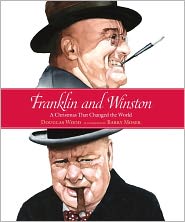
Franklin and Winston: A Christmas That Changed the World - a review

Wood, Douglas. 2011. Franklin and Winston: A Christmas That Changed the World. Ill. by Barry Moser. Somerville, MA: Candlewick.

It was the winter of 1941.  The valiant battleship HMS Duke of York struggled against the screaming winds and forty-foot waves of a mighty December gale.  On board, Winston S. Churchill, prime minister of Great Britain, calmly chomped his ever-present cigar as he strolled the pitching decks.  He was going to meet the president of the United States.  He was going to spend Christmas at the White House.  He would not be stopped by a mere storm.  He would not be stopped by a hurricane.
The focus of Wood's book is this single visit by Churchill to the White House following the early December attack on Pearl Harbor.  Although some background and biographical information is included to set the scene for young readers, Franklin and Winston is, in essence, a chronicle of the historic December 1941 visit.  Transportation (Churchill was too impatient to travel by land from his arrival point in Chesapeake Bay and was flown to Washington, D.C.), activities (Churchill explored the White House gardens in one-piece overalls),  press conferences, dining arrangements and meetings are fully detailed to give the reader a flavor of the era, and an understanding of the relationship between the two men and of their role in world politics.

Most importantly, the reader gains the insight that although these were powerful men deciding a course of action in dire circumstances, they were not larger than life, but full of life. They were friends, and they were very human - with the quirks and frailties one might find in any human being.  Roosevelt and Churchill overcame personal obstacles, and with a common cause and a fast friendship, they formed the bonds and the strategy needed to defeat the Axis powers in WWII.

Yet still, while the fate of the world was at stake, the two men took time to celebrate the Christmas holiday, giving heartfelt speeches at the lighting of the National Christmas Tree.  The included speeches are excerpted and edited by the author with great care to portray both the gravity of the world's situation and the context in which Roosevelt and Churchill were deciding its fate,

"I spend this anniversary and festival far from my country, far from my family, yet I cannot truthfully say that I feel far from home. . . . We may cast aside, for this night at least, the cares and dangers which beset us, and make for the children and evening of happiness in a world of storm. . . . Let the children have their night of fun and laughter.  Let the gifts of Father Christmas delight their play. . . . In God's mercy, a happy Christmas to you all."
Moser's full-page watercolor illustrations face pages of black text on a white background. Moser's paintings are rich in the simpler, more somber colors of the era - dark suits, night skies, a bathroom featuring white tiles, towels and fixtures, simply colored maps, military aircraft. But while the colors and details are evocative of a past time, the faces of Churchill and Roosevelt express life - mirth, joy, and gravity, all within the framework of the timeworn faces of real men, men of a different age who were respected for their actions - discolored teeth, bulbous nose, wrinkles, glasses and all.

Smaller illustrations appear with the text on many pages, and add visual details to the story - a view of the Foundry Methodist Church, the radio on which Roosevelt listened to Churchill's address to Congress, an adorned napkin from dinner with Mrs. Roosevelt.

Contains an Afterword (listing accomplishments of the Christmas 1941 meetings), Author's Note, and Bibliography.

Chronological and factual, Franklin and Winston: A Christmas that Changed the World, is moving as well.  Highly recommended.

You can preview the book at the author's website.

Today's Nonfiction Monday roundup may be found at Charlotte's Library.

Wednesday, May 12, 2010

The Boy Who Dared

Bartoletti, Susan Campbell. 2008. The Boy Who Dared. Read by David Ackroyd. Listening Library.


Based on the true story of Helmuth Hübener, The Boy Who Dared is told in a series of flashbacks by an imprisoned Helmuth as he awaits his sentence of death by guillotine. Helmuth revisits the events and decisions that drove him to defy the Nazi party and the Gestapo.

Many children's books have been written on Nazi atrocities, each with its own particular vantage point.  Milkweed looks at the plight of a young Gypsy.  Number the Stars tells of the Danish resistance. The Boy Who Dared focuses on what Helmuth Hübener would have known best - the experience of Germany's young, non-Jewish citizens. Forced to join the Hitler Youth and adhere to strict curfews, forbidden to attend school with their Jewish friends or shop at Jewish-owned stores, and particularly grievous to Helmuth, forbidden to read non-German books or listen to any radio other than The People's Radio.

This is a powerful story for middle-schoolers and is especially relevant because it highlights the impact that one single young person can have on his society.

However, as is often the case, the truth is a more compelling story.  Susan Campbell Bartoletti's earlier book, Hitler Youth: Growing up in Hitler's Shadow. It's a powerful and fascinating story that follows the lives of numerous young Germans and explores why some succumbed to the Nazi propaganda machine and others resisted. The outcome of their decisions is revealed as well. Katherin Kana's accent and "matter-of-fact" style of reading, is perfect for setting a chilling tone to a horrific period in history. Hitler Youth is the winner of over 10 major awards including a Newbery Honor and a Sibert Honor. Best for 7th grade and up.
Scholastic's video booktalk for The Boy Who Dared is available here.


An excerpt from Listening Library's Hitler Youth: Growing Up in Hitler's Shadow, also by Susan Campbell Bartoletti, and read by Katherin Kana. (2006)


Monday, August 18, 2008

The Green Glass Sea

2007. Klages, Ellen. The green glass sea. New York: Puffin.

The source of the title for Ellen Klages' book, The Green Glass Sea, is a mystery to the end. So too, is everything about life on "The Hill," to the story's protagonist, 11-year-old Dewey Kerrigan. Since her mother's disappearance, Dewey has been living with her Nana while her father works in Boston. When Nana suffers a stroke and has to enter a Home, an Army car comes to pick up Dewey. She is surprised, not only because her father has not come for her himself, but also because her destination is not Boston, but New Mexico. There, in Los Alamos, New Mexico, she finds that her father and many of the world's brightest scientists are at work on a top-secret "gadget" to help end the war. Officially, their neighborhood, called "The Hill," their town, and even they themselves, do not exist in this mysterious desert community. They are allowed no phones or regular communication with the outside world.

The four girls walked down the middle of the road, with Betty and Joyce a little behind, giggling to each other. They headed south, the pine-studded canyon far over on their right. The road didn't have a name, none of them did. Suze thought this made it really hard to give anyone directions, but the army didn't want people knowing much about the Hill. Even if you lived there.

Dewey, a bright and inquisitive inventor herself, loves this strange new life. She has her father all to herself and hours of time to spend on her inventions. The only thing she does not like is the treatment that she receives at the hands of the other scientists' children, who call her Screwy Dewey and mock her handicap - a leg, shortened by an injury. Another young girl, Suze, becomes an unlikely friend due to circumstances beyond either of their control.

Suze and Dewey's life, and life itself, are about to change as two cataclysmic events unfold - the successful test of the atomic bomb and Dewey's own personal tragedy.

The Green Glass Sea, winner of the Scott O'Dell Award for historical fiction, is the story of what life was like for scientists and their families working on the atomic bomb at Los Alamos, New Mexico. In addition to the story of the young girls, Dewey and Suze, and their families, The Green Glass Sea poses the age-old questions of scientific ethics and "greater good, " as in this exchange between two of the scientists:

"Well, yes. We started for a good reason, and we've been working so hard. It was pleasure. It was excitement," he said. "But you stop thinking about - you know? You just stop. And now..."
" And now that we've seen what it can do. My god," Terry Gordon said, her voice raised, sounding angry. "They can't use it. Not on civilians. Not on anyone, for that matter. I mean, maybe as a demonstration, but -"

"That's not realistic, Terry, said Dr. Teller in his Hungarian accent. "It's no longer an experiment to be demonstrated. It's a weapon, to end this terrible war once and for all."

This is moving and slowly paced novel - giving the reader time to absorb the hot New Mexico summer, the single-mindedness of the pursuit, the dreary and secretive life on "the Hill," and the enormity of the "gadget's" importance. The book is told alternately from the viewpoints of Dewey and her new friend, Suze, and contains supplementary information from and an interview with the author, Ellen Klages. The book's only distraction was the author's peculiar choice to write one chapter in a present-tense voice. Highly recommended for ages 11 and up.

Wednesday, July 30, 2008

DK Graphic Readers

I just finished reading two titles, Wagon Train Adventure and The Spy-Catcher Gang, both by John Kelly (2008) in the DK Graphic Readers series. The are classified by DK as Level 4 books for proficient readers.

I was disappointed in them both for several reasons. Graphic novels can be a great way to impart information in an engaging format. (see my earlier post on the 9/11 Commission Report)

A good graphic novel should rely on dialogue and illustrations. These titles are lacking in dialogue, and rely heavily on narration. In one scene of a near calamity on the wagon train trail to California, in two pages of illustrations, the dialogue consists only of "Arghh!" "This is Charles' fault!" and "Leave it, Max!" The illustrations are dreary and uninspired. Additionally, the stories themselves, do not contain crucial information necessary to truly comprehend the story of the pioneer wagon trains or the London Blitz. The most important information was not woven into the stories, rather it appears in a small print appendix or in barely visible (black letters on a blue, one-quarter inch footer) Did You Know? section at the bottom of each page.

Graphic novels certainly are a great tool for teaching or learning history. These DK Readers, however, are not up to the task.

Beneath the Waves - a review

As we read disturbing news accounts of dying manatees , environmental disasters caused by toxic waste, and ocean pollution on the scale of ...