Pages

Showing posts with label Christmas. Show all posts

Monday, December 7, 2015

Picture Book Roundup - December Holiday edition

Each year, hundreds of new holiday books are printed. Many are trite, forced, or pedantic—but not these gems.  Here are my five new favorites. Readjoice! 
  If you have trouble viewing the slideshow, visit it on Riffle.
Featured books:
  • A Homemade Together Christmas
  • Oskar and the Eight Blessings
  • Me and My Dragon: Christmas Spirit
  • Too Many Toys!
  • Miracle on 133rd Street

Thursday, November 24, 2011

Diary of a Wimpy Kid: Cabin Fever - a review

Kinney, Jeff. 2011 Diary of a Wimpy Kid: Cabin Fever. New York: Abrams.

The wait is over.  Cabin Fever has finally arrived!

I've seen a lot of movies where a kid my age finds out he's got magical powers and then gets invited to go away to some special school.  Well, if I've got an invitation coming, now would be the PERFECT time to get it.
A big snowstorm has Mrs. Heffley and the boys snowed in.  Greg is fearful that the police will be coming for him at any minute (it wasn't really vandalism - it just looks that way), Manny's reprogrammed the parental controls so that no one can watch any programs except his favorites, the basement's flooded and Rodrick moves into Greg's room, Greg has to care for Manny since Mom's glasses are broken (oops!),  Dad's stuck in a hotel (cue the bubble bath, robe, slippers, and cable TV), and the power's out.  Just a typical month in Greg Heffley's diary. Amidst the laughter, Jeff Kinney coaxes out a spirit of community, of giving, of Christmas, and family togetherness - whether Greg Heffley likes it or not.

Another great addition to the Wimpy Kid series!

One of the reasons I find the Wimpy Kid books so funny is that for all intents and purposes, I am Greg Heffley's mom (although my eyesight's better).  I see myself in her character and I laugh and I'm thankful that my children are turning out OK in spite of me. ;)  Hoping you have something to be thankful for, too.

Happy Thanksgiving!


And thanks to Abrams books for my review copy.

Monday, November 7, 2011

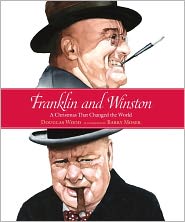
Franklin and Winston: A Christmas That Changed the World - a review

Wood, Douglas. 2011. Franklin and Winston: A Christmas That Changed the World. Ill. by Barry Moser. Somerville, MA: Candlewick.

It was the winter of 1941.  The valiant battleship HMS Duke of York struggled against the screaming winds and forty-foot waves of a mighty December gale.  On board, Winston S. Churchill, prime minister of Great Britain, calmly chomped his ever-present cigar as he strolled the pitching decks.  He was going to meet the president of the United States.  He was going to spend Christmas at the White House.  He would not be stopped by a mere storm.  He would not be stopped by a hurricane.
The focus of Wood's book is this single visit by Churchill to the White House following the early December attack on Pearl Harbor.  Although some background and biographical information is included to set the scene for young readers, Franklin and Winston is, in essence, a chronicle of the historic December 1941 visit.  Transportation (Churchill was too impatient to travel by land from his arrival point in Chesapeake Bay and was flown to Washington, D.C.), activities (Churchill explored the White House gardens in one-piece overalls),  press conferences, dining arrangements and meetings are fully detailed to give the reader a flavor of the era, and an understanding of the relationship between the two men and of their role in world politics.

Most importantly, the reader gains the insight that although these were powerful men deciding a course of action in dire circumstances, they were not larger than life, but full of life. They were friends, and they were very human - with the quirks and frailties one might find in any human being.  Roosevelt and Churchill overcame personal obstacles, and with a common cause and a fast friendship, they formed the bonds and the strategy needed to defeat the Axis powers in WWII.

Yet still, while the fate of the world was at stake, the two men took time to celebrate the Christmas holiday, giving heartfelt speeches at the lighting of the National Christmas Tree.  The included speeches are excerpted and edited by the author with great care to portray both the gravity of the world's situation and the context in which Roosevelt and Churchill were deciding its fate,

"I spend this anniversary and festival far from my country, far from my family, yet I cannot truthfully say that I feel far from home. . . . We may cast aside, for this night at least, the cares and dangers which beset us, and make for the children and evening of happiness in a world of storm. . . . Let the children have their night of fun and laughter.  Let the gifts of Father Christmas delight their play. . . . In God's mercy, a happy Christmas to you all."
Moser's full-page watercolor illustrations face pages of black text on a white background. Moser's paintings are rich in the simpler, more somber colors of the era - dark suits, night skies, a bathroom featuring white tiles, towels and fixtures, simply colored maps, military aircraft. But while the colors and details are evocative of a past time, the faces of Churchill and Roosevelt express life - mirth, joy, and gravity, all within the framework of the timeworn faces of real men, men of a different age who were respected for their actions - discolored teeth, bulbous nose, wrinkles, glasses and all.

Smaller illustrations appear with the text on many pages, and add visual details to the story - a view of the Foundry Methodist Church, the radio on which Roosevelt listened to Churchill's address to Congress, an adorned napkin from dinner with Mrs. Roosevelt.

Contains an Afterword (listing accomplishments of the Christmas 1941 meetings), Author's Note, and Bibliography.

Chronological and factual, Franklin and Winston: A Christmas that Changed the World, is moving as well.  Highly recommended.

You can preview the book at the author's website.

Today's Nonfiction Monday roundup may be found at Charlotte's Library.

Tuesday, November 17, 2009

Truce


Murphy, Jim. 2009. Truce. New York: Scholastic.
"[I]f I had my way, some person in authority would proclaim that Christmas will not be celebrated this year....Enemy, Death, and a Christmas tree - they cannot live so close together." German Captain Rudolf Binding (from Truce)

Jim Murphy's Truce, tells the remarkable true story of the spontaneous truces that broke out all along the entrenched battle lines of Europe in December, 1914. It is estimated that tens of thousands of British, German and Belgian soldiers took part in the cease-fires that lasted, in some instances, for several weeks. More than a cessation of hostilities, the hiatus was almost joyful as soldiers fraternized with each other - singing, exchanging gifts, and taking photos.

In six chapters, Murphy provides ample background information to give meaning and context to the remarkable occurrence of the many spontaneous truces and celebrations. One chapter recounts enemy soldiers praying together, translating the sermon from English to German, and burying their dead in solemn ceremonies. In another instance, German and British soldiers sing Christmas carols, alternating verses, one in English, one in German, and then joining in Latin to sing Adeste Fideles.

The truces ended, not because the men desired to resume fighting, but rather, because they could no longer hold out against the will of their commanders.

The German High Command ... issued a terse order: "Commander Second Army directs that informal understandings with enemy are to cease. Officers ...allowing them are to be brought before a court-martial." In some areas, these orders had immediate results. British private Bernard Brookes was standing guard at midnight on December 25 when "our artillery sent over ... four shells of small caliber to let them know that the truce, at which the whole world would wonder, was ended, and it its place, Death and Bloodshed would once again reign supreme." The Germans countered with an artillery barrage of their own.

The award-winning, Murphy, has meticulously researched his topic, and includes a Timeline, Notes and Sources, More about World War I, an Index, and a wealth of photographs, maps, period art and newspapers. The Epilogue, while factual, is more editorial than informational in nature.

The text is large and sepia-toned, to match the many accompanying photographs. Photographs of the desolate and razor-wired No Man's Land and the hideous trench conditions offer a stark contrast to those of smiling enemy soldiers posing for posterity.

To read this story in the men's' own words, is both compelling and thought-provoking. Readers will not come away unaffected.

Best for ages 10 and up. Truce should be a Sibert Medal contender.

Beneath the Waves - a review

As we read disturbing news accounts of dying manatees , environmental disasters caused by toxic waste, and ocean pollution on the scale of ...