Pages

Showing posts with label WWI. Show all posts

Thursday, July 2, 2015

The Great War ... - an audiobook review

The Great War: Stories Inspired by Items from the First World War by by David Almond, John Boyne, Tracy Chevalier, Ursula Dubosarsky, Timothee de Fombelle, Adele Geras, et al. | Read by Nico Evers-Swindell, JD Jackson, Gerard Doyle, Richard Halverson, Sarah Coomes, Nick Podehl
(2015, Brilliance Audio) is a powerful collection of short stories that view World Ward I and its repercussions from many different points of view.  

The link to my short review for AudioFile Magazine is below.  An audio sample is available at the link as well. Publisher recommended for grades 5 and up.


Note:
 I'm still working on a follow-up post to my trip to the American Library Association Annual Conference in San Francisco. It was a great experience.

Monday, July 7, 2014

Above the Dreamless Dead - a review


Duffy, Chris, ed. 2014. Above the Dreamless Dead: World War I in Poetry and Comics. New York: First Second.
(Advance Reader Copy)

Above the Dreamless Dead is an illustrated anthology of poetry by English soldier-poets, who served in WWI.  They are known collectively as the "Trench Poets."

Poems by famous writers such as Wilfred Owen and Rudyard Kipling are illustrated by equally talented comic artists, including Hannah Berry and George Pratt. The comic-style renderings (most spanning many pages), offer complementary interpretations of these century-old poems. The benefit of hindsight and perspective give the artists a broader angle in which to work.  The result is a very personal, haunting, and moving look at The Great War.

This is the "case" for Above the Dreamless Dead.
This, and many other interior photos at 00:01 First Second.

Look for Above the Dreamless Dead in September, 2014. Thanks to First Second, who provided this review copy at my request.

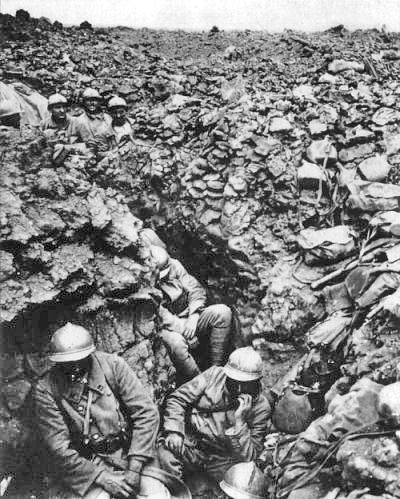
French soldiers of the 87th Regiment, 6th Division,
at Côte 304, (Hill 304), northwest of Verdun, 1916.
Public Domain image.
Note: Although this is not an anthology for children, it should be of interest to teens and teachers.  It could be particularly useful in meeting Common Core State Standards by combining art, poetry, history, and nonfiction.
Today is Nonfiction Monday.
See all of today's nonfiction posts at the Nonfiction Monday blog.

Thursday, February 14, 2013

In the Shadow of Blackbirds - a review

There is no easy segue from yesterday's Captain Underpants review to today's In the Shadow of Blackbirds. I primarily review children's books.  This one is definitely for young adults.

Winters, Cat. 2013. In the Shadow of Blackbirds. New York: Amulet.
Advance Reader Copy supplied by NetGalley.


Through the windows, I watched the boys proceed to a line of green military trucks that waited rumbling alongside the curb. The recruits climbed one by one beneath the vehicles' canvas coverings with the precision of shiny bullets being loaded into a gun. The trucks would cart them off to their training camp, which was no doubt overrun with feverish, shivering flu victims. The boys who didn't fall ill would learn how to kill other young men who were probably arriving at a German train station in their Sunday-best clothing at that very moment. (From Chapter 2, "Aunt Eva and the Spirits")

The year is 1918, and 16-year-old Mary Shelly Black is on her way from Portland to San Diego to stay with her widowed 26-year-old aunt. Her mother is dead. Her father has recently been arrested - swept up in the anti-German immigrant frenzy that's sweeping the country.

The sign in front of the eatery claimed the place specialized in "Liberty Steaks," but that was simply paranoid speak for We don't want to call anything a name that sounds remotely German, like "hamburger." We're pro-American. We swear! (from Chapter 13, "Ugly Things")

Young men are eagerly enlisting to fight in the trenches of Europe, and amidst it all, the "Spanish flu" ravages the population - their flimsy gauze masks are no match for the deadly virus.

The businessmen in smart felt hats rode with me, probably on their lunch break. They buried their gauze-covered noses in the San Diego Union, and one of them felt the need to read the October influenza death tolls out loud. "Philadelphia: over eleven thousand dead and counting - just this month. Holy Moses! Boston: for thousand dead." The use of cold statistics to describe the loss of precious lives made me ill. (From Chapter 17, "Keep Your Nightmares to Yourself")
The bleak situation is made all the worse by her recent discovery that her dearest Stephen, the only bright spot in her sad existence in San Diego, has enlisted in the Army, not because he desires to fight and kill German soldiers, but to show love for his country and free himself from living under the same roof as his brother, a drug-addled, "spirit photographer,"

So this is war. The declaration changed Coronado and San Diego overnight. The men are all enlisting and everyone is hurrying to make sure we all look like real Americans. One of our neighbors held a bonfire in his backyard and invited everyone over to burn their foreign books. I stood at the back of the crowd and watched people destroy the fairy tales of Ludwig Tieck and the Brothers Grimm and the poetry of Goethe, Eichendorff, Rilke, and Hesse. They burned sheet music carrying the melodies of Bach, Strauss, Beethoven, and Wagner. Even Brahm's "Lullaby."
In the Shadow of Blackbirds takes a decidedly darker turn when Mary Shelly learns of Stephen's death in the trenches of Europe.  She attends his funeral, but something is very wrong.  She can hear him, she can feel his torment.  His spirit is not at rest; and amidst the horror of war and the flu pandemic, something else is terribly, terribly wrong.  Spirit photography and séances are commonplace as millions across the country yearn to connect with loved ones lost to war or disease; but Shelly is a girl of science, of rationalism - raised in a house of reason and education.  But how can science and reason explain the anguished pleas of her deceased love?

In The Shadow of Blackbirds is gripping historical fiction and Mary Shelly Black is a tragic yet strong protagonist. Containing some of the same themes as Avi's dark, Seer of Shadows (Harper Collins, 2008) (spirit photography, rationalism vs. spiritualism), In the Shadow of Blackbirds examines these themes as well as romantic love and post-traumatic stress syndrome. The setting (San Diego and nearby Coronado Island) and the juxtaposition of love and war, disease and science combine to offer a dark and gritty debut novel.  The descriptions of trench warfare and everyday life during the massive flu pandemic are gritty and graphic, reminiscent of Mary Hooper's novel of Europe's 17th century plague, At the Sign of the Sugared Plum (Bloomsbury, 2003). The fear of death is almost palpable, made even more so by the reader's knowledge that garlic amulets and gauze masks are powerless against the killer flu. To read In the Shadow of Blackbirds is to be immersed in a grim period of American history that at times, bears resemblance to our own.


From the Author's Note,

...the influenza pandemic of 1918 (this particular strain was known as the "Spanish flu" and the "Spanish Lady") killed at least twenty million people worldwide. (Some estimates run as high as more than one hundred million people killed." Add to that the fifteen million people who were killed as a result of World War I and you can see why the average life expectancy dropped to thrifty-nine years in 1918 - and why people craved seances and spirit photography. 

Note: If you've ever watched the classic Academy Award Best Picture, All Quiet on the Western Front (1930), this warning from Mary Shelly to her love will foreshadow and haunt,

 "Please stay safe. It's not everyone who has the patience to photograph a butterfly."


Period photographs of life during the influenza pandemic of 1918 available at these sites:


There are great resources of all kinds (music, vintage video footage and photos) at Cat Winters' site.

Here's the trailer, just released today at the Mod Podge Bookshelf. I wish it hinted at the book's rich historical detail.

Tuesday, February 8, 2011

Moon over Manifest

Vanderpool, Clare. 2010. Moon over Manifest. New York: Delacorte.

Moon over Manifest is this year's winner of the John Newbery Medal, "awarded annually by the Association for Library Service to Children, a division of the American Library Association, to the author of the most distinguished contribution to American literature for children."

I admit that, like many other librarians, I hadn't read it before it was announced the 2010 winner - but no matter, other librarians wiser than I had picked this stellar gem out of last year's mine full of gems.

...and I learned something about cover art.  For better or worse, I do pick books by their covers (I'm fond of quoting Mary Rose Wood from the Mysterious Howling, "all books are judged by their covers until they are read")  The minute I saw this cover, I loved it, but I didn't read it.  Why?  Because I thought that this winsome little Midwest gal in overalls might not appeal to my little East coast customers.  I thought I might be completely enamored by it, as I was with Ruth White's 2008 book, Little Audrey, and then disappointed when it didn't garner the attention that I'd hoped for.  Well, it looks like Abilene Tucker and her creator, Clare Vanderpool will get plenty of attention - and believe me, they deserve it.  Next time I'll follow my instincts.

Photographer, Richard Tuschman gets credit for the inviting cover art. Check out his original photo of "Abilene" on his blog, Richard Tuschman Images.


Manifest is not only the fictional location of the story, manifest (both the verb and the noun) are an integral part of the story.  Manifest,Kansas, the dry (Dust Bowl and Prohibition style dry) Midwest town is revealed, or made manifest, through the stories of its people, most of whose names can be found on the manifests of ships that passed through Ellis Island. 
 
The story begins in 1936, with Abilene Tucker arriving by train.  Her dad, a drifter, has uncharacteristcally sent her away for the summer - to Manifest, a town she knows only from stories her dad has told her as they've ridden the rails throughout the country.  She hops off the train about a half mile before the Manifest stop, reasoning that
it's best to get a look at a place before it gets a look at you. 
 Abilene has been to enough towns in her short life to know that there are certain "universals" - the rich kid in town that looks down on everyone, the poor kid, and so on.  But as she gets to know the people of Manifest and uncovers bits of their lives through old newspaper articles and a box of hidden mementos, she comes to a realization,
Maybe the world wasn't made of universals that could be summed up in neat little packages.  Maybe there were just people.  People who were tired and hurt and lonley and kind in their own way and their own time.

Abilene tries to figure out why her father has sent her Manifest.  When did he live here?  Why did he leave? Is he coming back? The answers come slowly, with the help of the Hungarian Woman, a diviner, a storyteller who breathes life into the Manifest of 1918, during the Great War, a Manifest run by a wealthy mine owner, a Manifest where the immigrant mine workers are intimidated and exploited.  Abilene uncovers Manifest's secrets (and her own) from Miss Sadie's Divining Parlor, from faded copies of "Hattie Mae's News Auxiliary," and from letters found in the memento box - letters from a boy named Ned fighting overseas, to his hometown friend, Jinx.

Moon Over Manifest begins with a cast of characters, both from 1918 and 1936, and switches from Abilene's first-person account of the events of 1936, to the diviner's stories of 1918 Manifest happenings.  Wartime correspondence from Ned to Jinx, and Hattie Mae's newsy column (along with the occasional advertisement for healing elixirs and such) fill in the blanks or corraborate the Hungarian Woman's stories. Different fonts and points of view are used to help the reader transition from the past to the present. 

Moon Over Manifest is a many-layered story of parental love, redemption, determination, and community. It's also a mystery, and the story of the ultimate con job.  And it can be funny, heartbreaking and pointed at the same time, as shown in this article from "Hattie Mae's News Auxiliary" following a cross burning at the German Fraternal Hall,
July 20, 1918
Since the recent unfortunate happening at the German Fraternal Hall, everyone has been on edge and the mood of the town has been somber.  It is unclear if the motive was the Germans' nationality or their attempt to organize at the mine.  Mr. Keufer says future meetings of the order have been postponed until further notice.
     It is in times like these that this news column cannot provide the needed comfort and solace.  But as I was instructed in my journalism correspondence course through Harper's Magazine, a good reporter must continue to do her job, even in the most trying of times.  These are certainly trying times.
     It has been one year since the first "Yanks" went overseas, and the country hoped they would be home by Christmas past.  However, our boys rally on.  The American Defense Society continues to push for abolishing Hun names in America. For example, changing sauerkraut to liberty cabbage and frankfurters to patriotic pups.  However, many folks in Manifest seem to think that a bit unnecessary.  Especially Mr. Hermann Keufer, who rather likes his name and does not consider himself or his sauerkraut to be a threat to national security.
     Many of the soliders from Camp Funston had a rought boat ride overseas and are still feeling indisposed with flu symptoms.  The army doctor says he's never seen such a fast-spreading outbreak but it should soon be under control.  The troops will be pleased to know that Velma T. has sent off more relief parcels with her newly concocted elixir.
     For Mrs. Larking, who hasnt' been feeling herself of late, the elixir went down fairly easy the day of the Women's Temperance League meeting.  After consuming nearly an entire bottle, she appeared to be feeling better, and although her rendition of "how Dry I am" was a little off tune and a somewhat surprising selection for the gathering, she did seem to have a healthy glow about her.  ...
Hattie Mae Harper
Reporter About Town
A wonderful book!  Highly recommended.
Listen to Clare Vanderpool explain the inspiration for Moon over Manifest, and read a short excerpt.

Browse inside

Tuesday, November 17, 2009

Truce


Murphy, Jim. 2009. Truce. New York: Scholastic.
"[I]f I had my way, some person in authority would proclaim that Christmas will not be celebrated this year....Enemy, Death, and a Christmas tree - they cannot live so close together." German Captain Rudolf Binding (from Truce)

Jim Murphy's Truce, tells the remarkable true story of the spontaneous truces that broke out all along the entrenched battle lines of Europe in December, 1914. It is estimated that tens of thousands of British, German and Belgian soldiers took part in the cease-fires that lasted, in some instances, for several weeks. More than a cessation of hostilities, the hiatus was almost joyful as soldiers fraternized with each other - singing, exchanging gifts, and taking photos.

In six chapters, Murphy provides ample background information to give meaning and context to the remarkable occurrence of the many spontaneous truces and celebrations. One chapter recounts enemy soldiers praying together, translating the sermon from English to German, and burying their dead in solemn ceremonies. In another instance, German and British soldiers sing Christmas carols, alternating verses, one in English, one in German, and then joining in Latin to sing Adeste Fideles.

The truces ended, not because the men desired to resume fighting, but rather, because they could no longer hold out against the will of their commanders.

The German High Command ... issued a terse order: "Commander Second Army directs that informal understandings with enemy are to cease. Officers ...allowing them are to be brought before a court-martial." In some areas, these orders had immediate results. British private Bernard Brookes was standing guard at midnight on December 25 when "our artillery sent over ... four shells of small caliber to let them know that the truce, at which the whole world would wonder, was ended, and it its place, Death and Bloodshed would once again reign supreme." The Germans countered with an artillery barrage of their own.

The award-winning, Murphy, has meticulously researched his topic, and includes a Timeline, Notes and Sources, More about World War I, an Index, and a wealth of photographs, maps, period art and newspapers. The Epilogue, while factual, is more editorial than informational in nature.

The text is large and sepia-toned, to match the many accompanying photographs. Photographs of the desolate and razor-wired No Man's Land and the hideous trench conditions offer a stark contrast to those of smiling enemy soldiers posing for posterity.

To read this story in the men's' own words, is both compelling and thought-provoking. Readers will not come away unaffected.

Best for ages 10 and up. Truce should be a Sibert Medal contender.

Thursday, September 17, 2009

Day of the Assassins

O’Brien, Johnny. 2009. Day of the Assassins. Somerville, MA: Templar.
Advance Reading Copy made available by LibraryThing

A dynamic mix of historical fiction, sci-fi, and adventure, Day of the Assassins is the first in a planned series of Jack Christie Novels, time-traveling adventures featuring teenager, Jack Christie, and his best friend, Angus.

Preparing for transfer . . .
14 . . . 13 . . . 12 . . .
Transfer initiating . . .

Suddenly the glass blast screen started to lower. Belstaff, no longer pinned to the ceiling, tumbled to the floor. He didn’t move. Jack stared numbly at the body of his teacher and felt bile rise in his throat again as a terrifying thought suddenly occurred to him – Belstaff might be dead.
Jack saw Johnstone look down at his injured colleague and then up at him inside the Taurus. When he saw his eyes, he knew that boarding the Taurus had been the right decision. All of those men had one thing on their mind as they rushed forward toward him.

3 . . . 2 . . . 1 . . .


With a story line that crosses time and space, Day of the Assassins thrusts Jack into a crucible of European history, Sarajevo, Austria-Hungary, on the eve of Archduke Franz Ferdinand’s visit. If Jack can thwart the assassination of the Archduke, can he save the lives of millions destined to die in World War I? Or will meddling in history create greater problems unforeseen? Tangled in the midst of a deadly philosophical imperative, Jack and Angus must decide.

Johnny O’Brien adds a unique spin to historical fiction, moving seamlessly between the present and past, and successfully marrying video game action sequences with thrilling episodes in history. The modern British setting and European historical venues add spice to this action-packed series debut, and the cover art is a perfect complement

An author’s note, photo, and historical background completed this ARC. A timeline and map are planned for the final bound version. The website notes that this book is suitable for age 8 and up. I think 10 and up would be a better recommendation.

Beneath the Waves - a review

As we read disturbing news accounts of dying manatees , environmental disasters caused by toxic waste, and ocean pollution on the scale of ...