Pages

Showing posts with label immigrants. Show all posts

Wednesday, April 18, 2018

Alpha: Abidjan to Paris - a review

As you if you read my blog often, you know that I occasionally post adult books in addition to children's literature.  This is a powerful graphic novel that is also suitable for young adults, and I think it deserves attention. 


Alpha: Abidjan to Paris
By Bessora
Illustrated by Barroux
Translated by Sarah Ardizzone
Bellevue Literary Press, 2018

Alpha: Abidjan to Paris is a tragic, graphic novel account of one man's attempt to flee a life of misery in Côte d'Ivoire and follow his wife and child to Paris. After numerous attempts to depart legally, Alpha discovers that the process to obtain a visa is corrupt and impossible for an impoverished man. He researches his options carefully and strikes out with a group of other would-be emigrants. Although he knows the trip will be dangerous, he is nevertheless hopeful that he will be reunited with his family and his relatives in France. He fancies himself an "adventurer." His first-person account of his "adventures" devolves into a living nightmare as the journey drags on with a constantly changing group of companions. The prose is simple, and the story is told without embellishment—there is no need for embellishment; the facts are gruesome enough,

"Very quickly, I learn to avoid the barricades. We stop a lot. Abebi is vomiting froth. She has no bile left. She's spitting bubbles of saliva. We've been on the road for nine hours, and we still haven't covered a hundred miles. Darkness falls. Perhaps Abebi will feel better tomorrow. Augustine sucks his fingers in silence. It's a cold night. We sleep huddled together, forming a sort of human radiator. We can't even make a fire—the smoke would betray us."


The illustrations—one or two panels per page, are also spare—mostly shades of black and greys with an occasional splash of color—Alpha's red shirt, the striped soccer jersey of an emigrant hoping to land in Spain and play for Barcelona, a flowered dress. The illustrations set a mood of haste and simplicity, appearing to be marker sketches - almost as if they could have been made on the journey.

An epilogue provides the outcome of the trip from Abidjan to Paris. It will be difficult to look upon the plight of any refugees without reflecting on Alpha's journey. This is a short and powerful, award-winning graphic novel.

Alpha: Abidjan to Paris resources:


 My copy of Alpha was provided by LibraryThing Early Reviewers.

Tuesday, July 5, 2016

Save Me A Seat - an audiobook review

Save Me a Seat
by Sarah Weeks and Gita Varadarajan
Read by Josh Hurley and Vikas Adam

This is a perfect middle grade novel for highlighting how easily one can mischaracterize another's words or actions.  It's also an inside look at the immigrant and disability experience.  Teachers, you should read this one and share it with your students!

I reviewed Save Me a Seat for AudioFile Magazine.  The book spans only five days in fifth grade, the first week of school at Einstein Elementary School in Hamilton, NJ.  Its sections are titled with the school lunch of the day —Chicken Fingers, Hamburgers, etc., and chapters alternate between Joe, a boy with auditory processing disorder (APD) and Ravi, a recent immigrant from India.  Both boys are targets of the school bully—Joe, because of his disability, and Ravi because of his heavily accented English (which he himself cannot hear) and his family's style of food, dress, and manners.

Although Ravi was a favored, top-ranked student in his native Bangalore, India, his accent and lack of knowledge about his new country land him in the resource room at Einstein Elementary.  Joe also visits the resource room to learn coping skills for his APD. Initially, Ravi views Joe with disdain —mistaking the outward signs of his disability for stupidity.

In each chapter, the boys recount the same scene, allowing the reader or listener to fully understand how our perception of an event is shaped by our cultural, family, and personal background.  I'm sure that the printed book is wonderful as well, but the use of dual narrators in the audiobook really hammers home the differing perspectives.


Read my complete review of Save Me a Seat for AudioFile Magazine here. (An audio excerpt is also available at the same link, however, it only features the character Ravi, read by Vikas Adam.)

Read other reviews of Save Me a Seat and an interview with the authors at Sarah Weeks' website. 

I recently began working in a library with many new Indian-American families, and reading Save Me a Seat was enlightening. The challenges involved in adapting to a new country are many and cannot be overlooked. I'm so glad I listened to this one!


http://weneeddiversebooks.org/

Friday, February 20, 2015

Echo: A Novel - a review

If this is how the year is starting out, it's going to be a banner year for middle-grade books.  First, Gordon Korman's Masterminds (more on that fantastic new thriller another day) and now Echo: A Novel.

Ryan, Pam Muñoz. 2015. Echo: A Novel. New York: Scholastic.

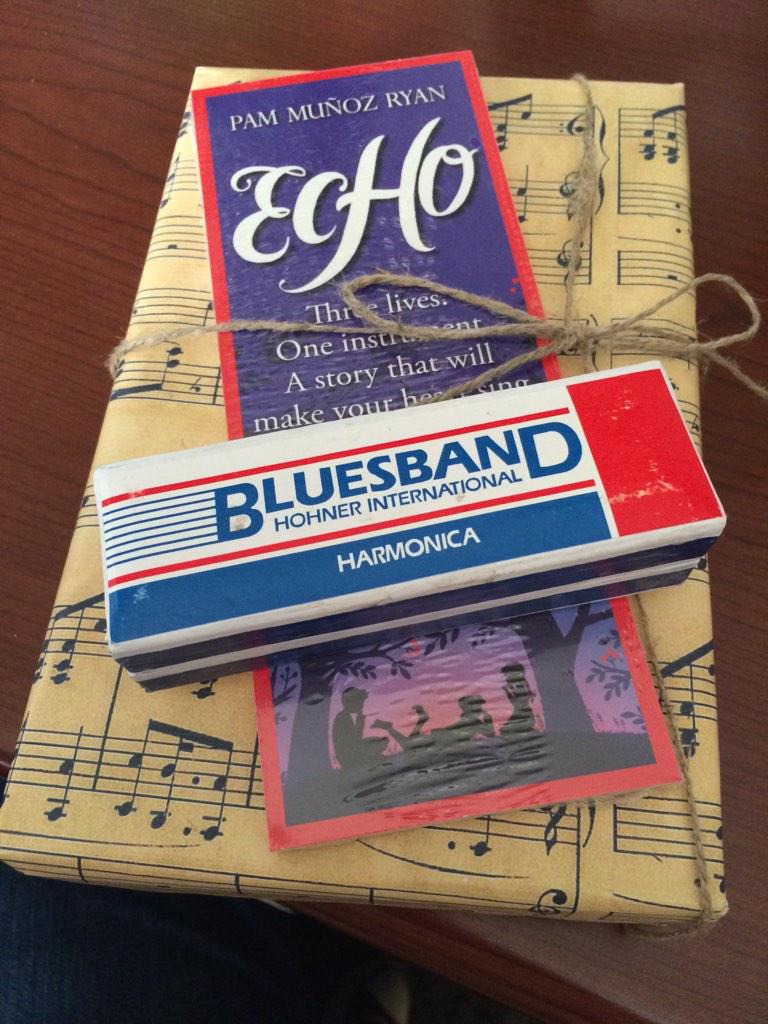
I received an Advance Reader Copy of Echo from Scholastic and was intrigued that it was wrapped in musical notation paper and had a smartly-boxed Hohner Blues Band harmonica tied to it.


I was happy to see an apparently music-related book, and was somewhat surprised to find that Echo begins with a fairytale, "The Thirteenth Harmonica of Otto Messenger," a fairytale replete with abandoned princesses, a magical forest, a mean-spirited witch, and a prophecy,

"Your fate is not yet sealed.  Even in the darkest night, a star will shine, a bell will chime, a path will be revealed."

Though brief, I became enthralled with the tale and was surprised and taken aback when I reached Part One and found myself not in the fairytale forest, but in

Trossingen, Baden-Württemberg, Germany, 1933, home to the world's oldest harmonica manufacturer.  I couldn't wait to find out what became of the abandoned princesses, but soon found myself wrapped up in the story of young Friedrich Schmidt, a German Jew during Hitler's ascendance to power.  This kind-hearted, young boy of a musical family was surely destined to be gathered up in the anti-Semitic wave sweeping through Germany. I became engrossed in Friedrich's story, anxiously hoping that things would work out for him and his family, and was again surprised when I reached Part Two and found myself in

Philadelphia, 1935, home of the then-famous Albert Hoxie and the Philadelphia Harmonica Band, and of the Bishop's Home for Friendless and Destitute Children, where I found myself in the company of piano-playing orphans, Mike and Frankie Flannery.  Their story was no less heart-wrenching than Friedrich's, and I found myself desperately rooting for the young boys when I suddenly arrived

in a migrant worker's community in Southern California, 1942, where young Ivy Maria Lopez was about to play her harmonica on the Colgate Family Hour radio show, but her excitement was short-lived.  I fell in with this hard-working, American family and hoped, along with Ivy, for her brother's safe return from the war.

Of course, there's more, but this is where I will leave off.

Pam Muñoz Ryan has written a positively masterful story that will take the reader from the realm of magic through the historical travails of the oppressed and the poor in the midst of the 20th century.  Through it all, music gathers the stories together in a symphony of hope and possibility.  In music, and in Echo, there is a magic that will fill your soul.

It may only be February, but I predict that praise for Echo will continue throughout the year.


On a library shelf near you - February 24, 2015.

Monday, November 17, 2014

The Paper Cowboy

Levine, Kristin. 2014. The Paper Cowboy. New York: Putnam.

In the seemingly idyllic, 1950s, town of Downers Grove, Illinois, handsome and popular 12-year-old Tommy Roberts appears to be a typical kid.  He lives with his parents, older sister Mary Lou, younger sisters Pinky and Susie, and a devoted family dog. He and his older sister attend Catholic school, his father works for Western Electric, and his mother stays at home with the younger girls.

Amidst the backdrop of the Red Scare and McCarthyism, Tommy's discovery of a Communist newspaper in the town's paper drive truck, and a horrific burn accident to Mary Lou, begin a chain of events that uncovers secrets, truths, and lies in his small town populated with many Eastern European immigrants.

Perhaps the biggest lie is Tommy's own life.  Though he never gets caught, Tommy is a bully, picking on kids at school, especially Little Skinny. When he plants the Communist newspaper in a store owned by Little Skinny's immigrant father, he's gone too far - and he knows it.  Now it's time to act like his cowboy hero, The Lone Ranger, and make everything right, but where can he turn for help?  His mother is "moody" and beats him relentlessly while his father turns a blind eye. His older sister will be hospitalized for months. He has his chores and schoolwork to do, and Mary Lou's paper route, and if Mom's in a mood, he's caretaker for Pinky and Susie as well.

It's hard to understand a bully, even harder to like one, but readers will come to understand Tommy and root for redemption for him and his family.  He will find help where he least expects it.

     I couldn't tell Mrs. Glazov about the dinner party. Or planting the paper.  But maybe I could tell her about taking the candy.  Maybe that would help.  "There's this boy at school, I said slowly, "Little Skinny."
.....
     "I didn't like him.  I don't like him.  Sometimes, Eddie and I and the choirboys, we tease him."
     "Ahh," she said again.  "He laugh too?"
     I shook my head.  I knew what Mary Lou would say.  Shame on you, Tommy! Picking on that poor boy.  And now she would have scars just like him.  How would I feel if someone picked on her?
     "What did you do?" Mrs. Glazov asked, her voice soft, like a priest at confession.  It surprised me. I'd never heard her sound so gentle.
     "I took some candy from him," I admitted.
     "You stole it."
     I shrugged.
     "Ahh."
     "It's not my fault! If Mary Lou had been there, I never would have done it!"
     Mrs. Glazov laughed.  "You don't need sister.  You need conscience."
     I had the horrible feeling that she was right.  I wasn't a cowboy at all. I was an outlaw.
Author Kristin Levine gives credit to her father and many 1950s residents of Downers Grove who shared their personal stories with her for The Paper Cowboy. Armed with their honesty and openness, she has crafted an intensely personal story that accurately reflects the mores of the 1950s.  We seldom have the opportunity (or the desire) to know everything that goes on behind the doors of our neighbors' houses.  Levine opens the doors of Downers Grove to reveal alcoholism, mental illness, abuse, disease, sorrow, and loneliness. It is this stark realism that makes the conclusion so satisfying.  This is not a breezy read with a tidy and miraculous wrap-up.  It is instead, a tribute to community, to ordinary people faced with extraordinary problems, to the human ability to survive and overcome and change.

Give this book to your good readers - the ones who want a book to stay with them a while after they've finished it.


Kristin Levine is also the author of The Lions of Little Rock (2012, Putnam) which I reviewed here.

Thursday, April 10, 2014

Picture Book Roundup - Wordless edition

It's been ages since I've done a picture book roundup!  Here are two wordless masterpieces.

  • Becker, Aaron. 2013. Journey. Somerville, MA: Candlewick.
A Harold and the Purple Crayon for a new generation.  Beautiful!


  • Kim, Patti. 2014. Here I Am. North Mankato, MN: Capstone Press. 
An insightful story of a young boy's experience in emigrating from Asia to the United States.


Monday, August 5, 2013

Angel Island: Gateway to Gold Mountain - a review


Freedman, Russell. 2014. Angel Island: Gateway to Gold Mountain. New York: Clarion.
(Advance Reader Copy)

Many of us, especially here on the East Coast, are familiar with stories of immigrants passing through the inspection station at Ellis Island in New Jersey. (Yes, folks, it is in New Jersey. The Supreme Court of the United States has said so.)  Less familiar are the stories of Asian immigrants who arrived and were processed or detained at Angel Island in San Francisco Bay.

  • Title: Immigration station, Angel Island, Cal.
  • Related Names: 
       Givens, J. D. (James David), 1863- , copyright claimant
  • Date Created/Published: c1915.
  • Reproduction Number: LC-DIG-ds-03059 (digital file from original item) LC-USZ62-125996 (b&w film copy neg.)
  • Rights Advisory: No known restrictions on publication.
  • Repository: Library of Congress Prints and Photographs Division Washington, D.C. 20540 USA
Thanks to the efforts of Park Ranger Alexander Weiss and an encouraging librarian, Russell Freedman has brought the stories of these Angel Island immigrants and the story of the Immigration Station's preservation to young readers in this brief, yet powerful, image-filled book.

When the buildings on Angel Island were falling into disrepair and slated for demolition in the 1970's, Alexander Weiss found rows and rows of poetry, much of it written in Chinese characters undecipherable to him, etched into the walls of the island's detention center.  Convinced of the historical significance of these poems, he brought them to the attention of Chinese community leaders in San Francisco, and so began a movement to retain the buildings as landmarks of cultural and historical significance.  Many of the poems were translated and included in the book,

Oh, poor me, Banned from landing,
     fearful of being deported back to China.
There is no way for me to face the elders east of the river.
I anticipated wealth, but it's only poverty, alas, that I've
     reaped.
Because of exclusionary laws, Chinese immigrants faced particularly intense scrutiny and interrogation, sometimes even questioning about the location of household items left in China! Answers were then checked against those of relatives to test for truthfulness.

Angel Island contains nine chapters, beginning with the discovery of the carvings by the park ranger, continuing with typical experiences of the immigrants and the notation of important laws and political events affecting immigrants, and finishing with a look at Angel Island State Park today.

Hundreds of thousands of immigrants, mostly Chinese, passed through Angel Island Immigration Station.  This is their story that deserves to be told.  

The final copy will have Source Notes, Selected Bibliography, Acknowledgments, Picture Credits and Index. Keep an eye out for its 2014 publication date.

A perfect fictional pairing for Angel Island: Gateway to Gold Mountain is Laurence Yep's,The Dragon's Child: A Story of Angel Island (2008, Harper Collins).


The Nonfiction Monday roundup is here today!  
Add your post to the form below, and I'll add them later in the day after work. Thanks for participating.

And don't forget - there's still time to enter the giveaway for an autographed copy of The Bear Hug by Sean Callahan. See Saturday's post for the online entry form.

Thanks to all of today's Nonfiction Monday contributors!  Be sure to check out these posts:


Jeanne at True Tales & a Cherry on Top, is featuring Write On, Mercy! The Secret Life of Mercy Otis Warren.  Jeanne just attended an SCBWI conference and felt inspired to feature a picture book biography of a female writer.  Write on, Jeanne!


At NC Teacher Stuff, Jeff has a review of No Monkeys, No Chocolate. "This is an interesting and informative account of how the cocoa tree produces cocoa beans for chocolate."  Thanks, Jeff, however, after reading your review, I think I now know a little too much about what's involved in the life of a cocoa bean! 


Sue, at Sally's Bookshelf, has Noisy Bug Sing-Along. "Summer is one huge concert of chirps, buzzes, hums and thrums. Who wouldn't want to sing along with the bugs?"  As this year is a 17-year cicada hatch in my area, there's been a lot of "singing!"


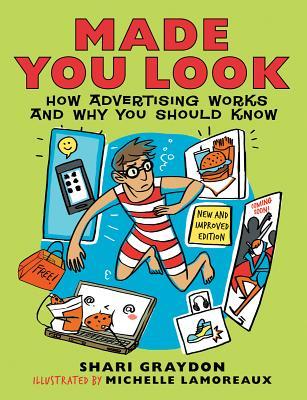
Made You Look is a featured book at Ms. Yingling Reads.This is a narrative nonfiction book for older readers. "This updated book on advertising includes helpful information on internet and social media advertising."  

Alex at Randomly Reading has a review of Lifetime: The Amazing Number in Animal Lives, a "counting book using different behaviors or features of animals in the wild."  Thanks, Alex.  I love the cover!


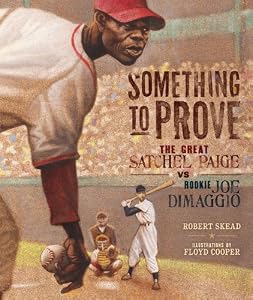
At Booktalking, Anastasia (our Nonfiction Monday organizer extraordinaire) features a picture book biography for older readers, Something to Prove: The Great Satchel Paige vs. Rookie Joe DiMaggio.  Baseball history - one of my favorite topics!


Wrapped in Foil's, Roberta, has a book on another of my favorite topics - space.  Beyond the Solar System: Exploring Galaxies, Black Holes, Alien Planets, and More is a "great book that ties history and astronomy with hands-on activities, perfect to share with the upcoming Perseid meteor shower."

(Don't miss the Perseid meteor showers coming up on the 11th and 12th of this month!)


At Jean Little Library, Jennifer has a review of the narrative nonfiction book, The Mystery of Darwin's Frog.


At A Mom's Spare Time (is there such a thing as a mom's spare time?), Ami has a picture book for young readers, A Little Book of Sloth.  No one will be able to resist that cover, and my teenage daughter tells me that sloths are the new hip animal. They do seem to popping up where they're least expected!  (How long before they get their own pistachio commercial?)


Sondy at Sonder Books has a review of Hoop Genius: How a Desperate Teacher and a Rowdy Gym Class Invented Basketball.  A picture book biography for young readers, Hoop Genius is a fun look at the invention of basketball.

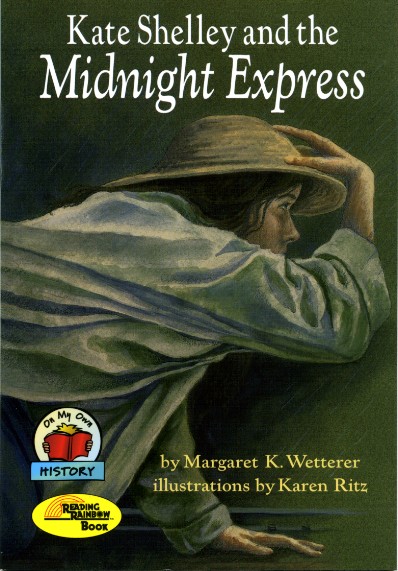
At Stacking Books, Reshama has a review of Kate Shelley and the Midnight Express, "a true story of a brave 15 year old girl, Kate Shelley, who saved lives in a raging storm by risking her own life when a railroad bridge collapsed."  


It's a wrap!   Thanks to everyone who participated!

Wednesday, April 6, 2011

April picture book roundup

It's been a while since I've done a picture book roundup and they've been piling up on my desk.  Here are a few new favorites:

Mayer, Mercer. 2011. Octopus Soup. Tarrytown, NY: Marshall Cavendish.


Wordless and wonderful!  Find out how Octopus escapes the chef's pot! Too funny!
(Look inside)


Yaccarino, Dan. 2011. All the Way to America: the Story of a Big Italian Family and a Little Shovel. New York: Knopf.
When Dan grew up, he married Helen.  These are my grandparents.  Together Dan and Helen opened a market.  They sold all sorts of wonderful Italian food.  Now the little shovel belonged to Dan, and he used it to measure out beans, macaroni, and olives.
Dan Yaccarino's personal tale of immigration and tradition.  A perfect introduction to genealogy, and a great choice for this summer's reading theme of One World, Many Stories.

Watt, Melanie. 2011. You're Finally Here! New York: Hyperion.
This hilarious book has been waiting for you, and it's about time you showed up!


Pfister, Marcus. 2011. Questions, Questions. New York: NorthSouth.

Simple, thoughtful and artistic.  Guaranteed to elicit questions.
How do birds learn how to sing? What brings summer after spring? What turns leaves from green to brown and sends them floating gently down?
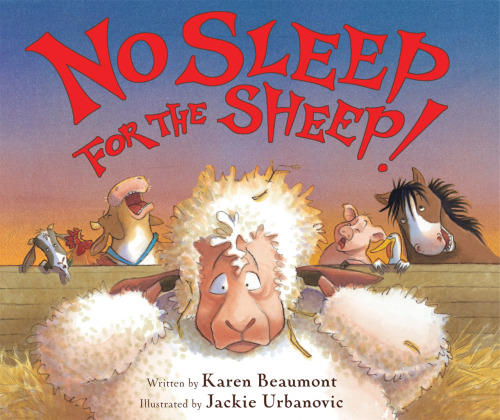
Beaumont, Karen. 2011. No Sleep for the Sheep! Ill. by Jackie Urbanovic. New York: Harcourt.

Get ready for a long night -
In the big red barn on the farm, on the farm, in the big red barn on the farm... A sheep fell asleep in the big red barn, in the big red barn on the farm. Then there came a loud QUACK at the door, at the door, and the sheep couldn't sleep any more.
 Rhyming and repetitive, this one is sure-fire fun!

Hartt-Sussman, Heather. 2011. Noni Says No. Ill. by Genevieve Cote. Plattsburgh, NY: Tundra.

For every child who has ever agreed to do something, go somewhere, share something, or play with someone, when she really wanted to say no.  An empowering book for the kind and gentle child who always says yes.
(My daughter was this child.  I sympathize.)

Monday, February 21, 2011

Batter up! Baseball book reviews

Opening day for the 2011 baseball season is March 31. (not that I'm counting or anything) Informed of my fondness for America's Pastime, Sleeping Bear Press sent me their spring baseball offerings.

First up,

Michelson, Richard. 2011. Lipman Pike: America's First Home Run King. Ill. by Zachary Pullen. Ann Arbor, MI: Sleeping Bear.

Everyone is familiar with Babe Ruth, but Lipman Pike has hardly been a household name.  Nevertheless, he was America's first home run king, and arguably, its first professional ball player.  Born in 1845 to Jewish immigrants from Holland, Lipman Pike joined the amateur National Association of Base Ball Players.  He became a star, playing for teams in New Jersey and New York.  However, more than just the story of his baseball career, Lipman Pike, is also a glimpse into society, politics, and daily life in Civil War era America.  The game of base ball was so popular at the time that even the infamous Boss Tweed was involved,
He joined the New Jersey Irvingtons until a man named Boss Tweed invited him to play closer to home.  Lip was excited because the New York Mutuals were one of the best clubs in the league.

"Of course, we can't pay you, " Boss Tweed explained.  "That would be against Base Ball Association policy, and as New York's Commissioner of Public Works, I would never break the rules."  He waved Lip closer so he could whisper.  "But I can offer you a job in our government office at Tammany Hall.  You would have little work to do and plenty of time to play ball."

Of course, many players were paid, and the league went professional soon after, in 1871.  Throughout his career, Lipman Pike was known as a gentleman as well as a slugger.

Follow-up information on Lipman's career and life, and an author's note complete the book, but no sources are offered.  The illustrations and primarily brown text on sepia-toned pages firmly establish the story in the mid 19th century.  Zachary Pullen's illustrations feature over sized heads with great detail and expression. An interesting picture book biography for older readers and baseball fans in general. How I wish that more teachers would accept picture books for middle grade biography projects.  In any case, this one could easily be shared in school, relating to units on biography or immigration.
Teacher's Guide available here.
On shelves now.

Herzog, Brad. I Spy with my Little Eye: Baseball. Ill. by David Milne. Ann Arbor, MI: Sleeping Bear.

Each double-spread, mirror (or is it?) illustration features an "I spy" rhyme,
I spy with my little eye, a colorful cardboard collection. Pennants switch places, cards get new faces, and a Tiger changes direction.

along with a baseball-related Photo Fact, and a challenge to spot the differences on the two pages.  A great gift for baseball fans, and a great way to pass the time on trips, doctor visits, etc.  I love "I spy!"

On shelves now.

also by Brad Herzog,

Little Baseball

A small board book with baseball riddles,
Give yourself a great big hand.  It's where a batted ball might land.

Answer: Baseball glove.

This will make a fun and interactive book to share at storytime.  The riddles are difficult enough so that kids won't guess them right away, but not hard enough to be frustrating.

My only frustration is the fact that this will be published in board book format. I wouldn't hand this one to a toddler - too difficult.  This seems to be a trend with many publishers lately. We can no longer count on board books to be simple, concept offerings. Still, this is a fun book with catchy rhymes and upbeat illustrations.
 
Due on shelves in April.
 
Review copies were galley proofs, not final copies.

Today's Nonfiction Monday is at Three Turtles and Their Pet Librarian.

Tuesday, February 8, 2011

Moon over Manifest

Vanderpool, Clare. 2010. Moon over Manifest. New York: Delacorte.

Moon over Manifest is this year's winner of the John Newbery Medal, "awarded annually by the Association for Library Service to Children, a division of the American Library Association, to the author of the most distinguished contribution to American literature for children."

I admit that, like many other librarians, I hadn't read it before it was announced the 2010 winner - but no matter, other librarians wiser than I had picked this stellar gem out of last year's mine full of gems.

...and I learned something about cover art.  For better or worse, I do pick books by their covers (I'm fond of quoting Mary Rose Wood from the Mysterious Howling, "all books are judged by their covers until they are read")  The minute I saw this cover, I loved it, but I didn't read it.  Why?  Because I thought that this winsome little Midwest gal in overalls might not appeal to my little East coast customers.  I thought I might be completely enamored by it, as I was with Ruth White's 2008 book, Little Audrey, and then disappointed when it didn't garner the attention that I'd hoped for.  Well, it looks like Abilene Tucker and her creator, Clare Vanderpool will get plenty of attention - and believe me, they deserve it.  Next time I'll follow my instincts.

Photographer, Richard Tuschman gets credit for the inviting cover art. Check out his original photo of "Abilene" on his blog, Richard Tuschman Images.


Manifest is not only the fictional location of the story, manifest (both the verb and the noun) are an integral part of the story.  Manifest,Kansas, the dry (Dust Bowl and Prohibition style dry) Midwest town is revealed, or made manifest, through the stories of its people, most of whose names can be found on the manifests of ships that passed through Ellis Island. 
 
The story begins in 1936, with Abilene Tucker arriving by train.  Her dad, a drifter, has uncharacteristcally sent her away for the summer - to Manifest, a town she knows only from stories her dad has told her as they've ridden the rails throughout the country.  She hops off the train about a half mile before the Manifest stop, reasoning that
it's best to get a look at a place before it gets a look at you. 
 Abilene has been to enough towns in her short life to know that there are certain "universals" - the rich kid in town that looks down on everyone, the poor kid, and so on.  But as she gets to know the people of Manifest and uncovers bits of their lives through old newspaper articles and a box of hidden mementos, she comes to a realization,
Maybe the world wasn't made of universals that could be summed up in neat little packages.  Maybe there were just people.  People who were tired and hurt and lonley and kind in their own way and their own time.

Abilene tries to figure out why her father has sent her Manifest.  When did he live here?  Why did he leave? Is he coming back? The answers come slowly, with the help of the Hungarian Woman, a diviner, a storyteller who breathes life into the Manifest of 1918, during the Great War, a Manifest run by a wealthy mine owner, a Manifest where the immigrant mine workers are intimidated and exploited.  Abilene uncovers Manifest's secrets (and her own) from Miss Sadie's Divining Parlor, from faded copies of "Hattie Mae's News Auxiliary," and from letters found in the memento box - letters from a boy named Ned fighting overseas, to his hometown friend, Jinx.

Moon Over Manifest begins with a cast of characters, both from 1918 and 1936, and switches from Abilene's first-person account of the events of 1936, to the diviner's stories of 1918 Manifest happenings.  Wartime correspondence from Ned to Jinx, and Hattie Mae's newsy column (along with the occasional advertisement for healing elixirs and such) fill in the blanks or corraborate the Hungarian Woman's stories. Different fonts and points of view are used to help the reader transition from the past to the present. 

Moon Over Manifest is a many-layered story of parental love, redemption, determination, and community. It's also a mystery, and the story of the ultimate con job.  And it can be funny, heartbreaking and pointed at the same time, as shown in this article from "Hattie Mae's News Auxiliary" following a cross burning at the German Fraternal Hall,
July 20, 1918
Since the recent unfortunate happening at the German Fraternal Hall, everyone has been on edge and the mood of the town has been somber.  It is unclear if the motive was the Germans' nationality or their attempt to organize at the mine.  Mr. Keufer says future meetings of the order have been postponed until further notice.
     It is in times like these that this news column cannot provide the needed comfort and solace.  But as I was instructed in my journalism correspondence course through Harper's Magazine, a good reporter must continue to do her job, even in the most trying of times.  These are certainly trying times.
     It has been one year since the first "Yanks" went overseas, and the country hoped they would be home by Christmas past.  However, our boys rally on.  The American Defense Society continues to push for abolishing Hun names in America. For example, changing sauerkraut to liberty cabbage and frankfurters to patriotic pups.  However, many folks in Manifest seem to think that a bit unnecessary.  Especially Mr. Hermann Keufer, who rather likes his name and does not consider himself or his sauerkraut to be a threat to national security.
     Many of the soliders from Camp Funston had a rought boat ride overseas and are still feeling indisposed with flu symptoms.  The army doctor says he's never seen such a fast-spreading outbreak but it should soon be under control.  The troops will be pleased to know that Velma T. has sent off more relief parcels with her newly concocted elixir.
     For Mrs. Larking, who hasnt' been feeling herself of late, the elixir went down fairly easy the day of the Women's Temperance League meeting.  After consuming nearly an entire bottle, she appeared to be feeling better, and although her rendition of "how Dry I am" was a little off tune and a somewhat surprising selection for the gathering, she did seem to have a healthy glow about her.  ...
Hattie Mae Harper
Reporter About Town
A wonderful book!  Highly recommended.
Listen to Clare Vanderpool explain the inspiration for Moon over Manifest, and read a short excerpt.

Browse inside

Beneath the Waves - a review

As we read disturbing news accounts of dying manatees , environmental disasters caused by toxic waste, and ocean pollution on the scale of ...