Pages

Showing posts with label orphans. Show all posts

Friday, February 20, 2015

Echo: A Novel - a review

If this is how the year is starting out, it's going to be a banner year for middle-grade books.  First, Gordon Korman's Masterminds (more on that fantastic new thriller another day) and now Echo: A Novel.

Ryan, Pam Muñoz. 2015. Echo: A Novel. New York: Scholastic.

I received an Advance Reader Copy of Echo from Scholastic and was intrigued that it was wrapped in musical notation paper and had a smartly-boxed Hohner Blues Band harmonica tied to it.


I was happy to see an apparently music-related book, and was somewhat surprised to find that Echo begins with a fairytale, "The Thirteenth Harmonica of Otto Messenger," a fairytale replete with abandoned princesses, a magical forest, a mean-spirited witch, and a prophecy,

"Your fate is not yet sealed.  Even in the darkest night, a star will shine, a bell will chime, a path will be revealed."

Though brief, I became enthralled with the tale and was surprised and taken aback when I reached Part One and found myself not in the fairytale forest, but in

Trossingen, Baden-Württemberg, Germany, 1933, home to the world's oldest harmonica manufacturer.  I couldn't wait to find out what became of the abandoned princesses, but soon found myself wrapped up in the story of young Friedrich Schmidt, a German Jew during Hitler's ascendance to power.  This kind-hearted, young boy of a musical family was surely destined to be gathered up in the anti-Semitic wave sweeping through Germany. I became engrossed in Friedrich's story, anxiously hoping that things would work out for him and his family, and was again surprised when I reached Part Two and found myself in

Philadelphia, 1935, home of the then-famous Albert Hoxie and the Philadelphia Harmonica Band, and of the Bishop's Home for Friendless and Destitute Children, where I found myself in the company of piano-playing orphans, Mike and Frankie Flannery.  Their story was no less heart-wrenching than Friedrich's, and I found myself desperately rooting for the young boys when I suddenly arrived

in a migrant worker's community in Southern California, 1942, where young Ivy Maria Lopez was about to play her harmonica on the Colgate Family Hour radio show, but her excitement was short-lived.  I fell in with this hard-working, American family and hoped, along with Ivy, for her brother's safe return from the war.

Of course, there's more, but this is where I will leave off.

Pam Muñoz Ryan has written a positively masterful story that will take the reader from the realm of magic through the historical travails of the oppressed and the poor in the midst of the 20th century.  Through it all, music gathers the stories together in a symphony of hope and possibility.  In music, and in Echo, there is a magic that will fill your soul.

It may only be February, but I predict that praise for Echo will continue throughout the year.
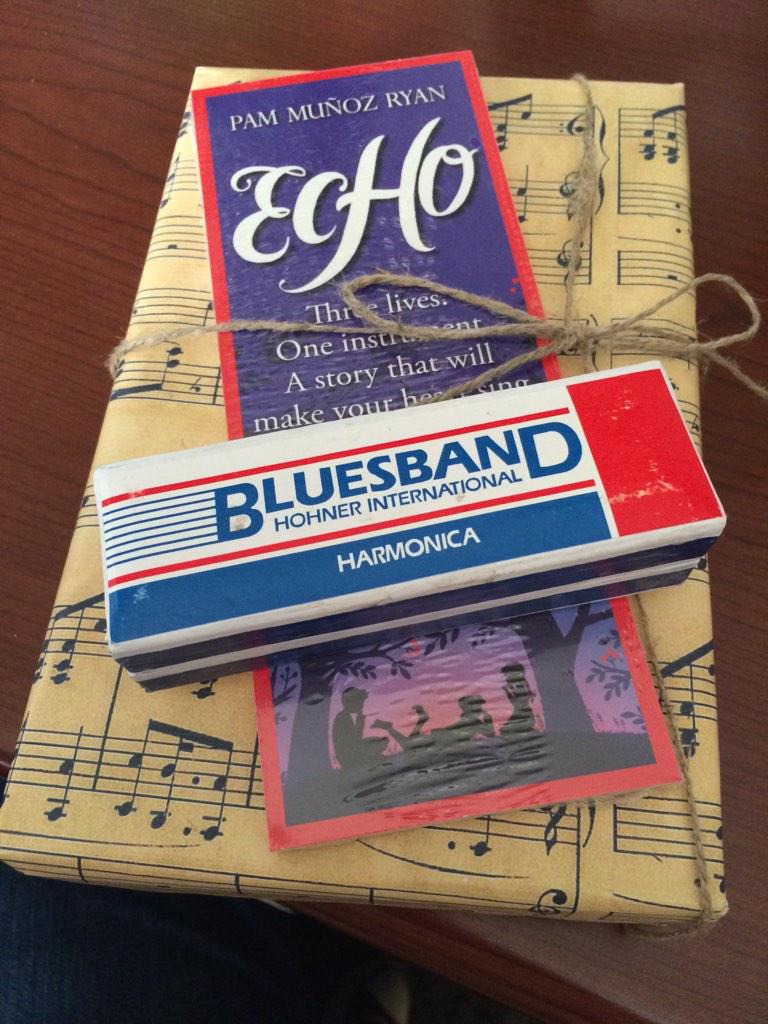

On a library shelf near you - February 24, 2015.

Wednesday, March 5, 2014

The Night Gardener - a review

A short review today.  I rushed to finish, as I knew the kids in my book club would surely want to get their hands on it last week.  I was right.

Auxier, Jonathan. 2014. The Night Gardener. New York: Amulet.

Set in England aground the 1840s, The Night Gardener features an Irish gal with the gift of  blarney, her10-year-old brother with a lame leg and stout heart, a mysterious storyteller, and a strange family inhabiting a creepy mansion on an island in the middle of the sourwoods.

Separated from their parents and forced to flee Ireland due to famine, Molly & Kip have no choice but to accept employment with the Windsor Family, the only inhabitants of the only home in the sourwoods,

At the far end of the lawn stood Windsor mansion.  The house had obviously been left vacant for some years, and in that time it seemed to have become one with the landscape. Weeds swallowed the base. Ivy choked the walls and windows. The roof was sagging and covered in black moss.
But strangest of all was the tree.
The tree was enormous and looked very, very old. Most trees cast an air of quiet dignity over their surrounding. This one did not. Most trees invite you to climb up into their canopy.  This one did not. Most trees make you want to carve your initials into the trunk. This one did not. To stand in the shadow of this tree would send a chill through your whole body. 
Even Molly's indomitable spirit and knack for storytelling cannot shield Kip and the young Windsor children from the horrors that lurk within the shadow of the giant tree.

Historical fiction and horror intertwine in this absolutely gripping story. With similarities to Claire LeGrand's The Cavendish Home for Boys and Girls, The Night Gardener is the stuff of nightmares.

Coming to a bookshelf near you in May, 2014!


Notes:

My Advance Reader Copy was thrust upon me by none other than the wonderfully funny, Tom Angleberger (of Origami Yoda fame), who insisted that I read it.  Thanks, Tom!

Also by Jonathan Auxier, Peter Nimble and His Fantastic Eyes, which I reviewed in 2011.

The book's cover was drawn by Patrick Arrasmith and designed by the talented Chad Beckerman, whom I had the pleasure of interviewing a while back.

Monday, January 13, 2014

A Long Walk to Water - an audiobook review


I first reviewed Linda Sue Park's, A Long Walk to Water in 2010.  At the time, I wrote:
In an interview, author Linda Sue Park says that this was an easy book to write because she let Salva's story speak for itself.  Linda Sue Park gave Salva's powerful story a voice. Brief and straightforward, A Long Walk to Water is inspiring for its truth and simplicity.  Park eschews sentimentalism and allows Salva's understated dignity, perseverance and virtue to awe the reader.  No embellishment is necessary. This is a compelling story.  Highly recommended.
Recently, I was offered the opportunity to review the new audiobook version of A Long Walk to Water.  It was my pleasure. Following is my starred review of the audiobook as it appeared in the January, 2014, edition of School Library Journal.


A Long Walk to Water. By Linda Sue Park. 3 CDs. 2:45 hrs. Full Cast Audio. 2013. ISBN 9781936223121. $34.

Gr 5–9 -- Differentiated, African-inspired chapter introduction music assists in delivering this parallel story of two very different, but equally difficult, lives in Sudan. The story alternates between Nya, a composite character based on the lives of real girls, in 2008, and Salva, a young boy in the war-torn Sudan of 1985. Nya's life consists of the grueling and monotonous task of hauling water. All day, every day, her task is finding, acquiring, and transporting brown, dirty water to meet her family's needs. Salva's story unfolds in the midst of a horrific civil war. Separated from everything and everyone he knows, he spends more than 15 years walking across Sudan, Ethiopia, and Kenya, living in refugee camps, and struggling to survive. His is a true story based on the experiences of one of the "lost boys of Sudan." An echo effect is used to highlight the nagging questions that are always in the forefront of Salva's mind, "When will I see my family again?" and "What will become of me?" Readers David Baker and Cynthia Bishop worked with a dialect coach to ensure authenticity in pronunciation and accents. An update on Salva's ongoing project follows the story. Listeners will not ever leave the tap water running without thinking of this powerful story.

##

Copyright © 2013 Library Journals, LLC, a wholly owned subsidiary of Media Source, Inc.
 Reprinted with permission.


Note:
Amazon.com offers a free audio excerpt on the book's product page: http://www.amazon.com/A-Long-Walk-to-Water/dp/B00GJ6LE6S

It is heartbreaking to think that the tribal violence between the Dinka and Nuer that precipitated Salva's tortuous years of exile back in 1983, has erupted again in South Sudan, the world's newest country.

Friday, October 11, 2013

A Tangle of Knots - a review

Graff, Lisa. 2013. A Tangle of Knots. New York: Philomel.

A travelling salesman with a Talent for tying knots. "The Owner," a man with no discernible Talent of his own, other than perhaps floating a few inches above the ground. Miss Mallory, who has a Talent for matching orphans with new families. And Cadence,

If you peeked in the window of the orphanage you would see her,

"Cadence, that was her name.
She was standing there now, Cady, deciding what to add to her bowl of batter.  If you squinted through the window, you could just make her out from the chin up (Cady was barely a wisp of a thing). You'd see the shiny, crow-black hair that hung smooth as paper from the top of her head to the bottom of her earlobes.  And you'd see the petite - pixieish, Miss Mallory called them - features of her face.  Tiny nose, tiny mouth, tiny ears.  Cady's eyes, however, those were large in comparison to the rest of her.  Large and dark and round, and set just so on a face the color of a leaf that has clung too long to its tree."

Cady has a Talent for baking the perfect cake.

A chance encounter in a long ago bus station,  a powder blue suitcase, a boy with a Talent for getting lost - these and hundreds of other threads are tangled together, and slowly unravel to reveal a mystery of love and longing and desire and family. A wonderful book!

If you read no other middle grade fiction book this year, you will have made a good choice.

Saturday, August 24, 2013

Three Times Lucky - an audiobook review

Turnage, Sheila. 2012. Three Times Lucky. New York: Penguin Audio. Read by Michal Friedman.

I was looking for a good book to listen to while traveling, and I had heard rave reviews about the 2013 Newbery Honor book, Three Times Lucky.  It features North Carolina, the latest addition to my college road trip cycle, and it comes in Playaway format - how convenient since I've misplaced my mp3 player. I picked up a copy from the library before heading out.

This was the best book that I've listened to all year!  I can't tell you the number of times that I had to pause the recording, chuckling all the while, to repeat a well-turned simile or metaphor to my daughter.  If I had the print copy in hand, I could quote you a dozen - just in the first chapter.

Rising sixth grader, Mo (short for Moses) LoBeau is the funniest, winningest, spunkiest heroine of children's literature that I've met in quite a while.  By the time you've finished Three Times Lucky, you'll know every resident of Tupelo Landing, North Carolina, as well as if they were your own relations. Robbery, snobbery, lies, domestic violence, and alcoholism rear their heads as they do in every community; but despite some heavy-hitting themes, this modern-day, first person narrative is not "contemporary realistic fiction," but rather a delightfully funny, quirky murder mystery, and the story of a loving family, best friends, and a close-knit community. And oh yes, there's a hurricane.

I think you'll love it.  Suggested for ages 10 and up.

Do listen to an audio excerpt of Three Times Lucky here.  You'll love it!

Note:
After reading the book and looking for more information on its fantastic reader, Michal Friedman, I discovered that she died in 2011, from complications from a Cesarean section after giving birth to healthy twins. Heartbreaking and tragic.

Thursday, July 11, 2013

Horrors of History: City of the Dead - a review

Anderson, T. Neill. 2013. Horrors of History: City of the Dead. New York: Charlesbridge.

City of the Dead is gripping historical fiction that strays very little from historical accounts of the Galveston Hurricane of 1900. In ten chapters, T. Neill Anderson chronicles the unnamed hurricane from the dawn of its approach to the dawn of its passing. Employing fictional and actual persons of the time, the story unfolds from various points of view and parts of town - alternating between the orphans and sisters of the beachfront St. Mary's Orphanage, which had only three actual survivors, the inhabitants of the Lucas Terrace Apartments* located several blocks from the beach on the north side of town, Dr. Samuel Young in his sturdy home closer to the center of town, and Charlie, an African American laborer. Neill added Charlie's ordeal to the story to reflect the racial diversity that existed in Galveston at the time but is not reflected in the written annals of the storm.

The circumstances and dialogue are invented,

"It's a good thing we stooped by the grocery store last night," Alice muttered. There were almost twenty people in the parlor now -- they had all fled their houses when the flooding had become too great.The increasingly shrill cries of the cats reverberated through the living room,

But the photos, maps, and important details are real and accurate. A Prologue, Epilogue, and Author's Note put the story into context. Photo Credits are also included.


From the Epilogue:
Even to this day the Galveston hurricane of September 8, 1900, remains the deadliest natural disaster in the history of the United States.  Approximately eight thousand men, women, and children lost their lives -- in other words, about one in six Galvestonians are believed to have died, either in the hurricane or in the flood that followed.

City of the Dead: Galveston Hurricane, 1900, is the first  in the new  Horrors of History series, created for readers from age 11 - 14. Gripping, compelling and tragic, City of the Dead debuts in August, 2013.

  • * Title: Lucas Terrace under which 51 people lie buried, Galveston
  • Summary: Remnants of multi-story building, bricks and lumber strewn in the wake of the 1900 hurricane and flood, Galveston, Texas.
  • Reproduction Number: LC-USZ62-123884 (b&w film copy neg. of right half stereo)
  • Rights Advisory: No known restrictions on publication.
  • Repository: Library of Congress Prints and Photographs Division Washington, D.C. 20540 USA

Note:

Adult readers interested in this topic may enjoy Isaac's Storm (Random House, 2000), a true account of the disaster, the politics of weather, and of U.S. Weather Meteorologist and hurricane survivor, Isaac Cline, stationed in Galveston at the time of the hurricane. Sadly, weather politics exists today as well as one can see from the competing information provided by European and American hurricane tracking models.  A USA Today article on the deficiencies of the US model in predicting Hurricane Sandy may be found here.

Also of interest is the National Hurricane Center's page on the history of tropical cyclone naming.  In 1900, at the time of the Galveston Hurricane, it was not customary to name hurricanes.  That practice was officially adopted in the United States in 1953.

Wednesday, October 24, 2012

The Great Unexpected - a review

Creech, Sharon. 2012. The Great Unexpected.  New York: Harper Collins.

Many things are unexpected in The Great Unexpected, but none more so than the dead boy's body that drops from a tree, nearly landing on Naomi Deane, who notes,

Leaves have fallen on me, and twigs, and a branch during a storm.  Bird slop, of course, everyone gets that.  But a body?  That is not your usual thing dropping out of a tree.

(after some time, the body talked)

And as the body opened his eyes and slowly looked up and looked all around - at the meadow, at the cows in the distance, at the tree out of which he had fallen, and at me, and then he yelled, "Oh no!" and fell back on the ground and his eyes closed and he was dead again.
 
(Hear it read by Sharon Creech)


Unexpected, indeed! The boy, in fact, is Finn, a mysterious, young, flirtatious boy about 12-years-old, with whom Naomi and her best friend, Lizzie, are smitten. 

Half of the story takes place in the small indeterminate town of Blackbird Tree, where many "unfortunate souls," reside - including Naomi and Lizzie - both orphans, "Witch Wiggins," "Crazy Cora," Mr. Canner, and the huge and unruly clan of Dimmenses.  Naomi narrates the story with a generous helping of Sharon Creech's delightfully descriptive prose, as in this description of the newcomer, "the Dingle-Dangle Man,"

His head jerked slightly to the left and then to the right, like a bird on a worm prowl.
 
Or in this depiction of Witch Wiggins' house,

If you had to guess which house a witch lived in, this would be it.  The house tilted to one side, as if eavesdropping on its neighbor.
The other half of the story takes places in Rook's Orchard, Ireland.  The connection between the two towns is also unexpected, and early in the book, unexplained.  The Rook's Orchard chapter names are prefaced with "Across the Ocean," and contain a third person narrative of the activities of a certain Sybil Kavanaugh, her constant companion, Miss Pilpenny, and Mr. Dingle (known stateside as "the Dingle-Dangle Man").

The Great Unexpected is a story of possibility, of friendship, of first loves, and the nature of true love.  Many things are unexpected, and if we greet them with open arms, and there is a hint of magic in the air, who knows what may happen.

Delightful and quirky and highly recommended.
The Great Unexpected by Sharon Creech

Wednesday, March 28, 2012

The Midnight Zoo - a review

My review of The Midnight Zoo  (as it appeared in the March 2012 edition of SLJ)

The Midnight Zoo (unabr.). 4 CDs. 4.33 hrs. Prod. by Bolinda Audio. Dist. by Brilliance Audio. 2011. ISBN 978-1-7428-5126-6. $49.97.

Gr 7–10-- Like a 20th-century version of Avi's Crispin, who fled across 14th-century England, 12-year-old Andrej is without parents and adrift in Europe during World War II with his younger brother, Tomas, and infant sister in tow. Without destination or an understanding of the war that has divided them from their nomadic Roma clan, the siblings travel by night and sleep by day, sensing danger at every juncture. Andrej scavenges for their food and necessities for the baby. One moon-drenched evening, the trio arrives at a zoo in the ruins of a bombed village. They encounter a menagerie of talking animals, trapped in zoo cages with neither keeper nor keys. Throughout a surreal evening, the boys and animals share life stories. Through the animals, Andrej and Tomas begin to understand the nature of man and war. This understanding, however, offers more questions than answers. Richard Aspel's, rich and sonorous voice creates memorable characterizations for the many humans and animals in Sonya Harnett's novel (Candlewick, 2011), including German-speaking soldiers; his Aussie pronunciation requires a keen ear. Listeners who persevere will be rewarded with a stellar performance. With some aspects of fable, minimal dialogue, and heavy use of allegory, this artfully crafted look at the character of man and the concept of freedom may have limited popular appeal.

Copyright © 2012 Library Journals, LLC, a wholly owned subsidiary of Media Source, Inc. Reprinted with permission.


Thursday, August 11, 2011

Peter Nimble and His Fantastic Eyes

Auxier, Jonathan. 2011. Peter Nimble and His Fantastic Eyes. New York: Amulet.

(Advance Reader Copy provided by the publisher and signed in New Orleans by the young, very friendly, and tall Jonathan Auxier. Some lucky young reader will be the recipient of this great new book!)

A sightless, orphan boy under the control of a heartless man, the Dickensian Peter Nimble uses his remarkable senses to survive, becoming as unseen as he is sightless - a master of thievery, lock picking, diversion, filching, clipping and pilfering.  It is a mean and demeaning life until the day he steals an elaborately guarded, locked and fortified box containing three sets of eyes - eyes which catapult him into a strange and fantastic journey to the spaces that have heretofore been left blank upon the maps of the world.  His destiny is a quest for the Vanished Kingdom. To accomplish his mission, he has only his new companion, the part feline/part equine/part human Sir Tode (a most miserably enchanted knight), an unfinished riddle, his burgle-sack, and of course, the Fantastic Eyes.

The language of Peter Nimble is the straightforward language of action and adventure, which is not to say that this book is simple or unsophisticated. In fact, the plot has many twists with depth equal to the cruel mines of the Vanished Kingdom. There is some obvious foreshadowing, but this may be a planned device, offering the reader a sense of accomplishment while following this exciting adventure as it changes perspective when new characters enter and expand the story.

As Peter Nimble is blind, the reader depends upon the narrator and good Sir Tode to set the visual scene. Peter's view of the world is colored, so to speak, by his other senses.  He tells the time of day by the "feel" of the sun or moon.  He can "smell the dew percolating up from the ground."  He can judge the size of a chamber or hall by the echo of voices or machinery. But he cannot do it all alone, and enlists the help of the loyal Sir Tode, a fish, thieves, a raven, and "the Princess," in a fierce battle to aid the author of the riddle,
Kings aplenty, princes few,
The ravens scattered and seas withdrew.
Only a stranger may bring relief,
But darkness will reign, unless he's --
For ages 10 and up, readers of Peter Nimble and His Fantastic Eyes can expect some violence and even death (no quest is without danger!), but Peter and his allies are up to the challenge, and when they falter, they are reminded,
There are times when Justice demands from us more than we would give.
A satisfying and captivating debut novel that certainly leaves open the possibility of future adventures. (Read more about that in this BookPage interview with author, Jonathan Auxier.) A treat for fans of action, adventure, magic and fantasy!

(I love the cover art!)
True story: I have never encountered the word sternutation before reading Peter Nimble and His Fantastic Eyes. After looking it up, I shared my discovery with my family that evening only to have my son tell me that he, too, had learned the word sternutation that day - from a Snapple cap!  A strange coincidence to be sure!

Other reviews @
Shelf-awareness
Fuse #8

Tuesday, November 9, 2010

A Long Walk to Water

Park, Linda Sue. 2010. A Long Walk to Water. New York: Clarion.

A Long Walk to Water begins as the parallel stories of Salva, a young boy in the Southern Sudan of 1985 and Nya, a young Sudanese girl in the year 2008. 

Salva once had the life of a well-to-do villager's son.  His father owned many cows.  He attended school. He herded the cows.  But when the rebels arrived, shooting at everyone in the village, his life changed in an instant.  Now he is alone.  Get to the next hill, the next watering hole, the next day.  This is the mantra that keeps him going, one painful step at a time, searching for years for a safe haven - across deserts, war zones and countries.

Nya's life consists of providing water for her family.  When the brackish pond is full, she walks hours each day - first to the pond to collect water, then  home, carrying a full container upon her head.  After a quick meal of thin gruel, she has enough time for a second trip.  During the months when the pond is dry, her family relocates to a temporary shelter near a dry lake bed.  The work is easier there.  Nya spends all day digging in the mud, waiting for subterranean water to fill the hole she has dug with her bare hands.  She scoops out the water, one gourd full at a time and waits for the hole to refill.  It is tedious work and takes all day, but at least she does not have to walk for miles in the heat with the heavy water atop her head.

Park's minimal use of dialogue fits the stark landscape and mood of the story,
The nurse, a white woman, was talking to Nya's mother. "Her sickness came from the water," the nurse explained.  "She should drink only good clean water.  If the water is dirty, you should boil it for a count of two hundred before she drinks it."

Nya's mother nodded that she understood, but Nya could see the worry in her eyes.

The water from the holes in the lakebed could be collected only in tiny amounts.  If her mother tried to boil such a small amount, the pot would be dry long before they could count to two hundred.
Nothing else needs to be said.  How can a mother choose between dehydration and cholera for her children? 

As Salva's arduous journey continues, the years add on until Park has woven his story from the Sudanese Civil War years into the modern day Sudan of Nyla's time, of our time.  Sudan is Africa's largest country, full of wildlife and riches and oil and beauty and war and poverty and genocide and starvation. The reader can sense that the two stories will intertwine, but is at first, unsure how. When it becomes apparent how the lives of Salva and Nyla will intersect, it almost unbelievable, considering the circumstances.  And yet, their stories are true. Despite the overwhelming odds against Salva's survival, and Nyla's fragile subsistence existence, they do survive.

Salva, after more than ten years of wandering becomes one of the Lost Boys of Sudan, miraculously chosen from the untold tens of thousands of people in Kenyan refugee camps- chosen to start a new life in the United States.  And with his new life, he returns to repair his old one.

In an interview, author Linda Sue Park says that this was an easy book to write because she let Salva's story speak for itself.  Linda Sue Park gave Salva's powerful story a voice. Brief and straightforward, A Long Walk to Water is inspiring for its truth and simplicity.  Park eschews sentimentalism and allows Salva's understated dignity, perseverance and virtue to awe the reader.  No embellishment is necessary. This is a compelling story.  Highly recommended.

Review copy provided by NetGalley. Due on shelves, November 15, 2010.

 Linda Sue Park talks about A Long Walk to Water.


Watch Salva and see the work of his creation, the non-profit, Water for Sudan.


The November 2010 edition of National Geographic Magazine offers two feature articles on Sudan, "Sudan's Shaky Peace" and "The Lost Herds are Found."  Both are well worth reading.
Share |

Sunday, March 14, 2010

The Incorrigible Children of Ashton Place: The Mysterious Howling

Wood, Maryrose. 2010. The Mysterious Howling. New York: Harper Collins.

"All books are judged by their covers until they are read."
A most appropriate quote from Agatha Swanburne, founder of the Swanburne Academy for Poor Bright Females, from which our protagonist, 15-year-old Penelope Lumley, has recently graduated.  An appropriate quote for it was the cover that initially drew me in to this story of Miss Lumley and the peculiar inhabitants of Ashton Place.

Although only fifteen, Miss Penelope Lumley is an extremely capable young lady, in the mold of Mary Poppins or any number of similar governesses that one might find in mid-nineteenth century England - firm, but not inflexible; kind but not sentimental.  Still, her rigorous training could hardly have been preparation for her new position at Ashton Place. Lord Ashton is a puzzling man with curious habits and a strange sense of humor, Lady Constance Ashton is a flighty, excitable woman, and the children (if one may call them children) are three siblings that have apparently been raised by wolves in the wild and forbidding Ashton Forest.  Of course, this does not pose a problem for the capable Miss Lumley; however, there are many unexplained mysteries afoot. Who wishes to sabotoge the children's transition into civilized society?  What secret is Mr. Ashton hiding?  What secrets lie hidden with Ashton Place? What became of the children's parents (and for that matter, of Miss Lumley's parents as well!)? 

Consistently written in a style that evokes the sensibilities of England in the 1850s, Wood's writing is amusing as well and contains frequent helpful "asides" from the narrator.
Now there is a scientific principle that states: Once a train has left the station and is going along at a good clip, it is often fiendishly difficult to slam on the brakes, even if you are clearly headed for trouble (the same holds true for horses that have already left their barns).  This principle is Newton's very first law of motion and was considered old news even in Miss Penelope Lumley's day.
   Penelope had taken physics at Swanburne and, thus, knew all about Newton's laws of motion. Still, she felt that a final, desperate, and heroic attempt to change the course of events that now led inexorably and disatrously to the children attending Lady Constance's party seemed called for, and so she gave it her all.
    "Lady Constance, your plans for a holiday ball sound delightful, and I am sure the children would hate to miss it," she began, "but coincidentally, I was intending to ask you if I may take them on a ski holiday in France until after the New Year..."
   To give you an idea how final, desperate, and heroic this suggestion was, it should be noted that Penelope had never skied in her life, nor had she ever been to France that she could recall, nor did she know precisely where one might ski in France.  However, she assumed that any country with so sterling a reputation must be equipped with mountains somewhere; the rest of the information she knew she could easily find in an encyclopedia.

It's difficult not to admire Miss Lumley; and her young wolfish charges, Alexander, Beowulf, and Cassiopeia, adore her. You will too.

Finally, a word on series, as this is the first book in the new series, The Incorrigible Children of Ashton Place:
I always approach a series with trepidation.  There are so many outcomes possible - will I gain years of enjoyment and then a melancholy wistfulness as the series draws to a close as in Harry Potter?  Will I invest time and enthusiasm only to be left waiting interminably, as in The Abarat? Will I be interested enough in the outcome but lack the ambition to keep up, as in The 39 Clues?  Will I read only one installment and feel satisfied that I have enough feeling and understanding for the series to promote it as in Baby Mouse?  The jury is still out on The Incorrigible Children of Ashton Place.  The cover drew me in, but it is the confident Miss Penelope Lumley that may convince me to stay.

A reading guide is available from the publisher.

Friday, January 8, 2010

The Unfinished Angel

Creech, Sharon. 2009. The Unfinished Angel. New York: Harper Collins.
(a booktalk)

Highly recommended.

Monday, May 12, 2008

Locomotion

Woodson, Jacqueline. 2003. Locomotion. New York: Penguin.

I got to know this book better than I had planned. I was going to assist in a book discussion group for teens and young adults with varying and diverse abilities. They had chosen this book for their discussion and we were initially unable to secure enough copies. I showed up for the meeting without having ever read the book - as the group leader had our only copy.

Having read Jacqueline Woodson before, and being familiar with other books in verse gave me the confidence to proceed. I printed out some discussion questions from the author’s website and headed off to the meeting. It was decided that I would read the book aloud for the first week until we were able to procure enough copies. I read each poem slowly and deliberately, in what I hoped was the spirit of eleven-year-old, Lonnie Collins Motion, a young boy who has lost his parents in a fire and been separated from his younger sister – each sent to a different foster home. The book is written in verse, but is different that other free verse novels. Because of his fondness for poetry and his teacher, Miss Marcus, Lonnie tells his story in many types of verse – from haikus to sonnets. In addition to being an excellent YA novel, Locomotion is a study in verse and an introduction to the poet, Langston Hughes.

We read as far as the poem “How I Got My Name,” stopping to discuss each poem. I can’t say enough about what a perfect choice this book is for this type of group discussion! The teens were open and expressive and very receptive. Locomotion clearly speaks to young people. I had a vague idea that at a future meeting it might be fun to play the Little Eva song from which Lonnie, Locomotion, got his name. Surprisingly, the kids thought of the idea before I even mentioned it! By the end of the meeting, we were all singing the song together. It was a great evening!

I read the rest of the book at home, alone – and I missed the teens and young adults. Their insights and comments added to Woodson’s story in a way that was touching and uplifting. Later in the book, the story becomes more than just a boy struggling to overcome the loss of his parents. It becomes a story of the war, of Miss Edna’s true sons, of the new boy in Lonnie’s school struggling to fit in, of Eric’s sickle-cell anemia, of Lili’s search for God, of LaTenya’s disability, and on and on. At first, I resented the turn away from Lonnie’s story and introduction of so many tangential subplots; and then I realized that that is what makes Locomotion so real, so compelling. Life is not just about us, and it doesn’t go as planned, it just goes. And Lonnie goes along with it, spilling out his story in verse,

“and making the lines into pictures in your mind
And in the picture the people are
laughing and frowning and
eating and reading and
playing ball and skipping along and

spinning themselves into poetry.

This book was a National Book Award finalist, an ALA Notable Book, a Coretta Scott King Award Honor Book, and a Boston Globe/Horn Book Award Honor Book.

Beneath the Waves - a review

As we read disturbing news accounts of dying manatees , environmental disasters caused by toxic waste, and ocean pollution on the scale of ...