Pages

Showing posts with label harmonicas. Show all posts

Tuesday, December 19, 2017

Clayton Byrd Goes Underground - a review

Clayton Byrd Goes Underground
by Rita Williams-Garcia
Harper Collins, 2017

Cool Papa Byrd was Clayton's grandfather, his best friend, his musical muse, and the coolest electric blues guitar player in Washington Square Park.  Without him, Clayton was a discordant jumble of sorrow and loneliness.

"Everyone saw Clayton leave the school with his mother.  Some had even laughed at him and teased him about the whipping he had coming.

Clayton wasn't worried about a whipping.  His mother wasn't the whipping kind.  She'd take away his treasures first, the things he loved, and the things he loved to do.  But she didn't believe in whipping.  She did, however, believe in scolding.

Clayton's mother scolded from the time they left the school to the time she drove home to the time they got in the house.  Even when she wasn't out-and-out scolding, she spoke in scolding tones, In you-know-betters, what's-gotten-into-yous.  She said over and over, 'Your grandfather's passing is no excuse for this behavior.'

Clayton remained silent through the scolding. He couldn't tell her what was wrong even if he wanted to. He didn't understand it all himself. Even if he could tell her, she would only blame Cool Papa, and Clayton was tired of her being angry at the person he loved the most. He said nothing.'
Clayton Byrd Goes Underground is Clayton's journey through the blues.  Rita Williams-Garcia infuses this story of family grief, anger, and reconciliation with the bluesy notes of Clayton's harmonica, the smooth sounds of Cool Papa Byrd and his group, the Bluesmen, and a ragtag band of hip-hop street performers who ply their trade in New York's subway system.  No slow-starter here—Clayton Byrd Goes Underground grabs the reader from the pickup note.

I read this in one sitting.  Because of its brevity and musical connection, this would be a perfect middle-grade book for an in-school project collaboration between music and language arts teachers.  Queue some blues on your favorite music streaming service and get yourself in the mood for this award-winning book.


Awards for Clayton Byrd Goes Underground include:
National Book Award Finalist * Kirkus Best Books of 2017 * Horn Book Best Books of 2017 * Publishers Weekly Best Books of 2017 * School Library Journal Best Books of 2017 * NAACP Image Awards Nominee * Chicago Public Library Best Books * A Boston Globe Best Book of 2017


Note: If you want to hear some awesome blues harp, listen to the Led Zeppelin version of "When the Levee Breaks." (originally recorded in 1929 by Kansas Joe McCoy and Memphis Minnie)

Friday, February 20, 2015

Echo: A Novel - a review

If this is how the year is starting out, it's going to be a banner year for middle-grade books.  First, Gordon Korman's Masterminds (more on that fantastic new thriller another day) and now Echo: A Novel.

Ryan, Pam Muñoz. 2015. Echo: A Novel. New York: Scholastic.

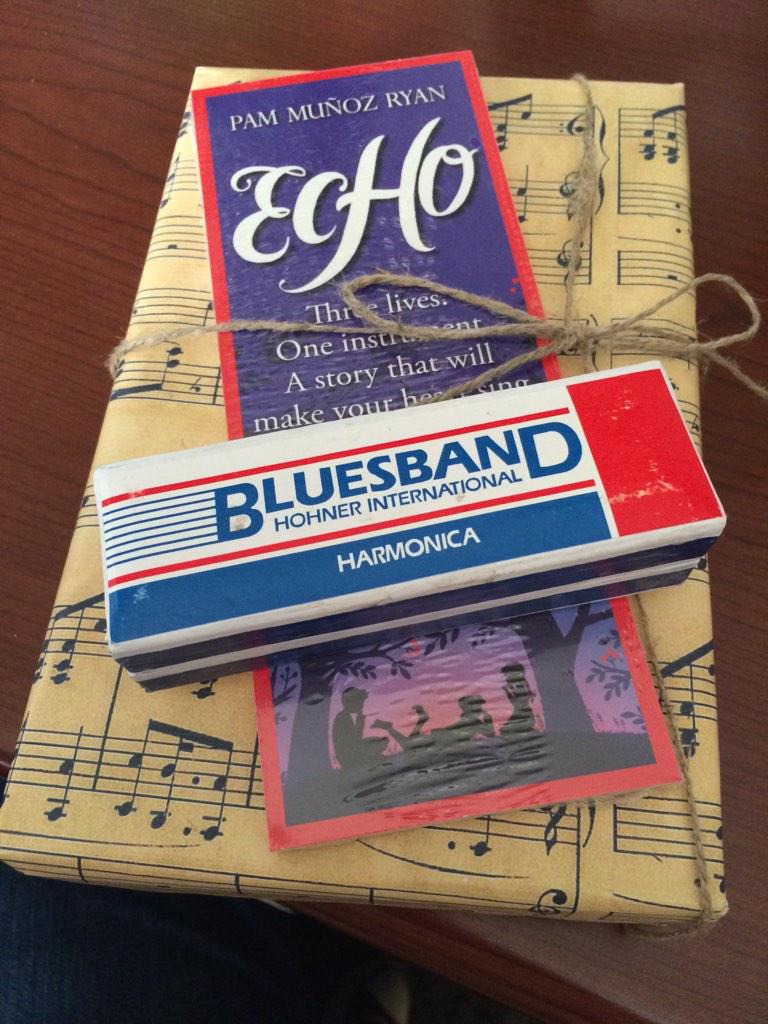
I received an Advance Reader Copy of Echo from Scholastic and was intrigued that it was wrapped in musical notation paper and had a smartly-boxed Hohner Blues Band harmonica tied to it.


I was happy to see an apparently music-related book, and was somewhat surprised to find that Echo begins with a fairytale, "The Thirteenth Harmonica of Otto Messenger," a fairytale replete with abandoned princesses, a magical forest, a mean-spirited witch, and a prophecy,

"Your fate is not yet sealed.  Even in the darkest night, a star will shine, a bell will chime, a path will be revealed."

Though brief, I became enthralled with the tale and was surprised and taken aback when I reached Part One and found myself not in the fairytale forest, but in

Trossingen, Baden-Württemberg, Germany, 1933, home to the world's oldest harmonica manufacturer.  I couldn't wait to find out what became of the abandoned princesses, but soon found myself wrapped up in the story of young Friedrich Schmidt, a German Jew during Hitler's ascendance to power.  This kind-hearted, young boy of a musical family was surely destined to be gathered up in the anti-Semitic wave sweeping through Germany. I became engrossed in Friedrich's story, anxiously hoping that things would work out for him and his family, and was again surprised when I reached Part Two and found myself in

Philadelphia, 1935, home of the then-famous Albert Hoxie and the Philadelphia Harmonica Band, and of the Bishop's Home for Friendless and Destitute Children, where I found myself in the company of piano-playing orphans, Mike and Frankie Flannery.  Their story was no less heart-wrenching than Friedrich's, and I found myself desperately rooting for the young boys when I suddenly arrived

in a migrant worker's community in Southern California, 1942, where young Ivy Maria Lopez was about to play her harmonica on the Colgate Family Hour radio show, but her excitement was short-lived.  I fell in with this hard-working, American family and hoped, along with Ivy, for her brother's safe return from the war.

Of course, there's more, but this is where I will leave off.

Pam Muñoz Ryan has written a positively masterful story that will take the reader from the realm of magic through the historical travails of the oppressed and the poor in the midst of the 20th century.  Through it all, music gathers the stories together in a symphony of hope and possibility.  In music, and in Echo, there is a magic that will fill your soul.

It may only be February, but I predict that praise for Echo will continue throughout the year.


On a library shelf near you - February 24, 2015.

Beneath the Waves - a review

As we read disturbing news accounts of dying manatees , environmental disasters caused by toxic waste, and ocean pollution on the scale of ...