Pages

Showing posts with label Nazi Germany. Show all posts

Thursday, December 15, 2016

The Nazi Hunters - an audiobook review

The Nazi Hunters: How a Team of Spies and Survivors Captured the World's Most Notorious Nazi
by Neal Bascomb
Read by Jason Culp
Scholastic Audiobooks, 2016

I reviewed this book for AudioFile Magazine, and it's the recipient of an Earphones Award.The Nazi Hunters chronicles the 16-year ordeal to capture the notorious Nazi, Adolf Eichmann. Narrator Jason Culp conveys a palpable sense of the fear and tension endured in dangerous and fraught circumstances.


My complete review of The Nazi Hunters for AudioFile Magazine is here.

Want to see the 2016 Best Audiobooks list as selected by AudioFile Magazine?  You can receive free access to the complete guide and enter their contest for 6 months of free audiobooks.  The guide is a great resource if you're in collection development with some budget money left over! Click here for details.  The contest ends tomorrow!

Friday, February 20, 2015

Echo: A Novel - a review

If this is how the year is starting out, it's going to be a banner year for middle-grade books.  First, Gordon Korman's Masterminds (more on that fantastic new thriller another day) and now Echo: A Novel.

Ryan, Pam Muñoz. 2015. Echo: A Novel. New York: Scholastic.

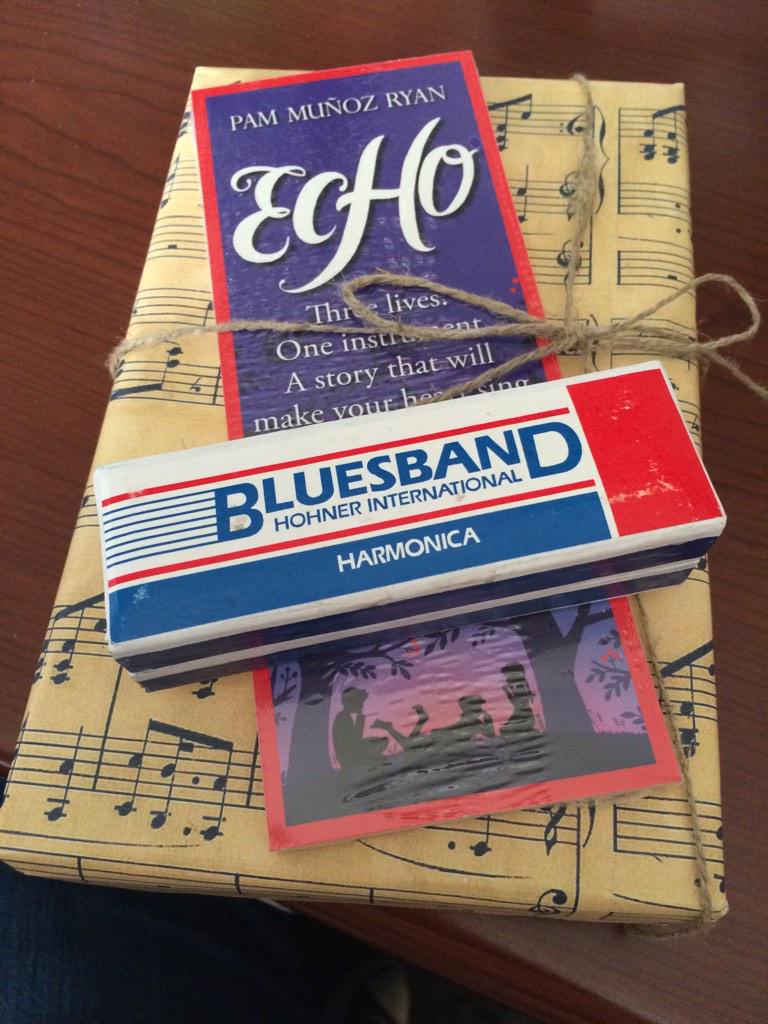
I received an Advance Reader Copy of Echo from Scholastic and was intrigued that it was wrapped in musical notation paper and had a smartly-boxed Hohner Blues Band harmonica tied to it.


I was happy to see an apparently music-related book, and was somewhat surprised to find that Echo begins with a fairytale, "The Thirteenth Harmonica of Otto Messenger," a fairytale replete with abandoned princesses, a magical forest, a mean-spirited witch, and a prophecy,

"Your fate is not yet sealed.  Even in the darkest night, a star will shine, a bell will chime, a path will be revealed."

Though brief, I became enthralled with the tale and was surprised and taken aback when I reached Part One and found myself not in the fairytale forest, but in

Trossingen, Baden-Württemberg, Germany, 1933, home to the world's oldest harmonica manufacturer.  I couldn't wait to find out what became of the abandoned princesses, but soon found myself wrapped up in the story of young Friedrich Schmidt, a German Jew during Hitler's ascendance to power.  This kind-hearted, young boy of a musical family was surely destined to be gathered up in the anti-Semitic wave sweeping through Germany. I became engrossed in Friedrich's story, anxiously hoping that things would work out for him and his family, and was again surprised when I reached Part Two and found myself in

Philadelphia, 1935, home of the then-famous Albert Hoxie and the Philadelphia Harmonica Band, and of the Bishop's Home for Friendless and Destitute Children, where I found myself in the company of piano-playing orphans, Mike and Frankie Flannery.  Their story was no less heart-wrenching than Friedrich's, and I found myself desperately rooting for the young boys when I suddenly arrived

in a migrant worker's community in Southern California, 1942, where young Ivy Maria Lopez was about to play her harmonica on the Colgate Family Hour radio show, but her excitement was short-lived.  I fell in with this hard-working, American family and hoped, along with Ivy, for her brother's safe return from the war.

Of course, there's more, but this is where I will leave off.

Pam Muñoz Ryan has written a positively masterful story that will take the reader from the realm of magic through the historical travails of the oppressed and the poor in the midst of the 20th century.  Through it all, music gathers the stories together in a symphony of hope and possibility.  In music, and in Echo, there is a magic that will fill your soul.

It may only be February, but I predict that praise for Echo will continue throughout the year.


On a library shelf near you - February 24, 2015.

Monday, February 24, 2014

The Boy on the Wooden Box - an audiobook review

Below is my starred review of The Boy on the Wooden Box: How the Impossible Became Possible on Schindler's List, as it appeared in the February, 2014, edition of School Library Journal.


LYESON, Leon. The Boy on the Wooden Box: How the Impossible Became Possible … on Schindler's List. 4 CDs. 4:15 hrs. Recorded Books. 2013. $46.75 ISBN 9781470369439. Playaway. Digital download.

Gr 4-9--In an intimate look at one family on Oskar Schindler's famous "list," Leyson's (born Leib Lezjon) memoir (S & S, 2013) begins with his earliest memories of his poor but idyllic life in a Polish village. His large Jewish family was short on money, but never on love or a sense of purpose and belonging. They eventually move to Krakow, a city that Leib finds enchanting. When the Nazis invade, however, life becomes desperate for the 10-year-old protagonist, his parents, sister, and three brothers. By sheer happenstance, Leib's father becomes a worker for Schindler, beginning a chain of improbable events that leads to Leib's survival, despite pogroms, ghettos, and Nazi work camps. Young Leib's feelings of fear, dread, and despondency are relayed simply. Narrator Danny Burstein speaks in decorous, measured tones, yet sounds conversational. The words have power, no embellishment is necessary. Despite the horrific subject, Burstein imparts Leyson's peaceable nature and even delivers a natural-sounding laugh or chuckle when relating the rare bright spots. Leyson here shares only his own memories and does not speculate or pontificate on the larger story. If he does not know the fate of a relative or friend, that uncertainty, too, is part of his story. Randomness, luck, and split-second actions that delineated life and death--these are the truths of the Holocaust, and of those on Schindler's list. A moving and heartfelt conveyance of Leyson's gratitude to his family and to Oskar Schindler.

Copyright © 2014 Library Journals, LLC, a wholly owned subsidiary of Media Source, Inc.
Reprinted with permission.

The Boy on the Wooden Box was recognized as an Honor Book for Older Readers in the 2014 Sydney Taylor Book Awards.

Visit today's roundup of nonfiction books for young people at the Nonfiction Monday blog.

Sunday, February 6, 2011

An Interview with Leland Purvis

 The Sydney Taylor Book Award Blog Tour, sponsored by the Association of Jewish Libraries, kicks off today!  One of the Honor Award Winners for Older Readers is Resistance by Carla Jablonski with art by Leland Purvis (First Second, an imprint of Macmillan Children’s Publishing Group)

Today I'm pleased to be interviewing the artist, Leland Purvis

Congratulations on your Sydney Taylor Honor Award for the artwork in Resistance, and thanks so much for participating in the Sydney Taylor Book Award Blog Tour


SE: I’m always curious about the manner in which great books are created. In  graphic novels and nonfiction, is the story generally written in its entirety before the artwork is conceived, is it a collaborative effort, or something completely different?

LP: Not all graphic novels are made the same way. In the case where the writer and artist are different people, often the working method grows out of the creators themselves, and the skills they bring to the table. In this case Carla did a full script but (unusual in comics) no panel-by-panel descriptions. The page design, shot-choices, and character design were all on me. Also, Carla had never done comics before. There are peculiarities of visual storytelling unique to the medium. Carla was very collaborative when occasions arose where I thought things needed changing for clarity, and really open to suggestions of solutions, which made it very satisfying. 
 
SE:  In Resistance, you often use Paul’s sketchbook to portray people or events  in the story. I found it interesting that, in most cases, Paul’s sketchbook depicts events not through the filtered eye of the young boy, but as they are. In my mind, that tells a story in itself - that the behavior of Nazi  Germany was so horrific that exaggeration, even for an imaginative young boy, is impossible. Was that the point that you were trying to make, or does the sketchbook have another purpose in the story?

LP: The sketchbook serves a couple of purposes, which is why you were sensing a dual-role, essentially. On the one hand it was a narrative device by which Paul could be valuable to the Maquis resistance in a credible way. Also it does provide a look into Paul's head about his reaction to the town and people around him. We very much included panels that were strictly Paul's P.O.V. This has continued into the sequels.

Copyright 2010 Leland Purvis and Carla Jablonski

P.O.V. shots can alter perspective and focus without necessitating exaggeration. Horror exaggerates itself. In this case, though, most of those scenes that really depict some of that were not so much in the sketchbook as they were shown from overheard conversations, or witnessed by the characters themselves. I think it was best to give the emotional landscape through the eyes of the children in the story. Otherwise, as horrific as we might have displayed a context, the readers wouldn't have related as fully. Carla did a wonderful job with that and it made my work much more engaging. 


SE: Your Blogger profile states that you’re from Brooklyn, but I read an earlier interview in which you hailed from Portland, Oregon . Two drastically different cities - one brooding (no offense, NY) and one earnest (ditto, Portland); where are you now, and are you happy there?

LP: I've fixed that now! It's funny that you see these cities as so different. In fact Portland, Oregon and Brooklyn, NY are sister-cities in a lot of respects. I know quite a few people who have lived in both places. There's a lot of do-it-yourself creative energy, artists, writers, bicycle riders, musicians, a really vibrant cultural life going on in each. Brooklyn is more diverse, Portland less stressed, but there are many similarities. And there are more comics-artists in Portland than anywhere but Brooklyn. After six years there (sixteen for my wife) we moved to my hometown of Portland last Summer.
 
SE: Based on Vox, Suspended in Language, Resistance and other projects on which you’ve chosen to work, I take it that you are a very serious thinker. But then, there’s Pubo. So, I’m puzzled... is your stated interest in “fighting entropy to soften the dreams of reason,” lighthearted or serious? Do you care to elaborate?


LP: Art, or making anything, really, is an 'organizating' that soothes the mind and offers some defense against the slings and arrows. So in that sense it's serious. But if you're going to take your work seriously, I think it's important to not take your Self too seriously. It's never out of place to lighten up a little. PUBO, while on the surface looks like just a funny-animal comic, does yield more to a closer read. It has some things to say, or at least questions to ask, about trust, fear and survival, what it's okay to do to our fellow Man, and how there is a distinction between that and what's allowed in the natural world. At least I hope it does. I meant it to. The first idea with PUBO being that a character who is a physical map of how we feel, would be a metaphor all by himself.
 
SE: And finally, what’s next?

LP: Next I'll be finishing up the three-book Resistance series. So there's more to hear from Paul and Marie and their little town. After that, I'll be stepping out of YA but continuing with historical work with writer Jim Ottaviani on a book called The Imitation Game, a biography of Alan Turing the British WWII codebreaker.
 
Many thanks to Leland Purvis for his time and thoughtful answers,
and to the Association of Jewish Libraries for sponsoring this tour. 


Wednesday, May 12, 2010

The Boy Who Dared

Bartoletti, Susan Campbell. 2008. The Boy Who Dared. Read by David Ackroyd. Listening Library.


Based on the true story of Helmuth Hübener, The Boy Who Dared is told in a series of flashbacks by an imprisoned Helmuth as he awaits his sentence of death by guillotine. Helmuth revisits the events and decisions that drove him to defy the Nazi party and the Gestapo.

Many children's books have been written on Nazi atrocities, each with its own particular vantage point.  Milkweed looks at the plight of a young Gypsy.  Number the Stars tells of the Danish resistance. The Boy Who Dared focuses on what Helmuth Hübener would have known best - the experience of Germany's young, non-Jewish citizens. Forced to join the Hitler Youth and adhere to strict curfews, forbidden to attend school with their Jewish friends or shop at Jewish-owned stores, and particularly grievous to Helmuth, forbidden to read non-German books or listen to any radio other than The People's Radio.

This is a powerful story for middle-schoolers and is especially relevant because it highlights the impact that one single young person can have on his society.

However, as is often the case, the truth is a more compelling story.  Susan Campbell Bartoletti's earlier book, Hitler Youth: Growing up in Hitler's Shadow. It's a powerful and fascinating story that follows the lives of numerous young Germans and explores why some succumbed to the Nazi propaganda machine and others resisted. The outcome of their decisions is revealed as well. Katherin Kana's accent and "matter-of-fact" style of reading, is perfect for setting a chilling tone to a horrific period in history. Hitler Youth is the winner of over 10 major awards including a Newbery Honor and a Sibert Honor. Best for 7th grade and up.
Scholastic's video booktalk for The Boy Who Dared is available here.


An excerpt from Listening Library's Hitler Youth: Growing Up in Hitler's Shadow, also by Susan Campbell Bartoletti, and read by Katherin Kana. (2006)


Beneath the Waves - a review

As we read disturbing news accounts of dying manatees , environmental disasters caused by toxic waste, and ocean pollution on the scale of ...