Pages

Showing posts with label interview. Show all posts

Monday, October 10, 2016

Extreme Wildfire - an interview with Mark Thiessen


Today I am pleased to offer a brief interview with Mark Thiessen
photographer and author of  Extreme Wildfire, published by National Geographic Kids, 2016.

Extreme Wildfire is a holistic view of wildfires—including scientific, historical, personal, tactical, and ecological aspects—and of course, there are the fantastic photos.

Photo by Mark Thiessen  © National Geographic

LT: Considering the danger and importance of fighting wildfires, I'm shocked that the training period for wildland firefighters is only five days!  Did you really feel prepared after only five days of training?
MT: You might call the five days of training “survival training”. It's basically everything you need to know so you won’t get yourself killed. Don’t try to outrun a fire going up hill, or always know where your escape route is and your safety zone. It’s 4 days of classroom instruction followed by practicing to deploy your fire shelter, and finally a practice fire. But certainly not enough to know how to fight a wildfire. That is learned on the job. Only a few rookies are added to a crew every year and they train with them leading up to fire season. It’s a great honor and they only accept the best of the best. The first task is fire training to get your “red card”.
The first time a rookie experiences the drudgery of digging line is when they work their first practice fire. To contain a wildfire you need to remove the vegetation along the fires perimeter down to mineral soil, a path about 2 ft wide. This is hard, back breaking work and even harder until you learn the technique. I will never forget a young, gung-ho rookie as we dug fire line on our practice fire. He was thoroughly exhausted after only 30 minutes of digging line. On the ride back to town he sat silent, he had that “50 ft. stare in a 10 ft. room” look about him. I knew what he was thinking, “What have it got myself into? How can I dig line all day, all summer long, when I can’t even do it for 30 minutes?”
LT: There are few people I know who would not want to be a National Geographic photographer.  On the other hand, knowing many firefighters, I can also understand that you've been "bit by the fire bug."  You've been very fortunate to combine two of your great interests.  If all things were equal financially, and you had to choose between photographer and firefighter, which would you choose?
MT: For many reasons, I would still like to do what I’m doing now, which is a photographer telling the story of fire. First you have the fire which moves like its alive and at times it's very beautiful. Next you have the firefighters who love the outdoors, love adventure and I want to show what it's like from the inside. Finally you have the issues of people moving into natural areas where fire has been the dominant player since the last ice age. It's not an matter of if wildfire is going to hit an area but when.  Not to mention firefighting is very hard work.
LT: You wrote of having flame retardant dropped on you from a plane. What special measures do you take to protect your equipment?
MT: It’s extremely dry and dusty out west during fire season. I’m afraid there isn’t much I can do to protect my equipment other than wipe it down at the end of the day and try to blow the dust off of it. The biggest problem is getting dust on my camera sensor when I change lenses. I can avoid this problem by having a camera body attached to each lens so I never have to change lenses. But no matter how hard I try, I still end up with dust inside my lenses.
LT: The goal of any writer, artist, or photographer is to evoke emotion.  What feeling do strive to create in your photos? Without a firefighter in the frame, how do you capture emotion?
MT: Fire is as beautiful as it is terrifying. And when you can anticipate the situation and get there when it’s going to happen, you just can’t take enough pictures of it. You end up in these other-wordly places. You’re in the middle of a forest with trees burning all around you – and it’s just magical. All of my favorite pictures all have this other-worldly feel to them. I hope to get into those situations where the light is doing things that it doesn’t normally do. I’m always drawn to photographing things where the light source is in the picture. So fire at night is a great opportunity for that.
LT: This final question was posed by my husband,  a veteran of as crusty a bunch of North Jersey firefighters as you're likely to meet! 😉When you are working as a photographer with a firefighting crew, do they accept you "into the fold?"  Do you share in the camaraderie?
 MT: Because I have been doing this for so long, I’ve developed a good reputation among firefighters. Yet I’m always working with crews for the first time. They can be a little “standoff-ish” at first. But after my first day with them, I call it “getting to know me day”, they see how I carry my self around fire and I earn their respect. After a week we are good friends, exchanging emails and becoming friends on Facebook. I also follow through on my promise to send them photos of themselves fighting fire.
LT: My thanks to Mark Thiessen, his publicist, and publisher!


From the National Geographic Store website:

Mark Thiessen has been a photographer with National Geographic since 1990. He is widely published in all areas of the National Geographic Society, including National Geographic magazine, National Geographic Adventure, and National Geographic Traveler. National Geographic books that feature Thiessen's work include Return to Midway, which documents the discovery of the U.S.S Yorktown, and Baseball as America, a look at the Baseball Hall of Fame.

Note:
My copy of Extreme Wildfire was provided by the author's publicist 

Tuesday, October 14, 2014

My Zombie Hamster - interview and giveaway

With Halloween just around the corner, it's a good time for a zombie book - even better yet - a free zombie book for a lucky winner.  Even if you don't win the book, you can enjoy my interview with Havelock McCreely, author of  the very funny, My Zombie Hamster

Havelock McCreely was kind enough to answer three questions for me.  Here goes ...


Three questions for Havelock McCreely, author of My Zombie Hamster:

1. I’m shocked that MS Word will highlight McCreely as a misspelled word, but not Havelock. Do you need three syllables, or can you get it done in two?
HM:    The name is Irish in origin, so the correct amount of syllables for authentic pronunciation is eight. (Or nine. It depends if you have all your own teeth or not.) But for our purposes, three will suffice.
2. I can find little about you on your “official” bio, other than “Teller of Tall Tales. Adventurer. Swordsman. Discoverer of the Fountain of Youth. Author of many great works, the latest of which is My Zombie Hamster.” Did your discovery of the Fountain of Youth pique your interest in longevity, thus inspiring your interest in zombies, or did another path bring you to zombies? I’ve drunk from your Fountain of Youth, by the way.  It tastes terrible. One does wonder though, what would be the effect of the Fountain of Youth on a zombie?
HM:    Many good questions there. My discovery of the fountain of youth is a story that would put Indiana Jones to shame. And perhaps it will one day be told. Many are the times I’ve thought about writing down my own adventures in a series of easy-to-read volumes aimed at the younger audience. Thrilling is not the word. Well, it’s one word. But there are many others. Exciting. Dangerous. Death-defying. Amazing. (For instance, there’s the time I took up with the traveling circus as they crossed the planes of Africa. This is where I saved one of my young protĂ©gĂ©s from a life of mind-numbing boredom cleaning up after hippogriffs. Then there’s the time I saved an entire city from the Witch King of Mallidar. And this is where I saved my second protĂ©gĂ©. They booth accompanied me on my many adventures and were with me when I discovered the fabled city of Shangri-La (which lead directly to my discovery of the fountain of youth.) Perhaps someday these tales will be told. 
As to the taste, yes, I agree.  Like rusted metal filtered through an old sock in which cabbage has been boiled. It’s not pleasant. 
Finally, as to my discovery of the fountain possibly inspiring my interest in zombies, yes. You are indeed correct. The fountain was guarded by a village of zombies who had all drunk from the fountain. It brought back their minds and consciousness (but did not repair their bodies.) That was where I got the idea of my little twist on zombies.
3. And of course, the most important question, what will Anti-Snuffles do next?
HM:    Never fear, he will be back. I have recently put down my fountain pen and completed the second book in the series, Attack of the Zombie Clones. It features everything from the first book, but bigger, better, and undead-er. 

Thanks for being a good sport, and best wishes to you for continued success with My Zombie Hamster.


Wednesday, June 26, 2013

An Interview with author Pamela M. Tuck


Today I’m pleased to welcome Pamela M. Tuck to Shelf-employed.  Pamela’s new book titled, As Fast as Words Could Fly is illustrated by Eric Velasquez and published by Lee & Low Books.  Pamela M. Tuck is Lee & Low’s “New Voices Award” winner.


Thank you so much Lisa, for the “warm” welcome.

Congratulations, Pamela, and thanks so much for stopping by on your blog tour for As Fast as Words Could Fly.


The pleasure is mine. I appreciate the congrats and your gracious hospitality. :)

Your book is a powerful, fictional account of Mason Steele, a black teenager with a gift for typing, who is part of a group of students entering a formerly all-white high school in 1960s, North Carolina.  

Lisa: You note that As Fast as Words Could Fly is based on the experiences of your father, Moses Teel, Jr.  (I love the photo of the two of you in the Author’s Note - how proud he must be!)  The fictional Mason Steele is greatly influenced by his father.  May I assume that your father instilled the same sense of community activism and passion in you? 


Pamela: Yes. My grandfather was committed to ensuring equal opportunities, not just for his family, but for everyone. That commitment filtered down to his children and grandchildren. My father would often remind me of how the opportunities that I enjoyed did not come freely. Ordinary people, like him, had to pay a very dear price for me to be able to enjoy my rights and freedoms.  I remember when I was very young, my father told me it was better to give rather than to receive. He demonstrated this advice over and over again by helping the less fortunate and giving them a second chance at missed opportunities. As I ventured into my “role” of carrying out the mission of equality and justice, I found the reward of giving hope to someone or putting a smile on a face extremely gratifying. My goal is to make a positive difference, whether physically or through my writing.

Lisa: “‘Mason Steele, from Belvoir High, has broken all previous records with a typing speed of sixty-five words per minute.’
     No one cheered.  Mason just stared straight ahead.
     Mr. Bullock accepted the typing championship plaque for Belvoir High.  Not a single person in the audience applauded.”

Even without the illustrations, this passage paints the most powerful picture in the book. The silence is just deafening.  Did you collaborate with award-winning illustrator Eric Velasquez on the book’s illustrations? 


Pamela: No, I didn’t collaborate with Eric directly. However, I did provide photos of my family, my grandmother’s kitchen, and relevant photos of Greenville, NC’s schools, students, typing classes, etc. from the 1960s era. I am so pleased with how well Eric captured my family’s spirit of determination and pride. I know my grandfather would have been proud to see how dynamic his character is portrayed through Eric’s paintings.

Lisa: There is a librarian in your book.  In 2012, librarians appeared in no less than three Civil Rights Era books for children, Glory Be (Scholastic), The Mighty Miss Malone (Random House), and The Lions of Little Rock (Penguin), and they encompassed a range of human dispositions from helpful to hurtful. The librarian in As Fast as Words Could Fly, is somewhere in the middle.  Was there an actual librarian that played a pivotal role in your family’s history? 


Pamela: The librarian in As Fast As Words Could Fly portrays the actual librarian who impacted my father’s journey during that time. Although he was faced with resistance at first, the librarian he worked with indirectly acknowledged his skill. Instead of staying with him after school, she gave him his assignment and left him to work independently. Her unspoken trust empowered my father with confidence.

Lisa:  What lesson do you believe that As Fast as Words Could Fly has for today’s young people? Are you hopeful for the future? 


Pamela: The lesson I would love for young people to get from my story is, never limit yourself on what you can accomplish based on the opinions of others. No matter how impossible a task may seem, it can be conquered by hard work, perseverance, and belief in yourself.
As far as the future, I’m like Mason . . . I “remember” where we came from, as a people and as a nation. We have made substantial progress toward accepting diversity, and that within itself gives hope. 

Thanks so much to Pam Tuck, and to Amanda from Lee & Low Books.

Preview As Fast as Words Could Fly at Lee & Low's site.

Monday, February 11, 2013

The Wooden Sword - an interview with Ann Stampler

Today I am pleased to welcome Ann Redisch Stampler, author of The Wooden Sword, the winner of a 2013 Sydney Taylor Honor Book Award*  in the Older Readers category.

Ann Stampler


First of all, my congratulations on your book's Sydney Taylor Honor Award.

What did you do when you heard the news?
Thank you so much!  Receiving recognition from the Association of Jewish Libraries is extremely significant to me personally, and in my career as a writer.

I feel a sense of responsibility and stewardship when I retell folktales --  in terms of language and humor and all of the things that make picture books work, but also in terms of presenting tales in a way that is authentic to their cultural context. The version of The Wooden Sword that I retold here is from Afghanistan, far from my Eastern European background, and my editor, the illustrator, and I worked hard to remain true to its roots.  So when Aimee Lurie called to give me the news, I was overjoyed!  An award from people who know and love Jewish children’s books is always enormously gratifying, but with this particular book, receiving the Sydney Taylor Honor was a very special affirmation.

The awards hadn’t been announced publicly yet, so I couldn’t share the news with the world, but I immediately told my editor, Abby Levine, my husband and kids, and of course, my mother, all of whom know how much Sydney Taylor recognition means to me, and who celebrated with me.
You mentioned in the author's note that you grew up knowing a "mean-spirited" European telling of "The Wooden Sword." How did you find this Afghani version?
I didn’t realize that the Afghani version of The Wooden Sword existed until Natalie Blitt, who was then with PJ Library, told me it was her favorite folktale.  Given the version I knew (and didn’t love), I was more than surprised.  But as I probed to find out why on earth she was so fond of this story, it emerged that the version she was thinking of came from Afghanistan.  And as I researched the Afghani story, learning more about the culture of the Jews who lived with their Muslim neighbors in Afghanistan for a thousand years, I loved it. It was hilarious, but at the same time, its message was profound.
Given that many older folktales are "mean-spirited" or have grim (no pun intended) endings, do you think that they impart different lessons than the milder, gentler versions written for modern children?
This is a complex question that has inspired some brilliant writing; I would refer people who find the question as fascinating as I do to Bruno Bettelheim’s The Uses Of Enchantment and Alison Lurie’s work on folk and fairytales.
Suffice to say, for myself, declawing and misrepresenting folktales is right up there with drawing overalls on Maurice Sendak’s Mickey in In The Night Kitchen so as not to offend library patrons with his nakedness.  (Not sure if this actually happened, but as a folklore person, I love urban legends – especially those that pertain to books!)  I am crazy about fractured fairy tales and stories that riff on well-known folktales, but bowdlerizing folktales – no!  Just no.
As a child, "The Princess and the Pea," was my favorite folktale. Which were your favorite folktales as a child and which did you share with your own children?
The folktales I retell in book form tend to be my favorites, so I can answer this question by pointing to my books.  Also, my father was very fond of Chelm stories*, so I heard a lot of those as a child as well.  With my own children, there was a strong desire to hear tales turned on their heads, and I can’t even tell you how many times I read them Trivizas’ The Three Little Wolves and the Big Bad Pig.
Your commitment to popularizing folktales is admirable. I would hazard a guess that among the world's nations, our country does not rank among the highest in the sharing of traditional folktales - even ones that originated in our own country. I am always surprised to see how few American children are familiar with traditional songs and tales. The Sydney Taylor Award seeks to address this problem as it relates to Jewish culture, but it addresses a larger issue as well. What do you think we (modern society as a whole) lose when we forget our traditional stories?
America is an immigrant culture populated with families that arrive here with folktales that reflect their diverse backgrounds.  I love that when I go to a library in Glendale, California and share a Jewish story from Poland, a Syrian Christian woman tells me of a similar folktale she learned growing up in Aleppo.  
The stories I learned from my family growing up were not American in the sense of coming from Native American communities, Pilgrims or pioneers.  They were European stories my grandparents brought with them, but that changed to reflect their American immigrant experience. There is something profoundly American about those Syrian-American children, who arrive at school knowing more about the folklore of Aleppo than Babe the Blue Ox, enjoying a Jewish folktale from Eastern Europe in their family’s new country.
While our children might not share a common body of folklore, we can rejoice in the many different traditions their stories represent, and encourage them to share their tales with one another, to let them know that their parents and librarians can lead them to books and other resources that tell stories from their ancestral homes, as well as their common, very diverse home in America.
Of course, traditional stories deserve a place in our children’s lives, and in all of our lives. They can teach us not only about ourselves and our own families’ roots, but about our friends’ and neighbors’ communities.  The tales that survive beyond academic collections tend to be extremely entertaining, wise, deep, satisfying, and sometimes laugh-out-loud funny.  Folktales convey our values, our challenges and triumphs, in a way that is accessible and moving, and that affects us on a deep, personal level that is very difficult to reach with didactic instruction.
In many religious and cultural traditions, our most deeply held convictions and beliefs are explored through stories about our ancestors, bringing their beliefs and struggles into our daily lives, illuminating our path.  I would never suggest that folktales elevate us to that level or should be revered, but I do think that before dismissing our time-honored stories, we ought to think about how relatable, profoundly meaningful, and successful in conveying our values, folktales can be. 
Thank you so much for sharing your time and your thoughtful answers.  It's truly been a pleasure.  I hope you have as much success with your newest book, The Cats on Ben-Yehuda Street.

* Note: If, like me, you are unfamiliar with the Chelm stories that Ann mentioned, this article by Matti Friedman from The Times of Israel  (March, 2012) will shed some light on their origin. LT

All of the medal and honor winners will be on blog tour this week.  A complete schedule of  the Sydney Taylor Award blog tour is available below and at the Association of Jewish Libraries.


MONDAY, FEBRUARY 11, 2013

Ann Redisch Stampler, author of The Wooden Sword
Sydney Taylor Honor Award winner in the Older Readers Category
At Shelf-Employed 

Carol Liddiment, illustrator of The Wooden Sword
Sydney Taylor Honor Award winner in the Older Readers Category
At Ann Koffsky’s Blog 

Doreen Rappaport, author of Beyond Courage: The Untold Story of Jewish Resistance During the Holocaust
Sydney Taylor Honor Award in the Teen Readers Category
At Bildungsroman

TUESDAY, FEBRUARY 12, 2013
  
Linda Glaser, author of Hannah’s Way
Sydney Taylor Book Award winner in the Younger Readers Category
At This Messy Life 

Adam Gustavson, illustrator of Hannah’s Way
Sydney Taylor Book Award winner in the Younger ReadersCategory
At Here in HP 

Louise Borden, author of His Name was Raoul Wallenberg
Sydney Taylor Book Award winner in the Older Readers Category
At Randomly Reading 

Deborah Heiligman, author of Intentions
Sydney Taylor Book Award winner in the Teen Readers Category
At The Fourth Musketeer 

WEDNESDAY, FEBRUARY 13, 2013 

Sheri Sinykin, author of Zayde Comes to Live
Sydney Taylor Honor Award in the Younger Readers Category
At Read, Write, Repeat 

Kristina Swarner, illustrator of Zayde Comes to Live
Sydney Taylor Honor Award in the Younger Readers Category
At Writing and Illustrating.

THURSDAY, FEBRUARY 14, 2013

Linda Leopold Strauss, author of The Elijah Door
Sydney Taylor Honor Award in the Younger Readers Category
At Pen and Prose 

Alexi Natchev, illustrator of The Elijah Door
Sydney Taylor Honor Award in the Younger Readers Category
At Madelyn Rosenberg’s Virtual Living Room 

FRIDAY, FEBRUARY 15, 2013

Blog Tour Wrap-Up at The Whole Megillah

*From the Association of Jewish Libraries website:


The purpose of the Sydney Taylor Book Award is to encourage the publication of outstanding books of Jewish content for children and teens, books that exemplify the highest literary standards while authentically portraying the Jewish experience. It is hoped that official recognition of such books will inspire authors, encourage publishers, inform parents and teachers, and intrigue young readers. The committee also hopes that by educating readers about the Jewish experience, they can engender pride in Jewish readers while building bridges to readers of other backgrounds.

Monday, May 7, 2012

Minette's Feast - an interview with Chad Beckerman

Today I have the pleasure of welcoming Chad Beckerman. He is here in his capacity as Creative Director for Abrams Books for Young Readers, to talk about the newly released Minette's Feast: The Delicious Story of Julia Child and Her Cat, written by Susanna Reich, and illustrated by Amy Bates.


Lisa: Although I did ask to interview the editor of Minette’s Feast, I did not anticipate interviewing the Creative Director for Abrams books.  When I looked you up online, I admit to being more than slightly intimidated by your very impressive resume.  I’m interviewing the art director behind the wildly successful Diary of a Wimpy Kid and Origami Yoda series? Peter Nimble and His Fantastic Eyes? The artistic muse behind Escape! and my new favorite, Huff & Puff?   Be still, my nervous heart.  Please forgive me in advance for my lack of knowledge in your area of expertise and allow me to quote one of my favorite lines from Mary Rose Woods', The Mysterious Howling, "all books are judged by their covers until they are read."

So, on we go …

Chad: Wow, you really have done your Designer research!  I am the evil design mastermind behind all of those books!

Lisa: Minette’s Feast– a superbly written narrative by Susanna Reich paired with the pencil and watercolor paintings of Amy Bates that exude the aura (and aroma!) of a 1950s French kitchen.   Was it you who brought these two talents together?  How do you choose an illustrator for a manuscript?  Was there ever a case where you’ve found artwork that sent you in search of a writer?

Chad: Tamar Brazis, editorial director, and I had worked with Amy Bates on two other picture books, The Dog who Belonged to No One and A Bear in the Air. We had been on the search for a picture book for Amy. When Susanna's Minette's Feast came across Tamar's desk, we knew without question this was a book for Amy. In most cases we have a manuscript and will search for just the right illustrator. Thankfully we had Amy stowed away for a rainy day.


Lisa: I understand that you have designed all of Amy Bates’ books for Abrams. You must be quite familiar with her and her work.  Does that make your job easier?

Chad: Being familiar with an illustrator's work definitely makes an art director's job easier. You know what their strengths and weaknesses are. You know where and when to push them to get better work from them. In the case of working with Amy, our first book we worked on together was The Dog who Belonged to No One. I had seen Amy's work on a few other pictures from our houses so I had an idea of what she could do. I wanted to make the books that she did with ABRAMS different than her other work. To solve that idea, we pushed Amy into creating designs and patterns that fit the content of the story; in turn giving the viewer more to look at than just full bleed or spot illustrations.  These border designs helped bring you into the time period of the story.

Lisa: Your job is to create an overall  “vision” for the book, to give it a particular “feel,” how do you affect that vision?  Within the pages of the book itself, is it primarily a matter of space and placement, typeface and font,  or is there more that you can do to achieve a particular effect? 

Chad: The first way a designer helps create his or her vision on the book is through his font choice. I feel this helps set the mood or time period for the story. Designers need to ask themselves, is this book wacky and deserves a more fun take on the typography, or does the typography need to be played down to let the art be the main star? Is this an historical book where a typeface from that time period or region might be the best choice?  This is the question I asked myself for Minette's Feast. I searched mainly for fonts that said "Paris" to me. This choice helped set the stage of where the story takes place, perhaps hinting at the atmosphere of the text.


The second way a designer or an editor helps create a vision for a particular book is working with the illustrator to shape the look of the book. For example we spent a lot of time working with Amy getting a few spreads to work exactly right.


As you can see we had to reshape the sketches so they worked better with the text and told the story better.

Lisa: How involved are you in the early sketches or color studies?  I saw the many transformations that occurred in the making of Peter Nimble and His Fantastic Eyes.  How do artists feel about going “back to the drawing board" for so many iterations? Are most cooperative?

Chad: I am very involved in the early stages. In a cover like Peter Nimble and His Fantastic Eyes, I had a idea of what I wanted the cover to be before hiring Gilbert Ford; but I also knew it might not be the right idea so I wanted to see what ideas Gilbert had.  This was definitely a long process - one that Gilbert stuck by me with.  No one likes to have to go "back to the drawing board." It helps to be very transparent about what is going on. Artists are not in the office with you; they don't hear the reasons why a cover or illustration is not working for someone. Not being part of that process can be hard since an illustrator can feel on the outside of the process. It's my job to make sure they don't feel that way.

Minette sketches
Julia sketches


Lisa: Why choose different artwork for the book’s cover and its dust jacket?  I love them both, but I am curious. Don’t picture books usually have the same cover art and dust jacket?

Chad: I find that you are correct that picture books tend to have the same case as the front jacket image. I find this a bit lazy from the designer's point of view. I say this because I am guilty of just placing the cover on the case as well. More and more, I find that designing the case with new art offers up a little something extra to help the book feel more special.

Lisa: Were the endpapers your idea?  I love the tablecloth motif.

Chad: Amy had made the end paper art for the copyright spread, I believe. The art that is now on the copyright spread was originally intended as the cover illustration. During the process of working out the pagination of the text/illustrations, we moved the tablecloth pattern to the end papers. It was just too good not to use.


Lisa: What do you feel is your greatest contribution to Minette’s Feast?

Chad: My greatest contribution is working alongside Tamar Brazis. Our teamwork is an accomplishment. We sit down, go over the sketches, and shoot ideas off each other, helping the book to grow into what it wants to be. This relationship adds to the quality of our books and Minette's Feast. But, if you are asking what is my favorite part of the book, I am quite fond of the case and endpapers, but you have already pointed those out.


Lisa: Finally, I’m curious – are those “brass knuckles” on your coffee cup?


Chad: Those are indeed brass knuckles attached to, yes, my coffee cup. Oddly, there has never been any coffee in that cup.

Lisa: Thanks so much! I've truly learned a great deal - about Julia Child, of course, and about picture books in general.  Until this interview, I never gave much thought to the art director's contribution, being more of a wordsmith than an artist, myself.  Writer, artist, editor and art director - together you've created a delicious offering in Minette's Feast,

Ooh-la-la! Magnifique!

The blog tour wraps up tomorrow at Readerkidz.

Today's Nonfiction Monday roundup is at The Swimmer Writer.

Monday, February 6, 2012

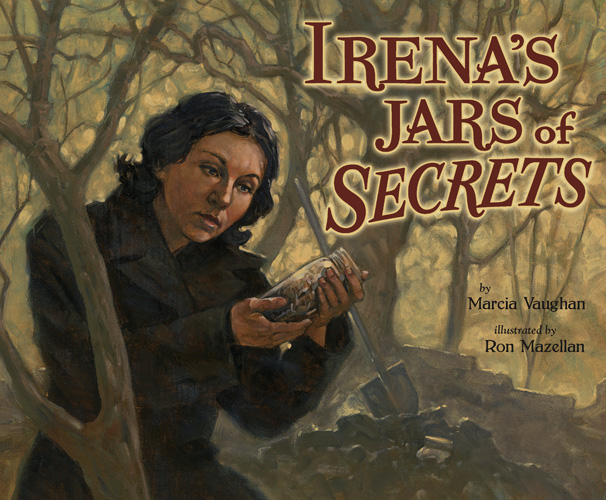
An interview with Marcia Vaughan - Irena's Jars of Secrets

Today I'm pleased to interview Marcia Vaughan, author of Irena's Jars of Secrets (2011 Lee & Low), a 2012 Sydney Taylor Honor Book in the  Older Readers category.  This interview is part of the official Sydney Taylor Book Award Blog Tour, sponsored by the Association of Jewish Libraries.

If you have not yet read Irena's Jars of Secrets, it is the true story of a courageous young Polish Catholic woman who saved the lives of more than two thousand children trapped in the Warsaw Ghetto, and destined for concentration camps during WWII.

Q. I had never heard the story of Irena Sendler prior to reading Irena’s Jars of Secrets. I understand from the Afterword that the Communist Polish government did not promote the heroism of Ms. Sendler. Can you share with us how you first discovered Irena’s story?

Marcia Vaughan
 © Marcia Vaughan
I came upon the story of Irena Sendler quite by accident. I was watching the Today Show three years ago when Matt Lauer announced he was about to read the obituary of a woman few people had ever heard of, a woman who helped rescue 2500 children from the Warsaw Ghetto during WWII. As I listened I could hardly believe what I was hearing. How could one woman and a small group of rescuers save so many lives! I had to know more and I knew young readers would be amazed by her courage and all the ingenious ways Irena Sendler and her team smuggled babies and young children out of the Ghetto past the German guards. I wanted to know about her life and what compelled a Polish Catholic woman to risk death time after time to save Jewish children. I felt young readers would want to know as well.

 Q. I am always interested in the collaboration (or lack thereof) between authors and illustrators. How did Ron Mazellan become your illustrator, and did you share any discussions over the artwork, which is, by the way, a fine complement to your story.

As author I am the storyteller. I’m not much of an artist at all. Publishing companies have editors and art directors who select artists to illustrate children’s picture books. While I researched the facts of Irena Sendler’s life, the illustrator researched the appearance of the characters and what Warsaw, Poland looked like during WWII. He used this information, his creative imagination and incredible talent to tell the story in pictures. Believe it or not, Rod Mazellan and I have never communicated directly about the story. He was free to interpret the story and bring the words to life as he wished. What a marvelous job he’s done!
Q.  Were you able to interview any survivors saved by Irena Sendler? And if not, how did you choose which particular rescues to highlight in the book?

While there were quite a few websites with reputable information on Irena Sendler, there were few books published when I was doing research. The most helpful book was written in German so I had it translated into English. I hope soon there will be many more books available for children, teens and adults about Irena Sendler’s incredible life. When selecting scenes for the book I tried to include examples of the variety of ways children were rescued. I was most impressed with the dog that was made to bark to cover the cries of frightened infants. I was also amazed that children were smuggled past guards in suitcases, tool chests, inside bundles of laundry,even under the floorboards of vehicles. For every child that was rescued, there was a story to tell. Yad Vasham was another excellent source and many emails were exchanged. I also contacted Stefanie Seltzer and other individuals who were extremely helpful. And my hat’s off to Louise May, VP and Editorial Director at Lee & Low Books for her invaluable help.

 Q. And finally, When ever I read a story of selfless heroism, I cannot help but think what I would do in a similar situation. Of course, this is somewhat of an imponderable, but after all of your research, do you have any thoughts on what compels some people to risk their own lives for the sake of others?

I’m not sure what compels some people to risk their lives to save the lives of strangers. Nor do I understand how others can sit back and do nothing when witnessing cruelty. When I read about people like Irena Sendler, or Abbie Burgess [Abbie Against the Storm, Beyond Words Publishing, 1999], who is left alone to care for her ailing mother and two little sisters while keeping the lighthouse running during a vicious winter storm, or the teacher who broke the law and taught a young slave to read and write before Emancipation [Up The Learning Tree, Lee & Low Books, 2003] it makes me wonder if I would have the courage to act as bravely. I do know that as I write about such people it inspires me to find my inner strength and be the best person I can. I hope in reading Irena’s Jars of Secrets children learn to look inside and find their own greatness.
Well said.  I hope so, too.  Thank you so much for sharing your thoughts with me and the readers of Shelf-employed.  Congratulations on your Sydney Taylor Honor Award.

Irena Sendler (1910-2008)
 Warsaw, February 13, 2005
Copyright: Mariusz Kubik

 About the Sydney Taylor Book Awards:

The Sydney Taylor Book Award is presented annually to outstanding books for children and teens that authentically portray the Jewish experience. Presented by the Association of Jewish Libraries since 1968, the award encourages the publication and widespread use of quality Judaic literature. Gold medals are presented in three categories: Younger Readers, Older Readers, and Teen Readers. Honor Books are awarded silver medals, and Notable Books are named in each category.

See the complete list of Sydney Taylor award, honor, and notable books for 2012.
The complete blog tour schedule is posted on the ALJ Blog.

Blog reviews of Irena's Jars of Secrets @
Today is Nonfiction Monday.  The roundup host is Capstone Connect.

Monday, January 30, 2012

Monday Morning Miscellany

First up,
  • It's Nonfiction Monday again.  Please be sure to visit host, Wendie's Wanderings to read today's posts. I've got no reviews to offer today, however, I did read this book yesterday and loved it for its beautiful photos, sweet story, and simple sentence structure (perfect for sharing with little ones at storytime):
(Be assured that the quality of the book's photos exceeds the quality of the book trailer video.)  A curiosity about this decidedly nonfiction book - the copyright page lists the classifying subject headings as the following:

1. Orangutan – Juvenile fiction. 2. Dogs – Juvenile fiction. [1. Orangutan – Fiction. 2. Dogs – Fiction. 3. Wildlife refuges – Fiction. 4. South Carolina – Fiction.]
I sent a note to the publisher to inquire if this is an error or a choice, but haven't had a response yet.  This is not the first time that I've seen erroneous cataloging information in print.  Can someone who is familiar with publishing enlighten me as to the source of the classifications?  I'm a curious sort. 

Next,
  • After many, many tries, I was finally successful in logging in to my White House account and signing the petition to  
Ensure that every child in America has access to an effective school library program.
If you haven't signed the petition, please do.  (You must create a White House account before signing.)  The log in process seems to be temperamental.  Please keep trying!  As I'm writing, 4411 signatures are still needed by February 4, to ensure a response from the President. Do yourself, your children, your students, your school, and your community a favor and support strong school library programs.

Finally,

Ms. Vaughan's visit here is part of the larger Sydney Taylor Book Award Blog Tour 2012.  The tour kicks off on February 5 with the following: 

Susan Campbell Bartoletti, author of Naamah and the Ark at NightSydney Taylor Honor Award winner in the Younger Readers Category
at Ima On & Off the Bima

Holly Meade, illustrator of Naamah and the Ark at NightSydney Taylor Honor Award winner in the Younger Readers Category
at
Into the Wardrobe

Shelley Sommer, author of Hammerin' Hank Greenberg, Baseball PioneerSydney Taylor Honor Award winner in the Older Readers Category
at
Great Kid Books

The complete schedule is available at the Association of Jewish Libraries blog, "People of the Books."  Follow the tour and support the authors and illustrators of this year's winners!

Have a great week!

Sunday, February 6, 2011

An Interview with Leland Purvis

 The Sydney Taylor Book Award Blog Tour, sponsored by the Association of Jewish Libraries, kicks off today!  One of the Honor Award Winners for Older Readers is Resistance by Carla Jablonski with art by Leland Purvis (First Second, an imprint of Macmillan Children’s Publishing Group)

Today I'm pleased to be interviewing the artist, Leland Purvis

Congratulations on your Sydney Taylor Honor Award for the artwork in Resistance, and thanks so much for participating in the Sydney Taylor Book Award Blog Tour


SE: I’m always curious about the manner in which great books are created. In  graphic novels and nonfiction, is the story generally written in its entirety before the artwork is conceived, is it a collaborative effort, or something completely different?

LP: Not all graphic novels are made the same way. In the case where the writer and artist are different people, often the working method grows out of the creators themselves, and the skills they bring to the table. In this case Carla did a full script but (unusual in comics) no panel-by-panel descriptions. The page design, shot-choices, and character design were all on me. Also, Carla had never done comics before. There are peculiarities of visual storytelling unique to the medium. Carla was very collaborative when occasions arose where I thought things needed changing for clarity, and really open to suggestions of solutions, which made it very satisfying. 
 
SE:  In Resistance, you often use Paul’s sketchbook to portray people or events  in the story. I found it interesting that, in most cases, Paul’s sketchbook depicts events not through the filtered eye of the young boy, but as they are. In my mind, that tells a story in itself - that the behavior of Nazi  Germany was so horrific that exaggeration, even for an imaginative young boy, is impossible. Was that the point that you were trying to make, or does the sketchbook have another purpose in the story?

LP: The sketchbook serves a couple of purposes, which is why you were sensing a dual-role, essentially. On the one hand it was a narrative device by which Paul could be valuable to the Maquis resistance in a credible way. Also it does provide a look into Paul's head about his reaction to the town and people around him. We very much included panels that were strictly Paul's P.O.V. This has continued into the sequels.

Copyright 2010 Leland Purvis and Carla Jablonski

P.O.V. shots can alter perspective and focus without necessitating exaggeration. Horror exaggerates itself. In this case, though, most of those scenes that really depict some of that were not so much in the sketchbook as they were shown from overheard conversations, or witnessed by the characters themselves. I think it was best to give the emotional landscape through the eyes of the children in the story. Otherwise, as horrific as we might have displayed a context, the readers wouldn't have related as fully. Carla did a wonderful job with that and it made my work much more engaging. 


SE: Your Blogger profile states that you’re from Brooklyn, but I read an earlier interview in which you hailed from Portland, Oregon . Two drastically different cities - one brooding (no offense, NY) and one earnest (ditto, Portland); where are you now, and are you happy there?

LP: I've fixed that now! It's funny that you see these cities as so different. In fact Portland, Oregon and Brooklyn, NY are sister-cities in a lot of respects. I know quite a few people who have lived in both places. There's a lot of do-it-yourself creative energy, artists, writers, bicycle riders, musicians, a really vibrant cultural life going on in each. Brooklyn is more diverse, Portland less stressed, but there are many similarities. And there are more comics-artists in Portland than anywhere but Brooklyn. After six years there (sixteen for my wife) we moved to my hometown of Portland last Summer.
 
SE: Based on Vox, Suspended in Language, Resistance and other projects on which you’ve chosen to work, I take it that you are a very serious thinker. But then, there’s Pubo. So, I’m puzzled... is your stated interest in “fighting entropy to soften the dreams of reason,” lighthearted or serious? Do you care to elaborate?


LP: Art, or making anything, really, is an 'organizating' that soothes the mind and offers some defense against the slings and arrows. So in that sense it's serious. But if you're going to take your work seriously, I think it's important to not take your Self too seriously. It's never out of place to lighten up a little. PUBO, while on the surface looks like just a funny-animal comic, does yield more to a closer read. It has some things to say, or at least questions to ask, about trust, fear and survival, what it's okay to do to our fellow Man, and how there is a distinction between that and what's allowed in the natural world. At least I hope it does. I meant it to. The first idea with PUBO being that a character who is a physical map of how we feel, would be a metaphor all by himself.
 
SE: And finally, what’s next?

LP: Next I'll be finishing up the three-book Resistance series. So there's more to hear from Paul and Marie and their little town. After that, I'll be stepping out of YA but continuing with historical work with writer Jim Ottaviani on a book called The Imitation Game, a biography of Alan Turing the British WWII codebreaker.
 
Many thanks to Leland Purvis for his time and thoughtful answers,
and to the Association of Jewish Libraries for sponsoring this tour. 


Thursday, February 3, 2011

Sydney Taylor Book Award Blog Tour

Just a reminder that the Sydney Taylor Book Award Blog Tour starts this Sunday.  The Sydney Taylor Book Award and honors are "presented annually to outstanding books for children and teens that authentically portray the Jewish experience."

The blog tour kicks off on Sunday, February 6, right here at Shelf-employed, along with stops at Biblio File and Jewish Comics

SUNDAY, FEBRUARY 6, 2011 tour schedule


  • Carla Jablonski, author of Resistance, Sydney Taylor Honor Award winner in the Older Readers Category at Jewish Comics
  •  Leland Purvis, illustrator of Resistance, Sydney Taylor Honor Award winner in the Older Readers Category  right here @ Shelf-Employed 
  • Sarah Gershman, author of Modeh Ani: A Good Morning Book, Sydney Taylor Honor Award winner in the Younger Readers Category at Biblio File


All the blog tour stops, dates and details are available at The Association of Jewish Libraries Blog.

See you Sunday!

Monday, September 27, 2010

An interview with Janice Weaver

Today I have a real treat! An interview with Janice Weaver, author of Hudson, the new middle grade biography of Henry Hudson.  Ms. Weaver graciously agreed to a VoiceThread interview, which means that you can participate and ask questions as well! The interview "thread" will remain open for a week or so, and Janice will answer any added questions, so please, dive right in! (Click "Play" to start and enable sound)  To see it in "full-screen," click this link. http://voicethread.com/share/1290692/
  I reviewed Hudson last month.

Other books by Ms. Weaver include:


Today's host for Nonfiction Monday is Wendy's Wanderings. Be sure to click on over.
Share |

Beneath the Waves - a review

As we read disturbing news accounts of dying manatees , environmental disasters caused by toxic waste, and ocean pollution on the scale of ...