Pages

Showing posts with label rural life. Show all posts

Sunday, December 16, 2018

When the Snow Falls - a review

I realized that I never posted this review that I wrote for SLJ last year.  It's rather timely, so I'll post it now.

When the Snow Falls
By Linda Booth Sweeny
Illustrations by Jana Christy
Penguin Random House, 2017

SWEENEY, Linda Booth. When the Snow Falls. illus. by Jana Christy. 32p. Putnam. Oct. 2017. Tr $16.99. ISBN 9780399547201. PreS-Gr 1–Three generations of a fun-loving family take advantage of an unexpected snow day to frolic from country to city. When Grandma spends the night at the home of two young siblings, they awake to find that school is canceled due to a snowstorm. While the parents stay home to work the farm, Grandma, a young girl, and her little brother ski to town on a winsome belled sled-chair. They make their way to Grandma and Grandpa's house and encounter natural wonders, city wonders, and friends along the way. Sweeney gives a sense of motion with simple rhyming quatrains punctuated by the recurring phrase, "When the snow falls …. Tracks curve./Skis glide./Fox curls./Rabbits hide." The transition from country to city occurs when they briefly stop on a bridge to wave at the plows below, "Trains toot./Cars slow./Plows push./Mountains grow." Softly colorful, the double-page images have the muted quality associated with a snowy day. Christie's digitally painted pencil sketches and mixed-media illustrations bounce with playful motion—snow falling, scarves flying, rabbits hopping through the forest, city folk shoveling. The family members have joyful faces and burst with enthusiasm. Their exuberant dog follows them throughout, even joining the children in making snow angels. The grandparents join in the fun, too. VERDICT Country and city kids alike will relate to this joyful romp celebrating family, snow, community, and the wonders of nature.
 ##

School Library Journal. Nov2017, Vol. 63 Issue 1, p66. Copyright © 2017 School Library Journal, the property of Media Source, Inc.  Reprinted here with permission.


Click here to look inside When the Snow Falls.

My copy of When the Snow Falls was provided by School Library Journal.

Monday, November 28, 2016

Moo - a review

I recently reviewed the audio book version of Moo by Sharon Creech.

I'm not permitted to repost my review here, but you can easily hop over to AudioFile Magazine and read it there. [http://www.audiofilemagazine.com/reviews/read/117341/moo--by-sharon-creech--/]

Sharon Creech's customary poetic frugality with words is evident in Moo, a story of two siblings, a family's move to Maine, and an obstinate cow named Zora. The audio version is read by Brittany Presley. You can't go wrong with Sharon Creech, and the brevity of her offerings makes her a perennial reluctant-reader favorite.


Other Sharon Creech books or short stories featured on Shelf-employed:
Can you tell that I'm a big Sharon Creech fan? 😊

Wednesday, May 25, 2016

Sweet Home Alaska - a book for librarians

Sweet Home Alaska
by Carole Estby Dagg
Read by Susan Denaker

I reviewed Sweet Home Alaska for AudioFile Magazine. It's historical fiction set during the Great Depression with particular interest to librarians. Though the main storyline is a family's struggles to homestead in Alaska, there is a library-related subplot. 

In an attempt to create a fledgling library for an impoverished population with scare resources, the protagonist (and later, the entire settlement), struggles with collection development and circulation issues. What should the library acquire and why? How will it be funded? Who will have access and how? Sound familiar? Of course, author Carole Estby Dagg is - you guessed it - a librarian!


Read my AudioFile Magazine review of Sweet Home Alaska here


Note:
I had a very brief conversation with the author via Twitter here .  Follow the conversation links if you're interested in commentary on Sweet Home Alaska from a Native American's perspective and the author's response.

Thursday, August 28, 2014

The Time of the Fireflies - a review

I was actually searching for a fantasy book, but stumbled upon a good old-fashioned ghost story instead.

Little, Kimberly Griffiths. 2014. The Time of the Fireflies.  New York: Scholastic.

Larissa Renaud doesn't live in a regular house. As she tells it,
"My parents moved us into the Bayou Bridge Antique Store—a fact I do not brag about. It's embarrassing to admit I share the same space as musty, mothball-smelly furniture, dusty books, and teacups that dead people once drank from."
Sometimes she wishes they had never come back here from Baton Rouge, but her family has a long history in the bayou town, much of it is tragic.

When Larissa receives  a mysterious call on a broken antique phone, she's got a real mystery on her hands.
"Trust the fireflies," 
the ghostly girl tells her, setting Larissa on  a strange and eerie path of discovery. Can Larissa right the wrongs of the past to save her family's future?

Though it highlights rural poverty, bullying, and new sibling issues, The Time of the Fireflies is at heart, a ghost story with a remarkably likable and resourceful protagonist.

To avoid giving away too much, I'll merely mention that readers may see some similarities to Rebecca Stead's Newbery Medal-winning, When You Reach Me. The spunky Larissa and author Kimberly Griffiths Little will draw you into the rich world of the Louisiana bayou until you too, are carried away by the fireflies.

A link to The Time of the Fireflies trailer is here.  I'm not posting the trailer here because, honestly, I think the book is better than its trailer.

(My copy of the book was provided by the publisher as an Advance Reader Copy.)

Saturday, August 24, 2013

Three Times Lucky - an audiobook review

Turnage, Sheila. 2012. Three Times Lucky. New York: Penguin Audio. Read by Michal Friedman.

I was looking for a good book to listen to while traveling, and I had heard rave reviews about the 2013 Newbery Honor book, Three Times Lucky.  It features North Carolina, the latest addition to my college road trip cycle, and it comes in Playaway format - how convenient since I've misplaced my mp3 player. I picked up a copy from the library before heading out.

This was the best book that I've listened to all year!  I can't tell you the number of times that I had to pause the recording, chuckling all the while, to repeat a well-turned simile or metaphor to my daughter.  If I had the print copy in hand, I could quote you a dozen - just in the first chapter.

Rising sixth grader, Mo (short for Moses) LoBeau is the funniest, winningest, spunkiest heroine of children's literature that I've met in quite a while.  By the time you've finished Three Times Lucky, you'll know every resident of Tupelo Landing, North Carolina, as well as if they were your own relations. Robbery, snobbery, lies, domestic violence, and alcoholism rear their heads as they do in every community; but despite some heavy-hitting themes, this modern-day, first person narrative is not "contemporary realistic fiction," but rather a delightfully funny, quirky murder mystery, and the story of a loving family, best friends, and a close-knit community. And oh yes, there's a hurricane.

I think you'll love it.  Suggested for ages 10 and up.

Do listen to an audio excerpt of Three Times Lucky here.  You'll love it!

Note:
After reading the book and looking for more information on its fantastic reader, Michal Friedman, I discovered that she died in 2011, from complications from a Cesarean section after giving birth to healthy twins. Heartbreaking and tragic.

Tuesday, February 8, 2011

Moon over Manifest

Vanderpool, Clare. 2010. Moon over Manifest. New York: Delacorte.

Moon over Manifest is this year's winner of the John Newbery Medal, "awarded annually by the Association for Library Service to Children, a division of the American Library Association, to the author of the most distinguished contribution to American literature for children."

I admit that, like many other librarians, I hadn't read it before it was announced the 2010 winner - but no matter, other librarians wiser than I had picked this stellar gem out of last year's mine full of gems.

...and I learned something about cover art.  For better or worse, I do pick books by their covers (I'm fond of quoting Mary Rose Wood from the Mysterious Howling, "all books are judged by their covers until they are read")  The minute I saw this cover, I loved it, but I didn't read it.  Why?  Because I thought that this winsome little Midwest gal in overalls might not appeal to my little East coast customers.  I thought I might be completely enamored by it, as I was with Ruth White's 2008 book, Little Audrey, and then disappointed when it didn't garner the attention that I'd hoped for.  Well, it looks like Abilene Tucker and her creator, Clare Vanderpool will get plenty of attention - and believe me, they deserve it.  Next time I'll follow my instincts.

Photographer, Richard Tuschman gets credit for the inviting cover art. Check out his original photo of "Abilene" on his blog, Richard Tuschman Images.


Manifest is not only the fictional location of the story, manifest (both the verb and the noun) are an integral part of the story.  Manifest,Kansas, the dry (Dust Bowl and Prohibition style dry) Midwest town is revealed, or made manifest, through the stories of its people, most of whose names can be found on the manifests of ships that passed through Ellis Island. 
 
The story begins in 1936, with Abilene Tucker arriving by train.  Her dad, a drifter, has uncharacteristcally sent her away for the summer - to Manifest, a town she knows only from stories her dad has told her as they've ridden the rails throughout the country.  She hops off the train about a half mile before the Manifest stop, reasoning that
it's best to get a look at a place before it gets a look at you. 
 Abilene has been to enough towns in her short life to know that there are certain "universals" - the rich kid in town that looks down on everyone, the poor kid, and so on.  But as she gets to know the people of Manifest and uncovers bits of their lives through old newspaper articles and a box of hidden mementos, she comes to a realization,
Maybe the world wasn't made of universals that could be summed up in neat little packages.  Maybe there were just people.  People who were tired and hurt and lonley and kind in their own way and their own time.

Abilene tries to figure out why her father has sent her Manifest.  When did he live here?  Why did he leave? Is he coming back? The answers come slowly, with the help of the Hungarian Woman, a diviner, a storyteller who breathes life into the Manifest of 1918, during the Great War, a Manifest run by a wealthy mine owner, a Manifest where the immigrant mine workers are intimidated and exploited.  Abilene uncovers Manifest's secrets (and her own) from Miss Sadie's Divining Parlor, from faded copies of "Hattie Mae's News Auxiliary," and from letters found in the memento box - letters from a boy named Ned fighting overseas, to his hometown friend, Jinx.

Moon Over Manifest begins with a cast of characters, both from 1918 and 1936, and switches from Abilene's first-person account of the events of 1936, to the diviner's stories of 1918 Manifest happenings.  Wartime correspondence from Ned to Jinx, and Hattie Mae's newsy column (along with the occasional advertisement for healing elixirs and such) fill in the blanks or corraborate the Hungarian Woman's stories. Different fonts and points of view are used to help the reader transition from the past to the present. 

Moon Over Manifest is a many-layered story of parental love, redemption, determination, and community. It's also a mystery, and the story of the ultimate con job.  And it can be funny, heartbreaking and pointed at the same time, as shown in this article from "Hattie Mae's News Auxiliary" following a cross burning at the German Fraternal Hall,
July 20, 1918
Since the recent unfortunate happening at the German Fraternal Hall, everyone has been on edge and the mood of the town has been somber.  It is unclear if the motive was the Germans' nationality or their attempt to organize at the mine.  Mr. Keufer says future meetings of the order have been postponed until further notice.
     It is in times like these that this news column cannot provide the needed comfort and solace.  But as I was instructed in my journalism correspondence course through Harper's Magazine, a good reporter must continue to do her job, even in the most trying of times.  These are certainly trying times.
     It has been one year since the first "Yanks" went overseas, and the country hoped they would be home by Christmas past.  However, our boys rally on.  The American Defense Society continues to push for abolishing Hun names in America. For example, changing sauerkraut to liberty cabbage and frankfurters to patriotic pups.  However, many folks in Manifest seem to think that a bit unnecessary.  Especially Mr. Hermann Keufer, who rather likes his name and does not consider himself or his sauerkraut to be a threat to national security.
     Many of the soliders from Camp Funston had a rought boat ride overseas and are still feeling indisposed with flu symptoms.  The army doctor says he's never seen such a fast-spreading outbreak but it should soon be under control.  The troops will be pleased to know that Velma T. has sent off more relief parcels with her newly concocted elixir.
     For Mrs. Larking, who hasnt' been feeling herself of late, the elixir went down fairly easy the day of the Women's Temperance League meeting.  After consuming nearly an entire bottle, she appeared to be feeling better, and although her rendition of "how Dry I am" was a little off tune and a somewhat surprising selection for the gathering, she did seem to have a healthy glow about her.  ...
Hattie Mae Harper
Reporter About Town
A wonderful book!  Highly recommended.
Listen to Clare Vanderpool explain the inspiration for Moon over Manifest, and read a short excerpt.

Browse inside

Thursday, September 23, 2010

Elsie's Bird

Yolen, Jane. 2010. Elsie's Bird. Ill by David Small.  New York: Philomel.

An uplifting story of a young girl and her newly widowed father who leave Boston with the girl's beloved canary to make a new life on the Nebraska frontier. At first lonely and depressed, Elise learns to appreciate the beauty, vastness and music of the prairie. A wide book with double-spread watercolor and ink paintings is the perfect format for evoking the beauty and solitude of the prairie in contrast with the hustle and bustle of Boston. A hopeful story in which the small, loving, well-tended family blooms in the rich Nebraska soil.


More Elsie's Bird reviews @

Share |

Wednesday, June 16, 2010

The Keening

LaFaye, A. 2010. The Keening. Minneapolis, MN: Milkweed.

Funny thing - I began making the tags for this book before I finished it.  Other than the obvious tags - Maine, rural life, historical fiction, epidemics, ...  I had planned to add - mental illness, autism or spectrum disorder, but I had it all wrong.  It's a matter of perception, and The Keening may change yours.

The Laytons keep to themselves.  Folks in their rural area think Lyza's Pater is crazy - fit only for the "farm" down the road, Elysian Fields, a home for the insane.  Mater's family thinks she's a bit touched as well - must be for marrying Evan Layton.  As for the protagonist, 14-year-old Lyza Layton, she loves both her parents, and cannot imagine life outside her remote, coastal home of 1918 Maine.  The influenza epidemic has hit the area hard and Lyza sees the regular march of keening mourners heading to the cemetery.  She and Pater have survived the influenza, but many others in the community are not so lucky. 

Pater says little.  He carves beautifully intricate faces into wood and then sets them adrift.  He spends hours writing letters, though he has no known friends. Mater takes in sewing and sees to it that Pater eats, sleeps and wears weather-appropriate clothing - difficult chores for a wife whose husband has no concept of time or hunger or other worldly concerns.  Pater talks to angels, writes his letters and disappears into his workshop for hours or days on end, carving, carving, always carving.

But there is love in the Layton household.  Lyza feels it - even from Pater. Despite the scorn and ridicule of local folks, the Laytons are happy in their solitude.  Mater is kind, unflappable and devoted to her husband.  Lyza is enveloped in the cocoon of her family, but Mater encourages her to go to college - to the big city - to Portland. 
"...college will show you a thousand other paths." Are you sorry you took this one?"  Mater startled like I'd poked her. "Not hardly!"  She turned to me, her face pale and waxy in the faint light. "Life's hard, Lyza. Filled with little invisible walls you have to climb over.  The walls surprise you.  Or, who knows, maybe you put them there yourself to keep your parents out, but the climbing's the thrill of it.  The real work.  I love your pater.  I love you.  And this house. My sewing.  And God forgive their stubbornness, my family."
Lyza is afraid, but her only close friend, Jake, entreats her to go.  He will be tied to a life of fishing.  He wants Lyza to see more.  He wants to go with her.  When tragedies strike, Lyza will go to Portland; and she will find the way into her father's world, willing or not.

The Keening is eloquently written with phrasing that captures the mood and period - the remoteness of the community, the sadness of the epidemic, the resourcefulness of Mainers,
I headed down a shoreline road just wide enough for a horse and a body to pass each other.  Trees lined either side.  As darkness filled the road with shadows, I cursed myself for forgetting a lantern.  The moon pitied my foolishness and lit the way.

Perhaps the grand questions that author A. LaFaye hopes to inspire are ones of purpose, the soul, and the afterlife.  The one, however, that comes most immediately to mind is one of perception.  If a home is filled equally with madness and love, is that not a better home than one filled with judgment and sanity?  The Keening is a short and thoughtful book, sure to leave the reader pondering his own grand questions. Recommended reading for Grades 7 and up.

Read an excerpt from The Keening.

The Keening is published by Milkweed Editions, a non-profit publisher with a mission of "making a humane impact on society, in the belief that good writing can transform the human heart and spirit."  This is the first book that I've read from Milkweed Editions.


Share |

Thursday, June 10, 2010

Grandma's Pear Tree

Santillan, Suzanne. 2010. Grandma's Pear Tree/El Peral de Abuela. Illustrated by Atilio Pernisco. McHenry, IL: Raventree.

Jessie has promised to stay away from Abuela's pear tree. When his ball gets stuck in the tree, he consults Abuelo, who advises him to throw his shoe at it. When "el zapato" becomes stuck, Tío suggests a broom ... a humorous and cumulative tale that contextually introduces Spanish words for family members and common items. Painted illustrations help readers and listeners make the English/Spanish connection without unnecessary explanation.  A surprise ending will keep listeners laughing. I took this book on an outreach visit to a preschool. Any book that has a room full of preschoolers yelling out the refrain, "¡Ay, caramba!" is a winner in my book! ¡Qué divertido! (What fun!)
 
A Spanish/English glossary is included, but curiously, does not contain the word peral, part of the title. I did not find it in the glossary, but verified later that peral is Spanish for pear tree.  (Being most accustomed to English, I did not realize that in Spanish there is a word that encompasses both the tree and its fruit.  How handy!)

Activity sheets are available from the publisher.


Share |

Friday, May 7, 2010

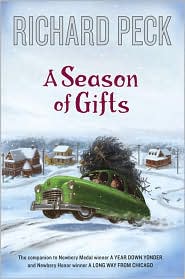
A Season of Gifts

Peck, Richard. 2009. A Season of Gifts. New York: Dial.

In A Season of Gifts, Richard Peck returns to rural Illinois and the small town that  larger-than-life Mrs. Dowdel calls home.  This time, the year is 1958 and Elvis, television and Civil Defense are the buzz words of the day when the Barnhardts move into town.  A poor Methodist preacher in a town of "foot-washers," Mr. Barnhardt and his wife have their work cut out for them, as do their children - narrator, 12-year-old Bob, younger sister Ruth Ann, and Phyllis, a high-schooler on the road to trouble.  Local kids don't  feel any brotherly love for PK's (preacher's kids).

Although each of the books in this companion set A Season of Gifts (A Year Down Yonder and A Long Way from Chicago) has its own narrator, it is the over-sized, outrageous Mrs. Dowdel who dominates the story. And  though she "doesn't neighbor," and is often trigger-happy,
I'm about a squat jump away from a loaded Winchester 21, ...and I'm as tetchy as a bull in fly time,
underneath her flap hat, apron, boots, and afghans, she's got a heart of gold.

Like a master comedian, storyteller, or practical joker, Peck takes his time in setting up the dry humor that characterizes Mrs. Dowdel. The reader, so engaged in the story, never sees the setups that span a chapter, two chapters, even the entire book. Mrs. Dowdel is always one step ahead.

A Year Down Yonder is still my favorite, but A Season of Gifts runs a close second.  Highly recommended.

Share

Friday, April 2, 2010

A Year Down Yonder

Peck, Richard. 2000. A Year Down Yonder. New York: Dial.

I admit that I don't "get" America's Heartland.  Other than a few trips to Texas, Colorado, and Louisiana, I usually think of the Midwest as something in between where I am and where I'm going.  So it was with great pleasure that on my recent vacation, I became acquainted with the rural Illinois of the Depression-era, and I fell in love with it!  Mary Alice and Grandma Dowdel are two of the best characters in children's literature, and I'm sorry that it's taken me so long to find them.  If you haven't read A Year Down Yonder, you're missing a very funny and heartwarming (but never sappy) story.  Many reviews are available of this 2001 winner of the Newbery Medal winner.  (The original PW review nailed it.)

Now I can't wait to read its prequel, A Long Way from Chicago (downloading to my mp3 as I type), and Peck's latest, A Season of Gifts.

Thursday, February 5, 2009

Tillie Lays an Egg

Golson, Terry Blonder. 2009. Tillie lays an egg. New York: Scholastic.

Of course, I live in NJ, so take this with a grain of salt, but my eldest daughter related something to me the other day - Her language arts teacher mentioned that, in one of her classes, not one student knew the sound that a donkey makes. How sad that we've become so far removed from the farms and country that feed us. (Doesn't anyone sing "Old MacDonald" anymore?)

Tillie Lays an Egg may be just the book to inspire a preschooler's interest in farm life.

The stunning photography combined with the fun of look-and-find,

"Where has Tillie laid her egg?"

and the attendant humor (Tillie lays her eggs on the kitchen table and the ironing board, among other unlikely places!)

make this book a winner!! Hee Haw!

Thursday, June 26, 2008

The Happy Hocky Family moves to the Country!

Smith, Lane. 2003. The happy Hocky family moves to the country! New York: Viking.

This is an older title, but one that I just discovered. This is a hilarious story comparing city life to country life as the Happy Hocky family learns to adjust to their new home in the country. The deadpan delivery of jokes, combined with the delightfully simple illustrations is a perfect mix.

A+B=C
(Country Math)
A. Here is the wild bunny.
B. Here is the wild bunny's big belly.
C. Here is where Mrs. Hocky's GARDEN used to be.

or my favorite

Baby's Caterpillar Story
I have a caterpillar. Do you have a caterpillar?
I have a caterpillar.
My caterpillar is fuzzy.
My caterpillar is ...
?
I have a jar.
Do you have a jar?
I have jar.

(You'll have to imagine the illustrations of the bald, diapered baby and his soon-to-be-empty jar!)

Too funny!

Beneath the Waves - a review

As we read disturbing news accounts of dying manatees , environmental disasters caused by toxic waste, and ocean pollution on the scale of ...