Pages

Showing posts with label Hispanic/Latino. Show all posts

Friday, November 9, 2018

Carlos Santana Sound of the Heart, Song of the World - a review

Carlos Santana: Sound of the Heart, Song of the World
By Gary Golio
Illustrated by Rudy Gutierrez
Christy Ottaviano, 2018


"Autlán de Navarro, Jalisco, Mexico
     It's 1947, in a town with only dirt roads and mud houses.
     There are no electric lights, but electricity crackles in the air as a child is born—a little boy whose aunt calls him cristalino, someone clear and bright, destined to make a mark in this world. 
     The boy's name is Carlos Santana, and his mark will be made with lightning, 
on the ears of the wind!"

A fitting beginning to a book about one the world's most unique and innovative guitar players.  As with all of the text in the book, the above is printed in a small font, nestled artfully against the dreamy, surrealist, mixed-media illustrations by the renowned, Rudy Gutierrez.  All of the images are double-spreads. Though the book chronicles Santana's life only through his boyhood in Mexico, the artwork is a mix of Mexican influences and those of the psychedelic era in which Carlos Santana came to great fame in the U.S. This perfectly complements  the narrative, which highlights Carlos' greatest influences—his family and the music of Mexico, and his stirring connection with American blues. Carlos Santana Sound of the Heart, Song of the World is an inspiring and uplifting picture book biography for older reader.

Cue up some Santana on your Spotify account and enjoy! Peace.

You know it's a cool book when it's covered on WMMR out of Philadelphia.  Listen to an interview with author Gary Golio that aired on WMMR in October.

View four interior spreads from Carlos Santana: Sound of the Heart, Song of the World at the publisher's website.


My copy of Carlos Santana: Sound of the Heart, Song of the World was provided by the publisher.

Monday, September 21, 2015

Storytime picks for Hispanic Heritage Month

Each year, I try to do something new for Hispanic Heritage Month at the library.

This year, I fell in love with Susan Middleton Elya's, Little Roja Riding Hood (Putnam, 2014), so I based a program around that title.  We had a fun time retelling the classic story as we knew it, recreating it with felt board pieces,  reading Susan Middleton Elya's version, using the globe to find Spanish-speaking countries, playing a game of Color, Colorcito, and finally some free play with the felt board pieces and a rojo coloring page.

Below is a slide show with reviews of other bilingual favorites that I've used for storytime.  I also have a list of fun preschool songs, music, and activities for Hispanic Heritage Month.  Feel free to ask me about them.  If you have trouble seeing the slideshow, you can access it on Riffle. [https://read.rifflebooks.com/list/181065]
 

Monday, September 8, 2014

Colors of the Wind - a review


National Hispanic Heritage Month is September 15 - October 15. What a great time to celebrate the life and work of Mexican-American painter, George Mendoza.  

Powers, J.L. 2014. Colors of the Wind: The Story of Blind Artist and Champion Runner George Mendoza. Cynthiana, KY: Purple House Press.

As a child, George Mendoza began seeing brilliantly-colored lights, shapes and squiggles, eventually losing most of his sight except his peripheral vision and the ever-present colors.  Unable to play basketball or other do other things he wanted, George took up running. He excelled in the sport and competed twice in the Olympics for the Disabled.  In the back of his mind, however, he'd kept a long-ago word advice from his youth.

One day, a flyer arrived in the mail,
advertising a contest for blind artists.
George remembered the priest, who told him,
"You should paint what you see."

George started to paint,
just like the priest told him to do.
And so began the painting career of George Mendoza.

The text appears in a plain, small font on white pages, accompanied by simple blank ink drawings, often highlighted with colors from Mendoza's paintings.  Each facing page contains a full-bleed image of one of Mendoza's paintings.

Biographical information, photos of Mr. Mendoza, and painting titles are included in the book's back matter.


The joyful, riotous colors of Mendoza's paintings will certainly appeal to children, as will his story of perseverance and purpose.  Enjoy!

You can see photos from Mendoza's "Colors of the Wind" exhibit at the Ellen Noel Art Museum here.  The exhibit is listed with the Smithsonian Affiliate Exhibition Exchange.


My copy of the book was provided by the author.

Thursday, July 10, 2014

Lowriders in Space - a review

The #WeNeedDiverseBooks campaign points out many reasons why it's important to have diversity in books. One of the reasons is that people like/want/need to see themselves reflected in the books that they read. Another is that people like/want/need to see the world through the eyes of people other than themselves. Whatever your reason for seeking diversity in books, I hope you find it in Lowriders in Space.


Camper, Cathy. 2014. Lowriders in Space. New York: Chronicle.
Illustrated by Raul the Third.
(Advance Reader Copy)

Quirky and unique, Lowriders in Space is a graphic, sci-fi novel that extols the virtues of working hard, working together for a common goal, and striving for success despite the odds of achieving it. It's also funny and stylish, and peppered with Mexican-American slang as it shines a rare spotlight on "lowrider" culture.

The cast of characters includes an impala, an octopus, and a mosquito:


  • "Lupe Impala was the finest mechanic south of Vacaville.  She could rescue a dropped gasket, notch a belt, or electrocharge a sparkplug, swish a swashplate or wrangle a manifold with a twist of her wrench a flick of her wrist."
  • El Chavo "Flapjack Octopus wielded the wettest washcloth North of the Salton Sea. When he polished a car, he spun over the paint job like an eight-pointed ninja star flying through the night."
  • "Elirio was the best detail artist around. People were a little afraid of Elirio Malaria."

They're best friends. They work together. They can count on each other.  But can they build a lowrider to win the Universal Car Competition?  They can when they accidentally use rocket parts and get a truly cosmic makeover!

Besides its truly unique and fun characters, I like that Lowriders in Space features adults. The general rule is that books for kids will be about kids. That's fine as a general rule, but a quality children's book about adults is a breath of fresh air.  When I was a very young kid, my favorite things to read were Archie and Veronica comic books and Nancy Drew mysteries.  They had cars and boyfriends and nary a parent in sight (unless you count Nancy's father, who was more like an early version of an ATM than a parent).

Humor?  Lowriders has that, too. My favorite panels?

El Chavo (the octopus) sitting in his new bucket seat (a bucket!). "¡Que suave!"
Elario rescuing the group from a black hole with ... Wite Out!

What else do I like about Lowriders in Space?  The subtitle is "Book 1." I sure had fun reviewing this one. I look forward to seeing more of this unconventional trio.

Back matter includes a dictionary of the Mexican-American slang and scientific terms used throughout the book (it is a sci-fi novel, after all).

Note: 
My advance copy was in black and white, with only a small sampling in color. See full color pages on the book's FB page. [https://www.facebook.com/pages/Low-Riders-in-Space/487615068027769?sk=photos_stream] 

Though I'm a Jersey Girl now, I lived for many years in Southern California. If you've never been stopped at a red light next to one of these bouncing babies, you're really missing something!  Want to see some lowrider action?  Check out this YouTube video, "60 Seconds of Low Riders."

Monday, March 7, 2011

Good Sports: Baseball Heroes

Stout, Glenn. 2011. Good Sports: Baseball Heroes. Boston: Houghton Mifflin Harcourt.

This book is not what I thought it would be!  When I saw it's small size and paperback format, I didn't give it much of a glance - instead, putting on the cart to be shelved.  Later, when searching for books on female athletes to display for Women's History Month, this book popped up in the catalog.  Huh?  I gave it a second look, and I'm glad I did.

Baseball Heroes contains the stories of four ball players who overcame enormous odds to rise to the top of the game they loved - Jackie Robinson, the first African American player in the major leagues, Hank Greenberg - who paved the way for Jewish ball players, Fernando Valenzuela - Mexico's first major league superstar, and Ila Borders.  Ila Borders?

No, I had never heard of Ila either, but her story is no less impressive than the rest. Born in 1975 to a baseball-loving family, Ila was as talented a baseball player as any of the boys her age.  Despite catcalls and complaints from parents and some coaches, she played Little League with the boys, pitching her way through elementary and junior high school.  When she enrolled in high school, however, the law said that she had to play on the school's girls' softball team.  But that didn't stop Ila.  With the support of her family, she enrolled in a private school where she earned a spot on the varsity team,
and when players from the opposition tried to show her up by blowing her kisses from the batter's box or acting disrespectful in other ways, Ila knew what to do. "I just brush them back," she later told a reporter, meaning she threw the ball close to them.  "It's my favorite pitch."
(I love this girl already!)  But high school was not the end of Ila's career.  She went on to pitch in college, and rebuffed by the major league teams, Ila Borders found a home playing professional baseball for an independent league, pitching for the Duluth-Superior Dukes, before retiring to finish college in 2000.
"You never know how far you're going to go," she said.  You just work your tail off and see what happens."
A truly inspirational chapter - perfect to share for Women's History Month.

Baseball Heroes is the first in a planned series, Good SportsGood Sports is a good idea. I wish Mr. Stout good luck and better copy editing with the rest of the series.  The cover contains two errors that will be corrected in future editions.  For the record, Glenn Stout's correct web address is http://www.goodsportsbyglennstout.com/.  Baseball Heroes is a good book that deserved a better kickoff.
A parent and teacher guide for baseball heroes is available from the author.

Look for a great post later this month from Audrey Vernick, author of She Loved Baseball: The Effa Manley Story on Kidlit Celebrates Women's History Month!


Today's Nonfiction Monday roundup is at Picture Book of the Day,

Saturday, November 13, 2010

Jazz Fly 2: The Jungle Pachanga

Gollub, Matthew. 2010. Jazz Fly 2: The Jungle Pachanga: Wherein los Jazz Bugs Meet la banda de las Termitas. Santa Rosa, CA: Tortuga.

Choo-ka Choo-ka ting,” the Jazz Fly’s back!
He’s in the rainforest, selva, so it’s time to pack.

But ¡Ay, caramba! - the Bug Band’s swing
just doesn't make las termitas sing.

So add Spanish words, a Latino beat.
Then those bugs start groovin’ in the southern heat,

proving jazz and Latin are a hoppin’ mix.
(Made all the better with Karen Hanke’s pix)

Let Matthew Gollub do the reading with the book’s CD.
Kids will love it. Es bueno. Check it out. You’ll see.


Listen to and see a preview of Jazz Fly 2 at Matthew Golub's site.
(The original Jazz Fly, is fly, too!)

Share |

Saturday, July 31, 2010

Another picture book roundup - read on!

Once again my bags of books are overflowing! Here are a few new titles worthy of mention:

Jacobs, Paul DuBois and Jennifer Swender. 2010. Fire Drill. Ill. by JuyVoun Lee. New York: Holt.

A picture perfect, non-threatening, multicultural, rhyming book about fire drills.  What more can one ask for? A must-have for every Kindergarten teacher.

Elya, Susan Middleton. No More, Por Favor. 2010. Ill. by David Walker. New York: Putnam.

Know a picky eater? Well, he's in good company.  There are plenty of picky eaters in the rain forest too! 
Deep in the rain forest - selva, so green,
lives Papagayo, an eating machine.
"Here, Bebe Parrot, papaya is yummy."
"No!" says the baby. "No more in my tummy!
Papaya for breakfast, for lunch and la cena.
Too many times in a row no es buena!"
With cute, double-spread acrylic on paper illustrations, a glossary and pronunciation guide for the many Spanish words, and a very funny story about eight picky rain forest inhabitants, No More, Por Favor is great fun! ¡qué divertido!


Roberton, Fiona. 2010. Wanted: The Perfect Pet. New York: Putnam. (first published in Australia)

Simple ink sketches, highlighted with minimal coloration tell the simple story of Henry, who, "more than anything else in the whole wide world," wanted a dog.  It is also the story of a duck, to whom
Nobody ever wrote. Nobody ever called. Nobody ever e-mailed,
that is, until he created "The Perfect Disguise."  Funny, touching, and hilariously illustrated!
                                                                         
London, Jonathan. 2010. I'm a Truck Driver. Ill. by David Parkins. New York: Holt.

This rhyming picture book has large sturdy pages featuring trucks of all kinds - cement mixers, fire engines, power shovels, and more.  Each truck has a 2-page spread with a short rhyme.  Some of the rhymes are a little forced,
I'm a big crane operator.  I lift steel beams high and build tall buildings that scrape the blue sky,
and in others, London rhymes words with themselves, but overall this is a winning book for two reasons - kids love trucks and these personified trucks are cute! 

Pinkwater, Daniel. 2010. Beautiful Yetta: The Yiddish Chicken. New York: Feiwel and Friends.

A trilingual book - English, Spanish, and Yiddish?  Yes, Yiddish - the language of Yetta, a runaway from Mr. Flegleman's organic chicken ranch!  Daniel Pinkwater has a unique sense of humor and he's obviously fond of chickens (The Hoboken Chicken Emergency comes to mind). Both of these are evident in Beautiful Yetta, in which the heroine escapes the chicken truck and finds herself in Brooklyn, where she promptly saves a small green bird, a parrot belonging to one of the local colonies,
Parrots?  ?פּאָפּוגײַ  popuGEYehn?
The chicken saved me. And look! Isn't she beautiful?
¡La gallina me salvó! ¡Y miren! ¿No es ella hermosa?
la gahYEEna me sahlVO! ee MEErehn, no ess EHya ehrMOsa?
And so begins the odd friendship and pairing of chicken and parrot, Yiddish and Spanish, on the streets of Brooklyn. The in-text pronunciation guides make it possible to share this story with only a passing ability in Spanish or Yiddish. A short explanation and chart of the Hebrew/Yiddish alphabet follows the story. A Spanish alphabet chart would have been welcome as well.

Monday, July 19, 2010

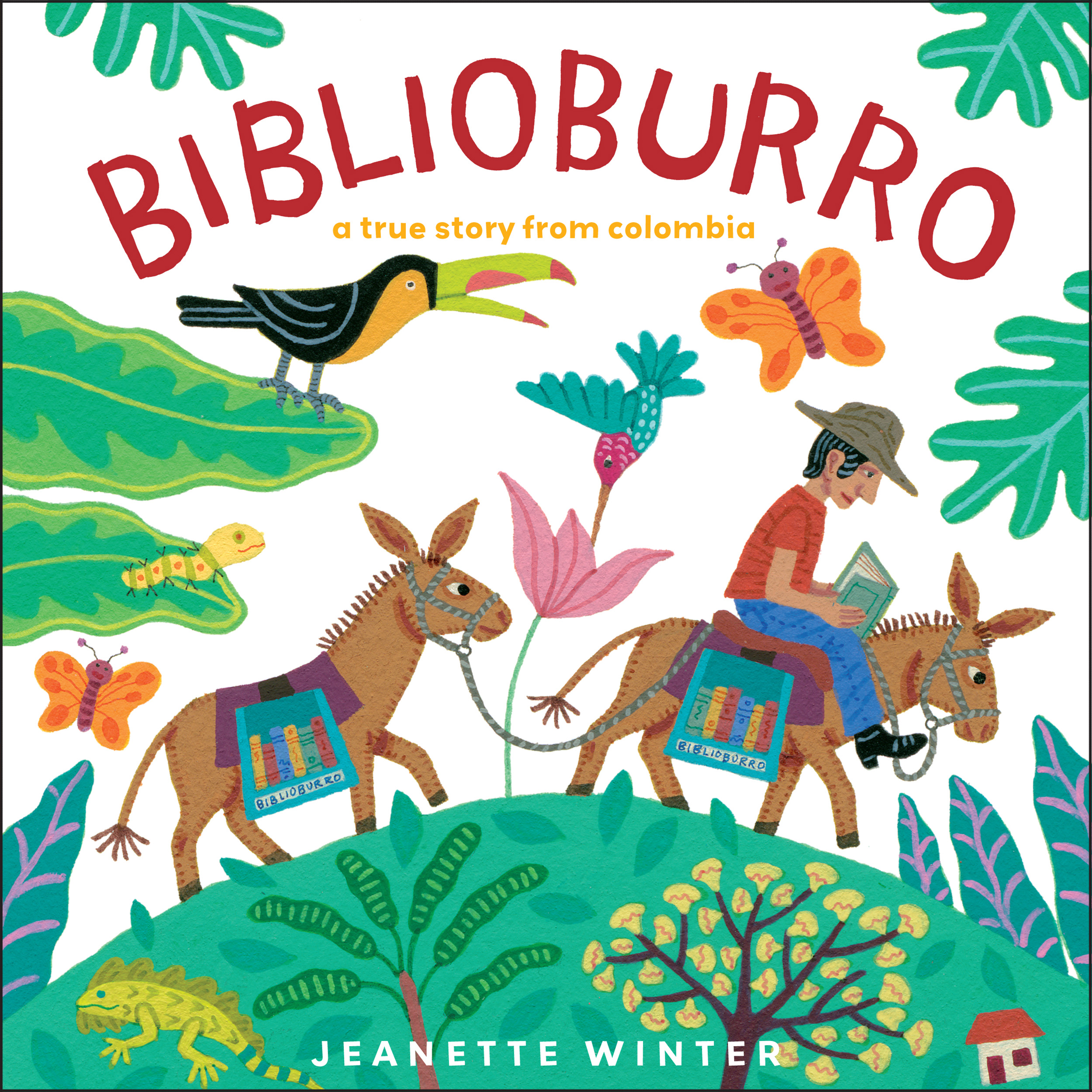
Biblioburro

Winter, Jeanette. 2010. Biblioburro: A true story from Columbia. New York: Beach Lane.

Biblioburro is a true story, simply told, about Luis and his two burros, Alfa and Beto.  Together they carry books to children in remote Columbian villages, undeterred by burning sun, long distances, or even a bandit seeking silver! (Luis gives him a book.)
Every week, Luis and Alfa and Beto set off across the countryside to faraway villages in the lonely hills.  This week they travel to El Tormento. ... The Biblioburro continues on its way over the hills, until at last, Luis sees houses below.  The children of El Tormento run to meet him.

The illustrations are reminiscent of the colorful traditional clothing or the small, hand-sewn trinkets that are sold as souvenirs in many South American Countries.   The book states that the "illustrations are rendered in acrylic paint with pen and ink," however, it appears that Winter has used fabric or felt and markers as well, to evoke a vibrant, rural feel.

Biblioburro is a joyful celebration of books and one man's determination to make a difference in the lives of children, and thus "a small corner of the world is enriched."  Highly recommended for ages 4 and up.

Please take the time to watch this video of Luis Soriano.  It's truly inspirational.


It's Nonfiction Monday again! Check out all of today's contributions at In Need of Chocolate. I'll be hosting next week!

Share |

Thursday, June 10, 2010

Grandma's Pear Tree

Santillan, Suzanne. 2010. Grandma's Pear Tree/El Peral de Abuela. Illustrated by Atilio Pernisco. McHenry, IL: Raventree.

Jessie has promised to stay away from Abuela's pear tree. When his ball gets stuck in the tree, he consults Abuelo, who advises him to throw his shoe at it. When "el zapato" becomes stuck, Tío suggests a broom ... a humorous and cumulative tale that contextually introduces Spanish words for family members and common items. Painted illustrations help readers and listeners make the English/Spanish connection without unnecessary explanation.  A surprise ending will keep listeners laughing. I took this book on an outreach visit to a preschool. Any book that has a room full of preschoolers yelling out the refrain, "¡Ay, caramba!" is a winner in my book! ¡Qué divertido! (What fun!)
 
A Spanish/English glossary is included, but curiously, does not contain the word peral, part of the title. I did not find it in the glossary, but verified later that peral is Spanish for pear tree.  (Being most accustomed to English, I did not realize that in Spanish there is a word that encompasses both the tree and its fruit.  How handy!)

Activity sheets are available from the publisher.


Share |

Friday, March 26, 2010

My Abuelita

Johnston, Tony. 2009. My Abuelita. Illustrated by Yuyi Morales. Boston: Harcourt.
(winner of a 2010 Pura Belpre Illustrator Honor)

A riot of brightly colored collage and puppet art infused with a Latino flair, accompanies this delightful story of a young child watching his Abuelita prepare for work.
While she cooks, she yodels about bedroom slippers. "Pantuflas - pantuflas - pantuflas!" "Yodeling loosens my voice," she explains, "for work." I know that already. My abuelita says it every day. But I like to hear it anyway.

So, what does Abuelita do for work that requires yodeling, a feathered crown, a plumed snake, a cloud-scarf? You'll have to read this enchanting story to find out!
Check out the cat!  Her name is Frida Kahlo!

Tuesday, January 26, 2010

Gracias Thanks


Mora, Pat. 2009. Gracias / Thanks (English and Spanish Edition). New York: Lee & Low.


A small boy is thankful for the many small things that we often take for granted,
For the ladybug that landed on my finger, a little red flying surprise, thanks. ... For my little brother, who threw mashed peas at my sister and made me laugh so hard I fell off my chair, thanks.
Each sentence is presented on a double-spread page, with Spanish appearing on one page and English on the next. The illustrations are done in a warm and weathered style, reminiscent of a well-worn, favorite desk or chair. The narrator is of Hispanic descent, his mother appears to be white, friends and schoolchildren are of varying races. All are portrayed with slightly oversized heads, highlighting soft and friendly features. Hispanic influence is prominent throughout the book - Spanish language books on the shelves, a brightly colored tile floor, palm trees, a red-tiled roof. His American side is apparent in the US dollar received from Abuelita, his baseball gear and posters, his English language homework, and sadly (humorously?) the garden gnome in the yard.

A cheery and light-hearted book of gratitude. Perfect for storytime and as a gentle reminder that we all have much to be thankful for; sometimes the little things are the most precious.

Friday, July 11, 2008

The Afterlife

Soto, Gary. 2003. The afterlife. Harcourt.

The Afterlife, by prolific and acclaimed author, Gary Soto, is both a serious and a humorous look at the meaning of a life. Upon his demise, Chuy is able to view his world from a new perspective, both literally and figuratively, as he floats above his hometown of Fresno.

He sees the distress of his friends and family, but notes that he will soon be forgotten, “a photo in a yearbook, nada más”. He realizes the value of a single life, as he tries with mixed success to save the life of a homeless man. He learns the uselessness of revenge as he faces his murderer. He meets Crystal, a ghost who may be his true love.

Characteristic of his short life, Chuy is able to float through the afterlife with a sense of wonder as well as a sense of humor. Watching the police break up a loud fighting couple, Chuy kicks back in the couple’s recliner, feet up. “This was better than a telenovela.” Later, unable to eat or drink, he spies a pot of coffee at his home, “I can’t believe it…I hadn’t even lived long enough to have coffee.”

In the end, the only answers to the mystery of the afterlife are the answers that Chuy finds for himself. He continues his journey; not regretful, but grateful.

The Afterlife is an intralingual young adult novel, liberally peppered with Spanish words and phrases. The use of Spanish gives color and authenticity to the story, however those readers unfamiliar with any Spanish words may find themselves constantly flipping to the included glossary. Other cultural markers in the story include a strong connection to the Roman Catholic faith, the close relationships between family and close family friends, and frequent references to typical Mexican foods. The Afterlife is not a stereotypical Mexican story featuring holidays, immigrants, migrants or food. Rather, The Afterlife is a fine example of Hispanic Literature that embraces the Mexican culture, yet appeals to any audience.

Friday, February 22, 2008

Doña Flor: A Tall Tale About a Giant Lady with a Great Big Heart

Mora, Pat. 2005. Doña Flor: A Tall Tale About a Giant Lady with a Big Heart. Ill.by Raúl Colon. New York: Knopf. ISBN 13: 9780375823374.

PLOT SUMMARY
Doña Flor is the epitome of the gentle-giant. With a house "as big as a mountain" and hands as "wide as plates," she has a heart to match, inspiring the love and respect of the people in her Southwest village. When a fearsome noise frightens the villagers, Doña Flor comes, as always, to the rescue. Raúl Colon won the 2006 Pura Belpré Illustrator Medal for his contribution to this fresh and inventive tall tale.

CRITICAL ANALYSIS
Pat Mora's, Doña Flor: A Tall Tale About a Giant Lady with a Big Heart, has the hallmarks of a classic tall tale, a multi-faceted heroine and rich details. Despite her overarching kindness, Dona Flor can be tired - as when the wind keeps her from sleep, angry - as she stomps off to find the puma that annoys the village, and indulgent - as she takes a "long, hot bubble bath," the smell of roses rising from the chimney. Her size and kindness are communicated expressively. "When she worked, Flor sang, and birds came and built nests in her hair."
"She gave the school band her hollyhocks to use as trumpets. The music smelled like spring."

Mora introduces multiple Spanish words in Doña Flor with varying techniques and effect. Literal translations are clear to the reader, but interrupt the story flow. "'¿Dónde estás? Where are you?' called her worried neighbors." Nonliteral translations include "Everyone called her Doña Flor because they respected her." and ""Mi casa es su casa," she said...so they knew they were always welcome." Most pleasing are the untranslated words, "Are you the chico who's causing all the trouble?" "Why, you're just a kitten to me, Pumito." These passages allow a smooth rhythm to the story with unfamiliar words fitting contextually into the sentence.

In addition to Spanish words, Doña Flor contains many textual references to the story's Southwest setting. Tortillas are prominently featured in the story; Flor makes tortillas with her huge "plate-sized" hands. The children use them as rafts and villagers use them as roofs for their homes. The village or pueblo is filled with adobe homes and is located near a tall mesa. Pumas, rattlers and coyotes inhabit the village.

Raúl Colon's award winning illustrations are a "combination of watercolor washes, etching, and colored and litho pencils." The muted, yet varied colors, evoke the Southwest atmosphere - dry and serene, yet not without life. Dona Flor herself has skin the color of the Southwestern soil, lips the color of adobe walls, and luxurious long dark hair - wrapped in a braided bun for the day's work and flying loose in the starlight sky at night. She appears to be a child of the Southwest earth itself. Her benevolent brown eye peers in the doorway of a village family. The home is adorned with a woven rug, a clay pot, and a sombrero; and although her eye fills much of the doorway, it does not inspire fear. Her giant tortillas provide rafts for the children, and in the evening, she envelops herself in a woven blanket, cradling the village creatures in her arms. Next to Doña Flor, the sky is the prominent feature in most of Doña Flor's illustrations portraying the vastness of the Southwest; dwarfing the whitewashed adobe homes and tiny villagers dressed in long skirts, serapes, and sombreros.

Doña Flor is an inventive tall tale, beautifully illustrated and told with rich details. When the sun shines upon the giant tortilla roofs of the villagers, the reader can almost smell the corn baking. "Mmmm, the houses smelled corn-good when the sun was hot." It also is a story with deep connections to the earth. Flor's mother sings to her in a voice as "sweet as river music," and in the evening, Flor makes her bed, filling her arms "with clouds smelling of flowery breezes." This is not a retelling or variation of a traditional tale. Readers will enjoy the fresh plot and it's surprising ending, as Flor finds the littlest mountain lion making the biggest of noises.

CONNECTIONS
Read the Doña Flor audience-participation poems on Pat Mora's website. http://www.patmora.com/ideas_dona.htm This is suitable for very young children and public library storytime as well.

Read this story with other "tall-tale heroine" books -
Thunder Rose, by Jerdine Nolan and Ill. by Kadidr Nelson and Sitka Rose by Shelley Gill and Ill. by Shannon Cartwright.

Compare these to the classic tale of Paul Bunyan.

Beneath the Waves - a review

As we read disturbing news accounts of dying manatees , environmental disasters caused by toxic waste, and ocean pollution on the scale of ...