Pages

Showing posts with label based on a true story. Show all posts

Wednesday, April 18, 2018

Alpha: Abidjan to Paris - a review

As you if you read my blog often, you know that I occasionally post adult books in addition to children's literature.  This is a powerful graphic novel that is also suitable for young adults, and I think it deserves attention. 


Alpha: Abidjan to Paris
By Bessora
Illustrated by Barroux
Translated by Sarah Ardizzone
Bellevue Literary Press, 2018

Alpha: Abidjan to Paris is a tragic, graphic novel account of one man's attempt to flee a life of misery in Côte d'Ivoire and follow his wife and child to Paris. After numerous attempts to depart legally, Alpha discovers that the process to obtain a visa is corrupt and impossible for an impoverished man. He researches his options carefully and strikes out with a group of other would-be emigrants. Although he knows the trip will be dangerous, he is nevertheless hopeful that he will be reunited with his family and his relatives in France. He fancies himself an "adventurer." His first-person account of his "adventures" devolves into a living nightmare as the journey drags on with a constantly changing group of companions. The prose is simple, and the story is told without embellishment—there is no need for embellishment; the facts are gruesome enough,

"Very quickly, I learn to avoid the barricades. We stop a lot. Abebi is vomiting froth. She has no bile left. She's spitting bubbles of saliva. We've been on the road for nine hours, and we still haven't covered a hundred miles. Darkness falls. Perhaps Abebi will feel better tomorrow. Augustine sucks his fingers in silence. It's a cold night. We sleep huddled together, forming a sort of human radiator. We can't even make a fire—the smoke would betray us."


The illustrations—one or two panels per page, are also spare—mostly shades of black and greys with an occasional splash of color—Alpha's red shirt, the striped soccer jersey of an emigrant hoping to land in Spain and play for Barcelona, a flowered dress. The illustrations set a mood of haste and simplicity, appearing to be marker sketches - almost as if they could have been made on the journey.

An epilogue provides the outcome of the trip from Abidjan to Paris. It will be difficult to look upon the plight of any refugees without reflecting on Alpha's journey. This is a short and powerful, award-winning graphic novel.

Alpha: Abidjan to Paris resources:


 My copy of Alpha was provided by LibraryThing Early Reviewers.

Saturday, November 11, 2017

Sticks 'n' Stones 'n' Dinosaur Bones - a blog tour and book giveaway


 (An Unhinged History Book)
By Ted Enik
Illustrated by G.F. Newland
Schiffer, 2017

Welcome to Day #5 of the Sticks ‘n’ Stones Blog Tour

To celebrate the release of Sticks ‘n’ Stones ‘n’ Dinosaur Bones, written by Ted Enik and illustrated by G.F. Newland, blogs across the web are featuring exclusive content about this humorous tall tale and giving away chances to win a copy of Sticks ‘n’ Stones ‘n’ Dinosaur Bones.  Below, you can find today's Rafflecopter giveaway and the location of other blog tour sites.

From the publisher:
This first book in Ted Enik and G.F Newland's "Unhinged History" series is a ripping yarn - full of adventure and deceit - that brings to life the best-known public spat in all of paleontology: the bitter rivalry between Edward Drinker Cope and Othniel Charles Marsh that became known as "The Bone Wars." Lively and witty rhymes plus beautifully demented illustrations by Newland reveal how the paleontologists' infamous rivalry began and how their mutual obsession with outdoing and ruining one another spun out of control.
 
Here's my takeaway on the book:

Stick 'n' Stones 'n' Dinosaur Bones is what I usually characterize as a picture book for older readers.  This one is unique in that it can appeal on several levels.  It's Seussian, sing-song nature and humorous illustrations will entertain even children too young to understand the book's overall concept.  It will attract kids interested in paleontology—and aren't all kids interested in paleontology at some point? And finally, it's useful in introducing the subject of information literacy.

Here's how:

The crazy one-upmanship and outright lies of Edward Drinker Cope and Othniel Charles Marsh may be fodder for laughs and entertainment, but it's useful to point out that belief in outlandish claims is nothing new in American history.  One need only look to today's internet, television, and newspaper articles to see rampant and competing claims of "fake news!"  What's an educated news consumer to believe?

Sticks 'n' Stones 'n' Dinosaur Bones can be an educational or cautionary tale about the need to investigate news sources and shun sensationalism.  Remember, the "Bone Wars" was not the only time that a gullible populace has fallen for exaggerated, overblown, or downright false claims. Jim Murphy's book, The Giant and how he Humbugged America (Scholastic, 2012) and Candace Fleming's The Great and Only Barnum: The Tremendous, Stupendous Life of Showman P. T. Barnum (Schwartz & Wade, 2009), are two stellar books for older readers that spotlight the gullibility of the general public and the great lengths that people will take to exploit it.

I can't wait to see what topic will be tackled next in the "Unhinged History" series.

a Rafflecopter giveaway


Schedule of Blog Tour
November 8: Books My Kids Read
November 10: Kid Lit 411
November 11: Shelf Employed
November 12: Frog on a Blog


From the publisher:
About the Author
Ted Enik has worked as an illustrator for most of the well-known New York publishing houses, applying his versatility to both original art as well as classic and current children’s book characters, including the Magic School Bus, the Eloise books, and the popular “Fancy Nancy I Can Read” series. This is the first picture book Ted has authored. It was first published in 2013 by Pixel Mouse House, New York, and honored as a Finalist in the American Book Fest’s 2014 Best Children’s Nonfiction and a Finalist in American Book Fest’s 2014 International Book Award for Best Children’s Nonfiction. Learn more about his books at unhingedhistory.com and his illustration at tedenik.com.
About the Illustrator
G.F. Newland is a part-time illustrator and the systems administrator at the School of Visual Arts, New York, NY. His doodles have found their way onto buttons, bags, posters, and T-shirts, and have been published by Scholastic, Hachette, and Pixel Mouse House. He lives in Brooklyn with his wife and a pet fish named Enki. Visit his website at gfnewland.com.

My copy of Sticks 'n' Stones 'n' Dinosaur Bones was provided by the publisher.

Note: This book trailer was created by a previous publisher.

Wednesday, June 7, 2017

Picture book audiobook reviews

Here are two audio books that I reviewed recently for AudioFile Magazine.  Both are historical fiction, picture books for older readers/listeners and are based on real events.


Flowers for Sarajevo by John McCutcheon is a child-centered look at living in a war-torn city. Though difficult to do, John McCutcheon coaxes optimism from misery. Read the full review for Flowers for Sarajevo at AudioFile Magazine.  

 Read an excerpt here: [http://peachtree-online.com/…/Flowers-for-Sarajevo-Excerpt.…]


The Cellist of Venice by Kim Maerkl with music by Bach, is a brief historical fiction audio book. Music and narration are combined to tell a magical, melancholy, musical, and mysterious story.  My full review of The Cellist of Venice is available from AudioFile in print or online.


Don't forget to check out Audiobook SYNC free audio books all summer! There are two titles available every Thursday.  One is a classic and one is a modern YA book with a similar theme to the classic.  Books are free and yours to keep!  Spread the word! You can find SYNC on Facebook.

[http://www.audiobooksync.com/]

Monday, December 7, 2015

Picture Book Roundup - December Holiday edition

Each year, hundreds of new holiday books are printed. Many are trite, forced, or pedantic—but not these gems.  Here are my five new favorites. Readjoice! 
  If you have trouble viewing the slideshow, visit it on Riffle.
Featured books:
  • A Homemade Together Christmas
  • Oskar and the Eight Blessings
  • Me and My Dragon: Christmas Spirit
  • Too Many Toys!
  • Miracle on 133rd Street

Monday, January 13, 2014

A Long Walk to Water - an audiobook review


I first reviewed Linda Sue Park's, A Long Walk to Water in 2010.  At the time, I wrote:
In an interview, author Linda Sue Park says that this was an easy book to write because she let Salva's story speak for itself.  Linda Sue Park gave Salva's powerful story a voice. Brief and straightforward, A Long Walk to Water is inspiring for its truth and simplicity.  Park eschews sentimentalism and allows Salva's understated dignity, perseverance and virtue to awe the reader.  No embellishment is necessary. This is a compelling story.  Highly recommended.
Recently, I was offered the opportunity to review the new audiobook version of A Long Walk to Water.  It was my pleasure. Following is my starred review of the audiobook as it appeared in the January, 2014, edition of School Library Journal.


A Long Walk to Water. By Linda Sue Park. 3 CDs. 2:45 hrs. Full Cast Audio. 2013. ISBN 9781936223121. $34.

Gr 5–9 -- Differentiated, African-inspired chapter introduction music assists in delivering this parallel story of two very different, but equally difficult, lives in Sudan. The story alternates between Nya, a composite character based on the lives of real girls, in 2008, and Salva, a young boy in the war-torn Sudan of 1985. Nya's life consists of the grueling and monotonous task of hauling water. All day, every day, her task is finding, acquiring, and transporting brown, dirty water to meet her family's needs. Salva's story unfolds in the midst of a horrific civil war. Separated from everything and everyone he knows, he spends more than 15 years walking across Sudan, Ethiopia, and Kenya, living in refugee camps, and struggling to survive. His is a true story based on the experiences of one of the "lost boys of Sudan." An echo effect is used to highlight the nagging questions that are always in the forefront of Salva's mind, "When will I see my family again?" and "What will become of me?" Readers David Baker and Cynthia Bishop worked with a dialect coach to ensure authenticity in pronunciation and accents. An update on Salva's ongoing project follows the story. Listeners will not ever leave the tap water running without thinking of this powerful story.

##

Copyright © 2013 Library Journals, LLC, a wholly owned subsidiary of Media Source, Inc.
 Reprinted with permission.


Note:
Amazon.com offers a free audio excerpt on the book's product page: http://www.amazon.com/A-Long-Walk-to-Water/dp/B00GJ6LE6S

It is heartbreaking to think that the tribal violence between the Dinka and Nuer that precipitated Salva's tortuous years of exile back in 1983, has erupted again in South Sudan, the world's newest country.

Monday, October 28, 2013

The Man with the Violin - a review

Stinson, Kathy. 2013. The Man with the Violin. Toronto: Annick Press.  Ill. by Dušan Petričić.

Kathy Stinson's story of a boy who is interested in his surroundings and captivated by the music of a performing violinist is perfectly complemented by the illustrations of Dušan Petričić. Targeted use of watercolors highlight the flow of music and joy emanating from the violinist and the spirited observations of the child. Wanting to linger, the boy is instead pulled along, forced to adhere to the busy schedule of his mother who hurries obliviously through the crowd.  In a satisfying conclusion, the mother later finds the time to appreciate and savor the music that so captivated her young son in the transit station.

Sure to be counted among one of 2013's best picture books, The Man with the Violin is a reminder that the world is often seen and heard best through the eyes and ears of a child.

While this is not actually a nonfiction book, it is based on a true story, an experiment done by the Washington Post.  Read the Washington Post article by Gene Weingarten and watch the actual footage of violin virtuoso Joshua Bell playing in the L'Enfant Metro Station in Washington, DC.  For almost 45 minutes, harried commuters passed by, barely noticing the music of Joshua Bell. There was indeed, a young boy who wanted so badly to watch the performance, but his mother was too pressed for time.  It's a lesson for us all.


For today's roundup of children's nonfiction book reviews, visit Booktalking, where author Anastasia Suen is hosting today's Nonfiction Monday.


Thursday, April 26, 2012

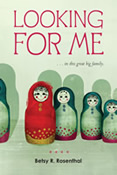
Looking for Me - a review

April is National Poetry Month, and I realize that I've almost let the month slip away without any poetry book reviews.  Just in time, I came across my Advance Reader Copy of Looking for Me, which went on sale April 17.


Rosenthal, Betsy R. 2012. Looking for Me. Boston: Houghton Mifflin Harcourt.

Based on the real stories of her mother and many aunts and uncles, Betsy Rosenthal tells a story in verse of her mother, Edith - the fourth child in a large, Jewish, Depression-era family in Baltimore,

Family Portrait, Baltimore, 1936

We're lined up:
girl boy, girl boy, girl boy, girl boy, girl boy

and in the middle of us all, Dad,
who ordered us to smile
right before the Brownie clicked,
standing stiff as a soldier
no smile on his face,

and Mom's beside him,
a baby in her arms
and in her rounded belly
another one,

just a trace.


Girl, boy, girl, boy, count them up - twelve children in a row house, sleeping three to a bed, always short of money, new clothes and food.  Edith's teacher asks her to write about her family, but she doesn't write about herself.  After all, who is she in this great big family?  Looking for Me chronicles Edith's quest to find individualism in a time when, seemingly, there was no time for such frivolous thoughts. Rosenthal's poetic style varies from free verse, to concrete to metered rhymes.  The subject matter varies as well - following the ups and downs of a year in Edith's life, which, while harsh and disciplined, also held moments of great joy and fun,

They're Lucky I Found Them

Lenny, Sol, and Jack
said Mom left them sleeping
on the sofa bed,
or so she thought,
and ran to the store.

But after she left,
they started to bounce
and bounce
and bounce some more.
Then the bed closed up

and they were stuck
until I came home
and changed their luck.

Some poems are heart-wrenching depictions of life as an 11-year-old Jewish girl who has been touched by death, poverty, meanness, bigotry, and indifference.  Others are uplifting,

Floating

I am a bubble
blown full
with Miss Connelly's words,

floating out of the classroom,
bobbing across the grassy lot,
drifting by Levin's Bakery,

letting the breeze carry me to the diner.
"WHERE HAVE YOU BEEN!?"
Dad yells when I come in,
but I just float right by him.

It's always said that it's best to write what you know.  This is Betsy Rosenthal's family, and she knows it well.  The poignant stories of her mother, aunts, uncles and grandmothers have lived on in her home, and she has done us the very great favor of inviting us in to hear them.

Monday, January 2, 2012

Titanic Sinks! a review

Barry Denenberg. 2011. Titanic Sinks! New York: Viking.

Employing the recently recovered journal of a fictional journalist on board the Titanic, Barry Denenberg has seamlessly and expertly blended fact and fiction  to create a gripping re-telling of the Titanic's doomed voyage.  Titanic Sinks! is well-researched and documented with extensive use of period photos.  Timelines, menus, and more are also included in this large-sized picture book for older readers.
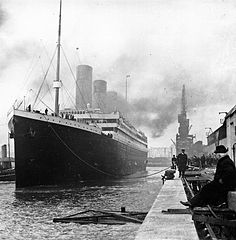
Titanic at the docks of Southampton
April 1912
Public domain photo
 As historical fiction, Titanic Sinks! is a phenomenally successful exercise in creating an exciting method of presenting history to young readers.  As nonfiction, Titanic Sinks! is a wealth of well-documented facts, quotes, photos, and timelines from one of modern history's worst and best-known disasters.  As a "unique presentation of fact and fiction," as stated on the book's jacket, I find Titanic Sinks! mildly troubling.  Barry Denenberg has done such a tremendous job of creating the fictional Modern Times magazine, complete with masthead, table of contents, an explanatory "Letter from the Publisher," and even editor's notes, that it will be difficult for readers (both young and old) to discern fact from fiction.  Granted, there is "A Word from the Author" in the book's final pages which explains the melding of fact and fiction, however, a reader might easily pass over the author's note, or be so convinced by the previous publisher's letter and editor's note that he is left confused and unsure of what is fact and what is fiction.

That being said, I would not discourage anyone from reading this compelling account of the Titanic's sinking.  In fact, I highly recommend it, but with a word of caution that some explanation may be in order.  Alternatively, it would make excellent subject matter for older students to learn the process of determining authenticity in a work of nonfiction.

Other reviews @
Kirkus
Publishers Weekly

Barry Denenberg's previous book, Lincoln Shot! is done is a similar vein. He is a prolific author of quality nonfiction and historical fiction titles.  His website offers a link to his blog Another Side, which, if you are a lover of history, you will find incredibly well-written and interesting!  It's now on my list of "must read" blogs.

It's Nonfiction Monday.  Today's roundup is at The Nonfiction Detectives.

Friday, September 30, 2011

Butterfly Tree: a review

At least once in a lifetime, we should be totally awed by the natural world – not by its destructive power, which so many have seen this year in the form of floods, hurricanes and fires; but by its beauty.

For me, it was a frigid late autumn evening about eight years ago.  It was the time of the annual Leonid meteor showers, and excellent visibility was in the forecast.  Excellent yes, but also in the wee hours of the morning on a bitterly cold night.  My husband agreed to be the advance scout.  We would prepare everything in advance – thermoses of hot coffee and cocoa, blankets, sleeping bags, and warm outerwear.  My husband would head up to the beach at 2am.  If the meteor showers were visible, he would come back to wake the kids and me. 

He came back and hurried us all to the beach where we parked our pickup truck facing west and sat in the bed of the truck gazing eastward.  The meteor showers were not just visible.  They were spectacular!  At least one meteor every second – zooming across the sky, long tails following behind.  As earth hurtled through the meteor storm for hours, we sat transfixed – unable to keep our eyes from the sky.  It was raining stars, and it was unspeakably beautiful!  The cold and darkness added to the atmosphere of quiet awe. Only a few hardy souls and families willing to spend the night on a Northeastern beach in November shared it.  When the sun began to rise in the east, we turned and faced the darker, western horizon to get a last look at what we knew was a once-in-a-lifetime experience.

This type of singular experience, this awesome display of nature’s beauty is the topic of Butterfly Tree by Sandra Markle and illustrated by Leslie Wu. (2011 Peachtree, Atlanta, GA)  In Butterfly Tree, Markle recreates, as she explains in the Author’s Note, the day she
happened to be on the beach when a migrating flock of monarchs crossed the lake and settled for the night.  Their arrival first seemed spooky – then magical.  Being surrounded by these golden-orange butterflies and seeing a tree totally covered with fluttering, shimmering monarchs was unforgettable.
Together, Markle and Wu perfectly capture that magical, dusky twilight on Lake Erie.  Wu’s dreamy pastel illustrations in brisk autumnal hues fill out the wide, double-spread pages.  The story is told through the voice of a young girl, heading home with her dog and her mother.  The text rests lightly on the page, arranged in verses that add depth and measure to the vibrant images,
An explosion
of golden orange bits
fills the sunlight
streaming between branches.

Wow! I exclaim.  They’re not leaves.
They’re butterflies.

Monarch butterflies, Mom says.

There must be hundreds – thousands.
The tree looks like it is in motion.
All the butterflies are slowing fanning their wings.

We are in an orange cloud.
Though it contains an "Author’s Note," "Traveling Monarchs," "Books," "Websites," and a migration map, this is not a nonfiction book; however, it deserves to be included in scientific discussion with children because it captures what so many books do not – the sense of wonder about the natural world, the sense of wonder that has driven man to push past the limits of our collective knowledge.

Highly recommended for grades K-2.

Read Sandra Markle's post on her book!


Today is the first time that I'm participating in STEM Friday.
  The roundup is at Chapter Book of the Day.  Stop by and check it out!

Tuesday, November 9, 2010

A Long Walk to Water

Park, Linda Sue. 2010. A Long Walk to Water. New York: Clarion.

A Long Walk to Water begins as the parallel stories of Salva, a young boy in the Southern Sudan of 1985 and Nya, a young Sudanese girl in the year 2008. 

Salva once had the life of a well-to-do villager's son.  His father owned many cows.  He attended school. He herded the cows.  But when the rebels arrived, shooting at everyone in the village, his life changed in an instant.  Now he is alone.  Get to the next hill, the next watering hole, the next day.  This is the mantra that keeps him going, one painful step at a time, searching for years for a safe haven - across deserts, war zones and countries.

Nya's life consists of providing water for her family.  When the brackish pond is full, she walks hours each day - first to the pond to collect water, then  home, carrying a full container upon her head.  After a quick meal of thin gruel, she has enough time for a second trip.  During the months when the pond is dry, her family relocates to a temporary shelter near a dry lake bed.  The work is easier there.  Nya spends all day digging in the mud, waiting for subterranean water to fill the hole she has dug with her bare hands.  She scoops out the water, one gourd full at a time and waits for the hole to refill.  It is tedious work and takes all day, but at least she does not have to walk for miles in the heat with the heavy water atop her head.

Park's minimal use of dialogue fits the stark landscape and mood of the story,
The nurse, a white woman, was talking to Nya's mother. "Her sickness came from the water," the nurse explained.  "She should drink only good clean water.  If the water is dirty, you should boil it for a count of two hundred before she drinks it."

Nya's mother nodded that she understood, but Nya could see the worry in her eyes.

The water from the holes in the lakebed could be collected only in tiny amounts.  If her mother tried to boil such a small amount, the pot would be dry long before they could count to two hundred.
Nothing else needs to be said.  How can a mother choose between dehydration and cholera for her children? 

As Salva's arduous journey continues, the years add on until Park has woven his story from the Sudanese Civil War years into the modern day Sudan of Nyla's time, of our time.  Sudan is Africa's largest country, full of wildlife and riches and oil and beauty and war and poverty and genocide and starvation. The reader can sense that the two stories will intertwine, but is at first, unsure how. When it becomes apparent how the lives of Salva and Nyla will intersect, it almost unbelievable, considering the circumstances.  And yet, their stories are true. Despite the overwhelming odds against Salva's survival, and Nyla's fragile subsistence existence, they do survive.

Salva, after more than ten years of wandering becomes one of the Lost Boys of Sudan, miraculously chosen from the untold tens of thousands of people in Kenyan refugee camps- chosen to start a new life in the United States.  And with his new life, he returns to repair his old one.

In an interview, author Linda Sue Park says that this was an easy book to write because she let Salva's story speak for itself.  Linda Sue Park gave Salva's powerful story a voice. Brief and straightforward, A Long Walk to Water is inspiring for its truth and simplicity.  Park eschews sentimentalism and allows Salva's understated dignity, perseverance and virtue to awe the reader.  No embellishment is necessary. This is a compelling story.  Highly recommended.

Review copy provided by NetGalley. Due on shelves, November 15, 2010.

 Linda Sue Park talks about A Long Walk to Water.


Watch Salva and see the work of his creation, the non-profit, Water for Sudan.


The November 2010 edition of National Geographic Magazine offers two feature articles on Sudan, "Sudan's Shaky Peace" and "The Lost Herds are Found."  Both are well worth reading.
Share |

Beneath the Waves - a review

As we read disturbing news accounts of dying manatees , environmental disasters caused by toxic waste, and ocean pollution on the scale of ...