Pages

Showing posts with label dinosaurs. Show all posts

Saturday, November 11, 2017

Sticks 'n' Stones 'n' Dinosaur Bones - a blog tour and book giveaway


 (An Unhinged History Book)
By Ted Enik
Illustrated by G.F. Newland
Schiffer, 2017

Welcome to Day #5 of the Sticks ‘n’ Stones Blog Tour

To celebrate the release of Sticks ‘n’ Stones ‘n’ Dinosaur Bones, written by Ted Enik and illustrated by G.F. Newland, blogs across the web are featuring exclusive content about this humorous tall tale and giving away chances to win a copy of Sticks ‘n’ Stones ‘n’ Dinosaur Bones.  Below, you can find today's Rafflecopter giveaway and the location of other blog tour sites.

From the publisher:
This first book in Ted Enik and G.F Newland's "Unhinged History" series is a ripping yarn - full of adventure and deceit - that brings to life the best-known public spat in all of paleontology: the bitter rivalry between Edward Drinker Cope and Othniel Charles Marsh that became known as "The Bone Wars." Lively and witty rhymes plus beautifully demented illustrations by Newland reveal how the paleontologists' infamous rivalry began and how their mutual obsession with outdoing and ruining one another spun out of control.
 
Here's my takeaway on the book:

Stick 'n' Stones 'n' Dinosaur Bones is what I usually characterize as a picture book for older readers.  This one is unique in that it can appeal on several levels.  It's Seussian, sing-song nature and humorous illustrations will entertain even children too young to understand the book's overall concept.  It will attract kids interested in paleontology—and aren't all kids interested in paleontology at some point? And finally, it's useful in introducing the subject of information literacy.

Here's how:

The crazy one-upmanship and outright lies of Edward Drinker Cope and Othniel Charles Marsh may be fodder for laughs and entertainment, but it's useful to point out that belief in outlandish claims is nothing new in American history.  One need only look to today's internet, television, and newspaper articles to see rampant and competing claims of "fake news!"  What's an educated news consumer to believe?

Sticks 'n' Stones 'n' Dinosaur Bones can be an educational or cautionary tale about the need to investigate news sources and shun sensationalism.  Remember, the "Bone Wars" was not the only time that a gullible populace has fallen for exaggerated, overblown, or downright false claims. Jim Murphy's book, The Giant and how he Humbugged America (Scholastic, 2012) and Candace Fleming's The Great and Only Barnum: The Tremendous, Stupendous Life of Showman P. T. Barnum (Schwartz & Wade, 2009), are two stellar books for older readers that spotlight the gullibility of the general public and the great lengths that people will take to exploit it.

I can't wait to see what topic will be tackled next in the "Unhinged History" series.

a Rafflecopter giveaway


Schedule of Blog Tour
November 8: Books My Kids Read
November 10: Kid Lit 411
November 11: Shelf Employed
November 12: Frog on a Blog


From the publisher:
About the Author
Ted Enik has worked as an illustrator for most of the well-known New York publishing houses, applying his versatility to both original art as well as classic and current children’s book characters, including the Magic School Bus, the Eloise books, and the popular “Fancy Nancy I Can Read” series. This is the first picture book Ted has authored. It was first published in 2013 by Pixel Mouse House, New York, and honored as a Finalist in the American Book Fest’s 2014 Best Children’s Nonfiction and a Finalist in American Book Fest’s 2014 International Book Award for Best Children’s Nonfiction. Learn more about his books at unhingedhistory.com and his illustration at tedenik.com.
About the Illustrator
G.F. Newland is a part-time illustrator and the systems administrator at the School of Visual Arts, New York, NY. His doodles have found their way onto buttons, bags, posters, and T-shirts, and have been published by Scholastic, Hachette, and Pixel Mouse House. He lives in Brooklyn with his wife and a pet fish named Enki. Visit his website at gfnewland.com.

My copy of Sticks 'n' Stones 'n' Dinosaur Bones was provided by the publisher.

Note: This book trailer was created by a previous publisher.

Friday, October 4, 2013

How Big Were Dinosaurs? a review

Judge, Lita. 2013. How Big Were Dinosaurs? New York: Roaring Brook Press.


Just how big were dinosaurs? Well, it's easy to offer an approximate size in feet or meters or tons or pounds - but what does that mean to the average child?  Not too much.  How Big Were Dinosaurs? uses cheerful comparative artwork to make common comparisons that children will easily understand.

Twelve dinosaurs are featured.

From the small,
MICRORAPTOR was a deadly hunter, but he would barely be able to look a modern-day chicken in the eye,
To the enormous,
ARGENTINOSAURUS. As long as four school buses, this dinosaur was probably the biggest animal ever to walk on land.  A full-grown adult weighed more than a herd of seventeen elephants.
A  double fold-out featuring each of the dinosaurs in the book is accompanied by a few pages titled, "How do we know how big dinosaurs were? A few suggested websites and books are also included.
Kids will finish this book with a great sense of the comparative sizes of dinosaurs.


Join STEM Friday!
  • Write about STEM each Friday on your blog.
  • Copy the STEM Friday button to use in your blog post.
STEM Friday

It's STEM Friday! (STEM is Science, Technology, Engineering, and Mathematics)
  • Link your post to the comments of our weekly STEM Friday Round-up. (Please use the link to your STEM Friday post, not the address of your blog. Thanks!)
Site Meter Copyright © 2013 All Rights Reserved.

Monday, June 11, 2012

Nonfiction Monday is here! Featuring DK Pocket Genius

Welcome, everyone!  I'm happy to be today's host for Nonfiction Monday,
a weekly gathering of bloggers writing about nonfiction books for kids. 

DK Publishing. 2012. Pocket Genius series. New York: Dorling Kindersley.

I've always loved camping, hiking, plants and the outdoors, but was never much of a bird watcher.  My husband, however, is a bird lover and can tell the difference between similar waterfowl or shore birds at a great distance.  The Audubon Society Field Guide to North American Birds has been a fixture in our house for ages.  After the addition of curious kids, we added the Field Guide to Seashore Creatures, North American Trees, and North American Insects & Spiders.  There's something very satisfying about these little books - a modern, non-lethal form of hunting perhaps.  I love that "Aha, I've found it!" moment when I discover the unknown bird in the yard or the little critter crawling on the windowsill.  So, it was with pleasure that I received the set of DK Pocket Genius guides for my branch.
 
Now granted, kids won't be able to spot a shark or dinosaur in the neighborhood and rush home to identify it, but the books are designed in much the same manner as adult field guides and will teach the same classification skills.  For example, Sharks begins with an overview of sharks, their common attributes, habitats and features.  The guide is then divided into two sections: Sharks and Rays, skates, and chimaeras.  Sections are then subdivided into types (e.g. Frilled and cow sharks) and then into the neat little photographic plates with which any fan of field guides is familiar.

Differing from adult guides, the informative text is presented in the same box as the photograph (no flipping to tissue paper thin pages in the rear).  Similar to adult guides, icons appear in each box.  These icons, however, are much more fun than a silhouette of a tree-clinging bird or coniferous tree!  The shark icon depicts a swimmer with a proportionally sized shark swimming above.  The Rocks and Minerals guide shows a hand next to the average size of a found specimen.  Animals and Dinosaurs icons compare a human body to the featured creature.

Each book also contains fun facts, an index and a glossary. And while they don't have the flexible, textured covers of National Audubon Society guides, they are still a cozy and satisfying size, about 5.5" x 6.5" x .5".  The publisher's suggested age for Pocket Genius books is 8 and up.

I may be nerdy, but I like them!

Future additions to the series will include: Ancient Egypt, Earth, Space and Bugs.

 I look forward to reading your offerings.   Add your link below using InLinkz.  Thanks!

Monday, October 24, 2011

Geronimo Stilton: Dinosaurs in Action

It's Nonfiction Monday.  So why am I featuring Geronimo Stilton, the "famouse" editor of "The Rodent's Gazette?"  Well, I just finished another great online ALSC course. Each participant was given the task of creating "club" based on a children's book series.  I chose the perennially popular Geronimo Stilton series. In researching ideas to use in my club, I discovered that the Scholastic Geronimo Stilton books are not the only Geronimo Stilton books.  There is a separate series published in graphic novel format by Papercutz.

Unlike the original Geronimo Stilton series, the Papercutz titles (I haven't read them all) are a blend of fact, fantasy and adventure, à la Magic Tree House. Following is a review of the 7th book in the series.

Stilton, Geronimo. 2011. Dinosaurs in Action. New York: Papercutz.

In the course of a slim, 50-page volume (equal in size to a typical beginning reader book), the reader is entertained by the adventures of Geronimo and his gang as they try to foil the plans of the dastardly Pirate Cats, while they are simultaneously educated in the classification and habits of dinosaurs in the Cretaceous Period. 
Both within the context of the dialogue,
Moldy Mozzarella! That's not a cloud.

It's a quezacoatlus!

It's enormous!

And looking for prey ...It's heading for us!

HIDE!

Look! It's going away.

Thank goodness ... I wouldn't have wanted to end up in its belly!

We were lucky! The quezacoatlus is the biggest flying animal that ever lived.
and in integrated panels that contain encyclopedia-style facts, the reader learns about each dinosaur featured in the story, as well as information on flowers, plants and prehistory in general. In keeping with the style of the original Geronimo Stilton series, the fonts in the dialogue bubbles are often varied in size, style or color.

Here's a page from the first book in the series (note the fact panel, bottom right):
 The Discovery of America ©Papercutz
The bottom line?  Geronimo Stilton definitely attracts reluctant readers.  The graphic novel format may attract even the most reluctant of reluctant readers.  Additionally, they're a source of facts that can be used to invoke interest in a topic (science, history, etc.), or a tool for teaching kids the ability to discern fact from fiction. 

Is it fact?  Is it fiction? Neither.  It's faction, and it's fun!


Reading Guides and Games for the several Geronimo Stilton graphic novels are available here.

You can find all eight titles in the graphic novel series, reading guides, previews and more on Papercutz' Geronimo Stilton pages.

For all things Geronimo Stilton related (TV, books, graphic novels), the official Geronimo Stilton website is here.

Today's Nonfiction Monday is at Apples with Many Seeds.  Stop by.

Friday, October 14, 2011

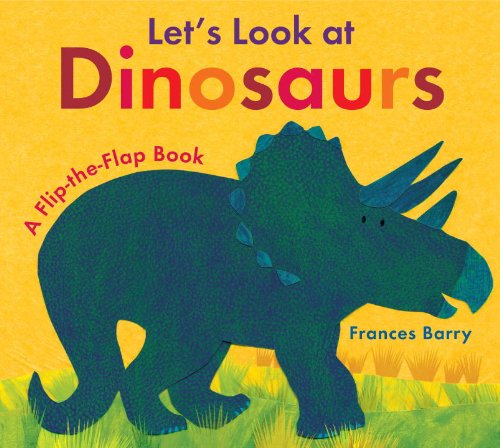
Let's Look at Dinosaurs - a review for STEM Friday

STEM Friday is here today!
(Science. Technology. Engineering. Mathematics.)
Please add your link below and thanks for stopping by!

Barry, Frances. 2011. Let’s Look at Dinosaurs: A Flip-the-Flap Book. Somerville, MA: Candlewick.

This book may skew a bit younger than your average STEM Friday contribution (ages 3-7), but it caught my eye for several reasons. First, I thought it needed rescuing. A thick (and very appealing) cover with substantial pages containing large foldouts and flaps, necessitates a wide and somewhat fluid spine. Due to the slack in the spine, or perhaps a difficult trip through the delivery process, mine already had a slight tear in the spine upon arrival. Since it’s such a nice book, I rescued it, and added it to my storytime collection, rather than putting it on the shelf.

It’s a worthy addition to the storytime collection, whether it needs rescuing or not. Many books about dinosaurs for the very young fall into one of two categories – too difficult or unrealistic. Let’s Look at Dinosaurs (567.9) strikes a perfect balance. The attractive collage art is both realistic and inviting. A wide book, its double-spread illustrations help convey the size of dinosaurs, though sadly, they are not in proportion to one another except on the front and end papers. Flaps are used for varying purposes: a 3D effect for the flying Pterodactylus, a neck extension for the huge Diplodocus, a pronounced frill for Triceratops. Each of the twelve dinosaurs represented has a foldout or pop-out component.
The artwork, however, is not the only draw for this book. Each dinosaur is listed by its name in large font, followed by a question,
I wonder why Anklyosaurus has a club at the end of his tail.

 The facing page contains a simple, large font answer,

It is made of solid bone; he uses it against attackers.

and strategically placed additional details in a smaller font, presumably for older readers,

Many dinosaurs had spikes and horns for protection against predators.

The final two spreads contain a very simple and concise explanation of fossils, and a cut out of dinosaur bones as seen in a museum.

Artwork and age-appropriate language and presentation make this a stellar introduction to dinosaurs.


Oh, one more thing – you’d better know your dinosaur pronunciations before reading this one aloud. You won’t find them here.
STEM Friday is looking for hosts for upcoming Fridays.  If you'd like to host, check out the STEM Friday site.
If you have difficulty using Inlinkz, please feel free to leave a comment and I'll add your post later.

Friday, April 16, 2010

Picture Book Roundup

In no particular order, these were some of the wonderful picture books
 that I found in my book bag this week! I loved them all.

Spinelli, Jerry. 2010.I Can be Anything! Illustrated by Jimmy Liao. New York: Little, Brown.

A rhyming romp through all of the possibilities of the future - "cross-legged sitter, make-believe critter, deep-hole digger, lemonade swigger." Who knows? Bright and joyful illustrations!

Fuge, Charles. 2010. Yip! Snap! Yap! New York: Sterling.

Another lively, rhyming romp! This one featuring delightfully goofy dogs!

Thomson, Bill. 2010. Chalk. Tarrytown, NY: Marshall Cavendish.

The illustrator of the exquisitely illustrated, Baseball Hour, Bill Thompson outdoes himself with Chalk - a wordless book that tells the story of a magical, rainy day at the playground for three children and a mysterious bag of chalk.  Let your imagination run wild and enjoy Bill Thomson's hand-crafted brilliance!

Geringer, Laura. 2010. Boom Boom Go Away! Illustrated by Bagram Ibatoulline. New York: Atheneum.

Music lovers, noise makers, and children who don't want to go to bed will love Boom Boom Go Away! Its cumulative rhyme is full of playfulness and imagination.  The warm illustrations evoke picture books of an earlier era.

Jeffers, Oliver. 2010. The Heart and the Bottle. New York: Philomel.

This is not a book for storytime.  It's a serious book for a special child - perhaps a grieving child, a child with a profound loss, a child who may have placed her heart in a bottle, a child who needs to know that there is a way to retrieve her own heart.  Gently and tastefully done.

Bottner, Barbara. 2010. Miss Brooks Loves Books (And I Don't). Illustrated by Michael Emberly. New York: Knopf.

The tagline for the book is "a librarian and a contrarian face off in this tale of a very reluctant reader." I predict that this will become a librarian favorite! When Miss Brooks assigns a book report (in costume!) for Children's Book Week, it prompts the best line in the book -
When I get home, I ask my mother if we can move to a new town. My mother says there's a librarian in every town.
 Too funny!

Thursday, April 17, 2008

Dinosaur Trouble

King-Smith, Dick. 2008. Dinosaur Trouble. New York: Roaring Book Press.

This short J novel by prolific children's writer, Dick King-Smith was first published in Britain in 2005. Dinosaur Trouble is actually historical fiction mixed with elements of fantasy. A young pterodactyl, Nosy, makes friends with Banty, an apatosaurus - despite bias by both sets of parents against the other species. The personified dinosaur children learn to work together in the common interest of avoiding the fearsome Tyrannosaurus Rex, Hack the Ripper.

This tongue-in-cheek novel fills a gap. Many children are huge dinosaur fans. Other than non-fiction selections and picture books, I have not seen any novels featuring dinosaurs. This one is chock-full of humor, large words (Nosy's mom, Aviatrix, is quite the erudite pterosaur), and factual information about the Jurassic age.

This book is a great choice for fiction-seeking, young dinosaur enthusiasts.

Beneath the Waves - a review

As we read disturbing news accounts of dying manatees , environmental disasters caused by toxic waste, and ocean pollution on the scale of ...