Pages

Showing posts with label animals. Show all posts

Tuesday, March 10, 2020

Nature's Ninja - a review

Nature's Ninja: Animals with Spectacular Skills
By Rebecca L. Johnson
Millbrook, 2019


Below is my review as it appeared in the October, 2019, edition of School Library Journal.


Gr 4-9–Animals are compared to Japan's medieval ninja warriors in this picture book for older readers. Nine chapters follow an introduction offering background information on the practiced arts of the ninja. Each chapter features an animal with natural abilities closely aligned to a particular ninja skill and begins with the skill highlighted in a stylized text box—"CHOHO: Spying—infiltrating an enemy's camp or society without being discovered." Rove beetles have the natural ability of a choho master. Amazingly, they look, smell, and even behave like army ants, living among the wellknown predators. They've even been seen eating army ant larvae! Geckos and sailfish are among the other featured creatures. In addition to a description of the animal's ninja- like skill, there is a section on each creature titled "The Science Behind the Story." Photographs and scientific graphics illustrate each comparison. Back matter is comprehensive and includes a glossary, index, and "Meet the Scientists." VERDICT Both the premise and execution of this title are intriguing. Steer older students toward this book; they will not be disappointed.

Sunday, June 2, 2019

Giraffe Problems - a review

Giraffe Problems


by Jory John
Illustrated by Lane Smith
Random House, 2018


Below is my review of Giraffe Problems as it appeared in School Library Journal. Oct 2018, Vol. 64 Issue 10, p55, 2 p.


PreS-Gr 2-In a follow-up to Penguin Problems, John and Smith team up again and bring their zany brand of comedy. Edward the giraffe has a problem with his neck—it's just too necky. Who wants such a long neck? "Everybody stares at it. This guy. That guy. Him. Her. Them. Whatever that is. Her again." Edward envies his fellow African animals, who generally respond unfavorably. When Edward admires the zebra's classic stripes, the zebra snaps, "Quit staring at me," but it takes a self-effacing turtle named Cyrus to convince him that his neck is just perfect. A foldout page reveals Edward using his neck for its intended purpose. In a beautiful introduction to the uniqueness of a giraffe's spots, Smith has created large, block-printed spots in natural colors to adorn the end pages. The textured print continues throughout, visible in the hides of animals, the bark of trees, and the textured ground of the African plain. Of course, there is the theme of self-acceptance and a bit of sublime silliness as well, especially in Edwards's fruitless attempts at camouflage and in the expressively simple eyes of Cyrus the turtle. VERDICT This book will appeal to older preschoolers as well as elementary school kids, and would lend itself perfectly to dramatic interpretation or an art lesson in sponge or block printing.

Copyright © 2018 School Library Journal, the property of Media Source, Inc.  Reprinted here with permission.

Peek inside Giraffe Problems.


My copy of Giraffe Problems was provided by SLJ.
 

Wednesday, December 19, 2018

Picture book roundup - upcoming, new, and translated

Here are a few books that have recently come to my attention—one upcoming, one fairly new, and one newly translated.

Madeline Finn and the Shelter Dog 
By Lisa Papp
Peachtree, 2019

Sometimes a second book in a series doesn't measure up to the first. Madeline Finn and the Shelter Dog not only measures up, it surpasses Madeline Finn and the Library Dog. It's a wonderful story of dog adoption, volunteering, responsibility, reading, and libraries. What's not to love?

Due on shelves near you in March, 2019.

There's a Dinosaur on the Thirteenth Floor
By Wade Bradford
Illustrated by Kevin Hawkes
Candlewick, 2018

A smartly dressed bellhop, old-fashioned phones, and the slicked back hair, pince-nez, and bow-tie of Mr. Snore set up the retro atmosphere of this book on the first pages. Mr. Snore’s immediate need is also quickly apparent,

“Welcome to the Sharemore Hotel,” said the bellhop.
“You must be Mr. Snore. Let me show you to your room.”

“The sooner the better,” said Mr. Snore.
“I am very” —YAWN—“sleepy.”

But, alas, Mr. Snore is destined to have a long night before he finally finds a place to rest his head—and his hysterically large nose! On each floor, Mr. Snore finds himself paired with an unsuitable roommate, prompting continued calls to the ever-cheerful bellhop.

The generous 10x11 size of this book is the perfect showcase for this delightful high-rise hotel and its unusual occupants. Over-the-top illustrations are a perfect complement for often understated, but droll dialogue,

“How do you feel about bees?” asked the bellhop.
“The same way I feel about spiders,” said Mr. Snore.
“Please skip the sixth floor.”

The expressions of creatures and humans are priceless, popping in bright acrylics and ink. Even with the spoiler in its title, There’s a Dinosaur on the 13th Floor will still surprise you!


Hello Lilac — Good Morning, Yellow
by Judith Drews

Hello Lilac — Good Morning, Yellow is a book about colors that's perfect for very young listeners and sure to invite conversation and participation. Each color is featured on a two-page illustration with a very simple introduction,
"Good day, Brown. You look so cuddly."
On the facing page, you will find things that are commonly in that color, e.g., soil, basket, door, bun

What is so interesting in this book translated from German, is the phrasing and choice of items.  For example, orange's page says
"Dear Orange,  I prefer to eat you cold."
An unusual sentiment, but understandable from a child's point of view.  What child doesn't prefer a crisp carrot or juicy orange to cooked squash?

On the brown page, in addition to the above, you will find poop (!).  On the white page, amidst the more common items (snowman, egg, bone, sheep), you'll find toilet paper, a syringe, and a plug.  These choices seem peculiar, but they give us an insight into parenting in Germany, and they reflect the wide variety of items that kids will actually see, whether we choose to point them out or not!  Also making them more endearing is the fact that they are drawn in a manner similar to a child's drawing.

So, go ahead - point out those jellyfish, trophies, bird cages, screws, and gnats.  I'm sure it will result in some interesting conversation! The more I look at it, the more it grows on me. Peek inside Hello Lilac Good Morning, Yellow

Wednesday, December 5, 2018

The Ugly Five - a review


The Ugly Five
By Julia Donaldson
Illustrated by Axel Scheffler
Scholastic, 2018

Below is my review of The Ugly Five as it appeared in School Library Journal. Enjoy!

DONALDSON, Julia. The Ugly Five. illus. by Axel Scheffler. 32p. Scholastic. Jul. 2018. Tr $17.99. ISBN 9781338249538. PreS-Gr 2—This rhyming book takes place on the African plain and introduces a collection of animals not known for attractiveness, but beloved by their children nonetheless. It begins with an introduction to the wildebeest, and she soon sings a song that is repeated with variations throughout the book, “I’m the ugly one, I’m the ugly one. I’m the ugliest animal under the sun. My ungainly appearance is second to none. I’m the ugly one, I’m the ugly one.” Wildebeest meets up with spotted hyena, lappet-faced vulture, warthog, and marabou stork, and the song reflects each addition. Scheffler is a frequent artist for Donaldson and has the perfect approach for her lighthearted prose. The “ugly” beasts are not ugly at all, but endearing, with wide-eyed faces expressing playfulness while picking through garbage, crunching bones, shredding carrion, and wallowing in mud. Comical illustrations in bright, but natural colors, are unadorned by text or borders. Each features a natural habitat with plenty of creatures and small details for observant eyes to seek. The satisfying and happy ending for the actually “lovely five” is depicted in a richly hued spread. Safari notes follow the story, which is prefaced by an author’s note. VERDICT Playful and positive, this book is an introduction to creatures of the African plain and a reminder that beauty is in the eye of the beholder. 


School Library Journal. Jul2018 Copyright © 2018 School Library Journal, the property of Media Source, Inc.  Reprinted here with permission.

My copy of The Ugly Five was provided by School Library Journal.

Tuesday, September 25, 2018

So Far Up - a review


So Far Up
by Susanne Strasser
Charlesbridge, 2018

So Far Up is a perfect book for sharing with toddlers. It's simple and repetitive, it introduces various animals and opposites,and it has a simple story line. The only thing that could make it better would be a larger size for sharing with bigger groups. It is a 5"x7" board book.

I tested it in storytime and it was a hit. 

My copy of So Far Up was provided by the publisher at my request.

Monday, August 20, 2018

The Bat Can Bat - a review

The Bat Can Bat: A True Book of Homonyms
By Gene Barretta
Christy Ottaviano, 2018

Below is my review of The Bat Can Bat as is appeared in School Library Journal.


BARRETTA, Gene. illus. by Gene Barretta. 40p. Holt/Christy Ottaviano Bks. Feb. 2018. Tr $17.99. ISBN 9780805099461.
Gr 2-4–Sports and animals are perennially popular, and Baretta uses them as the common denominator in this collection of illustrated homonyms. It begins with the easily understood “The bat can bat!” featuring a bat playing baseball, then progresses to more difficult examples. The font is simple, in black or white, depending on the background color of the full-bleed illustrations. The homonyms are printed in capital letters. The use of horizontal and vertical spreads is helpful in explaining the finer points of homonyms. One of the vertical illustrations features a two-tiered, high diving board—the top deck hosts an angry, red-faced rhino who is throwing a fit over the fit of his ridiculously tiny swimsuit. For comic relief, on the lower diving deck, a young girl casts a nervous glance upwards. A “Note to the Reader” includes useful definitions of homonyms, homophones, and homographs. VERDICT More concept book than storybook, this is a fundamental purchase for school libraries and public libraries with heavy educator usage.

See a preview of The Bat Can Bat at the Macmillan Publishers site.

School Library Journal. Feb2018, Vol. 64 Issue 2, p54-56. 2p.
Copyright © 2018 School Library Journal, the property of Media Source, Inc.  Reprinted here with permission.


My copy of The Bat Can Bat was provided by School Library Journal.

Friday, August 3, 2018

Terrific Tongues - a review


Terrific Tongues!
By Maria Gianferrari
Illustrated by Jia Liu
Boyds Mills Press, 2018


I have to wait a few months before I am permitted to re-post reviews I write for School Library Journal, but here it is—better late than never.

I tested this book in a school classroom. The kids enjoyed it and were able to remember the differences between the animals' tongues. 😛

GIANFERRARI, Maria. illus. by Jia Liu. 32p. Boyds Mills. Apr. 2018. Tr $17.95. ISBN 9781620917848.

PreS-Gr 3–An expressive monkey acts as a guide to the animal kingdom's most interesting tongues. Liu chooses the monkey's own mouth to illustrate, literally, the many things a tongue is similar to—straw, sword, nose, and mop. In each instance, Gianferrari's simple analogy appears in large font with a humorous illustration. “If you had a tongue like a sword, you might be a…” In the first example, the monkey's tongue is actually a sword as he dukes it out with a fencer. On the following page, we discover the answer, “Woodpecker!” and see a rendering of a woodpecker in its natural habitat, its long pointed tongue stabbing underneath the bark of a tree. A short paragraph explaining the workings of the animal's tongue is embedded within the illustration. Readers will enjoy finding the monkey in each habitat, too. Eleven creatures are featured in similar fashion. Back matter offers greater detail and also explains the workings of the human tongue. The appealing cover and bright, cheery illustrations will capture the attention of even casual browsers. VERDICT A fine addition to early nonfiction collections.


School Library Journal. Feb2018, Vol. 64 Issue 2, p112-112. 2/9p.

Copyright © 2018 School Library Journal, the property of Media Source, Inc.  Reprinted here with permission.


It’s STEM Friday! (STEM is Science, Technology, Engineering, and Mathematics)
See more nonfiction books reviews at the STEM Friday blog.

Wednesday, October 4, 2017

One Cheetah, One Cherry - a review


One Cheetah, One Cherry: A Book of Beautiful Numbers
Otter-Barry Books

My review as it appeared in School Library Journal:

 PreS –A simple animal counting book with a regal air. Each number is represented on a spread featuring a single type of animal, with dogs and mice being the only household varieties. In an interesting juxtaposition, the animals are lifelike and stately, yet playfully attired or engaged. Pandas sport “pretty painted parasols,” tigers play “pat-a-cake,” and mice sip from tiny china teacups. The subdued, earthy watercolor tones are accurate for each species, but the settings and attire have a hint of majesty as a result of the addition of gold leaf and a repeated paisley background motif, often in purple. Also adding a degree of opulence is a rich, mottled ochre color suggesting marble. No seeking or finding is necessary; the animals are large in scale and neatly arrayed for easy counting. White border space on the bottom of each page provides the location for simple, descriptive text that is sometime alliterative, sometimes loosely rhymed: “Two dogs, two balls, one big, one small.” Endpapers offer further opportunities for counting and contain the only numerical representations of the numbers one through 10. VERDICT A unique, artistic addition to the counting canon.

My review copy was provided by School Library Journal

Monday, June 30, 2014

What's New? The Zoo! - a review

Krull, Kathleen. 2014. What's New? The Zoo!: A Zippy History of Zoos. New York: Scholastic.  Illustrated by Marcellus Hall.


What's New? The Zoo? is an illustrated overview of zoos that combines history with hard science and social science.  Kathleen Krull outlines the history of zoos, and offers insight into what compels us to keep animals, what we've learned from them, and what has changed in zoos since the founding of the first known zoo,

4,400 Years Ago, The Sumerian City of Ur, in Present-Day Iraq
The king of beasts lunges and roars.  The King of Ur roars right back, feeling like the ruler of all nature.  How delicious to wield his power over dangerous animals!  It's the world's first known zoo, and all we're sure about (from clay tablets in libraries) is that is has lions.
From this beginning, Krull highlights transitional moments in zoos throughout the ages and across the globe.  Just a few examples include:

  • Ancient Egypt and Rome where zoos were created to impress
  • Ancient China where the zoo was a contemplative and sacred place
  • Sweden where the science of zoology was established in 1735
  • The U.S. National Zoo where the concept of zoos protecting threatened species was introduced
  • South Africa's Kruger National Park where the protection of rhinos was so successful that rhinos were delivered to other zoos
  • Germany, 1907, where the "cageless zoo" concept is introduced
(Did you know that Aristotle wrote the first encyclopedia of animals?)

On most pages, humorous, watercolor illustrations nestle around paragraphs of simple font against white space.  Several pages, however (including one depiction of fifteen buffalo waiting for a train at Grand Central Station, 1907), are double-spreads with many amusing details.

The very talented Kathleen Krull never disappoints!  If you like your science accessible and entertaining, this is the book for you.

A SLJ interview with Kathleen Krull on the history of zoos.

Monday, March 17, 2014

Baseball Animals - a review


Whether or not you buy MLB's position that Opening Day is March 22, 2014 in Australia (Sorry Australia, baseball "down under" just doesn't feel right), baseball season, will soon be here. Opening Day for the US and Canada is March 31.

If you are a baseball fan, are raising a young baseball fan, or are trying to connect with a young baseball fan, here's the book for you - a marriage of baseball and animals!


Jordan, Christopher. 2014. Baseball Animals. Plattsburgh, NY: Fenn/Tundra.

Which MLB team shares its name with a songbird that loves acorns?
This blue, black and white bird is thought to be responsible for spreading the oak tree across North America.

If the beautiful photograph of my favorite bird on a stark white background doesn't give you the answer, just turn the page to reveal a full-page action shot of a Toronto Blue Jays batter. (Sorry that I don't know which one. Since they beat the Phillies in the 1993 World Series, I refuse to pay attention to the Blue Jays. We fans have long memories.)

Each baseball page features the team's logo, a full-page action photo taken at the ballpark, and some team uniform trivia.  Did you know that the Cardinals (often called the Redbirds) were not named for the beautiful bird, but rather for the color of their original uniforms? Their uniforms were cardinal red. So, presumably they are named after the traditional color of a Catholic cardinal's cassock.  Now that's a great baseball trivia question!

Fun and informative, this is a must-have for little baseball fans. I don't know why someone didn't think of it earlier!  An Appendix of MLB Teams and Logos rounds out the book - featuring all of the teams - even those sans animals on their logos.


Advance Reader Copy supplied by LibraryThing's Early Reviewers program.


In addition to being St. Patrick's Day, today is Nonfiction Monday.  Be sure to stop by the Nonfiction Monday blog for all of today's featured books.


Monday, July 8, 2013

Aesop's Fables - everything old is new again


McGovern, Ann. 2013. Aesop's Fables. New York: Scholastic.
Advance Reader Copy

First published in 1963, Ann McGovern's Aesop's Fables is a collection of over 60 of Aesop's classic fables.  Readers will recognize some, like "The Boy Who Cried Wolf" and the "Lion and the Mouse," but others will likely be new to the reader.  Some may be a familiar surprise.  Most will know the phrase, "one good turn deserves another," but not many will know that it came from Aesop's fable of "The Ant and the Dove."

There are several things to like about McGovern's telling of Aesop's fables.  Because fables were originally an oral tradition, these are short and succinct stories.  None of these stories take up more than two pages in this small (5 1/4 x 7 5/8 inches) book; many are only a half page. Their brevity offers up many possibilities.  They can told quickly - as part of a library storytime, as short bedtime stories, or even as an introduction to a school lesson on animal behavior.  Though fables were based on the deeds and misdeeds of men, the characteristics assigned to each animal generally bear some resemblance to the actual animal's abilities.  Fables also invite imagination and embellishment.  They're perfect for creating short plays, puppet shows, and flannelboard stories.

As Aesop and McGovern remind us in "The Man and the Lion,"

How a story ends often depends on the storyteller.

Read Aesop's Fables, have fun, tell some stories!


Here's a copy of the original cover from the 1963 Scholastic Apple Classics version of Ann McGovern's book.  Amazon has a "look inside" feature for this book. In comparing the two, it appears that in addition to new cover art, the new version, has simplified the language.  For example, the moral in "The Fox and the Grapes" has been changed from
Which proves, of course, that it is easy to despise what you know you cannot possess,
to
It is easy to speak badly about what you cannot have. 

(Italics and bold sections are as they appear in the books)

These are subtle differences, but should make the fables accessible to a younger audience.  In fact, the target audience has been changed from Grades 4-6, to Grades 2-5.  My copy is an Uncorrected Proof, but it appears that the interior artwork will remain unchanged.

Aesop's Fables will be available in hardcover, paperback and e-book versions in September, 2013 - just in time for school.


Be sure to visit Abby the Librarian to see all of today's Nonfiction Monday posts!


For those of you who are "non-librarian" folks, you may be wondering why I'm featuring fables on Nonfiction Monday.  Classic fables and folktales are found in the library with the Dewey Decimal Classification of 398 or Folklore, and more specifically, 398.2. Both are sub-classifications of the broader category of Customs, Etiquette, and Folklore.  "Fractured" folk and fairy tales, or re-tellings that change the setting and/or characters, are often shelved with fiction.

Librarians and all may enjoy a peek at what may be found on Etsy when searching "398.2."  Some of these items also show up when searching "geekery."
;)


Note:
I have no connection with Etsy, other than the fact that I love checking out the great offerings there!

Monday, May 20, 2013

Primates - a review


I borrowed this one from a colleague - hated to give it back.


Ottaviani, Jim. 2013. Primates: The Fearless Science of Jane Goodall, Dian Fossey, and Biruté Galdikas. New York: First Second. (Illustrated by Maris Wicks)
(Advance Reader Copy)

The stories of pioneering primate researchers Jane Goodall, Dian Fossey and Biruté Galdikas are woven together in this nonfiction graphic novel by award-winning Jim Ottaviani.  Most know Jane Goodall because of her  long and storied career with chimpanzees. Many know Dian Fossey and her work with gorillas and from the film, Gorillas in the Mist (Universal Pictures, 1988). Lesser known is Biruté Galdikas, a pioneer in the study of orangutans.

Besides the obvious primate connection, another connection unites these three women and the threads of Primates: The Fearless Science of Jane Goodall, Dian Fossey and Biruté Galdikas.  Goodall, Fossey and Galdikas were all hired by famed archaeologist, Louis Leakey.  Amazingly, when hired, none were experienced researchers.  Goodall had no college experience; Fossey's profession was occupational therapist. Only Galdikas was a college student with an intent to study primates. Leakey believed that women were more insightful and better suited to understand primate behavior.  The book hints that he may also have been attracted to the three women, noting his wife's skepticism.

The chronology works well in Primates, which is less biographical and more an intense look at a fascinating period of scientific research in the field of primate studies. Hired by Leakey over a period of several years, Goodall left for Tanzania to study chimpanzees in 1960, Dian Fossey to Congo (later Rwanda) in 1967, to study gorillas, and Galdikas to research orangutans in Borneo in 1971. Ottiavani tells the three stories chronologically in first person commentary, with each story spilling over into the next.  Wicks employs different color dialogue boxes to differentiate the researchers when their lives intersect in London at various points in time. During the course of their careers, the women met, knew, and understood each other.

Equal time is given to the behavior and locale of the primates, and the monumental discoveries and personal sacrifices of each woman.  Goodall discovered that chimpanzees use tools. Little was know about orangutans before Galdikas' research. Fossey made many behavioral discoveries about gorillas and worked tirelessly against poaching.  All three changed long-standing methods of animal observation. In the case of Fossey, Primates alludes to her tragic and untimely death, but does not mention her murder, instead showing an image of the the side-by-side headstones of Fossey and her favorite silverback gorilla, Digit. Wicks' illustrations are simple, but invoke the intense colorful beauty of the primates' habitats, the uniqueness of each primate species, the vastness of the forests and jungles and the incredible difficulties of three humans living within their midst.

An author's note explains where narrative license was used within the story.

Primates: The Fearless Science of Jane Goodall, Dian Fossey, and Biruté Galdikas will surely evoke an urge to learn more about these three fascinating women and the primates to whom they devoted their lives. An engaging and thought-provoking book for ages 12 and up.

Due on shelves in June, 2013.

Learn more at
Jane Goodall Institute
Orangutan Foundation International
There are also many nonprofits dedicated to the protection and conservation of gorillas.


It's Nonfiction Monday.  Check out the always interesting Perogies & Gyoza,
for links to all of today's nonfiction book reviews and postings.

Monday, August 13, 2012

Who's Looking at You? a review


Frattini, Stéphane. 2012. Who's Looking at You? New York: Sterling.

Eighteen 8"x8" pages feature eighteen different eyes peering out at the reader.  Each eye is on a flap nearly as big as the page with a narrow, brightly colored frame surrounding it.  Open the flap to see "who's looking at you," and learn a few facts, focused, not surprisingly, on the eye.
Snail
How did this hungry snail find the leaf? Snails can't see very well - they mostly depend on touch and smell to find their way.  But most snails do have eyes, right at the ends of two bendable tentacles called eyestalks.
The snail is actually one of the easier eyeballs to recognize.  Very young children won't find many easy guesses as it's surprisingly difficult to determine some animals from a single eye, but slightly older kids will have fun with Who's Looking at You?  Even the adults at the library were enjoying this one!  Some of the featured eyeballs are those of the gorilla, wolf, cuttlefish, chameleon, and blue-spotted grouper.  The butterfly is a bit of stretch - the photo features the "fake" eye that some butterflies sport on their wings to fool predators.  The inside back cover contains eight additional eyes for guessing, with small flaps hiding nothing more than the animal's name.

The photography is beautiful and the guessing is fun!


Monday, June 11, 2012

Nonfiction Monday is here! Featuring DK Pocket Genius

Welcome, everyone!  I'm happy to be today's host for Nonfiction Monday,
a weekly gathering of bloggers writing about nonfiction books for kids. 

DK Publishing. 2012. Pocket Genius series. New York: Dorling Kindersley.

I've always loved camping, hiking, plants and the outdoors, but was never much of a bird watcher.  My husband, however, is a bird lover and can tell the difference between similar waterfowl or shore birds at a great distance.  The Audubon Society Field Guide to North American Birds has been a fixture in our house for ages.  After the addition of curious kids, we added the Field Guide to Seashore Creatures, North American Trees, and North American Insects & Spiders.  There's something very satisfying about these little books - a modern, non-lethal form of hunting perhaps.  I love that "Aha, I've found it!" moment when I discover the unknown bird in the yard or the little critter crawling on the windowsill.  So, it was with pleasure that I received the set of DK Pocket Genius guides for my branch.
 
Now granted, kids won't be able to spot a shark or dinosaur in the neighborhood and rush home to identify it, but the books are designed in much the same manner as adult field guides and will teach the same classification skills.  For example, Sharks begins with an overview of sharks, their common attributes, habitats and features.  The guide is then divided into two sections: Sharks and Rays, skates, and chimaeras.  Sections are then subdivided into types (e.g. Frilled and cow sharks) and then into the neat little photographic plates with which any fan of field guides is familiar.

Differing from adult guides, the informative text is presented in the same box as the photograph (no flipping to tissue paper thin pages in the rear).  Similar to adult guides, icons appear in each box.  These icons, however, are much more fun than a silhouette of a tree-clinging bird or coniferous tree!  The shark icon depicts a swimmer with a proportionally sized shark swimming above.  The Rocks and Minerals guide shows a hand next to the average size of a found specimen.  Animals and Dinosaurs icons compare a human body to the featured creature.

Each book also contains fun facts, an index and a glossary. And while they don't have the flexible, textured covers of National Audubon Society guides, they are still a cozy and satisfying size, about 5.5" x 6.5" x .5".  The publisher's suggested age for Pocket Genius books is 8 and up.

I may be nerdy, but I like them!

Future additions to the series will include: Ancient Egypt, Earth, Space and Bugs.

 I look forward to reading your offerings.   Add your link below using InLinkz.  Thanks!

Monday, July 11, 2011

Little Kids' First Big Book of Why

Shields, Amy. 2011. Little Kids' First Big Book of Why.Washington, DC: National Geographic.

A fun book for several reasons, the First Big Book of Why asks many of the great questions that occur to children, but grownups never ponder.  "Why can I see myself in a mirror?" "Why do the stairs seem to disappear on an escalator?" "Why does the moon change shape?" 

In addition, it's a great title to booktalk or share on school visits.  Just read a few pages and kids will want to know more.

And, it's a great browsing book.  Just leave it out and someone will find something interesting inside.

The questions are highlighted by large font in colored text boxes and the pages are brightly colored with photos of kids and the things which keep them wondering. The answers are short and sweet with bold font for the most important points,
Why does Grandma have wrinkles?
Skin grows and stretches as you grow from baby size to adult.  When you've been an adult for a while, skin stops growing and stretching.  It gets a little tired and a little less elastic.
The lines you make when you smile today are where your wrinkles will be when you are old.  A lifetime of laughter helps your skin wrinkle very nicely.
Nicely put!

Although this is a great browsing book, it is divided into four themed chapters, Amazing Me, How Things Work, Animals All Around and Wonders of the World.  In addition to the questions and answers, there are scattered text boxes and insets with interesting facts and experiments.  Little Kids' First Big Book of Why has a Table of Contents, a Glossary (albeit a very small one), Parent Tips, and Additional Resources.

Want to know why doughnuts have holes and why your toes get wrinkly in the tub?  You'll have to read it to find out! Nonfiction fun for lower elementary school grades.

Yes, it's Nonfiction Monday again and today's roundup is at proseandkahn.

Thursday, May 19, 2011

May picture book roundup

I am in the midst of transferring from one branch to another, and I now have two desks overflowing with great new books!  Here are a few:
Gibbs, Edward. 2011. I Spy with my Little Eye. Somerville, MA: Templar. (Candlewick)

That big (almost 2.5"), yellow, circular eye on the cover is actually a hole - an oh, the things we can spy through that hole!  On a predominantly white spread with an eye on the left page and a circle of blue on the right, we read,
I spy with my little eye  ... something that is blue. "I am the biggest animal in the world."
Turn the page to find a richly colored blue whale, which due to some artfully placed curlicues, manages to appear realistic and at the same time, fanciful.

I'm a BLUE WHALE.
Each featured animal unfolds in the same manner.  The rear cover of the book features a hole for your own little eye to go spying! Colors, animals, guessing - this book has it all!
Edward Gibbs is listed as a "debut artist."  What a debut! This one's dynamite!

Tusa, Tricia. 2011. Follow Me. Boston: Harcourt.

From the book jacket, here is the description of the art,
The illustrations in this book were done using an etching process with monoprinted color.  The text type was set in Prin.  The display type was set in Rats and Carrotflower.
(Rats and Carrotflower? - love that one!)  What this means to me is a softly-colored book with fanciful drawings outlined in etched brown lines.  The color sometimes spills out of its intended (?) perimeter in much the same way that the young protagonist spills out of her swing and floats and flies through the breezes, "lost in small, green, happy music."  She invites the reader to follow her through all of nature's colors, "deep into brown, into the bright white of yellow, into orange that slips into red."   From the illustrator of In a Blue Room, another beautiful book!


Johnson, Lindsay Lee. 2011. Ten Moonstruck Piglets. Ill. by Carll Cneut. Boston: Clarion.

All in a scramble,
all ready to gambol,
ten moonstruck piglets
on a midnight ramble.

Through the mud wallow,
beyond the wide hollow,
leapfrogging piglets
in turns lead and follow.
It's all fun and games until the moon goes behind a cloud!  But not to worry - Mama's coming.  These sleepy-eyed, wrinkly little runts are irresistible!

Where Ten Little Piglets is filled with amusing detail, this next book features uncomplicated simplicity ... (but in both books, you can count on mom to the rescue!)

Monday, April 18, 2011

Time for a Bath, Time to Eat

It's Nonfiction Monday again!  (where does the week go?) 

Just a short post today because I'm on vacation. 
 I'll try to post a photo or two later in the week and perhaps you can guess where I am. 
Here's a hint: It's a great town for baseball and ducklings.  Feel free to make a guess in the comments. 

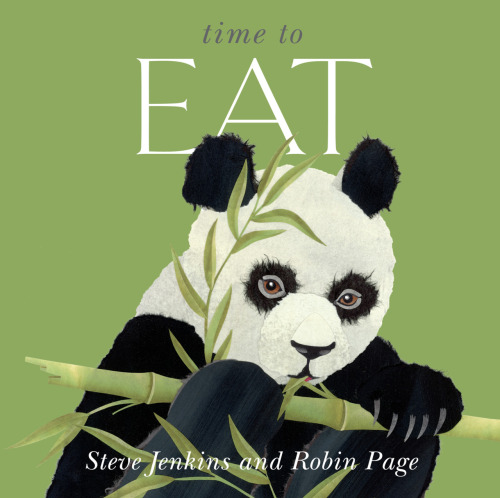
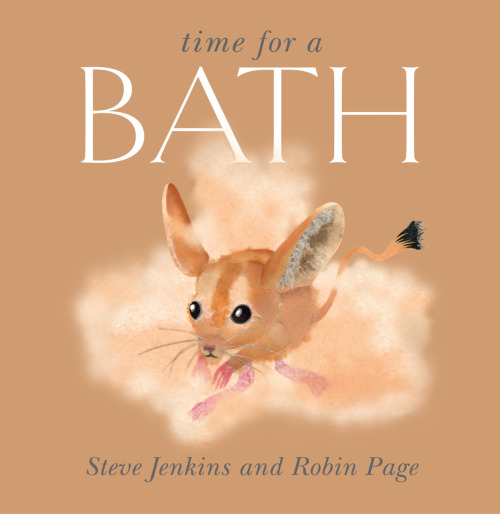
Here are two great new offerings from the talented duo of Steve Jenkins and Robin Page.

Time to Eat and Time for a Bath. 2011. Boston: Houghton Mifflin.

Illustrated in typical Steve Jenkins style, these small (81/4" square), attractive books feature the ways in which various animals eat and bathe.  The facts presented are particularly interesting, especially for young children,
Got milk?  Like all mammals, the baby blue whale drinks milk. A lot of milk - the equivalent of 800 glasses every day.  On this rich diet, a young whale can gain 200 pounds 991 kilograms) every twenty-four hours.
Don't want to take a bath?  How about a shower?
Rainy day bath The hummingbird takes its bath on a rainy day, perching on a branch and spreading its wings in a downpour.
The final pages include lengthy paragraphs of general information on each featured animal.


There is a  third book in this series, Time to Sleep, but my branch did not have a copy. I'm sure it's great as well.

Today's roundup is at The Cat and the Fiddle.
Stop by and check out all of today's Nonfiction Monday posts.

Beneath the Waves - a review

As we read disturbing news accounts of dying manatees , environmental disasters caused by toxic waste, and ocean pollution on the scale of ...