Pages

Showing posts with label science. Show all posts

Friday, August 3, 2018

Terrific Tongues - a review


Terrific Tongues!
By Maria Gianferrari
Illustrated by Jia Liu
Boyds Mills Press, 2018


I have to wait a few months before I am permitted to re-post reviews I write for School Library Journal, but here it is—better late than never.

I tested this book in a school classroom. The kids enjoyed it and were able to remember the differences between the animals' tongues. 😛

GIANFERRARI, Maria. illus. by Jia Liu. 32p. Boyds Mills. Apr. 2018. Tr $17.95. ISBN 9781620917848.

PreS-Gr 3–An expressive monkey acts as a guide to the animal kingdom's most interesting tongues. Liu chooses the monkey's own mouth to illustrate, literally, the many things a tongue is similar to—straw, sword, nose, and mop. In each instance, Gianferrari's simple analogy appears in large font with a humorous illustration. “If you had a tongue like a sword, you might be a…” In the first example, the monkey's tongue is actually a sword as he dukes it out with a fencer. On the following page, we discover the answer, “Woodpecker!” and see a rendering of a woodpecker in its natural habitat, its long pointed tongue stabbing underneath the bark of a tree. A short paragraph explaining the workings of the animal's tongue is embedded within the illustration. Readers will enjoy finding the monkey in each habitat, too. Eleven creatures are featured in similar fashion. Back matter offers greater detail and also explains the workings of the human tongue. The appealing cover and bright, cheery illustrations will capture the attention of even casual browsers. VERDICT A fine addition to early nonfiction collections.


School Library Journal. Feb2018, Vol. 64 Issue 2, p112-112. 2/9p.

Copyright © 2018 School Library Journal, the property of Media Source, Inc.  Reprinted here with permission.


It’s STEM Friday! (STEM is Science, Technology, Engineering, and Mathematics)
See more nonfiction books reviews at the STEM Friday blog.

Saturday, November 11, 2017

Sticks 'n' Stones 'n' Dinosaur Bones - a blog tour and book giveaway


 (An Unhinged History Book)
By Ted Enik
Illustrated by G.F. Newland
Schiffer, 2017

Welcome to Day #5 of the Sticks ‘n’ Stones Blog Tour

To celebrate the release of Sticks ‘n’ Stones ‘n’ Dinosaur Bones, written by Ted Enik and illustrated by G.F. Newland, blogs across the web are featuring exclusive content about this humorous tall tale and giving away chances to win a copy of Sticks ‘n’ Stones ‘n’ Dinosaur Bones.  Below, you can find today's Rafflecopter giveaway and the location of other blog tour sites.

From the publisher:
This first book in Ted Enik and G.F Newland's "Unhinged History" series is a ripping yarn - full of adventure and deceit - that brings to life the best-known public spat in all of paleontology: the bitter rivalry between Edward Drinker Cope and Othniel Charles Marsh that became known as "The Bone Wars." Lively and witty rhymes plus beautifully demented illustrations by Newland reveal how the paleontologists' infamous rivalry began and how their mutual obsession with outdoing and ruining one another spun out of control.
 
Here's my takeaway on the book:

Stick 'n' Stones 'n' Dinosaur Bones is what I usually characterize as a picture book for older readers.  This one is unique in that it can appeal on several levels.  It's Seussian, sing-song nature and humorous illustrations will entertain even children too young to understand the book's overall concept.  It will attract kids interested in paleontology—and aren't all kids interested in paleontology at some point? And finally, it's useful in introducing the subject of information literacy.

Here's how:

The crazy one-upmanship and outright lies of Edward Drinker Cope and Othniel Charles Marsh may be fodder for laughs and entertainment, but it's useful to point out that belief in outlandish claims is nothing new in American history.  One need only look to today's internet, television, and newspaper articles to see rampant and competing claims of "fake news!"  What's an educated news consumer to believe?

Sticks 'n' Stones 'n' Dinosaur Bones can be an educational or cautionary tale about the need to investigate news sources and shun sensationalism.  Remember, the "Bone Wars" was not the only time that a gullible populace has fallen for exaggerated, overblown, or downright false claims. Jim Murphy's book, The Giant and how he Humbugged America (Scholastic, 2012) and Candace Fleming's The Great and Only Barnum: The Tremendous, Stupendous Life of Showman P. T. Barnum (Schwartz & Wade, 2009), are two stellar books for older readers that spotlight the gullibility of the general public and the great lengths that people will take to exploit it.

I can't wait to see what topic will be tackled next in the "Unhinged History" series.

a Rafflecopter giveaway


Schedule of Blog Tour
November 8: Books My Kids Read
November 10: Kid Lit 411
November 11: Shelf Employed
November 12: Frog on a Blog


From the publisher:
About the Author
Ted Enik has worked as an illustrator for most of the well-known New York publishing houses, applying his versatility to both original art as well as classic and current children’s book characters, including the Magic School Bus, the Eloise books, and the popular “Fancy Nancy I Can Read” series. This is the first picture book Ted has authored. It was first published in 2013 by Pixel Mouse House, New York, and honored as a Finalist in the American Book Fest’s 2014 Best Children’s Nonfiction and a Finalist in American Book Fest’s 2014 International Book Award for Best Children’s Nonfiction. Learn more about his books at unhingedhistory.com and his illustration at tedenik.com.
About the Illustrator
G.F. Newland is a part-time illustrator and the systems administrator at the School of Visual Arts, New York, NY. His doodles have found their way onto buttons, bags, posters, and T-shirts, and have been published by Scholastic, Hachette, and Pixel Mouse House. He lives in Brooklyn with his wife and a pet fish named Enki. Visit his website at gfnewland.com.

My copy of Sticks 'n' Stones 'n' Dinosaur Bones was provided by the publisher.

Note: This book trailer was created by a previous publisher.

Friday, July 21, 2017

Seashores - a review


About Habitats: Seashores
by Cathryn Sill
Peachtree, 2017

Approximately 40% of U.S. residents live near the coast, yet there is a dearth of nonfiction titles for very young readers on the topic.  Seashores fills this gap with beautiful, painted illustrations by wildlife artist, John Sill.  The illustrations are reminiscent of Audubon's style. Cathryn Sill offers very simple observations,

Plants have to be tough to live in the salty spray, strong winds, and hot sunshine at seashores.
Each sentence is in a large simple font on a white background.  The accompanying illustration is on the facing page.  In a nod to all types of seashores, there are depictions of muddy flats, rocky cliffs, palm-ringed beaches, and beaches from across the globe.  Wildlife and bird life are accurately represented in each location.

There is only one sentence or thought per page, however, for older readers, a note at the bottom offers the title and plate number of the illustration.  The author's Afterword lists each plate number with a small representation of the illustration and a paragraph that more fully describes the scene.  For the quote above, the description reads,

Many seashore plants grow close to the ground for protection from the wind.  Others have thick and waxy leaves that make it easier to store water.  Some have leaves covered with tiny hairs that protect the plant from the heat.  Pink Sand Verbenas have thick, water-storing leaves.  They live in sandy soil along the western coast of North America.
A Glossary and Bibliography complete the book.  The suggested age range for About Habitats: Seashores is from 3-7.  This is a lovely, educational book that will appeal to shore dwellers and mid-staters alike.


A Teacher's Guide for the About Habitats series is available here.


My copy of Seashores was provided by Peachtree Publishers.  It will be on a shelf near you in August.

Tuesday, February 16, 2016

Infinity and Me - an audiobook review

Although I reviewed a print version of Infinity and Me book several years ago (my original review is linked here), I recently had the opportunity to review the audio version for School Library Journal.  My review as it appeared in the February, 2016, edition of SLJ is below.

HOSFORD, Kate. Infinity and Me. 1 CD w/tr book. 44 min. Live Oak Media. 2015. $29.95. ISBN 9781430120049.

K-Gr 3—A small girl, Uma, ponders infinity while gazing at stars, “How many stars were in the sky? A million? A billion? Maybe the number was as big as infinity.” Uma proceeds to ask friends and family how they conceive of infinity. They define it in quantities of numbers, time, music, ancestors—even spaghetti! Finally, she settles on her own measure of infinity, quantified in something that is personal and boundless. Narrator Nancy Wu is accompanied by a full cast of characters, music, and sound effects that complement the text and the book’s full-bleed, painted illustrations by Gabi Swiatkowska. Background sound effects include a bicycle bell, the “tinkling” of stars, chattering voices, and churning gears. A sense of wonder is embodied in Wu’s narration, the illustrations, and the overall production. The audiobook contains two tracks, one with page turn signals and one without. VERDICT This is an intriguing introduction to a mathematical concept, perfect for those seeking to inspire very young people to wonder about math and science. [“This quiet jewel is sure to spark contemplation and conversation": SLJ 10/12 review of the Carolrhoda book.]

 ##

Copyright © 2016 Library Journals, LLC, a wholly owned subsidiary of Media Source, Inc.
Reprinted with permission.


Wednesday, April 22, 2015

Audiobook reviews

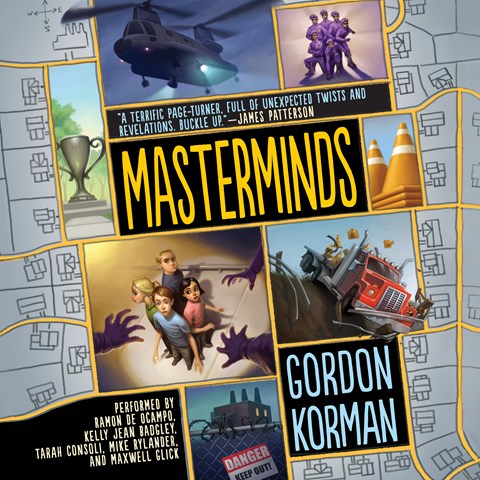
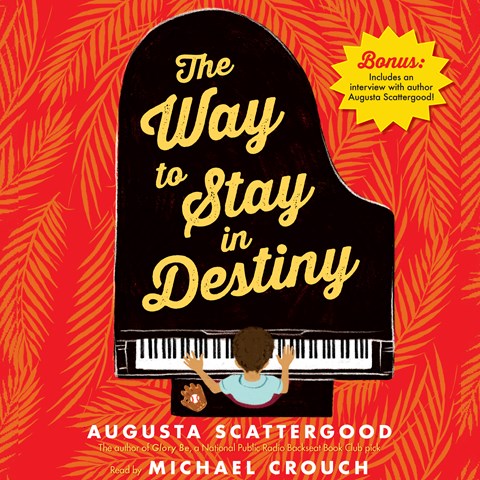
I recently reviewed two audiobooks with a peculiar connection.  Masterminds is a thriller set in the seemingly perfect town of Serenity, New Mexico.  The Way to Stay in Destiny is a character-driven novel set in the woefully imperfect town of Destiny, Florida.  Neither town is quite what it seems.  Click the links to read the complete reviews.

Masterminds by Gordon Korman.  Read by a cast of five(2015) 

[http://www.audiofilemagazine.com/reviews/read/98783/]
A contemporary science thriller set in New Mexico - a real page-turner!  This is the first in a planned series.  I'm not sure how he can top this one!


 [http://www.audiofilemagazine.com/reviews/read/99246/]
Historical fiction set in 1970s Florida by the author of Glory Be. Another paean to the power of music.  (Try Echo by Pam Muñoz Ryan, too!)


I'm confident that either of these is great in print as well.

Friday, February 13, 2015

Star Stuff: Carl Sagan and the Mysteries of the Cosmos - a review

Sisson, Stephanie Roth. 2014. Star Stuff: Carl Sagan and the mysteries of the cosmos. New York: Roaring Brook.

In simple text augmented by word bubbles, thought bubbles, and sketches, Stephanie Roth Sisson gives us the highlights of Carl Sagan's lifebut more importantly, she offers a sense of his wondrous enthusiasm for the cosmos,

It gave Carl goose bumps to think about what he had learned about the stars, planets, and the beginnings of life.  He wanted everyone to understand so that they could feel like a part of the stars as he did.
So he went on television.


This is the first book that Stephanie Roth Sisson has both written and illustrated.  The fact that she is enthralled with her subject is apparent in the artwork. Painted cartoon images (often in panels with word bubbles), depict a happy Sagan, wide-eyed and curious.  While some pages are like panel comics, others are full-bleed, double spreads depicting the vastness of the darkened skies, dotted by planets or stars.  One foldout opens vertically, reminding us of our infinitesimal existence in the cosmos.  We are so small, yet we are reminded,

The Earth and every living thing are made of star stuff.
Star Stuff is a 2015 NCTE Orbis Pictus Award Honor book for "outstanding nonfiction for children."

Substantial back matter includes Author's Note, Notes, Bibliography and Sources, Special Thanks, and Source Notes.

Preview the first eight pages of Star Stuff on the publisher's website.

Note: 
Carl Sagan graduated from Rahway High School in Rahway, NJ.  As far as I can tell, he's not mentioned anywhere on the school's website. Pity.


It's STEM Friday! (STEM is Science, Technology, Engineering, and Mathematics)
See all of today's STEM-related posts at the STEM Friday blog.

Monday, May 19, 2014

Great Men and Women in the History of Medicine - an audiobook review


Angus, David. 2013. Great Men and Women in the History of Medicine. Read by Benjamin Soames. Naxos Audiobooks.

It is a shame that this compendium of influential people in the history of medicine is not available in print or e-book format.  It would be a great reference for students doing research or biography reports.  Don't let the audio book format deter you, however.  As I wrote in my review for AudioFile Magazine (linked below), Benjamin Soames conveys a fascination for his topic that is infectious! (pun intended)

Some of the people featured in Great Men and Women in the History of Medicine include:
Hippocrates, Galen, Hildegard of Bingen, Ibn Sina, Al-Razi, Andreas Vesalius, William Harvey, Edward Jenner, Crick and Watson.  You may not know their names, but their discoveries have benefitted you.  I'm not sure of the best audience for this book, but I can tell you that I thoroughly enjoyed it.

Read my review of  Great Men and Women in the History of Medicine for AudioFile Magazine here.

Listen to an audio sample of Great Men and Women in the History of Medicine here.

Read all of today's nonfiction reviews at the Nonfiction Monday blog!

Friday, January 24, 2014

Parrots over Puerto Rico - a review

Roth, Susan L. and Cindy Trumbore. 2013. Parrots Over Puerto Rico. New York: Lee & Low.


I'll be the first to admit that when it comes to nonfiction books about the natural world, I prefer photography to artistic renderings.  Of course, there are always exceptions.  Jim Arnosky's, Thunderbirds (Sterling, 2011) and Martin Jenkins', Can We Save the Tiger? (Candlewick, 2011) come to mind.

Parrots Over Puerto Rico, however, is an extraordinary exception. Using highly detailed collage art, and employing many textured and brightly colored materials, Susan L. Roth has created a book that accurately portrays the colors of the island and evokes the stunning beauty of the endangered parrots of Puerto Rico. Designed to be read "portrait style," the collages cover about 2/3 of each double-spread layout.  Cindy Trumbore's narrative appears in a simple black font in the bottom third of the collage against a plain, complementary-colored background.

As stunning as it is, the artwork is not the only thing to love about Parrots over Puerto Rico. An astute teacher's dream, Parrots takes a holistic view of the parrots' rapid decline and slow slog back to viability in the wild.  As the story of the American Bison is forever entwined with the story of American Westward expansion, the Puerto Rican's parrot story is entwined with that of the Tainos, the Spaniards, and the Americans, as well as that of invasive species, and natural disasters like Hurricane Hugo.

Existing for millions of years on the island of Puerto Rico, they once numbered in the hundreds of thousands, and by 1975, had dwindled to only 13.

Above the treetops of Puerto Rico flies a flock or parrots as green as their island home.  If you look up from the forest, and you are very lucky, you might catch the bright blue flashes of their flight feathers and hear their harsh call.
These are Puerto Rican parrots.  They lived on this island for millions of years, and then they nearly vanished from the earth forever.  This is their story.

An Afterword contains photographs and information on the Puerto Rican Parrot Recovery Program.  Also included is a timeline of Important Dates in the History of Puerto Rico and Puerto Rican Parrots, and Author's Sources.
Among others, Parrots Over Puerto Rico can boast of these awards:


  • Starred Reviews in: Kirkus Reviews, Publishers Weekly, School Library Journal, Booklist, The Horn Book Magazine
  • Original Art 2013, Society of Illustrators
  • Books for Youth Editors' Choice 2013, Booklist 
  • Junior Library Guild Selection


You can see a preview of Parrots Over Puerto Rico on Lee & Low's website, however, it doesn't do the book justice, as the preview is in landscape mode, while the actual bound book reads lengthwise.  Still, it's worth a gander.


 Check out this short video if you'd like to see an actual Puerto Rican parrot.


  Join STEM Friday! We invite you to join us!
  • Write about STEM each Friday on your blog.
  • Copy the STEM Friday button to use in your blog post.
STEM Friday

It's STEM Friday! (STEM is Science, Technology, Engineering, and Mathematics)
  • Link your post to the comments of our weekly STEM Friday Round-up. (Please use the link to your STEM Friday post, not the address of your blog. Thanks!)
Site Meter Copyright © 2014 L Taylor All Rights Reserved.

Monday, November 18, 2013

Electrical Wizard - a review


Rusch, Elizabeth. 2013. Electrical Wizard: How Nikola Tesla Lit Up the World. Somerville, MA: Candlewick.  Ill. by Oliver Dominguez.


While Thomas Edison was busy lighting up big American cities with his new invention, Nikola Tesla was pondering the current that made it possible.  While watching a college professor demonstrate a new electrical machine,
Inspiration flashed.
Nikola realized that the motor didn't need to be run by direct current.  Alternating current, like the kind created by the hand crank, could power the motor. Sticking with alternating current would be simpler than converting to direct current -- and it would eliminate that awful sparking.
His professor scoffed, and when Nikola Tesla traveled to the United States to meet his hero, Thomas Edison scoffed, too.  Although he gave Tesla a job, Edison saw Tesla's alternating current (AC) idea as a direct competitor to the power grid he had already set up using direct current (DC).  The two men had a falling out and became rivals in the race to power the United States.

Despite Edison's attempts to discredit Tesla's AC, which Edison considered (or at least feigned to consider) more dangerous, it was Nikola Tesla's alternating current that became the standard for the US, due largely to its spectacular debut at the 1893 Chicago World's Fair, the culminating event of Electrical Wizard: How Nikola Tesla Lit up the World.

Tesla polyphase exhibit at 1893 worlds fair

Inside the 1893 World's Fair in Chicago
By Starks W. Lewis, Brooklyn, NY [Public domain],
via Wikimedia Commons
Oliver Dominguez' illustrations in graphite, acrylic, gouache and ink add a feeling of age and seriousness, and break up the lengthy small text.  Electrical Wizard is a great choice for those inventor reports assigned each year. (Teachers, please allow the picture books!)

Back matter includes:

  • "Ahead of his Time" - a look at another Tesla invention - wireless transmission
  • "Tesla vs. Edison: The Rivalry" - notes on the inventors' rivalry (see note)
  • "Scientific Notes" - detailed, illustrated notes on AC and DC electricity and explanations of events featured in the book
  • "Select Bibliography & Further Reading"
Though born in Serbia, Tesla eventually made New York his home, and it is home to the Tesla Science Center.

Note:
In Edison's defense, that he and/or his associates electrocuted an elephant with AC current is true (and in a rather gruesome footnote, he actually filmed the event), however, the elephant had killed three people and had already been condemned to die. Electrocution was considered a more humane method of death for animals than the alternatives of the time.  Edison is guilty of using this horrific circumstance in an attempt to gain commercial advantage over Tesla by using alternating current to execute the animal, thereby implying an inherent danger in AC. However, he is not guilty of killing the elephant or other animals without any cause or motive save his own financial gain, a point not necessarily made clear in Electrical Wizard.
  References: 
  • 2003. "America's debt to Topsy." Economist 368, no. 8334: 33. Academic Search Premier, EBSCOhost (accessed November 16, 2013).
  • Pollard, JJ 2010, 'The eccentric engineer', Engineering & Technology (17509637), 5, 15, p. 80, Academic Search Premier, EBSCOhost, viewed 16 November 2013.

Bruce Springsteen and Frank Sinatra notwithstanding, Thomas Edison is one of New Jersey's most famous citizens. Though most know him for inventing the light bulb, he also invented most everything one would need to use a light bulb -  and most importantly, the system for delivering electricity to the lamp - in effect, the entire electrical system of his day.  He is also credited with inventing the phonograph and motion pictures. If you are in New Jersey, a trip to the National Park Service's Thomas Edison National Historic Park is an enlightening experience. (pun intended) ;)


Today's Nonfiction Monday roundup is hosted at NC Teacher Stuff
where you can check out other reviews of nonfiction books for children and young adults.

Friday, August 9, 2013

What Floats in a Moat? a STEM Friday review

OK, here's one for you - can you think of a funny, rhyming picture book that teaches Archimedes' Principle? It's hard to believe, but yes, it does exist! What Floats in a Moat?

Berry, Lynne. 2013. What Floats in a Moat? New York: Simon & Schuster. Illustrated by Matthew Cordell.

Archie the Goat
stopped short at a moat.

He measured and mapped.

He doodled and drew.
He sketched and scribbled
 and scrawled.

"Aha! To cross the moat,"
pronounced the goat,
"we build a contraption to float!"
And so begins a silly tale of trial and error as Archie and Skinny the Hen try to cross the moat in the S.S. Buttermilk, a barrel that is in turns full, empty, and finally, just right.  If there is a more fun way to learn about Archimedes' Principle, it surely involves actual water!  Fun, entertaining, and educational, too.  What more can you ask for?

See a preview of What Floats in a Moat? here.


Today’s post is part of STEM Friday, a weekly round-up of children’s science, engineering, math and technology books.

Join STEM Friday! We invite you to join us!
  • Write about STEM each Friday on your blog.
  • Copy the STEM Friday button to use in your blog post.
STEM Friday
It's STEM Friday! (STEM is Science, Technology, Engineering, and Mathematics)
  • Link your post to the comments of our weekly STEM Friday Round-up. (Please use the link to your STEM Friday post, not the address of your blog. Thanks!)

Thursday, June 27, 2013

Pi in the Sky - a review

Pi in the Sky free preview
I requested this Advance Reader Copy of Pi in the Sky for 3 reasons:
  1. My girls are math nerds and I was intrigued by the title
  2. I need something to read  from Wendy Mass while I wait for the final book in the Willow Falls series  
  3. It's a Wendy Mass book
My review will be short. Most of my Advance Review Copy books go home in the hands of young library patrons, especially book club members. My book club meets this week, and I know that one of the kids will be wanting to take this book home! 

Mass, Wendy. 2013. Pi in the Sky. New York: Little Brown.

Straight-up sci-fi, Pi in the Sky is the first-person account of Joss, seventh son of the Supreme Overlord, head of the Powers that Be (PTB), and ruler of the universe.  Joss, his family, and his best friend, Kal, inhabit an area called The Realms, hidden away in a vast area of dark matter that even the dwellers of The Realms have not fully explored. Kal's parents, OnWorlders, are stationed temporarily on Earth.

Although they know of all the planets in all the galaxies, the slow-aging inhabitants of The Realms have a particular fondness for Earth (despite our primitive nature).   But The Realms must stay hidden and unknown to outsiders.  When Annika, a young girl from Earth, looks through her telescope and spies Joss' Aunt Rae baking the "pies" that secure the fabric of the universe, the universe as we know it, is about to change.

"Seriously?" the girl says, looking around the room in annoyance. "First I dream about some old lady baking a pie and now this? I totally shouldn't have watched that Star Trek marathon last weekend."  ...
 The PTB stare at each other in amazement, and it takes a lot to amaze these guys.
"Fascinating!" Dad repeats, beaming. He loves the mysterious and unexplainable. That's why he's so good at his job.
 I just gape.
Annika is in The Realms; the Earth is gone, but where (or when) are Kal and his parents?  It's up to Joss to find a way to bring them back and right the universe.

Each chapter opens with a quote from a famous writer, scientist, or mathematician and hints at the real science behind this funny science fiction romp. Readers will enjoy this light-hearted novel that will hopefully send their thoughts skyward to ponder the depths of the universe in even the most mundane of everyday tasks.

As Carl Sagan is quoted in Chapter One, "If you wish to make an apple pie from scratch, you must first invent the universe."


For a contemporary realistic fiction book that delves into the secrets of the universe for slightly older readers, try Every Soul a Star, another "stellar" book by Wendy Mass.


In other Wendy Mass news, Candymakers will be a movie! Follow Wendy Mass' blog for the latest details.

Monday, May 20, 2013

Primates - a review


I borrowed this one from a colleague - hated to give it back.


Ottaviani, Jim. 2013. Primates: The Fearless Science of Jane Goodall, Dian Fossey, and Biruté Galdikas. New York: First Second. (Illustrated by Maris Wicks)
(Advance Reader Copy)

The stories of pioneering primate researchers Jane Goodall, Dian Fossey and Biruté Galdikas are woven together in this nonfiction graphic novel by award-winning Jim Ottaviani.  Most know Jane Goodall because of her  long and storied career with chimpanzees. Many know Dian Fossey and her work with gorillas and from the film, Gorillas in the Mist (Universal Pictures, 1988). Lesser known is Biruté Galdikas, a pioneer in the study of orangutans.

Besides the obvious primate connection, another connection unites these three women and the threads of Primates: The Fearless Science of Jane Goodall, Dian Fossey and Biruté Galdikas.  Goodall, Fossey and Galdikas were all hired by famed archaeologist, Louis Leakey.  Amazingly, when hired, none were experienced researchers.  Goodall had no college experience; Fossey's profession was occupational therapist. Only Galdikas was a college student with an intent to study primates. Leakey believed that women were more insightful and better suited to understand primate behavior.  The book hints that he may also have been attracted to the three women, noting his wife's skepticism.

The chronology works well in Primates, which is less biographical and more an intense look at a fascinating period of scientific research in the field of primate studies. Hired by Leakey over a period of several years, Goodall left for Tanzania to study chimpanzees in 1960, Dian Fossey to Congo (later Rwanda) in 1967, to study gorillas, and Galdikas to research orangutans in Borneo in 1971. Ottiavani tells the three stories chronologically in first person commentary, with each story spilling over into the next.  Wicks employs different color dialogue boxes to differentiate the researchers when their lives intersect in London at various points in time. During the course of their careers, the women met, knew, and understood each other.

Equal time is given to the behavior and locale of the primates, and the monumental discoveries and personal sacrifices of each woman.  Goodall discovered that chimpanzees use tools. Little was know about orangutans before Galdikas' research. Fossey made many behavioral discoveries about gorillas and worked tirelessly against poaching.  All three changed long-standing methods of animal observation. In the case of Fossey, Primates alludes to her tragic and untimely death, but does not mention her murder, instead showing an image of the the side-by-side headstones of Fossey and her favorite silverback gorilla, Digit. Wicks' illustrations are simple, but invoke the intense colorful beauty of the primates' habitats, the uniqueness of each primate species, the vastness of the forests and jungles and the incredible difficulties of three humans living within their midst.

An author's note explains where narrative license was used within the story.

Primates: The Fearless Science of Jane Goodall, Dian Fossey, and Biruté Galdikas will surely evoke an urge to learn more about these three fascinating women and the primates to whom they devoted their lives. An engaging and thought-provoking book for ages 12 and up.

Due on shelves in June, 2013.

Learn more at
Jane Goodall Institute
Orangutan Foundation International
There are also many nonprofits dedicated to the protection and conservation of gorillas.


It's Nonfiction Monday.  Check out the always interesting Perogies & Gyoza,
for links to all of today's nonfiction book reviews and postings.

Monday, May 13, 2013

Pluto's Secret - a review

Weitekamp, Margaret and DeVorkin, David. 2013. Pluto's Secret. New York: Abrams.


Written by experts from the Smithsonian National Air and Space Museum, and humorously illustrated in watercolors, colored pencils and pen and ink by Diane Kidd, Pluto's Secret gives Pluto a chance to speak for itself about its discovery, its addition as the 9th planet in the solar system, and its eventual reclassification as an icy world in the Kuiper belt.

The astronomers soon learned that Pluto did not always stay in its place.  Sometimes it even switched places with Neptune, coming closer to the sun that Neptune did.
"Hey!" yelled the astronomers.  "Planets cannot do that!"

"Well, I can and I do!" Pluto giggled.

Remember, the icy world Pluto had a secret - a clue about what exists at the outer edges of the solar system and across the universe.

"You still have not figured me out!" sang Pluto.  "Keep trying!"

Balancing information and entertainment, kids will enjoy learning that Pluto was named by 11-year-old, Venetia Burney of England, and that its orbit is tilted, tipped "up like a slide in the playground." The text is similar to Comic Sans Serif and is presented on white background punctuated with occasional illustrated or colored text, and surrounded by anthropomorphic illustrations of the celestial bodies.

As one would expect from the Smithsonian, the book contains photographs of Pluto's discovery, discoverers and young Venetia Burns, a Who's Who of planets, Glossary, Notes, Suggested Reading, Bibliography and Index.

A final note that shouldn't need to be mentioned, but I will mention it anyway:
Pluto was deemed to be something other than a planet in 2006.  Whether you are a teacher, a librarian, a mother, or anyone who is connected with the education of young people, if you still have books that declare Pluto to be a planet, you need to throw those books away - now.

 Today's collection of Nonfiction Monday posts may be found at Instantly Interruptible.

Monday, April 29, 2013

Wild Boy - a review


Losure, Mary. 2013. Wild Boy: The Real Life of the Savage of Aveyron. Somerville, MA: Candlewick.


Found living wild and naked in the mountains of France in 1797, the Savage of Aveyron, or Victor, as he was later called, was treated in turns as  a curiosity, an object of derision, a specimen, an imbecile, a burden.

About ten years old at the time of his discovery and capture, the Savage of Aveyron lived the rest of his life under the scrutiny of other people.  "Doctors" and "scientists" of the time, were a far cry from what they are today and it is fascinating to compare and contrast the state of modern science.  In the same circumstance today, the scientists most likely studying the young boy would be cultural anthropologists, with a focus on learning how the child adapts to his environment, what he eats, how he communicates.  Modern scientists would study him in his own habitat. In France, 1797, however, there is only one main focus - acculturate the boy and teach him to speak French.  No attempt is made to study the boy where he lives; in fact, nothing about his home in the wild is even noted.

Mary Losure has done an excellent job in telling "Victor's" story using period source documents (orphanage rolls, medical journals, correspondence) and accounts written in previous centuries.  There is little or no narrative license taken in this chronological account.  Her description of towns, roads and structures are taken from accounts of the time, and where information is missing, she helpful in filling in the back story, but clear on what is factual and what is speculation.


No one alive today knows the details of what happened next - whether the woodsmen kept a rode around the wild boy's neck or tied his hands behind his back.  No one knows if that night, they took him somewhere to sleep or left him in the square, tied and helpless.  But every day, he was forced to stand, hour after our, for everyone to see. 
And maybe it was then that the wild boy began to hate the staring eyes of crowds.

The boy escapes and is recaptured many times over the years.  He is given to the care of several different scientists, and finds (outside the scientific community), a few people who genuinely care for him.  However, his life is always difficult and sad.  He was known to laugh with glee at the opportunity to enjoy even the coldest of days outdoors, and alternatively, to pine sadly at windows when the moon was full and he was trapped indoors.

Despite spending years in the care of Dr. Itard at the Paris Institute for Deaf-Mutes, and in close proximity to its deaf students, no one ever attempted to teach him to sign.

Dr. Itard had known from the first time he'd met the wild boy that communicating with hand gestures came naturally to him. 
Yet it never seemed to occur to Dr. Itard to try to teach Victor formal sign language.
Dr. Itard himself had never learned it, even though he spent more than thirty years working at a school for deaf children.  Like many people in those days, he did not believe that the formal signing used by deaf people was real language.  He wanted Victor to speak, and to Itard, that meant speaking aloud.

Victor never learned to speak aloud, therefore, the entire decades-long intrusion into the life of Victor, the Savage of Aveyron, was considered a failure by the scientific standards of the time. A strange, sad and true tale that, though featuring a boy without words, speaks volumes about communication and ethnocentrism.  It is the savage, not science, that triumphs in Wild Boy.

Haunting, monochromatic illustrations by Timothy Basil Ering add much to the story.  Endpapers contain maps of the boy's journey, and back matter includes an Author's Note, Source Notes, Bibliography, Index, and Acknowledgments.

Written for a target audience of age ten and up (difficult words are often explained parenthetically), this is a biography that will be of interest to teens and adults as well.

Mary Losure is the author of The Fairy Ring.  Timothy Basil Ering has illustrated many books including Kate DiCamillo's The Tale of Despereaux.

An interesting note: As a boy, Victor Hugo lived just a few doors away from the adult Victor, and most likely would have seen him loping and gamboling in the garden. 

Some say the hero of Hugo's book The Hunchback of Notre Dame may have been based on the young boy's glimpses of the strange, wild man who roamed the convent gardens and never spoke.

Today's Nonfiction Monday roundup is at Stacking Books.

Beneath the Waves - a review

As we read disturbing news accounts of dying manatees , environmental disasters caused by toxic waste, and ocean pollution on the scale of ...