Pages

Showing posts with label inventors. Show all posts

Wednesday, May 27, 2015

The Boy Who Harnessed the Wind: Young Readers Edition

The story of William Kamkwamba is so inspiring that three books have been written to tell it. I listened to the audio book version of the 305-page, young reader's edition. 

My review of The Boy Who Harnessed the Wind: Young Readers Edition, 
written for AudioFile Magazine, is linked here. 


I cannot recommend this one enough.  I hope you have time to read at least one version of this inspiring true story of a teenager who created electricity for his impoverished, starving village in Malawi with nothing more than garbage, an elementary education, an old borrowed Physics book (in a language that he did not speak or read!), and a will to make things better!
  1. The Boy Who Harnessed the Wind: Creating Currents of Electricity and Hope by William Kamkwamba and Bryan Mealer (William Morrow, 2009)
  2. The Boy Who Harnessed the Wind: Picture Book Edition by William Kamkwamba and Bryan Mealer (Dial, 2012)
  3. The Boy Who Harnessed the Wind: Young Readers Edition by William Kamkwamba and Bryan Mealer (Penguin, 2015)

Here are William Kamkwamba's two TED Talks.  They're short and well worth a listen.
[http://www.ted.com/talks/william_kamkwamba_on_building_a_windmill?language=en]


[https://www.youtube.com/watch?v=6QkNxt7MpWM]

Monday, January 26, 2015

Picture Book Roundup - January 2015 edition


Some new picture book favorites!  A fairytale, a toddler book, and poetic nonfiction.  Enjoy!


A beautiful princess, a pony, a red umbrella and red tights.  This is the girls' empowerment fairytale that you've always wanted. Be who you are; love who you are. If the illustrations in this one do not enchant you, you have no magic in your soul.  (So glad that this one made the leap across the pond!)


While tow truck and fire truck are out performing rescues, mild-mannered and bespectacled garbage truck "just collects the trash." It takes a snowstorm and an attachable snow plow to turn him into Supertruck! Simply told and simply illustrated for a young audience, this is a story of doing your job simply because it's the job that needs to be done. I like it! 

Note: Despite its snowstorm theme, this one should be popular for the 2015, "Every Hero Tells a Story" summer reading theme.


A beautifully photographed, poetic look at rain - what it does and where it lands and how we see it. Simple, gorgeous science,

It thuds.
Makes mud.
It fills.
It spills.

Have a great week, and don't forget to check out the posts on the Nonfiction Monday blog.

Monday, November 18, 2013

Electrical Wizard - a review


Rusch, Elizabeth. 2013. Electrical Wizard: How Nikola Tesla Lit Up the World. Somerville, MA: Candlewick.  Ill. by Oliver Dominguez.


While Thomas Edison was busy lighting up big American cities with his new invention, Nikola Tesla was pondering the current that made it possible.  While watching a college professor demonstrate a new electrical machine,
Inspiration flashed.
Nikola realized that the motor didn't need to be run by direct current.  Alternating current, like the kind created by the hand crank, could power the motor. Sticking with alternating current would be simpler than converting to direct current -- and it would eliminate that awful sparking.
His professor scoffed, and when Nikola Tesla traveled to the United States to meet his hero, Thomas Edison scoffed, too.  Although he gave Tesla a job, Edison saw Tesla's alternating current (AC) idea as a direct competitor to the power grid he had already set up using direct current (DC).  The two men had a falling out and became rivals in the race to power the United States.

Despite Edison's attempts to discredit Tesla's AC, which Edison considered (or at least feigned to consider) more dangerous, it was Nikola Tesla's alternating current that became the standard for the US, due largely to its spectacular debut at the 1893 Chicago World's Fair, the culminating event of Electrical Wizard: How Nikola Tesla Lit up the World.

Tesla polyphase exhibit at 1893 worlds fair

Inside the 1893 World's Fair in Chicago
By Starks W. Lewis, Brooklyn, NY [Public domain],
via Wikimedia Commons
Oliver Dominguez' illustrations in graphite, acrylic, gouache and ink add a feeling of age and seriousness, and break up the lengthy small text.  Electrical Wizard is a great choice for those inventor reports assigned each year. (Teachers, please allow the picture books!)

Back matter includes:

  • "Ahead of his Time" - a look at another Tesla invention - wireless transmission
  • "Tesla vs. Edison: The Rivalry" - notes on the inventors' rivalry (see note)
  • "Scientific Notes" - detailed, illustrated notes on AC and DC electricity and explanations of events featured in the book
  • "Select Bibliography & Further Reading"
Though born in Serbia, Tesla eventually made New York his home, and it is home to the Tesla Science Center.

Note:
In Edison's defense, that he and/or his associates electrocuted an elephant with AC current is true (and in a rather gruesome footnote, he actually filmed the event), however, the elephant had killed three people and had already been condemned to die. Electrocution was considered a more humane method of death for animals than the alternatives of the time.  Edison is guilty of using this horrific circumstance in an attempt to gain commercial advantage over Tesla by using alternating current to execute the animal, thereby implying an inherent danger in AC. However, he is not guilty of killing the elephant or other animals without any cause or motive save his own financial gain, a point not necessarily made clear in Electrical Wizard.
  References: 
  • 2003. "America's debt to Topsy." Economist 368, no. 8334: 33. Academic Search Premier, EBSCOhost (accessed November 16, 2013).
  • Pollard, JJ 2010, 'The eccentric engineer', Engineering & Technology (17509637), 5, 15, p. 80, Academic Search Premier, EBSCOhost, viewed 16 November 2013.

Bruce Springsteen and Frank Sinatra notwithstanding, Thomas Edison is one of New Jersey's most famous citizens. Though most know him for inventing the light bulb, he also invented most everything one would need to use a light bulb -  and most importantly, the system for delivering electricity to the lamp - in effect, the entire electrical system of his day.  He is also credited with inventing the phonograph and motion pictures. If you are in New Jersey, a trip to the National Park Service's Thomas Edison National Historic Park is an enlightening experience. (pun intended) ;)


Today's Nonfiction Monday roundup is hosted at NC Teacher Stuff, 
where you can check out other reviews of nonfiction books for children and young adults.

Monday, August 8, 2011

Imaginative Inventions - a review

Harper, Charise Mericle. 2011. Imaginative Inventions: The who, what, where, when, and why of roller skates, potato chips, marbles, and pie and more! New York: Little Brown.

Cherise Mericle Harper is the author of the very popular Just Grace and Fashion Kitty series, as well as one of my personal favorites, Pink Me Up. In Imaginative Inventions, she turns her talented hand to nonfiction.

In 3-6 paragraph rhymes, she features the history of fourteen inventions, including  doughnuts, high-heeled shoes, eyeglasses and animal cookies.  The "Piggy Bank" was a particularly interesting invention,
In the Middle Ages
pots were made from pygg.
It was an orange clay
that wasn't hard to dig.
When someone had some money
to save or hide away,
they kept it in their pygg jar
for a future rainy day.
Some potter probably said,
after giving it some thought,
"What if I take my fine pygg clay
and make a pig-shaped pot?"
Well, soon the other potters
who formed and shaped the clay
were making jars in piggy shapes
just like they do today.
Humorous, brightly-colored acrylic paintings accompany each entry, and are a mixture of folk art, caricature and comic styles.  The double spread illustrations are framed on three sides by a quilt motif of related illustrations (shoes, doughnuts, etc.) and the fourth side has a border featuring facts - Who, Where, When, and more.

Sources are not included, however, Imaginative Inventions is not intended as a research tool, but more as a source of fun or an introduction to inventions.  Many teachers assign projects on inventors.  This would be a fun read-aloud to inspire further investigation.

Visit Cherise Mericle's great website!

(I can't wait to see her upcoming book If Waffles Were Like Boys - what a great title!)
Another review @ Rasco from RIF

Today is Nonfiction Monday and the host is Apples with Many Seeds.

Monday, October 4, 2010

All Aboard! Elijah McCoy’s Steam Engine

Kulling, Monica. 2010. All Aboard! Elijah McCoy’s Steam Engine. Ill. by Bill Slavin. Ontario, CA: Tundra.

One of the things that I love about reviewing children’s nonfiction is the number of new things that I learn every day.  Today I learned a little-known, but interesting and inspirational life story, as well as an interesting tidbit of etymology, the origin of the phrase “the real McCoy.”
Get on Board!

we hear our conductor
singing low
the song she uses
to let us know
now is the time
to get on board...

the midnight train
runs underground
we hide and pray
not to be found
we risk our lives
to stay on board...
So begins All Aboard! But All Aboard! is not the story of the Underground Railroad, rather it is the culmination of the Underground Railroad's greater purpose - a self-determined, productive life, lived out in  freedom.  Elijah McCoy was the son of slaves who escaped to Canada on the Underground Railroad. His determined and hardworking parents saved enough money to send Elijah to school overseas, where he studied to become a mechanical engineer. 

He returned in 1866 to join his family in Michigan.  Though he may have been free, his opportunities were not equal.  Despite his education, he was only able to secure work as an "ashcat," feeding coal into the firebox of a steam engine for the Michigan Central Railroad,
What a letdown! Elijah knew engines inside and out.  He knew how to design them.  He knew how to build them.  He also knew the boss didn't think much of him because he was Black.  But Elijah needed work, so he took the job. 
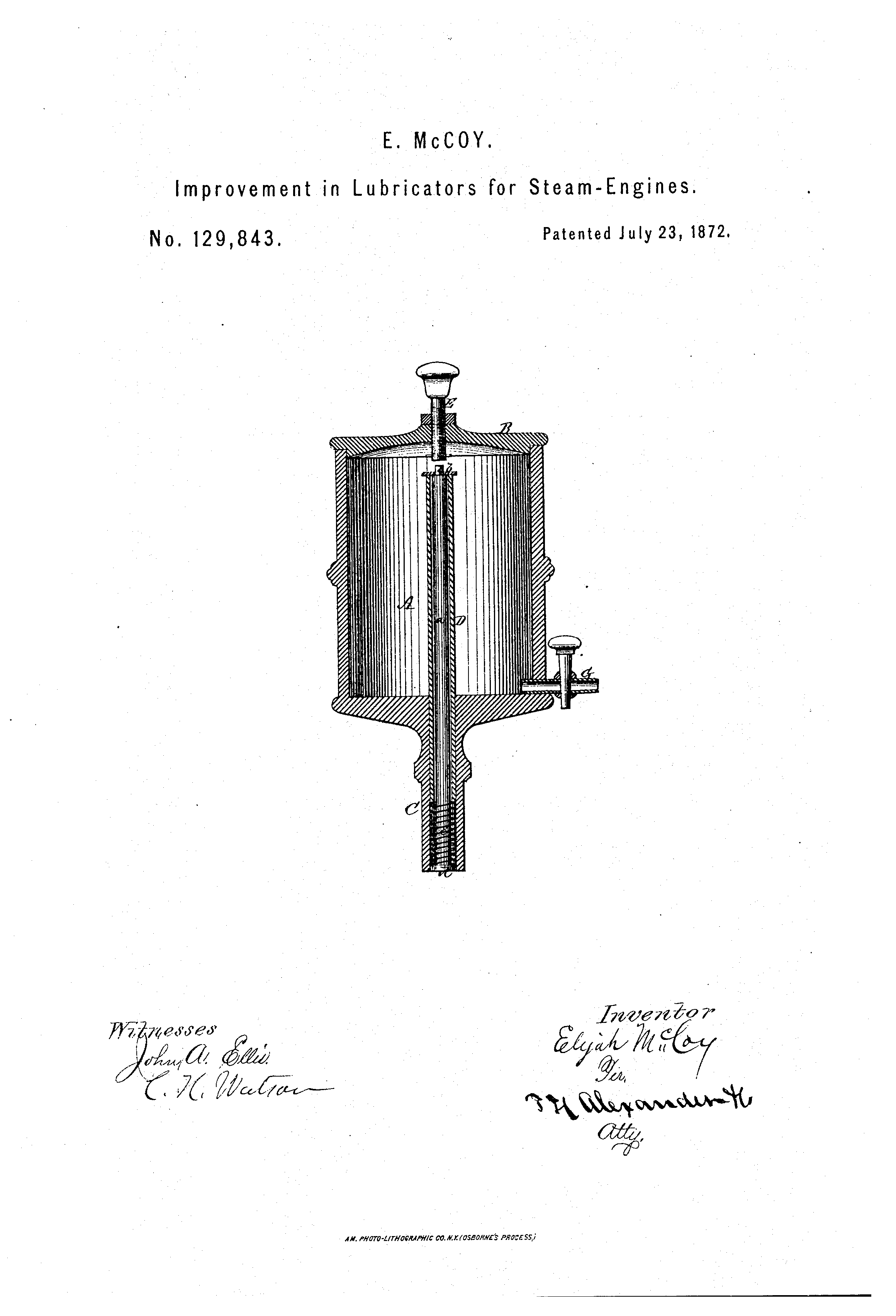
Still, Elijah persevered in his job while his mind, trained in engineering, sought to find a solution to the miserable job of "grease monkey," the boys (including Elijah) who oiled all of a train's gears when they frequently seized up due to friction and lack of lubrication.  Trains of the time were typically stopped every half hour or so for greasing.  After several years, Elijah invented (and patented) an oil cup, which was used successfully  to keep the trains running.  Travel by train became faster, safer, and more efficient.  He continued to invent throughout his life, eventually filing 57 patents!  Others tried to copy Elijah McCoy's oil cup, but none were able to match his success. 
When engineers wanted to make sure they got the best oil cup, they asked for the real McCoy.
All Aboard! Elijah McCoy's Steam Engine is an obscure but inspiring story, made particularly poignant by the juxtaposition of his parents' Underground Railroad experience, and his own experience working for the Michigan Central Railroad.  The dialogue is invented and there are no references cited, however, the engaging story is simply told in a manner that makes complex topics like the inventive process and racism accessible to young readers.  All Aboard! is short enough that it can easily be read aloud to a classroom or storytime for older children.

 The book's pen and watercolor illustrations are colorful, and full of life and expression; the reverse side of the dust jacket doubles as poster. The cover design, however, does not showcase the Slavin’s work in the most favorable manner and gives the book a rather dated appearance. The design was likely chosen to match the series format.  Don't judge this book by its cover. All Aboard! Elijah McCoy’s Steam Engine is the second book in the Great Idea series.

All Aboard has been nominated for the Cybils, Children's and Young Adult Bloggers' Literary Awards,  in the nonfiction, picture book category.  You can nominate books in many categories until Oct. 15th.  (Be sure to read the eligibility rules first!)

Review copy received from publisher. 
It's Nonfiction Monday and today's host is Madigan Reads.
Check out all of today's posts.
(I'll be hosting again on Nov 8)
Share |


First page of US patent 129,843 for Improvement in Lubricators for Steam-Engines
(from Wikimedia Commons)
 

Friday, September 10, 2010

Pop! The Invention of Bubble Gum

McCarthy, Meghan. 2010. Pop! The Invention of Bubble Gum. New York: Simon & Schuster.

Pop! The Invention of Bubble Gum tells the improbable story of bubble gum and its inventor, young Walter Diemer, an accountant in a 1920s Philadelphia chewing gum factory. Walter's boss had given up on the idea of a gum that could make bubbles,
But Walter hadn't.  He spent months playing with different mixtures.  Finally something was happening!  Bubbles!  Big, glorious bubbles!
Using simple text and colorful, simple artwork, McCarthy infuses a bubbly, buoyant flavor to Pop!  The illustrations range from ancient Greeks with gum in their cheeks, to a double-spread collection of joyous, bug-eyed, hand-holding, bubble-blowers from across the globe!

Pop! The Invention of Bubble Gum is a delicious mix of nonfiction and fun!  (Don't let all the fun fool you, it's well-researched too!)

Browse inside Pop!

Thanks to Rasco from RIF for pointing out Pop!
Rasco from RIF's review.


A personal note, Walter Diemer's invention, Dubble Bubble is my absolute favorite!  I chew at least 3 pieces at a time and one of my peculiar talents is that I can blow a bubble inside a bubble.  But alas, despite years of practice, I still cannot snap my gum.

Share |

Beneath the Waves - a review

As we read disturbing news accounts of dying manatees , environmental disasters caused by toxic waste, and ocean pollution on the scale of ...