Pages

Showing posts with label Underground Railroad. Show all posts

Monday, October 4, 2010

All Aboard! Elijah McCoy’s Steam Engine

Kulling, Monica. 2010. All Aboard! Elijah McCoy’s Steam Engine. Ill. by Bill Slavin. Ontario, CA: Tundra.

One of the things that I love about reviewing children’s nonfiction is the number of new things that I learn every day.  Today I learned a little-known, but interesting and inspirational life story, as well as an interesting tidbit of etymology, the origin of the phrase “the real McCoy.”
Get on Board!

we hear our conductor
singing low
the song she uses
to let us know
now is the time
to get on board...

the midnight train
runs underground
we hide and pray
not to be found
we risk our lives
to stay on board...
So begins All Aboard! But All Aboard! is not the story of the Underground Railroad, rather it is the culmination of the Underground Railroad's greater purpose - a self-determined, productive life, lived out in  freedom.  Elijah McCoy was the son of slaves who escaped to Canada on the Underground Railroad. His determined and hardworking parents saved enough money to send Elijah to school overseas, where he studied to become a mechanical engineer. 

He returned in 1866 to join his family in Michigan.  Though he may have been free, his opportunities were not equal.  Despite his education, he was only able to secure work as an "ashcat," feeding coal into the firebox of a steam engine for the Michigan Central Railroad,
What a letdown! Elijah knew engines inside and out.  He knew how to design them.  He knew how to build them.  He also knew the boss didn't think much of him because he was Black.  But Elijah needed work, so he took the job. 
Still, Elijah persevered in his job while his mind, trained in engineering, sought to find a solution to the miserable job of "grease monkey," the boys (including Elijah) who oiled all of a train's gears when they frequently seized up due to friction and lack of lubrication.  Trains of the time were typically stopped every half hour or so for greasing.  After several years, Elijah invented (and patented) an oil cup, which was used successfully  to keep the trains running.  Travel by train became faster, safer, and more efficient.  He continued to invent throughout his life, eventually filing 57 patents!  Others tried to copy Elijah McCoy's oil cup, but none were able to match his success. 
When engineers wanted to make sure they got the best oil cup, they asked for the real McCoy.
All Aboard! Elijah McCoy's Steam Engine is an obscure but inspiring story, made particularly poignant by the juxtaposition of his parents' Underground Railroad experience, and his own experience working for the Michigan Central Railroad.  The dialogue is invented and there are no references cited, however, the engaging story is simply told in a manner that makes complex topics like the inventive process and racism accessible to young readers.  All Aboard! is short enough that it can easily be read aloud to a classroom or storytime for older children.

 The book's pen and watercolor illustrations are colorful, and full of life and expression; the reverse side of the dust jacket doubles as poster. The cover design, however, does not showcase the Slavin’s work in the most favorable manner and gives the book a rather dated appearance. The design was likely chosen to match the series format.  Don't judge this book by its cover. All Aboard! Elijah McCoy’s Steam Engine is the second book in the Great Idea series.

All Aboard has been nominated for the Cybils, Children's and Young Adult Bloggers' Literary Awards,  in the nonfiction, picture book category.  You can nominate books in many categories until Oct. 15th.  (Be sure to read the eligibility rules first!)

Review copy received from publisher. 
It's Nonfiction Monday and today's host is Madigan Reads.
Check out all of today's posts.
(I'll be hosting again on Nov 8)
Share |
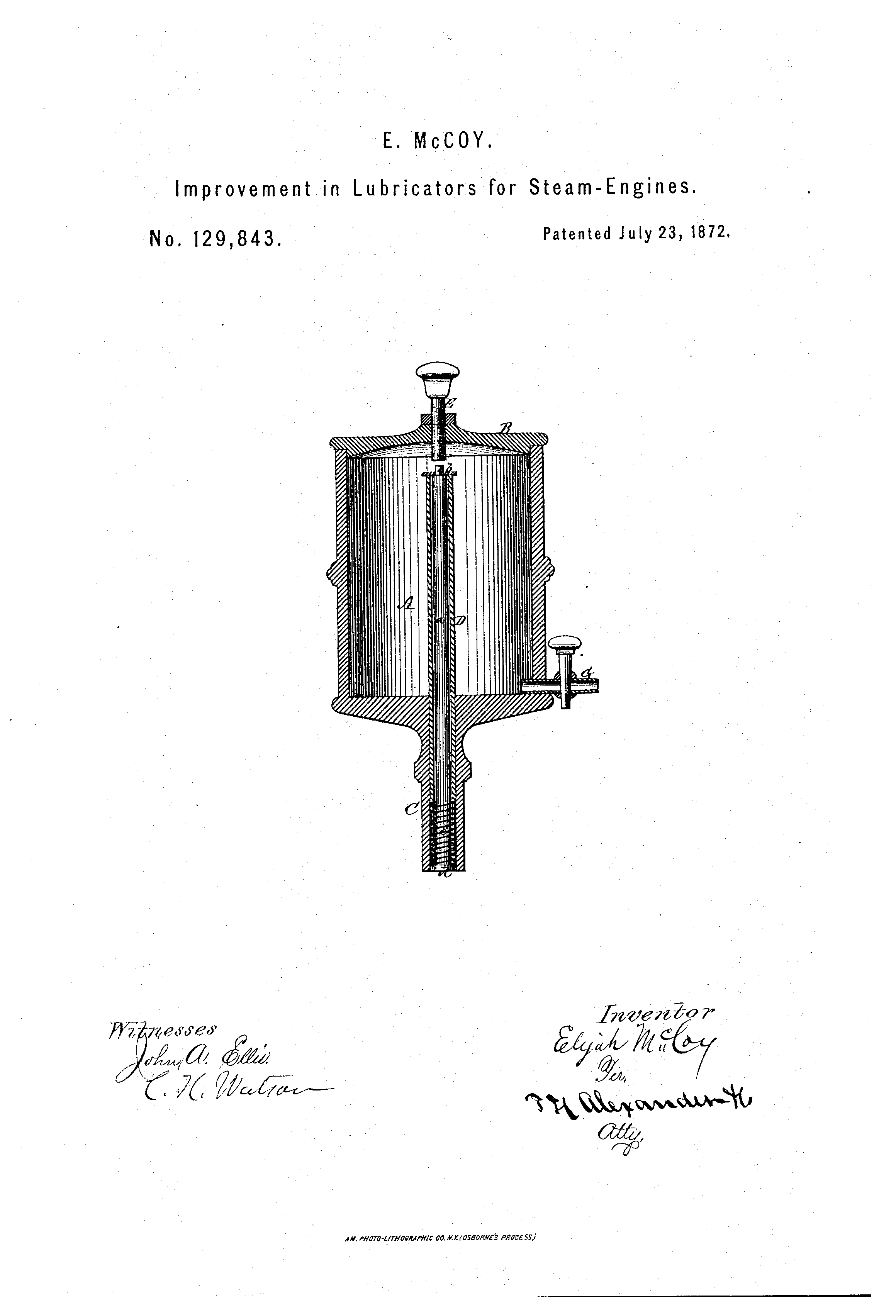


First page of US patent 129,843 for Improvement in Lubricators for Steam-Engines
(from Wikimedia Commons)
 

Sunday, July 20, 2008

Ain't Nobody a Stranger to Me

Ain't Nobody a Stranger to Me
Grifalconi, Ann. 2007. Ain't Nobody a Stranger to Me. Ill. by Jerry Pinkney. New York: Hyperion. ISBN 13 9780786818570.

PLOT SUMMARY
In Ain’t Nobody a Stranger to Me, loosely based on historical persons, a Grandfather shares with his young granddaughter his tale of escape from Southern slavery with his wife and baby. He recalls the helpfulness of strangers on the Underground Railroad, including Quaker James Stanton. His sense of gratitude has shaped his belief that “ain’t nobody a stranger.” The story appears to be set in the 1930s.

CRITICAL ANALYSIS
Ain't Nobody a Stranger to Me is a story of fortitude, gratitude, forgiveness, and a spirit of optimism. As a slave, Gran'pa collected apple seeds in hope of a day that he might be free to plant them on his own land as a free man. He tells of his flight to freedom and the generosity of strangers. Grifalconi tells this story in a manner appropriate to introduce this heartbreaking topic to young children. The text expresses Gran'pa's belief in the goodness of mankind and his faith in God. "We had to put our trust in the Good Lord. We'd set our hearts right, and along the way help came when we needed it."The darker aspects of slavery and the dangers of the Underground Railroad are expressed not in words, but in Jerry Pinkney's line and watercolor paintings. The harrowing escape of Gran'pa his wife and baby, and their subsequent struggle to survive as free people are depicted in shades of browns and greys, evoking dark moments. The expressive eyes of Grandfather and his wife in these scenes are alternately fearful, wary, and weary. In contrast, the scenes of Gran'pa with his granddaughter are joyful colors and expressions of tenderness and love. In a colorful and heartwarming ending, Gran'pa and the young girl eat apples in the orchard he planted as a freed man. The apple blossoms are a riot of cheerful pink, and the young girl plants a new seed and promises to remember.

Grifalconi's story is a solid, age-appropriate (5-9) introduction to the Underground Railroad, however her choice of story delivery is awkward at times. Grandfather's story is told within the confines of the girl's first person account, and the girl often speaks in language styles that are conflicting or unusual for a young girl (Black or White) in the 1930s or any time period. In quoted passages, she speaks in a voice more typical of a Black child from the South in the 1930s. "They be from our stone cellar, Grandpa?" and "...could I one day plant me a seed of memory here, too?" In other passages, she speaks as an educated adult, "He grinned happily down at me" and "Soon, the spring air began to carry the fresh, sweet smell of apple blossoms to us." The frequent switching of dialect and narrator may be confusing to readers.

Jerry Pinkey's credentials as an African American illustrator are numerous and impressive. The jacket notes that he has "illustrated more than one hundred books for children" and is the recipient of Caldecott Honors, Coretta Scott King Awards, and more. His artwork for this story sets the period (a horse-drawn ice wagon, long-skirted women with hats and boots) and sets the tone (the darkness of hiding, the green grass of freedom). Kirkus Reviews refers to an "author's note" explaining the attribution of the title phrase, "Ain't Nobody a Stranger to Me." The book, however, does not contain any author's notes. The dust jacket only explains that the phrase was inspired by former slave, Orleans Finger. Overall, this book can be recommended on the basis of Pinkney's expressive artwork and Grifalconi's presentation of a difficult picture book topic.

CONNECTIONS
This is a picture book that can be used to introduce older students (3rd and 4th grades) to the Underground Railroad experience.

A follow-up to the story can be an exploration of the excellent National Geographic site that allows for a guided, interactive journey from slavery to freedom on the Underground Railroad. http://www.nationalgeographic.com/features/99/railroad/

Pair this book with Caldecott Honor Book, Moses: When Harriet Tubman Led Her People to Freedom, by Carole Boston Weatherfield, Illustrated by Kadir Nelson.

Friday, February 22, 2008

Ain't Nobody a Stranger to Me

Grifalconi, Ann. 2007. Ain't Nobody a Stranger to Me. Ill. by Jerry Pinkney. New York: Hyperion. ISBN 13 9780786818570.

PLOT SUMMARY
In Ain’t Nobody a Stranger to Me, loosely based on historical persons, a Grandfather shares with his young granddaughter his tale of escape from Southern slavery with his wife and baby. He recalls the helpfulness of strangers on the Underground Railroad, including Quaker James Stanton. His sense of gratitude has shaped his belief that “ain’t nobody a stranger.” The story appears to be set in the 1930s.

CRITICAL ANALYSIS
Ain't Nobody a Stranger to Me is a story of fortitude, gratitude, forgiveness, and a spirit of optimism. As a slave, Gran'pa collected apple seeds in hope of a day that he might be free to plant them on his own land as a free man. He tells of his flight to freedom and the generosity of strangers. Grifalconi tells this story in a manner appropriate to introduce this heartbreaking topic to young children. The text expresses Gran'pa's belief in the goodness of mankind and his faith in God. "We had to put our trust in the Good Lord. We'd set our hearts right, and along the way help came when we needed it."

The darker aspects of slavery and the dangers of the Underground Railroad are expressed not in words, but in Jerry Pinkney's line and watercolor paintings. The harrowing escape of Gran'pa his wife and baby, and their subsequent struggle to survive as free people are depicted in sepia tones of browns and greys, evoking dark moments of the past. The expressive eyes of the grandfather and his wife in these scenes are alternately fearful, wary, and weary.

In contrast, the scenes of Gran'pa with his granddaughter are joyful colors and expressions of tenderness and love. In a colorful and heartwarming ending, Gran'pa and the young girl eat apples in the orchard he planted as a freed man. The apple blossoms are a riot of cheerful pink, and the young girl plants a new seed and promises to remember.

Grifalconi's story is a solid, age-appropriate (5-9) introduction to the Underground Railroad, however her choice of story delivery is awkward at times. Grandfather's story is told within the confines of the girl's first person account, and the girl often speaks in language styles that are conflicting or unusual for a young girl (Black or White) in the 1930s or any time period. In quoted passages, she speaks in a voice more typical of a Black child from the South in the 1930s. "They be from our stone cellar, Grandpa?" and "...could I one day plant me a seed of memory here, too?" In other passages, she speaks as an educated adult, "He grinned happily down at me" and "Soon, the spring air began to carry the fresh, sweet smell of apple blossoms to us." The frequent switching of dialect and narrator may be confusing to readers.

Jerry Pinkey's credentials as an African American illustrator are numerous and impressive. The jacket notes that he has "illustrated more than one hundred books for children" and is the recipient of Caldecott Honors, Coretta Scott King Awards, and more. His artwork for this story sets the period (a horse-drawn ice wagon, long-skirted women with hats and boots) and sets the tone (the darkness of hiding, the green grass of freedom).

Kirkus Rewiews refers to an "author's note" explaining the attribution of the title phrase, "Ain't Nobody a Stranger to Me." The book, however, does not contain any author's notes. The dust jacket only explains that the phrase was inspired by former slave, Orleans Finger.

Overall, this book can be recommended on the basis of Pinkney's expressive artwork and Grifalconi's presentation of a difficult picture book topic.


CONNECTIONS
This is a picture book that can be used to introduce older students (3rd and 4th grades) to the Underground Railroad experience. A follow-up to the story can be an exploration of the excellent National Geographic site that allows for a guided, interactive journey from slavery to freedom on the Underground Railroad. http://www.nationalgeographic.com/features/99/railroad/

Pair this book with Caldecott Honor Book, Moses: When Harriet Tubman Led Her People to Freedom, by Carole Boston Weatherfield, Illustrated by Kadir Nelson.

Thursday, February 21, 2008

Underground

Ferris, Jean. 2007. Underground. Farrar, Strauss & Giroux.

Underground is the story of slaves that, through varying paths, find themselves working at the Mammoth Cave Hotel in 1839. The hotel houses visitors stopping to see Kentucky’s natural wonder, Mammoth Cave.

Life for Charlotte and the other slaves is comparatively good at Mammoth Cave Hotel, but Charlotte knows of a worse life as a slave in the Deep South. Stephen is content with his limited autonomy as an underground guide. Brothers, Nick and Mat, are thankful for regular meals and little trouble from their master. Mittie, the elder slave of the group, is quiet and serious and keeps her opinions to herself.

Thh slaves' lives are changed when a “runner” from the south appears on the hotel property. Now Charlotte must make a choice about the "underground," both literally and figuratively, that will affect them all, as Mammoth Cave and the Underground Railroad become entwined.

Although Mammoth Caves was not likely a stop on the Underground Railroad, most of the characters in this story were real persons. Charlotte and Stephen’s names are still scratched or smoked onto the walls of the caves. An Author’s Note explains which occurrences in the story actually happened. Ferris also reveals the fates of the four young slaves.

Historical fiction fans should enjoy this book. It is cataloged as a YA book, but seems more appropriate as J Fic. Discussions of the slaves' parentage may have prompted the YA label. Several brief references are made to masters fathering children with unwilling slaves.

Beneath the Waves - a review

As we read disturbing news accounts of dying manatees , environmental disasters caused by toxic waste, and ocean pollution on the scale of ...