Pages

Showing posts with label disasters. Show all posts

Wednesday, July 24, 2013

I Survived: The Japanese Tsunami, 2011 - a review

At last year's KidLitCon, attendees were reminded to blog for a particular purpose and audience. I selfishly blog primarily for myself - to help me remember and gather my thoughts about the many children's books that I read in pursuit of my favorite job - connecting children with the "perfect" book, or in librarian terms, reader's advisory.  If along the way if I can save you some time or help you in a similar pursuit, so much the better.  This is why I don't always read the most talked about books, the most award-winning books, or the books with the greatest literary merit. I want to read what children like, and  a boy in my book club told me emphatically what he likes, I Survived books! "I've read them all," he told me.

I must confess that despite their popularity, I hadn't read any! Fortuitously, however, Scholastic sent me a galley copy of their upcoming, I Survived; The Japanese Tsunami, 2011 by Lauren Tarshis.

This is the 8th book in the series.  Written for grades 2-5, these are small, short chapter books; each chapter is only a few pages. The Japanese Tsunami, 2011, contains 13 chapters and is 83 pages, not including the back matter - facts, author's note, and resource materials.

I assume that most of the books are similar - a child survives one of history's worst natural or man made disasters.  In The Japanese Tsunami, it is Ben, an American born child visiting his Japanese grandfather, along with his mother and brother.  His father, an Air Force pilot, recently died in Iraq.

Miraculously, although Ben is swept away from the rest of the family in the tsunami, they all survive and are eventually reunited.  It's not a likely story, but here's what there is to like about it:


  • Though it was written very soon (too soon?) after the disaster, it should be remembered that kids don't often pay attention to the news, and to them, March 11, 2011, may seem like a lifetime ago.  It's helpful to remind them of world-changing events.

  • Books like the ones in the I Survived series help bring history alive for young people.  It's easier to relate to history if it is seen through the eyes of someone in a similar situation to one's own.

  • The I Survived books are short and popular - great choices for reluctant readers.

And finally,

  • Author Lauren Tarshis understands the freshness, the immensity, and the gravity of this particular disaster, and treats it with respect.  It was, after all, three separate and devastating disasters - an earthquake of epic proportions (lasting five minutes), a tsunami (hundreds of feet long and dozens of feet high), and a nuclear meltdown that sent more than 200,000 people fleeing from their homes.


In her author's notes, "A Triple Disaster," she notes that writing about the Japanese Tsunami was unlike writing the other I Survived books in which she could imagine herself in the shoes of her protagonists.  Regarding the Japanese Tsunami, 2011, she writes, the

...disaster was so enormous, I really can't being to imagine what it was like - the terror, the destruction, the exhaustion, the despair.
 What I do feel - deep in my heart - is admiration for the millions of people of the Tohoku region and throughout eastern Japan who are rebuilding their towns and their lives, who are determined to move forward ..
Due on shelves in September, 2013, this one's sure to be popular.

The art in my copy was not final, but the book will apparently have several black and white illustrations.

Kids can take an I Survived Survival Skills Quiz on the Scholastic website.

Monday, March 26, 2012

Surviving the Hindenburg - a review

Verstraete, Larry. 2012. Surviving the Hindenburg. Ill. by Dave Geister.  Farmington Hills, MI: Sleeping Bear Press.


Many historical nonfiction books for kids naturally feature adults - as they are often the makers of history. Authors sometimes choose to highlight the childhood stories of important historical figures to make the topic more interesting to children, e.g., Oprah: The Little Speaker, Sonia Sotomayor: A Judge Grows in Brooklyn. Of course, a popular topic (dinosaurs) or person helps too.

Like the sinking of the Titanic (to which the Hindenburg was close in length), the Hindenburg disaster is a continuing source of interest for readers - particularly in my area of New Jersey. 

In Surviving the Hindenburg, Larry Verstraete has the gift of a perfect combination – a young protagonist and a history-making event – the horrific fire aboard the Hindenburg.

Fourteen-year-old Werner Franz was a German cabin boy aboard the Hindenburg on May 6, 1937, when it burned and crashed in Lakehurst, NJ. As the title indicates, Werner was one of the 62 survivors. Surviving the Hindenburg is his story.

This is a compelling account using easily-read, bold- font text opposite full-page or double-spread oil paintings. Scenes of the blimp's inner gangways add understanding of the ship’s inner workings, while views from the ground give context to the blimp’s immense size. The fiery scenes are powerfully gripping.

It appears that the quoted dialogue is taken from verifiable sources,
     “After a while, it came to me,” he said.“I lost my nerve. I cried and wailed like a baby. I didn’t know what to do.”
     Some men approached Werner.They thought he was a visitor, there to watch the landing.
     “They shook me to my senses,” Werner said. ‘Get a hold of yourself and try to help someone,’ they told me. But there was no one left to help.”
     In German, Wener tried to tell them who he was. “Ich bin der cabin-boy vom Hindenburg!” he said over and over,
however, no source notes are included in this otherwise stellar historical account. (A note in the Acknowledgements does cite Hindenburg authority, Patrick Russell, for ensuring accuracy)

A foreword and afterword offer a broader look at the disaster, including the interesting note that Werner Franz is the “last surviving member of the Hindenburg crew.”

The 75th anniversary of the Hindenburg will be marked this year on May 5th and 6th. Details, photos and more may be found at the Navy Lakehurst Historical Society site.

Interestingly, the Navy recently launched a new airship,  also located at the Lakehurst base, which is now Joint Base McGuire-Dix-Lakehurst.  However, after only about one year, the ship is due to be "mothballed" at Hangar 1 in Lakehurst.  A story and video of the airship appear here.  I have seen this behemoth fly over my home.  It's hard to imagine that airships were once used as luxury, transatlantic transportation!

Today's Nonfiction Monday roundup is at Anastasia Suen's Booktalking.

Monday, March 5, 2012

The Great Molasses Flood - a review

Kops, Deborah. 2012. The Great Molasses Flood: Boston, 1919. Watertown, MA: Charlesbridge.

As soon as I read Jeff Barger's review of The Great Molasses Flood on NC Teacher Stuff, I knew that this book would be next on my "to be read" pile.

Since then, it's cropped up on blogs all across the Kidlitosphere.  There's something about this horrific, yet freakishly bizarre story, that is simply irresistible.

I am fond of "event books" that offer a broader view of a particular occurrence, placing it into the context of the time.  This is such a book, offering a look at the American justice system, the anarchist movement of the early 20th century, the lifestyles of immigrants, the influence of big business, and the practical applications for science and engineering in the practice of law.  All of these elements cross paths in this chronological story of a deadly explosion of a Boston molasses tank holding over two million gallons of the sticky brown sweetener.

Because the incident ended up as the subject of intense litigation, Kops had ample resources, in addition to newspaper accounts.  The legal transcript of the trial fills forty volumes.

Kops' writing style is simple and compelling,

The View from Above
At about 12:40 the brakeman on the elevated line was standing near the window of a passenger train, which had left South Station about five minutes earlier.  As the train neared the molasses tank, the brakeman heard a loud noise, like metal ripping apart.  He looked down to see the molasses tank split wide open and a wave of molasses heading toward the tracks. 
     As the train came around a curve, there was another surprise.  The molasses hurled a great chunk of the tank against two columns supporting the elevated tracks.  A moment later one of the El supports bent as if it was just a skinny twig.  Park of the El's tracks, which the train had passed over just seconds before, sagged toward the road below.
Scattered sepia colored insets offer additional and helpful contextual information such as the burgeoning women's and anarchist movements, and an explanation of the urgency to use the stored molasses (prohibition was about to become the law of the land).

I did find fault with two stray comments that I thought "cringe-worthy" because they seemed dismissive of the catastrophic nature of the event.
A sea of molasses quickly surrounded them.  Antonio ran for his life, but he was no match for the tide.  It dragged him along, shoving him into a curb. Ouch! 
The young man lost two teeth and a sister.  Ouch?  The other is similarly cavalier -
Mrs. O'Brien Loses More Than Her Wash
Mrs. O'Brien, in fact, lost her home, which rode the molasses wave right off its foundation and into the nearby park.
These are minor aberrations, however, in an otherwise fascinating and well-told story.


Booktalk The Great Molasses Flood: Boston, 1919 to your fiction readers, too!  Freakish appeal and a generous amount of photos give this one cross-genre appeal.  Highly recommended. 


Finally, I think it's noteworthy that this is such a bizarre disaster, that it even warrants an entry on the always reliable, Snopes.com!
Claim: A fatal wave of molasses swept through Boston in January 1919.
TRUE.
Other reviews @

It's Nonfiction Monday.  Today's host is 100 Scope Notes.

Monday, January 2, 2012

Titanic Sinks! a review

Barry Denenberg. 2011. Titanic Sinks! New York: Viking.

Employing the recently recovered journal of a fictional journalist on board the Titanic, Barry Denenberg has seamlessly and expertly blended fact and fiction  to create a gripping re-telling of the Titanic's doomed voyage.  Titanic Sinks! is well-researched and documented with extensive use of period photos.  Timelines, menus, and more are also included in this large-sized picture book for older readers.
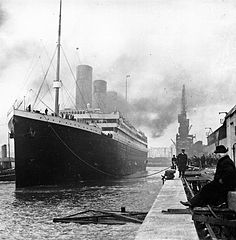
Titanic at the docks of Southampton
April 1912
Public domain photo
 As historical fiction, Titanic Sinks! is a phenomenally successful exercise in creating an exciting method of presenting history to young readers.  As nonfiction, Titanic Sinks! is a wealth of well-documented facts, quotes, photos, and timelines from one of modern history's worst and best-known disasters.  As a "unique presentation of fact and fiction," as stated on the book's jacket, I find Titanic Sinks! mildly troubling.  Barry Denenberg has done such a tremendous job of creating the fictional Modern Times magazine, complete with masthead, table of contents, an explanatory "Letter from the Publisher," and even editor's notes, that it will be difficult for readers (both young and old) to discern fact from fiction.  Granted, there is "A Word from the Author" in the book's final pages which explains the melding of fact and fiction, however, a reader might easily pass over the author's note, or be so convinced by the previous publisher's letter and editor's note that he is left confused and unsure of what is fact and what is fiction.

That being said, I would not discourage anyone from reading this compelling account of the Titanic's sinking.  In fact, I highly recommend it, but with a word of caution that some explanation may be in order.  Alternatively, it would make excellent subject matter for older students to learn the process of determining authenticity in a work of nonfiction.

Other reviews @
Kirkus
Publishers Weekly

Barry Denenberg's previous book, Lincoln Shot! is done is a similar vein. He is a prolific author of quality nonfiction and historical fiction titles.  His website offers a link to his blog Another Side, which, if you are a lover of history, you will find incredibly well-written and interesting!  It's now on my list of "must read" blogs.

It's Nonfiction Monday.  Today's roundup is at The Nonfiction Detectives.

Sunday, July 25, 2010

Three Rivers Rising

Richards, Jame. 2010. Three Rivers Rising: A Novel of the Johnstown Flood. New York: Knopf.

This book debuted in April 2010 to well-earned, rave reviews. In sparse verse, author Jame Richards, tells a story of devoted high society sisters, Celestia and Estrella, Whitcomb, their coldly calculating, businessman father, a miner's son, Peter, Maura, the wife of a Pennsylvania railroad engineer, and Kate, an obsessive-compulsive young widow struggling to find a purpose in life. Their lives become intertwined due to the tragically preventable Johnstown, Pennsylvania flood of 1889. Chapters of free-form verse alternate between the voices of the six characters.  An author's note separates the facts of the actual flood from the story. More than 2200 people died in the flood, including entire families.

The Johnstown Flood is the backdrop, but Three Rivers Rising is foremost a story of society, class, and first (or forbidden) love.
Highly recommended for grades 8 and up.


A reader's guide is available for teachers, librarians and book clubs.

The aftermath of the Johnstown Flood.
(Photograph from Wikimedia Commons, originally taken by an employee of the National Oceanic and Atmospheric Administration.)
Information about the flood and its victims is available from the Johnstown Area Heritage Association.

Beneath the Waves - a review

As we read disturbing news accounts of dying manatees , environmental disasters caused by toxic waste, and ocean pollution on the scale of ...