Pages

Showing posts with label books in verse. Show all posts

Wednesday, June 27, 2012

May B. A Novel - a review

Rose, Caroline Starr. 2012. May B. New York: Random House.
(booktalk)

In Kansas' early days as a state, there is no help in the prairie schools for a child with what will later become known as dyslexia.  Nor is there help for a farmer whose spring wheat crop has failed.

So it is neither unforeseen, nor unusual when the parents of Mavis Elizabeth Betterly, May B., literally "farm her out" as hired help to a prairie neighbor.  Hiram, the Betterly's son, will stay at home, he, being of more use to the frontier family.

The closest homestead is 15 miles away, a full day's journey by wagon.  Young May Betterly passes the long hours to the Oblinger's simple, sod house that will be her home until Christmas,

I play a game inside my head,
counting plum trees that dot a creek bed,
rabbits that scatter at the sound of wagon wheels,
clouds that skirt the sky.
For hours, that is all,
and grass,
always grass,
in different shades and textures
like the braids in a rag rug.

Miss Sanders told us that lines never end,
and numbers go on forever.
Here,
in short-grass country,
I understand infinity.

When Mrs, Oblinger takes a horse and deserts her new husband to return east, Mr. Oblinger goes off in pursuit.
"Don't worry about supper," he says.  "I could be gone some time."
"Some time" will be longer than May could ever have dreamed. It will take all of her courage, strength and perseverance to survive.

I am afraid
in the dark
all alone
I am afraid

 ######

In similar style to Karen Hesse's Newbery-winning, Out of the Dust, and Witness, Caroline Starr Rose's novel in verse is deeply affecting.  May's honesty in assessing her shortcomings is balanced by her inner optimism that she may yet overcome her situation - against all odds.

We all share that struggle.  May B. gives voice and hope to us all.
Teacher's Study Guide for May B.


Note:
The librarians of the NJLA's Children's Services Section will likely be discussing this book in the upcoming months on our new mock award blog, Newbery Blueberry Mockery Pie.  Please join us.

Thursday, April 26, 2012

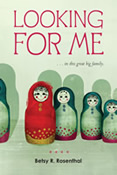
Looking for Me - a review

April is National Poetry Month, and I realize that I've almost let the month slip away without any poetry book reviews.  Just in time, I came across my Advance Reader Copy of Looking for Me, which went on sale April 17.


Rosenthal, Betsy R. 2012. Looking for Me. Boston: Houghton Mifflin Harcourt.

Based on the real stories of her mother and many aunts and uncles, Betsy Rosenthal tells a story in verse of her mother, Edith - the fourth child in a large, Jewish, Depression-era family in Baltimore,

Family Portrait, Baltimore, 1936

We're lined up:
girl boy, girl boy, girl boy, girl boy, girl boy

and in the middle of us all, Dad,
who ordered us to smile
right before the Brownie clicked,
standing stiff as a soldier
no smile on his face,

and Mom's beside him,
a baby in her arms
and in her rounded belly
another one,

just a trace.


Girl, boy, girl, boy, count them up - twelve children in a row house, sleeping three to a bed, always short of money, new clothes and food.  Edith's teacher asks her to write about her family, but she doesn't write about herself.  After all, who is she in this great big family?  Looking for Me chronicles Edith's quest to find individualism in a time when, seemingly, there was no time for such frivolous thoughts. Rosenthal's poetic style varies from free verse, to concrete to metered rhymes.  The subject matter varies as well - following the ups and downs of a year in Edith's life, which, while harsh and disciplined, also held moments of great joy and fun,

They're Lucky I Found Them

Lenny, Sol, and Jack
said Mom left them sleeping
on the sofa bed,
or so she thought,
and ran to the store.

But after she left,
they started to bounce
and bounce
and bounce some more.
Then the bed closed up

and they were stuck
until I came home
and changed their luck.

Some poems are heart-wrenching depictions of life as an 11-year-old Jewish girl who has been touched by death, poverty, meanness, bigotry, and indifference.  Others are uplifting,

Floating

I am a bubble
blown full
with Miss Connelly's words,

floating out of the classroom,
bobbing across the grassy lot,
drifting by Levin's Bakery,

letting the breeze carry me to the diner.
"WHERE HAVE YOU BEEN!?"
Dad yells when I come in,
but I just float right by him.

It's always said that it's best to write what you know.  This is Betsy Rosenthal's family, and she knows it well.  The poignant stories of her mother, aunts, uncles and grandmothers have lived on in her home, and she has done us the very great favor of inviting us in to hear them.

Thursday, December 15, 2011

Planet Middle School - a review

Grimes, Nikki. 2011. Planet Middle School. New York: Bloomsbury.

Ever since I heard Nikki Grimes read "Breathless" in New Orleans at the 8th Annual Poetry Blast, I've been waiting to read Planet Middle School, the book inspired by the poem.

Want to see Nikki Grimes reading "Breathless?"  Click here to watch the video at Poetry for ChildrenNote: "Breathless" is the 4th video down from the top.

I finally received a review copy from a colleague and was pleased that the book did not disappoint!  Was is disappointing, however, is the fact that in the midst of moving between library branches, I've misplaced my book. 

So, in short, without benefit of quotes or notes, this brief review will have to suffice.

In Planet Middle School, Nikki Grimes proves that she has the gift of distilling the entire range of adolescent emotions into an easy reading novel in verse.  With a brevity of words that belies the depth of content, Nikki Grimes takes us into the heart and mind of 12-year-old Joylin Johnson as she navigates middle school, changing friendships, uncomfortable family dynamics and her first crush.

This is a short and quickly read book that contains enough intensity to satisfy older readers.  A perfect choice for poetry fans, reluctant readers, and young teens who may find themselves in similar situations. And yes -  also for the reader who waited too long to choose a book for her book report - a perfect opportunity to help out a student, spark an interest in poetry, and introduce a reader to Nikki Grimes.

Read reviews from Kirkus, Hornbook, SLJ, and Booklist on Bloomsbury's website.

Another review @
Abby the Librarian

A Teacher's Guide is available here.

ARC supplied by a colleague.

Sunday, July 25, 2010

Three Rivers Rising

Richards, Jame. 2010. Three Rivers Rising: A Novel of the Johnstown Flood. New York: Knopf.

This book debuted in April 2010 to well-earned, rave reviews. In sparse verse, author Jame Richards, tells a story of devoted high society sisters, Celestia and Estrella, Whitcomb, their coldly calculating, businessman father, a miner's son, Peter, Maura, the wife of a Pennsylvania railroad engineer, and Kate, an obsessive-compulsive young widow struggling to find a purpose in life. Their lives become intertwined due to the tragically preventable Johnstown, Pennsylvania flood of 1889. Chapters of free-form verse alternate between the voices of the six characters.  An author's note separates the facts of the actual flood from the story. More than 2200 people died in the flood, including entire families.

The Johnstown Flood is the backdrop, but Three Rivers Rising is foremost a story of society, class, and first (or forbidden) love.
Highly recommended for grades 8 and up.


A reader's guide is available for teachers, librarians and book clubs.

The aftermath of the Johnstown Flood.
(Photograph from Wikimedia Commons, originally taken by an employee of the National Oceanic and Atmospheric Administration.)
Information about the flood and its victims is available from the Johnstown Area Heritage Association.

Friday, January 30, 2009

Diamond Willow

Frost, Helen. 2008. Diamond Willow. New York: Frances Foster. ISBN: 978-0-374-317768

Like a diamond, the concept for Diamond Willow is brilliant. Twelve-year-old Willow is named after a stick, a diamond willow stick, to be precise. When branches are cut from the willow, a diamond shaped scar is left on the branch. Written mostly in first person verse, each page of Willow's thoughts is a diamond-shaped poem; but the brilliance is not in the shape of the poem, it lies in the gem within. Nestled within each poem is a small truth - a truth that resides within Willow but cannot be seen from without,

"What
I love
about dogs;
They don't talk
behind your back.
If they're mad at you,
they bark a couple times
and get it over with. It's true
they slobber on you sometimes.
(I'm glad people don't do that.) They
jump out and scare you in the dark. (I know,
I should say me, not "you" - some people aren't'
afraid of anything.) But dogs don't make fun
of you. They don't hit you in the back
of your neck with an ice-covered
snowball, and if they did, and
it made you cry, all their
friends wouldn't stand
there laughing
at you.
(Me.)"
Diamond Willow takes place in a remote Alaskan town where dogs and snowmobiles are the most common form of transportation. Willow is most comfortable with her family and her dogs, especially now, since her closest friend has a boyfriend. When an accident occurs while Willow is mushing the dogs, Willow uncovers the truth within, as well as a closely-held family secret.
More than just a coming-of-age story, Diamond Willow is a mystical tale of Native American spirits that reside within the creatures of the Alaskan wild.
I was unable to find reviews of this book on sites dedicated to Native American literature (Oyate, American Indian Library Association, American Indians in Children's Literature), and am curious if those within the Athabascan community find Diamond Willow to be in keeping with native philosophy. I was pleased to see that the author, Helen Frost, spent much time in Alaska and consulted with an Athabascan elder while writing Diamond Willow.
A thoughtful look at the meaning of family, loss, friendship and love.

Friday, July 11, 2008

Witness

Witness
Hesse, Karen. 2001. Witness. New York: Scholastic. ISBN 0439271991

Plot Summary:
Witness is an account of a small Vermont town's experience with the Ku Klux Klan in 1924. The story is told in verse. Eleven disparate residents of the fictional town offer first person accounts of life after the Klan arrives. A small Jewish girl and her father, and a young African-American girl are the first of the Klan's targets, but the Klan's activities leave no one untouched.

Critical Analysis:
Witness is a narrative of the KKK’s infiltration of a small Vermont town in 1924. It is written in free verse through the voices of eleven different residents. The verse is largely without capitalization or punctuation, using line breaks instead to separate thoughts. Through the largely first-person accounts, each the character of each of the residents is revealed.

Esther, a six-year-old Jewish girl, and Leonora, a twelve-year-old African American girl tell much of the story. The voice of Leonora, an obvious target of the Klan is compelling. The reader senses her fear as she hides in a closet but finds no escape from the specter of a cross-burning. The speech patterns of Esther may be difficult for some readers to comprehend. Her unusual speech may be mistaken for simple-mindedness; however, it is more likely representative of a recent immigrant’s dialect, and is symbolic of her innocence. The voices of Harvey and Viola Pettibone, however, are the most intriguing. The Pettibone’s are middle-aged shop owners. Theirs is the only verse that contains back-and-forth dialogue as they debate the Klan’s value, effect, influence, and activities in the intimate dialogue of husband and wife.

Although Horn Book dismissed the protagonists as stereotypes (Hepperman 2001), the use of stereotypes is necessary to illustrate the myriad of opinions as the Klan’s influence extends throughout the town. Streaming, free-form verse unfolds the innermost thoughts of the characters, revealing the influences of fear, peer pressure, guilt, conviction, and uncertainty on their behavior.

Witness begins with a Carl Sandburg quote, followed by a Cast of Characters list, and the five acts of the book. Until the characters (including the doctor, preacher, newspaper editor, rumrunner, and others) are established, the Cast of Characters is a welcome reference. Aged photographic renderings of the fictional characters help the reader to distinguish them further.

Vermont is not the usual setting for tales of the KKK and the ugliness of racism and bigotry. Witness tells an ugly chapter of history from an unusual perspective that will intrigue readers. The tale is both disturbing and hopeful. Readers will find it believable and memorable.

Review Excerpts:
In the September 2001, School Library Journal, authors Persson, et al, wrote, "...includes some quiet yet irreducible moments that resonate long after the book is put down. The small details seem just right, and demonstrate that this is much more than a social tract. It's a thoughtful look at people and their capacity for love and hate."

Writing for Horn Book Magazine, Christine Hepperman, had a different view of Witness, writing in the Nov/Dec 2001 issue, "Karen Hesse's latest free-verse novel employs eleven different voices to record the Ku Klux Klan's effects on a Vermont town in 1924, with dubious success. The fictional cast, comprising two children and nine adults, is introduced with sepia-toned photographs to boost their verisimilitude and help sort out who's who. Yet many still feel more like types than complex individuals."

Connections:
Readers who enjoy this book will also enjoy Hesse's Newbery Award winning title Out of the Dust.

The short verse entries and multiple voices, make Witness and excellent choice for reader's theater. Readers should be encouraged to delve into the characters and find the motivation for their behaviors.

Friday, June 13, 2008

Love That Dog

Creech, Sharon. 2001. Love that dog. New York: Harper Collins.

I recently finished reading this book with a discussion group whose members vary in age from young teen to young adult. The book went over fairly well and all members seemed to enjoy it, as we alternated between reading aloud, reading at home, and listening to the audio version.

Love That Dog tells the story of a young boy coping with the death of his dog, Sky. The story is written in the form of a school journal in which the protagonist, Jack, writes notes or assignments for his teacher, Mrs. Stretchberry. Mrs. Stretchberry is teaching poetry. Over a period of months, Jack learns to cope with the death of his dog and becomes more confident and self-assured in his own writing ability through a series of writing exercises. The book introduces the reader to famous poets and poetry, notably Robert Frost and William Carlos Williams. Much of the book is also centered around poet and author, Walter Dean Myers, who visits Jack's school.

Several of the group members professed a liking for the audio version, read by Scott Wolf.

Monday, May 12, 2008

Locomotion

Woodson, Jacqueline. 2003. Locomotion. New York: Penguin.

I got to know this book better than I had planned. I was going to assist in a book discussion group for teens and young adults with varying and diverse abilities. They had chosen this book for their discussion and we were initially unable to secure enough copies. I showed up for the meeting without having ever read the book - as the group leader had our only copy.

Having read Jacqueline Woodson before, and being familiar with other books in verse gave me the confidence to proceed. I printed out some discussion questions from the author’s website and headed off to the meeting. It was decided that I would read the book aloud for the first week until we were able to procure enough copies. I read each poem slowly and deliberately, in what I hoped was the spirit of eleven-year-old, Lonnie Collins Motion, a young boy who has lost his parents in a fire and been separated from his younger sister – each sent to a different foster home. The book is written in verse, but is different that other free verse novels. Because of his fondness for poetry and his teacher, Miss Marcus, Lonnie tells his story in many types of verse – from haikus to sonnets. In addition to being an excellent YA novel, Locomotion is a study in verse and an introduction to the poet, Langston Hughes.

We read as far as the poem “How I Got My Name,” stopping to discuss each poem. I can’t say enough about what a perfect choice this book is for this type of group discussion! The teens were open and expressive and very receptive. Locomotion clearly speaks to young people. I had a vague idea that at a future meeting it might be fun to play the Little Eva song from which Lonnie, Locomotion, got his name. Surprisingly, the kids thought of the idea before I even mentioned it! By the end of the meeting, we were all singing the song together. It was a great evening!

I read the rest of the book at home, alone – and I missed the teens and young adults. Their insights and comments added to Woodson’s story in a way that was touching and uplifting. Later in the book, the story becomes more than just a boy struggling to overcome the loss of his parents. It becomes a story of the war, of Miss Edna’s true sons, of the new boy in Lonnie’s school struggling to fit in, of Eric’s sickle-cell anemia, of Lili’s search for God, of LaTenya’s disability, and on and on. At first, I resented the turn away from Lonnie’s story and introduction of so many tangential subplots; and then I realized that that is what makes Locomotion so real, so compelling. Life is not just about us, and it doesn’t go as planned, it just goes. And Lonnie goes along with it, spilling out his story in verse,

“and making the lines into pictures in your mind
And in the picture the people are
laughing and frowning and
eating and reading and
playing ball and skipping along and

spinning themselves into poetry.

This book was a National Book Award finalist, an ALA Notable Book, a Coretta Scott King Award Honor Book, and a Boston Globe/Horn Book Award Honor Book.

Beneath the Waves - a review

As we read disturbing news accounts of dying manatees , environmental disasters caused by toxic waste, and ocean pollution on the scale of ...