Pages

Showing posts with label Native Americans. Show all posts

Thursday, November 11, 2010

Thanksgiving books for storytime

Thanksgiving is a wonderful (mostly) non-commercial holiday that we can all enjoy regardless of our ethnic and religious backgrounds. Following are some of my Thanksgiving favorites for sharing:


Anderson, Laurie Halse. 2002. Thank You, Sarah: The Woman Who Saved Thanksgiving. New York: Simon and Schuster.

The fascinating true story of the woman who convinced the President Lincoln (the 5th president she petitioned!) to make Thanksgiving a national holiday - a quest on which she spent 38 years!  Written in a witty and engaging style, this one's a pleasure to share with older kids. This story never gets old.

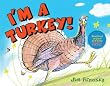
Arnosky, Jim. 2009. I'm a Turkey. New York: Scholastic. (click for review)

A singing look at the natural world of turkeys.  Not a Thanksgiving book, but timely (and fun!), nonetheless.
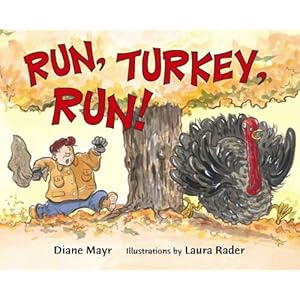
Mayr, Diane. 2007. Run, Turkey, Run!
A cumulative tale (reminiscent of We're Going on a Bear Hunt) of a turkey on the run.  For the faint of heart, you can even end the book at the point where the family sits down to enjoy a Thanksgiving dinner of grilled cheese while the turkey rejoices (and skip the final page when the turkey is spotted again when the family goes out to find a Christmas tree!).  Either way, it's a winner.


Anderson, Derek. 2005. Over the River: A Turkey's Tale. New York: Simon and Schuster. (Based on the song by Lydia Maria Child)
If you want to keep old songs alive, you've got to sing them - and children are the best audience.  They love to sing, they love you to sing with them, and they don't mind if you don't do it well! (I love kids for that)  Break out your singing voice and give "Over the River and Through the Woods" a go while you page through the delightful illustrations of this Thanksgiving classic.

Markes, Julie. 2004. Thanks for Thanksgiving. New York: Harper Collins.

This book's simple rhymes (one line per page)   
Thanks for Thanksgiving, for turkey and pie.
Thank you for fall and gold leaves floating by.
and warm illustrations make it perfect for sharing with your youngest listeners. (the "you" in thank you is left undefined and readers may draw from it what they wish)


Ruddell, Deborah. 2009. A whiff of pine, a hint of skunk: A forest of poems. (Ill. by Joan Rankin). New York: Margaret K. McElderry Books.


And if you're planning to have children create the classic hand print turkey this year, it simply begs for a reading of "A Wild Turkey Comments on his Portrait," from A Whiff of Pine, a Hint of Skunk: A Forest of Poems, if not for the kids, then read it for yourself!
I find it most insulting
that you traced around your hand
and colored all my feathers
either plain old brown or tan.

Where's the copper? Where's the gold
that a turkey should expect?
Where on earth is raw sienna,
and where is the respect?

Finally, I'm baffled
that you've made me look so dumb.
My head is quite distinguished
and it's nothing like your thumb.
The rest of the collection is great as well! Don't miss this one.


Finally, If you're thinking of choosing a book that tells the "traditional" "Thanksgiving story," check out the resources at Oyate first.  Oyate, a Native organization that works to promote honest depictions of Native history and stories, offers Recommended Books about Thanksgiving  and a guide, How to Tell the Difference. I'm thankful that they have decided to discontinue their page on "Books to Avoid."  A list of suggested books is more helpful and affirming than a list of offensive ones.  In the future, I hope that more culturally-correct, Thanksgiving inspired titles are written for preschoolers. In the meantime, I'll be sharing the ones above.

And that's Thanksgiving in a pie shell.  Enjoy!
Share |

Tuesday, October 5, 2010

Woods Runner

Paulsen, Gary. 2010.  Woods Runner. New York: Wendy Lamb.

At only thirteen years old, Samuel is already a man in some ways.  Born on the frontier, he is at home in the woods; hunting, tracking and providing for his family.  His parents have taught him to read, to be curious, to enjoy the hard work and simplicity of the frontier, but at heart, they are city-born, content to live at the edge of the great woods. Samuel, though, is perhaps even more at home in the woods than in his family's modest home.

So it is that Samuel is away hunting bear when the war comes to Western Pennsylvania.  Carefully deciphering the tracks and signs near the scorched earth of what was once their settlement, Samuel knows that his parents have been taken captive by British Redcoats and their Native allies.  Others from the settlement were not so lucky.  After burying the dead, Samuel sets out to find his parents - traveling eastward to the Redcoats stronghold, New York.

Like a Cold Mountain for teens and young adults, Woods Runner doesn’t recount the battles of war , but rather, its impact on civilian life.  Samuel, his parents, and his traveling companions do not fight in the war, but neither can they escape it.

     "It is the way of it," Abner put in from the darkness, "of war.  Some get, some don't, some live, some ... don't.  It's the way of it.
     "It's bad."
     "Yes. It is.  But it is our lot now, and we must live it."  Abner sighed. "The best we know how.”
A historical tale of action, suspense, determination and survival.  Single page entries of historical facts (ammunition, orphans, communication, etc.) separate the chapters and add background and perspective to this short, gripping story. History repeats itself every day in some location in the world.  It's good to remind ourselves sometimes of war's less visible consequences.  Highly recommended for grades 6 and up.


Read an excerpt from Woods Runner.

Bookpage has a great interview with Gary Paulsen.

Woods Runner, Three Rivers Rising, One Crazy Summer, The Keening, Countdown ... this has been a great year for historical fiction. I can’t wait to see what wins the Scott O’Dell Award.  It’s hard for me to pick a favorite.

I nominated this book for the Cybils (Children's and Young Adult Bloggers' Literary Awards) in the Young Adult category.  Anyone can nominate books until October 15th.  Just be sure to read the nomination rules first.

Share |

Sunday, August 9, 2009

Remember Me,: Tomah Joseph's Gift to Franklin Roosevelt

Soctomah, Donald and Jean Flahive. 2009. Remember Me: Tomah Joseph's Gift to Franklin Roosevelt. Gardiner, ME: Tilbury House.
(Reviewed from a galley proof supplied by Tilbury House through LibraryThing)


The inspiration for Remember Me: Tomah Joseph's Gift to Franklin Roosevelt is a birchbark canoe (see photo) given by a Passamaquoddy Elder, Tomah Joseph to the future president of the United States, Franklin Roosevelt.


Although the relationship between young Franklin and Tomah Joseph is imagined by the authors, Remember Me (Mikwid Hamin) is based in fact. Franklin's family did spend summers at Campobello Island in Maine and Franklin did receive the canoe from Tomah Joseph.


In the course of their time spent together, Franklin learns about canoeing, but more importantly, Tomah Joseph teaches Franklin about Passamaquoddy culture - their beliefs, their art, their history, their lifestyle. Franklin is an avid learner and Tomah Joseph is a willing teacher.

Watercolor and pen illustrations in soft, natural colors depict Tomah Joseph and Franklin Roosevelt in a variety of outdoor scenes, as they enjoy nature and each other's company. A page of etchings shows a map of the area, and the book's final pages show a portrait of Franklin Roosevelt as president and a depiction of Tomah Joseph and selections of his artwork.

Remember Me fills in an area of history that seldom appears in children's literature. While it hints at stories of "the Old Time," the story takes place long after the Europeans and later Americans first came into contact with America's native people. Rather than telling the story of "the Old Time" or the many wrongs committed against the Passamaquody, Remember Me focuses on a different aspect of history. A formal tribal chief, and an artist, Tomah Joseph chose to stay in his native lands and interact with the new settlers. In addition to creating baskets and birchbark etchings, he worked as a hunting and fishing guide. In this way, he was able to interact with the settlers and share with them his love and knowledge of nature as well as the culture of his clan.

According to the story, Tomah Joseph recognized young Franklin Roosevelt's potential as an influential leader and, as Tomah Joseph aged and Roosevelt became a young man, Tomah Joseph encouraged him, "Mikwid hamin, Franklin. Always remember me."

This book would be particularly appropriate for classroom use. Unique, informative, and written by a member of the Passamaquoddy tribe.

The publisher's website offers link to many useful links for educators and those interested in further exploration of this story.
Photo of Franklin in the canoe made by Tomah Joseph is from the official website of the the Roosevelt Campobello International Park Commission .

Tuesday, March 24, 2009

The Porcupine Year


Erdrich, Louise. 2008. The Porcupine Year. New York: Harper Collins.
ISBN: 978 0 06 0297879

The Porcupine Year, sequel to The Birchbark House and The Game of Silence, continues the adventures of an Anishinabe, or Ojibwe girl, Omakayas (Little Frog). In The Porcupine Year, so named for the porcupine “medicine animal” that befriends Omakayas’ brother, Omakayas is now twelve years old and is traveling with her family in 1852. The U.S. government is moving the native people ever westward, and Omakayas’ family hopes to join their relatives somewhere northwest of their homeland in current-day Minnesota.

In third person narration, The Porcupine Year recounts a year in the lives of the Anishinabe family. True to the Native American view of life as a circle, the book begins in spring and ends full-circle in the following spring. During that time, Omakaya’s annoying younger brother, Pinch, matures into a resourceful boy named Quill, Omakayas herself, earns a new name, Leading Thunderbird Woman, and the family endures hardship and adventure on the trail west. Native American culture is woven seamlessly into the story, and is experienced through context, rather than explanation. When Omakayas and Pinch narrowly survive a trip through dangerous rapids, the reader completely understands the symbolism behind Omakayas’ decision to leave her precious red beads on a rock by the river as a gesture of thankfulness. Native words are sprinkled liberally throughout the story, but few will send readers to the included glossary,

“’We should continue north, giiwedin,’ said Old Tallow. ‘Few chimookomanag have made their homes in the great woods and lakes. We don’t want them to kick us out again!’

‘I still think that my brother might come through this way,’ said Deydey. ‘This is our old stomping ground. We hunted here long ago, But now…’

‘Game is getting scarce.’

‘There is always good fishing on this lake. But I think we are camped close to the big path of our enemies, the Bwaanag. If their warriors come across us on their way back to their homes, after a raid – mad that they got nothing, howah! – we’d be in big trouble.’”

Native culture is also evident in the respect that Omakayas and the other children have for their elders. The Porcupine Year, is not, however, a novel that merely glorifies the Indian way of life and excoriates the Whites. Rather, Porcupine Year is an honest novel that treats each person individually. Although the whites are understandably blamed for the Anishinabe’s forced migration, the family readily takes in two white children that have been left homeless orphans after a fire. Omakayas’ father is half-white himself. Later, it is a relative from their own tribe that steals from Little Frog’s family, and members of the fierce Bwaanag tribe that kidnap members of the family. As in all cultures, there are good and evil people, and Erdrich does not shy from presenting both types.

Overall, however, The Porcupine Year is not a Native American story, it is the story of a girl…

a girl with a darling baby brother, a girl in a budding romance with a local boy, a girl seeking the approval of her father, a girl with a stern but loving mother, a pesky younger brother, a doting grandmother and a mean-spirited cousin. In short, a girl like any other girl - a girl that readers will understand.

The Porcupine Year is not as deep and soul-searching as the multiple award-winning, Birchbark House, but its faster pace and shorter length (193 pages) makes it more accessible to younger or less-avid readers. The Porcupine Year can easily be read on its own, without its prequels. Some Native American legends are included as stories within the story; a glossary of Ojibwe words and author’s notes conclude the book. Pencil illustrations are by the author. Highly recommended for fans of adventure, historical fiction, coming-of-age, and Native American books. Grades 5 and up.


Friday, January 30, 2009

Diamond Willow

Frost, Helen. 2008. Diamond Willow. New York: Frances Foster. ISBN: 978-0-374-317768

Like a diamond, the concept for Diamond Willow is brilliant. Twelve-year-old Willow is named after a stick, a diamond willow stick, to be precise. When branches are cut from the willow, a diamond shaped scar is left on the branch. Written mostly in first person verse, each page of Willow's thoughts is a diamond-shaped poem; but the brilliance is not in the shape of the poem, it lies in the gem within. Nestled within each poem is a small truth - a truth that resides within Willow but cannot be seen from without,

"What
I love
about dogs;
They don't talk
behind your back.
If they're mad at you,
they bark a couple times
and get it over with. It's true
they slobber on you sometimes.
(I'm glad people don't do that.) They
jump out and scare you in the dark. (I know,
I should say me, not "you" - some people aren't'
afraid of anything.) But dogs don't make fun
of you. They don't hit you in the back
of your neck with an ice-covered
snowball, and if they did, and
it made you cry, all their
friends wouldn't stand
there laughing
at you.
(Me.)"
Diamond Willow takes place in a remote Alaskan town where dogs and snowmobiles are the most common form of transportation. Willow is most comfortable with her family and her dogs, especially now, since her closest friend has a boyfriend. When an accident occurs while Willow is mushing the dogs, Willow uncovers the truth within, as well as a closely-held family secret.
More than just a coming-of-age story, Diamond Willow is a mystical tale of Native American spirits that reside within the creatures of the Alaskan wild.
I was unable to find reviews of this book on sites dedicated to Native American literature (Oyate, American Indian Library Association, American Indians in Children's Literature), and am curious if those within the Athabascan community find Diamond Willow to be in keeping with native philosophy. I was pleased to see that the author, Helen Frost, spent much time in Alaska and consulted with an Athabascan elder while writing Diamond Willow.
A thoughtful look at the meaning of family, loss, friendship and love.

Saturday, September 6, 2008

Daniel Boone's Great Escape

Spradlin, Michael. Daniel Boone's great escape. 2008. Ill. by Ard Hoyt. New York: Waler & Co.

Nonfiction, particularly history, is one of my favorite genres in children's literature, so I enjoyed this little-known episode in the life of the famous frontiersman, Daniel Boone. Daniel Boone's Great Escape recounts his escape from the Shawnee tribe, which had held him in friendly captivity for several months. Boone escaped to warn the settlement of Boonesborough, Kentucky (where his own family resided) of an imminent attack by the Shawnee. According to the Epilogue, Boone's own account of his journey through the wilderness, pursued by Shawnee warriors, is as follows: "On the 16th, before sunrise, I departed in the most secret manner and arrived at Boonesborough on the 20th, after a journey of one hundred and sixty miles, during which I had but one meal."

While Daniel Boone's heroism and bravery is the heart of the story, Spradlin makes sure to highlight the Shawnee position on the white settlements. The aggression of the Shawnee was a reaction to the murder of their chief at Fort Randolph, where he had traveled under a flag of truce to discuss broken treaties. Hoyt's pen and watercolor illustrations appear to depict both Whites and Indians in authentic dress and accoutrements. Life in the Shawnee village is shown as friendly and productive, while warriors and Boone alike are shown with the expected expressions - pride, anger, thoughtfulness, concern. It's clear that both author and illustrator have tried to take a balanced approach in this frontier tale.

The Epilogue contains detailed historical information, however, a bibliography or resource page would also have made a nice addition. This is a picture book for older readers, and as such, will probably receive limited use. It is not suitable as biographical material because it covers only four days in the life of Boone. It is equally unsuited as a balanced look at Westward expansion because of its limited scope. That being said, it is an interesting story and will hopefully find its niche.

Friday, February 22, 2008

The Birchbark House

Erdrich, Louise. 1999. The Birchbark House. Ill. by Louise Erdrich. New York: Hyperion. ISBN: 0786822414.

PLOT SUMMARY
Louise Erdrich’s, The Birchbark House, is a tale of love, loss, and growing up, for Omakayas, a 19th century Objibwa, or Anishinabe girl living near Lake Superior. It is also a recounting of the ways of the Anishinabeg at the dawn of Western expansion. The adventures of Omakyas, her family and her people will delight middle school age readers who will identify with Omakayas and her family.

CRITICAL ANALYSIS
Erdrich’s The Birchbark House is a beautiful weaving of the literary and the historical, following the life of 7-year-old, Omakayas in the year 1847. The details of Omakayas’ Anishinabeg lifestyle never interfere with the story; instead, they provide a rich backdrop providing interest as well as information. Native American cultural markers are numerous, authentic, and integral to this affecting story.

Omakayas lives a life familiar to many children. She has an older sister whom she envies for her beauty and grace, a younger brother whom she despises for his selfishness and greed, and a baby brother whom she adores for his sweetness and innocence. Her mother is firm, yet loving. Her grandmother, or nokomis, is kind and wise. Her father is often away on business, trapping to provide skins for the White traders. She loathes certain of her chores, particularly the scraping of hides to make leather, she looks after her brothers. These connections render Omakayas accessible to 21st century children. It is through this connection that cultural details are channeled.

Respect for elders is shown throughout the book, from a simple line regarding Grandma, “the dappled light of tiny new leaves moved on Grandma’s beautiful, softly lined face,” to Omakayas' behavior around the strong-willed elder, Old Tallow, “She wished the old woman good health, and called her “Auntie” because it was a sign of affection, though Omakayas was not really sure exactly what she felt. After she’d spoken, she stood politely, waiting.” A reverence for one’s elders is consistently apparent.

The Ojibwa people are portrayed realistically in Birchbark House- not always serious, not always good (especially in the case of Omakays’ brother known as Pinch!), and not always mystical and “all-seeing.” Omakayas’ father, Deydey has a wry sense of humor. Although dreams are taken seriously in the Anishinabe culture, he is not above poking fun at his friend’s sillier dreams. “’Last night I dreamed my head got stuck in a kettle,’ (LaPautre) revealed his voice low and troubled. ‘It must have been a very big kettle’ Deydey said, solemnly, for LaPautre had a big round head and a full moon face.” In another scene, Deydey again teases LaPautre for his dream about lice, while Omakayas and her sister, hiding in the brush “clapped hands over their mouths to stifle their glee.” Light hearted moments are interspersed throughout the book, as they are in life.

Another trait common to Native American people is a willingness to welcome strangers. This is exemplified, though disastrously so, when Omakayas’ people welcome a traveler with smallpox to their lodge.

Birchbark House also evokes the theme of the circle or cycle, common to many Native Americans. The chapters are grouped into books, each named for one of the Anishinabe seasons. The family travels from their winter quarters where they ice fish and survive the harsh winter, to the sap harvest when the maple trees thaw, to the rice harvesting grounds, and to birchbark house where they hunt, gather berries, prepare hides, and prepare foods for winter storage. The story spans a year in Omakaya’s life, beginning and ending at the birchbark house that her family builds anew each spring; and though the clan has suffered loss, there is also joy, the return of one lost, and the renewal of the spring season.

Ojibwa, or Anishinabe words are placed throughout the story, both with English translations and with contextual clues. An author’s note explains the Ojibwa language, and a glossary and pronunciation guide follows the story. Some words, such as the greeting, ahneen, are used often enough to remember. Other words and phrases will have the reader flipping frequently to the glossary. Welcome additions to the text are three “stand-alone” stories told by Omakayas’ relatives. The stories illustrate the inventiveness and purposefulness of Native folktales. “Deydey’s Ghost Story” is especially enjoyable, featuring cleverness in the face of fear.

Small pencil drawings by the author dot the story, adding interest, illuminating Omakayas’ encounters with bears, her parents’ makazins, members of her family and more. The drawings are crisp and clean with just enough detail. The faces are varied but distinctly Native in shape and coloring. The depictions of clothing, tools, and living quarters is reflective of the narrative's description.

An interesting facet of The Birchbark House is its varied perspective on Western expansion. Though the story is told via the young Ojibwa girl, it is clear that her family is not completely opposed to the Whites, or chimookoman. Omakayas’ father is part White. He regularly trades with the Whites and takes pride in his prowess at chess, the White man's game. The clan’s Old Tallow has a disdain for the Whites, yet she too has adapted somewhat to the White ways, living as Omakayas’ family, in a cabin during the winter. Mother sews metal thimbles to her daughter’s dress; father buys calico, velvet and beads from the fur traders. They harbor no ill will against the missionaries, and note that they were helpful in caring for Ojibwa with smallpox. At the same time, they note the European Americans' insatiable hunger for land and the eventual conflict that will arise from the incessant push Westward. This multi-faceted view adds to the richness and realism of the book.

The Birchbark House
is an exemplary example of a book depicting a Native American culture in a realistic and engaging manner. The historical and narrative qualities are equally first rate and the author’s own artwork adds to Birchbark’s authenticity. Highly recommended.

REVIEW EXCERPTS
Erdrich's "attention to historical detail perfectly balances the compelling story."

2004. "The Birchbark House (Book)." Book Links 13, no. 6: 24-24. Academic Search Complete, EBSCOhost (accessed July 8, 2007).

"Edrich's novel succeeds best in its efforts to present events with historical and cultural accuracy, while providing enough textual apparatus and insight into the inner life of her main character to draw young readers."

Rice, David. 2002. "Birchbark House/Muskrat Will Be Swimming/Rain is Not My Indian Name (Book)." MELUS 27, no. 2: 246. Academic Search Complete, EBSCOhost (accessed July 8, 2007).


CONNECTIONS
Suggest reading Louise Edrich's The Game of Silence (2005), which continues the story of Omakayas in the year 1850.

Share poems from Lee Francis' When the Rain Sings: Poems by Young Native Americans. (1999)

Suggest Four Seasons of Corn: A Winnebago Tradition by Sally M. Hunter. This book is recommended by Native American author Cynthia Leitich Smith and shows the cycle of the corn planting as practiced by a modern 12-year old, Winnebago or Hochunk boy.

Thursday, January 24, 2008

The Absolutely True Diary of a Part-Time Indian

Though I’m most interested in reading J titles, the Young Adult novel, The Absolutely True Diary of a Part-Time Indian was suggested to me by too many people to pass up.

Alcoholism, bullying, bigotry, racism, violence, masturbation, bulimia, obscenities – they all show up here in Sherman Alexie’s newest book, guaranteeing that it will be controversial; but yet – the book’s message is positive, funny, real, and not the least bit didactic. Reviews note that the character of Junior is somewhat autobiographical, explaining the protagonist’s honesty and believability. He is part Arnold-part Junior, part White-part Indian, part geek-part athlete, and an endearing mix of part chicken-part warrior. I thoroughly enjoyed this novel which is literally and figuratively animated by the hilarious cartoon illustrations of Ellen Forney.

I don’t know if Junior’s views on the nature of Indian life and reservations are widely held within the culture, but I am pleased to see that The Absolutely True Diary… won the inaugural American Indian Youth Literature Award for young adults. Knowing that the title has the blessing of those within the Indian culture is yet another reason to recommend this book. Junior’s ultimate realization that he has a rightful and natural place within many “tribes,” and that each of us must follow our own inner calling, is a fitting end to this coming-of-age novel of a “part-time Indian.”

Beneath the Waves - a review

As we read disturbing news accounts of dying manatees , environmental disasters caused by toxic waste, and ocean pollution on the scale of ...