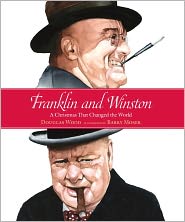
It was the winter of 1941. The valiant battleship HMS Duke of York struggled against the screaming winds and forty-foot waves of a mighty December gale. On board, Winston S. Churchill, prime minister of Great Britain, calmly chomped his ever-present cigar as he strolled the pitching decks. He was going to meet the president of the United States. He was going to spend Christmas at the White House. He would not be stopped by a mere storm. He would not be stopped by a hurricane.The focus of Wood's book is this single visit by Churchill to the White House following the early December attack on Pearl Harbor. Although some background and biographical information is included to set the scene for young readers, Franklin and Winston is, in essence, a chronicle of the historic December 1941 visit. Transportation (Churchill was too impatient to travel by land from his arrival point in Chesapeake Bay and was flown to Washington, D.C.), activities (Churchill explored the White House gardens in one-piece overalls), press conferences, dining arrangements and meetings are fully detailed to give the reader a flavor of the era, and an understanding of the relationship between the two men and of their role in world politics.
Most importantly, the reader gains the insight that although these were powerful men deciding a course of action in dire circumstances, they were not larger than life, but full of life. They were friends, and they were very human - with the quirks and frailties one might find in any human being. Roosevelt and Churchill overcame personal obstacles, and with a common cause and a fast friendship, they formed the bonds and the strategy needed to defeat the Axis powers in WWII.
Yet still, while the fate of the world was at stake, the two men took time to celebrate the Christmas holiday, giving heartfelt speeches at the lighting of the National Christmas Tree. The included speeches are excerpted and edited by the author with great care to portray both the gravity of the world's situation and the context in which Roosevelt and Churchill were deciding its fate,
"I spend this anniversary and festival far from my country, far from my family, yet I cannot truthfully say that I feel far from home. . . . We may cast aside, for this night at least, the cares and dangers which beset us, and make for the children and evening of happiness in a world of storm. . . . Let the children have their night of fun and laughter. Let the gifts of Father Christmas delight their play. . . . In God's mercy, a happy Christmas to you all."Moser's full-page watercolor illustrations face pages of black text on a white background. Moser's paintings are rich in the simpler, more somber colors of the era - dark suits, night skies, a bathroom featuring white tiles, towels and fixtures, simply colored maps, military aircraft. But while the colors and details are evocative of a past time, the faces of Churchill and Roosevelt express life - mirth, joy, and gravity, all within the framework of the timeworn faces of real men, men of a different age who were respected for their actions - discolored teeth, bulbous nose, wrinkles, glasses and all.
Smaller illustrations appear with the text on many pages, and add visual details to the story - a view of the Foundry Methodist Church, the radio on which Roosevelt listened to Churchill's address to Congress, an adorned napkin from dinner with Mrs. Roosevelt.
Contains an Afterword (listing accomplishments of the Christmas 1941 meetings), Author's Note, and Bibliography.
Chronological and factual, Franklin and Winston: A Christmas that Changed the World, is moving as well. Highly recommended.
You can preview the book at the author's website.
Today's Nonfiction Monday roundup may be found at Charlotte's Library.


