A Fire Story
by Brian Fies
Abrams Books, 2019
In graphic novel format,Brian Fies tells his own personal story as well as those of others who lost everything in the devastating Northern California fires of 2017. Their stories highlight the more mundane aspects of a living through a natural disaster—the bureaucratic red tape, the small things that trigger immense emotion, the weird sense of living as a displaced person in your own environs. Having experienced two devastating hurricanes myself, I can attest that Fies has accurately captured the moods and experiences of survivors of catastrophe. Some photos are also incorporated into the dramatic illustrations. This affecting book will stay with you much longer that the short time it will take to read it.
Originally published online, A Fire Story was recreated (the original web comic is included in the print version) and enhanced for print publication.
Read the original web-based version here.
Book reviews (and news) you can use. A librarian's opinion on books and media for children and young adults
Showing posts with label memoir. Show all posts
Thursday, January 2, 2020
Tuesday, October 2, 2018
Lost Soul, Be at Peace - a review
Lost Soul, Be at Peace
by Maggie Thrash
Candlewick Press, 2018
Librarians are always trying to ensure that all people are able to find people like themselves in books—people with disabilities, people of color, people from all nations and religions—it’s not only important that we see ourselves in books, but it’s important that others see people like us so that they may learn that while we may be different, we also have much in common. But I’ve often wondered…what about those who are depressed? Do they want to see themselves in books too, or does it painfully reinforce the depression from which it is so often difficult to emerge? I asked a dear family member who suffers from depression. She told me that it all depends on how the story is told. I think Maggie Thrash has told her story well in the graphic memoir, Lost Soul, Be at Peace.
Eleventh grader, Maggie is depressed,
“It’s like, you're falling into a deep cave on a moonless night, and there’s no escape, and suddenly you realize: it’s not a cave, it’s your soul.”Maggie is failing school, her brother has left home for college, her father is an introverted, workaholic judge, and her mother is a socialite with whom she has little in common. She’s fairly certain that she’s a lesbian, but contrary to what she thought, coming out at school didn’t make things any better or worse. She finds comfort in her cat, Tommi. When Tommi goes missing, Maggie’s search for her turns up something else entirely.
Maggie tells her story in graphic novel format with the emphasis on dialogue. Back story information is handwritten in memoir style, or provided in illustrations of newspapers, computer screens, notes, or other drawn realia. The panel style varies and includes full spreads, three-per page, classic comic book style, and gutterless panels. My review copy is in black and white, but judging from the cover, the colors in the finished book will be dark and rich. Even without color, emotion is clearly visible in Maggie’s large eyes and expressive face. That she is ill-at-ease in most situations is painfully obvious throughout most of the book, but yet, her position as person in charge of her dance group offers a hint that Maggie has an inner spirit that is only awaiting an opportunity to soar. She is not a girl without hope; she is only a girl searching for her opportunities. She will find them.
Look for this book in October. My copy was provided by LibraryThing's Early Reviewers program.
Thursday, February 4, 2016
Vacation
I'm on vacation this week - escaping the cold.
Until I get back, perhaps you'll enjoy my recent reviews for AudioFile Magazine:
- The Blackthorn Key by Kevin Sands (murder, mystery, and adventure set in a fantastical London, circa 1600)
- This Side of Wild: Mutts, Mares, and Laughing Dinosaurs by Gary Paulsen (a funny memoir)
Monday, November 2, 2015
The Other Side of the Wall - a review
The Other Side of the Wall by Simon Schwartz
Translated from German by Laura Watkinson
Published by Graphic Universe, 2015
112 pages, best for grades 6 and up
Paperback
Simon Schwartz was born in East Berlin in the 1980s.The Other Side of the Wall is his graphic memoir of growing up in the divided city, of his parent's three-year struggle to obtain an exit permit to leave East Berlin, and of his later forays between the two Berlins.
His parents met in college. His father came from a family of staunch Communist Party members. His mother's family was secretly more liberal, though any deviation from expected Party behavior was cause for examination and surveillance by the Stasi, or secret German police. It was dangerous to stray from party orthodoxy, particularly if you were a teacher, as Simon's father was. His parents became disillusioned with life in the restrictive East German city.
When his parents requested exit permits, their lives became fraught with poverty,ostracism, and physical danger.
The book's layout is as structured as Communist life - with few exceptions, four blocks per page - each bordered in black. The artwork is monochromatic, fitting for the stark reality of life behind the Wall. The story is told in speech bubbles, text blocks that set the scene or relay back story, and the occasional footnote explaining terms that may not be familiar to readers (well-known politicians or artists of the time, and uniquely German or Communist terms). Several panels are wordless - vague remembrances of the young Schwarz.
Back matter includes a glossary, a timeline of the Berlin Wall, and maps of Germany and Berlin 1961-1989.
I recently reviewed the historical fiction novel, A Night Divided, that describes life in East Berlin in the immediate aftermath of the Berlin Wall's construction.The Other Side of the Wall is a perfect companion book - a nonfiction, graphic novel account of the Wall's waning days. For younger readers not familiar with day-to-day life in the Cold War Era, this is a chilling introduction.
Translated from German by Laura Watkinson
Published by Graphic Universe, 2015
112 pages, best for grades 6 and up
Paperback
Simon Schwartz was born in East Berlin in the 1980s.The Other Side of the Wall is his graphic memoir of growing up in the divided city, of his parent's three-year struggle to obtain an exit permit to leave East Berlin, and of his later forays between the two Berlins.
His parents met in college. His father came from a family of staunch Communist Party members. His mother's family was secretly more liberal, though any deviation from expected Party behavior was cause for examination and surveillance by the Stasi, or secret German police. It was dangerous to stray from party orthodoxy, particularly if you were a teacher, as Simon's father was. His parents became disillusioned with life in the restrictive East German city.
The Soviet Union had recently invaded Afghanistan. My dad worked on his speech, night after night.
"God, how can you describe a war as just? They want me to use fancy words to justify this invasion."
"Just write something you can square with your own conscience -- at least in part."
"I don't know if I can do that."
When his parents requested exit permits, their lives became fraught with poverty,ostracism, and physical danger.
The book's layout is as structured as Communist life - with few exceptions, four blocks per page - each bordered in black. The artwork is monochromatic, fitting for the stark reality of life behind the Wall. The story is told in speech bubbles, text blocks that set the scene or relay back story, and the occasional footnote explaining terms that may not be familiar to readers (well-known politicians or artists of the time, and uniquely German or Communist terms). Several panels are wordless - vague remembrances of the young Schwarz.
Back matter includes a glossary, a timeline of the Berlin Wall, and maps of Germany and Berlin 1961-1989.
I recently reviewed the historical fiction novel, A Night Divided, that describes life in East Berlin in the immediate aftermath of the Berlin Wall's construction.The Other Side of the Wall is a perfect companion book - a nonfiction, graphic novel account of the Wall's waning days. For younger readers not familiar with day-to-day life in the Cold War Era, this is a chilling introduction.
Monday, November 24, 2014
GUs & Me - a review
Richards, Keith. 2014. Gus & Me: The Story of my Granddad and my First Guitar. Hachette Audio.Keith Richards, the rough-edged, raspy-voiced, Rolling Stones guitarist, is hardly the man that comes to mind for a picture book writer and narrator, but then again, who better to tell the story of his first guitar?
Richards wins the listener over immediately with his folksy, working class Estuary English accent (think dropped h's and "intrusive" r's) and unmistakable fondness for his topics - his first guitar and his beloved Granddad, Gus. It was the musically talented Gus who introduced a young Keith Richards to the guitar, teaching him how to 'old it, and suggesting the classical MalagueƱa(r) as the pinnacle of guitar mastery.
I have yet to see the print version of this story, but I don't believe it could surpass the audio book. A story with music at its heart needs music to be understood. Richards plays bits from MalagueƱa in appropriate spots throughout the story, and during a visit to a music shop in London, we hear Steve Jordan on drums. Once, the listener even hears a little chuckle - not musical, but surprisingly sincere. Richards collaborated with other authors, but this is obviously his story, and he delights in telling it.
(Run time: about 7 minutes)
My review of Gus & Me for AudioFile Magazine appears here with a small excerpt. Take a listen!
![]() |
Visit the Nonfiction Monday Blog, "rounding up the best nonfiction for children and teens."
Monday, October 27, 2014
Brown Girl Dreaming
Woodson, Jacqueline. 2014. Brown Girl Dreaming. New York: Penguin.Despite the title, Brown Girl Dreaming is most certainly not just a book for brown girls or girls. Jacqueline Woodson's memoir-in-verse relates her journey to discover her passion for writing. Her story is framed by her large, loving family within the confines of the turbulent Civil Rights Era.
Sometimes a book is so well-received, so popular, that it seems that enough has been said (and said well); anything else would just be noise. Rather than add another Brown Girl Dreaming review to the hundreds of glowing ones already in print and cyberspace, I offer you links to other sites, interviews and reviews related to Brown Girl Dreaming. And, I'll pose a question on memoirs in children's literature.
First, the links:
- Brown Girl Dreaming is a National Book Award Finalist in the Young People's Literature category.
- Jacqueline Woodson was interviewed on NPR regarding Brown Girl Dreaming.
- Read an excerpt from Brown Girl Dreaming here.
- Even the prestigious Christian Science Monitor carried a review of Brown Girl Dreaming - the review written by award-winning author, Augusta Scattergood.
- Elizabeth Bird's "Fuse 8" review of Brown Girl Dreaming - thoughtful and insightful, as always
- AudioFile Magazine's review of Brown Girl Dreaming and an excerpt - read by Jacqueline Woodson herself
- New York Times Sunday Book Review of Brown Girl Dreaming
As a librarian who often helps students in choosing books for school assignments, I have written many times about the dreaded biography assignment - excessive page requirements, narrow specifications, etc.
Obviously, a best choice for a children's book is one written by a noted children's author. Sadly, many (by no means all!) biographies are formula-driven, series-type books that are not nearly as engaging as ones written by the best authors. Rare is the author of young people's literature who writes an autobiography for children as Ms. Woodson has done. When such books exist, they are usually memoirs focusing only on the author's childhood years. This is perfectly appropriate because the reader can relate to that specified period of a person's lifetime. Jon Sciezska wrote one of my favorite memoirs for children, Knucklehead, and Gary Paulsen's, How Angel Peterson Got his Name also comes to mind as a stellar example. These books, however, don't often fit the formula required to answer common student assignment questions, i.e., birth, schooling, employment, marriages, accomplishments, children, death. Students are reluctant to choose a book that will leave them with a blank space(s) on an assignment.
I wonder what teachers, other librarians and parents think about this. Must the biography assignment be a traditional biography, or can a memoir (be it in verse, prose, or graphic format) be just as acceptable? I hate to see students turn away from a great book because it doesn't fit the mold. If we want students to be critical thinkers, it's time to think outside the box and make room for a more varied, more diverse selection of books.
Thursday, June 9, 2011
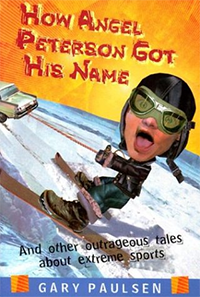
How Angel Peterson Got His Name: an audibook review
(2 hours, 10 minutes)
Now here's a book of which we don't see too many. Looking for an available audiobook to download, I came upon this one and chose it merely because it was written by Gary Paulsen, author of last year's Woods Runner. From the cover art, it looks to be a juvenile chapter book - but it's not.
Think of all the America's Funniest Videos shows that you've seen featuring crazy stunts performed by teenage boys. Imagine similarly crazy stunts performed in the wilds of 1950s and 1960s Minnesota (Bungee jumping anyone? All you need is a barn roof, a pulley and a truck tube!) Now imagine those stunts in the printed or spoken word. And finally, imagine them with a long and humorous "set-up" by the funny and talented Gary Paulsen. Now you've got the gist of How Angel Peterson Got His Name.
First published in 2003, released this year in audiobook, How Angel Peterson Got His Name is a young adult book and a memoir of sorts. I say "of sorts," because in it, Paulsen shares stories of his boyhood (and a wild and reckless boyhood it was!), but in each of the hilarious anecdotes, Paulsen is not the star player, but a member of the supporting cast. He is the one waxing the skis for the skiing speed record attempt (Who needs a hill when you've got a V-8 engine to assist?). He is the one hoisting the WWII surplus parachute into the air for what could arguably have been the first hang-gliding attempt. He is the one who is not(?) peeking under the canvas flap to see the circus "hoochie coochie" women.
Award-winning narrator, Patrick Lawlor, does a superb reading of How Angel Peterson Got His Name. Despite being many years younger than Paulsen, listening to Lawlor is like sitting at the foot of a beloved uncle (dads don't tell these kinds of stories) while he spins yarns about the past.
At 72 years young, Gary Paulsen has seen many changes in his life. Listeners may find a few tidbits from the book to be shocking, such as the accidental electrocution of many a curious cat, when televisions, with their super-charged vacuum tubes were first introduced. Or young boys using "live pucks" for hockey practice. (Paulsen mentions cats or chickens) While the past sometimes seems more glamorous or exciting, these are the smaller things that remind us that progress is good. However, some things never seem to change. I am reminded of the old adage, "boys will be boys." May it ever be so.
Read about Gary Paulsen here. He's an American treasure.
Note: My gmail account was hacked today. (My apologies if I sent you an email in broken English entreating you to buy a computer!) When "my" emails were reported as spam, Google shut down my blog for a short time. (Thanks, Google, for giving it back!) Moral of the story: Always back up your blog and change your password often!
Subscribe to:
Posts (Atom)
Beneath the Waves - a review
As we read disturbing news accounts of dying manatees , environmental disasters caused by toxic waste, and ocean pollution on the scale of ...
-
I'm delighted to host today's Nonfiction Monday. My contribution for today is Marc Aronson's If Stones Could Speak: Unlocking th...
-
Welcome to Shelf-employed! I'm the host of this week's Nonfiction Monday . Grubman, Steve and Jill Davis. 2010. Orangutans are Tic...
-
Gutman, Dan. 2012. Election! A Kid's Guide to Picking our President. New York: Open Road Media. Advance copy provided by NetGall...