Pages

Showing posts with label China. Show all posts

Tuesday, March 21, 2017

Threads - a review

Threads 

by Ami Polonsky
Disney Hyperion, 2016

I have always appreciated an interdisciplinary approach to everything.   My favorite children's science books integrate the hard and fast facts of science with the ways in which science affects people's lives.  The Boy Who Harnessed the Wind (Young Readers Edition) and The Day the World Exploded are two fine examples of this style of writing.  The same interdisciplinary approach can be taken with the social sciences. My children will attest to the fact that when they neglected to wash strawberries before eating them, I would point out that they may be riddled with toxic chemicals.  If they protested that I had purchased organic berries, I would counter that many migrant farm workers who pick strawberries have inadequate access to clean bathroom facilities.  In this way, they understand that there are choices to be made in the cultivation and harvesting of food. Produce does not arrive in the grocery store by some tidy and precise process. Hard human labor is behind every easy purchase.

Ami Polansky takes an interdisciplinary approach, and thereby broadens the reader's scope of the world while addressing a very personal and intimate problem.  Threads is a book about loss and grief and the difficulty in carrying on in the wake of a loved one's death.  However, she has placed it in within the broader story of Chinese adoption, forced child labor, and the complexities of Chinese culture.

In first person voice, 12-year-old Clara struggles with her adopted sister's death from cancer, while simultaneously attempting to assuage her grief by rescuing a similarly aged girl working in a sweatshop somewhere north of Beijing. 

A car horn honks and I snap my head up.  Dad is waving to me through the closed window, the air around his car glistening in the heat.  I stand up.  I don't know what to do with this letter and photograph, but Dad will.
He's scrolling through something on his phone--probably a text from Mom asking him how I'm doing, if I seem like myself.  I open the car door and look one more time at Yuming's photograph before getting in.

Yuming, the unfortunate captive girl, also relates her story in the first person; and chapters alternate between the two girls.

The door to our room creaks open.  My heart flutters, and I look back down at my sewing.  I know very well that by now someone in America could have found my note, and I curse myself yet again for signing my name and including the photograph.  I wasn't thinking; those risks were unnecessary.  Whoever finds the note could easily notify Mr. Zhang or the police.
Clara and her family journey to China, but with different goals in mind.  Clara hopes to find Yuming.  Her parents hope to find closure.  Yuming's goal is more immediate.  She needs to escape Mr. Zhang's purse factory.

This is a satisfying story on all fronts and I was thankful that I had a realistic conclusion.


From the publisher:
  • Age Range: 8-12
  • Grade Range: 3-7
  • Pages: 256

My copy of Threads is an Advance Reader Copy supplied by the publisher.

Tuesday, January 3, 2017

Father's Road - a review

Father's Road

by Ji-yun Hang. Translation from Korean by Joy Cowley.
Eerdmans Books for Young Readers, 2017


Young Wong Chung is old enough to take part in his father's caravan from Chang'an (Xi'an) to Constantinople (Istanbul). He heeds his kindly father's advice and pays attention to everything he sees along the way as they travel the Silk Road from east to West.

We arrived at a place called Turpan where I could smell a sweet aroma. "That's the smell of grapes," said Father.

"Grapes?" I asked. "In a desert?"
"See that white mountain over there? The ice from Tian Shan melts into the soil, and these delicious grapes grow." Father traded some silk for a bunch of grapes that tasted sweet as honey.

I gave two grapes to my camel. He liked them too.

Illustrator Tan Jung creates delicate ink drawings on paper that is flecked and textured to mimic sand. Its color also serves to represent the skin tone of the travelers and the coats of their many camels. Only the silks and featured geographical or commercial highlights are rendered in colors outside a muted palette of tans and grays.  Wong Chung, however, is readily discernible from the rest of the caravan by the pompom atop his cloth hat and his simple, yet endearing facial expressions.

Entertaining, educational, and culturally respectful,  Father's Road is part of the Trade Winds series.


Front and endpapers combine to create a map of the ancient Silk Road.
Back matter contains the following sections:

  •     The Silk Road (a discussion of its commercial and historical significance)
  •     Key Terms and Concepts (definitions of terms related to cultural and economic globalization)
  •     Global Exchange (a discussion of "non-commodities" exchanged on the Silk Road, e.g., religion, inventions, disease)
  •     Goods from Around the World (India, Rome, Europe, Eastern Mediterranean, Central Asia, China - a list of the main trading groups and their products)
  •     Geography of the Silk Road (a list of major Silk Road cities, their ancient and modern names, significance)
  •     A Timeline of Events ( 3000 BCE - 2013 )

On sale 1/30/17.
My Advance Review Copy of Father's Road was provided by LibraryThing Early Reviewers program. 

Monday, March 28, 2016

China's Forbidden City

The China Institute contacted me to see if I would be interested in seeing books from their We All Live in the Forbidden City program. (The Forbidden City refers to the Imperial Palace in Beijing that housed the seat of Chinese government for about 500 years.  It is now home to the Palace Museum.)  I reviewed their book for very young listeners or readers.

Bowls of Happiness: Treasures from China and the Forbidden City by Brian Tse.  Illustrated by Alice Mak.  Translated by Ben Wang.
China Institute, 2016

A mother creates a bowl and decides to paint it with a pig to represent her young daughter, nicknamed Piggy.

Mommy is good at making pottery.  She has made a bowl, and on the bowl she painted a piggy.

Holding the bowl, Mommy smiles and says "At the sight of Piggy, my hearts leaps with joy!" Oh, silly Mommy.
To make Piggy happy, the mother paints a cloud.  White Cloud, too, needs happiness, so she adds birds, and Flower, and Butterfly, and Tiny Goldfish.  Fruits join the tableau as well, to "represent the joyful meeting of all living things."  When finished, the bowl is lovely; and it is Piggy's; and it is a gift of happiness,

There are so many lovely things joined together on it, all gifts of happiness from Mommy to Piggy, which is me.  Mommy smiles and says, "Oh, silly Piggy!"

The story is short and simple, yet steeped in Chinese culture and meaning. The illustrations are of mixed medium and feature simple ink drawings colored in cheery pastel colors with watercolor highlights.  As each item is added to the painted bowl, the facing page features a facsimile of a  pattern on one of the porcelain bowls in the Palace Museum collection.

A small (3 small-print pages) section titled "What Happiness!" follows the story and briefly explains Chinese customs pertaining to auspicious name selection and the creation of symbolic happiness that brings concrete blessings.

A final section contains beautiful photographs of the antique bowls represented in the story.  The photos are presented on white space without text, so that young children can enjoy them.  Descriptions are on accompanying pages.

Bowls of Happiness will provide a very small introduction to Chinese art and culture to the very young.  Art teachers may find it useful for discussing painted pottery.  The book is perfect for small hands and sharing one-on-one or with a very small group.  The overall presentation is lovely.

Other books in the We All Live in the Forbidden City series are:


My copy of Bowls of Happiness was provided by the China Institute.
 

Thursday, October 4, 2012

Picture Book Roundup - old favorites

Today's Picture Book Roundup features older winners of the Caldecott Medal. 

The Caldecott Medal was named in honor of nineteenth-century English illustrator Randolph Caldecott. It is awarded annually by the Association for Library Service to Children, a division of the American Library Association, to the artist of the most distinguished American picture book for children.
I recently completed a class, "The Caldecott Medal: Understanding Distinguished Art in Picture Books," offered by the Association for Library Service to Children (ALSC), and taught by K.T. Horning.

In addition to learning much that I didn't know about art, I had the opportunity to encounter or revisit some Caldecott Medal winners that predate my career as a librarian. I have been working in a library since 2005, and received my masters degree and first professional librarian position in 2007. The Caldecott Medal has been awarded since 1938. Clearly, I had a lot of catching up to do.

Though I did not read them all, I did read many older winners. Here are some of my favorites from the years prior to 1990:

(In order by publication date - award dates are the January following the publication year)

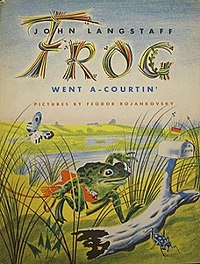
  • Langstaff, John. 1955. Frog Went A-Courtin'. New York: Harcourt Brace. Illustrated by Feodor Rojankovsky.

Richly detailed and expressive animals illustrate this favorite old folk song.  (If you don't know the song, Frog Went A-Courtin', Burl Ives' rendition was a classic)  This is my favorite of all the older Caldecotts.

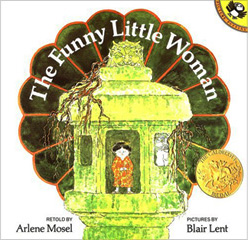
  • Mosel, Arlene. 1972. The Funny Little Woman. New York: Dutton. Illustrated by Blair Lent.

Humorous, with inventive illustrations, the funny little woman travels to a world beneath her simple home in Japan.


  • Yorinks, Arthur. 1986. Hey. Al. New York: Farrar, Strauss, and Giroux. Illustrated by Richard Egielski.

Generally disliked by most of my classmates, this quirky, surreal story about a man and his dog really grows on you.


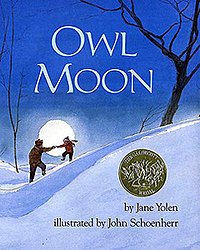
  • Yolen, Jane. 1987. Owl Moon. New York: Philomel. Illustrated by John Schoenherr.

I have been fortunate enough to hear owls in the night many times, though the only ones I have been able to spot are the low-flying burrowing owls.  In Owl Moon, the thrill of a night-time owling expedition is captured brilliantly in both illustration and prose.

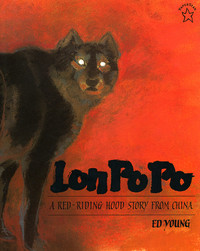
  • Young, Ed. 1989. Lon Po Po:A Red-Riding Hood Story from China.  New York: Philomel.

 
A masterpiece of danger, suspense and courage - a classic folktale. The only one of my picks written and illustrated by the same person, it's no surprise that it's a pitch-perfect pairing of text and art.

A complete list of Caldecott Medal winners 1938-present, may be found here.


I've left off many other wonderful old medal winners, I know.  Feel free to chime in with your favorite Caldecott winners from the 1930s-1980s.


Thursday, September 20, 2012

Starry River of the Sky - a review

Lin, Grace. 2012. Starry River of the Sky. New York: Little Brown.

A companion book to Grace Lin's 2009, Newbery Honor book, Where the Mountain Meets the Moon, Starry River of the Sky is much the same and yet very different. Like the earlier book, Starry River of the Sky contains Grace Lin’s beautiful artwork (see note), features folktale vignettes, and revolves around a journey.  But while Minli’s journey in Where the Mountain Meets the Moon, is an actual journey full of obstacles to overcome, main character, Rendi’s journey, in Starry River of the Sky, is an introspective journey of understanding and self-discovery.

The story opens with a miserable and distressed Rendi traveling as a stowaway in a merchant’s cart,

Rendi was not sure how long the moon had been missing.  He knew only that for weeks, the wind seemed to be whimpering as if the sky were suffering.  At first, he had thought the moans were his own because his whole body ached from hiding in the merchant’s cart.  However, it was when the cart had stopped for the evening, when the bumping and knocking had ended, that the groans began.
Rendi’s story is tied inexorably to that of the moon, though it will take some time for him to determine why the moon is missing and why he, and he alone hears the moaning of the sky each night.  He is discovered by the merchant and left in a dying town, the Village of Clear Sky.  With no other prospects, he becomes the chore boy for Master Chao, owner of the local inn.  Master Chao’s daughter,  Peiyi, takes an immediate dislike to the sullen young boy. It is not until the mysterious Madame Chang, the inn’s only guest, arrives, that fortunes begin to change.  Madame Chang is a beautiful and captivating storyteller, recounting age-old folktales that have particular significance to Rendi; the neighbor, Widow Yan, and her daughter; and Mr. Shan, an elderly, doddering dinner guest who frequents the Inn.  As Madame Chang shares her stories and encourages Rendi to do the same, his protective layer of insolence is removed like layers of skin from an onion.  Starry Village of the Sky is many-layered as well - each character has a hidden story that is coaxed out by the storytelling of Madame Chang.

This is a captivating story that, while holding deep meaning, may be enjoyed in many layers. A magical fantasy, a Chinese folktale, a tale of a boy lost and found, a love story, a mystery, a journey of self-discovery -- all may be found in the tiny and remote Village of Clear Sky.

Starry River of the Sky is another star-filled book for Grace Lin, already garnering three starred reviews and a Junior Library Guild selection.


Note: My Advance Reader Copy did not contain finished artwork, but I am confident that it will be both beautiful and magical.

Want a peek at the artwork?  Watch Grace Lin flip through her book!

“Behind Starry River of the Sky”

More reviews @

Due on shelves in October, 2012.

Thursday, January 27, 2011

Just in time for Chinese New Year: The Runaway Wok and Fortune Cookies

February 3, 2011 will usher in the Year of the Rabbit.  Chinese New Year is the first day of the first month in the lunar calendar.  The celebration lasts 15 days and includes the Lantern Festival.  If you were born in 1939, 1951, 1963, 1975, 1987, 1999, or 2011, you were born in the Year of the Rabbit.

Here are two timely new books that just crossed my desk: 

Compestine, Ying Chang. 2011. The Runaway Wok. Ill. by Sebastia Serra. New York: Dutton.

Based on the Danish folktale, The Talking Pot, The Runaway Wok is a new Chinese folktale about old Beijing and a magic wok,  a wok determined to right the wrongs committed by the greedy Mr. Li and his family.  It is the eve of the Chinese New Year and the poor Zhang family sends its son, Ming, to trade eggs for rice at the market.  In a move reminiscent of Jack and the Beanstalk, Ming trades his eggs not for rice, but for a wok that sings out to him,
Boy, Boy, trade for me, I am more than what you see!
And so it is!  But this wok has greater plans than residing with the Zhangs.  Ming's mother barely gets the wok cleaned up before it rolls out the door singing,
Skippity-hoppity-ho! To the rich man's wife I go,
And so the wok, like an Asian Robin Hood, travels back and forth, taking from the rich and delivering to the poor,
Skippity-hoppity-ho! To the poor man's house I go,
much to the delight of the Zhangs and all their friends. The Runaway Wok pays tribute to classic tales in a manner that is still wholly original. Kids will love hearing the wok's rhyming songs and exploring the book's detailed, folk art illustrations full of colorful parasols, foods, flowers, lanterns, and brocade garments. 

An author’s note explains the Chinese New Year holiday (with an emphasis on the culinary aspects), and concludes with a recipe for Festive Stir-Fried Rice. Yum!


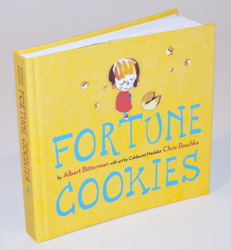
Bitterman, Albert. 2011. Fortune Cookies. Ill. by Chris Raschka. New York: Simon & Schuster.

Fortune Cookies isn't a Chinese New Year book, but it's a

Monday, December 6, 2010

Kubla Khan: The Emperor of Everything

Krull, Kathleen. 2010. Kubla Khan: The emperor of everything. Ill. by Robert Byrd. New York: Viking.

Working with what she acknowledges is "sketchy" information, Kathleen Krull has nonetheless provided a detailed and fascinating account of Kubla Khan, the Mongol warrior who, in 1271, became emperor of China.  Against overwhelming odds, Kubla Khan (grandson of the feared Genghis Kahn) oversaw an empire that he expanded to include Russia, Korea, Tibet and large portions of the Middle East.  Unlike later emperors, Kubla Khan welcomed foreigners (including Marco Polo), and his reign was a golden age for the arts and sciences as he freely embraced new ideas from the far reaches of his empire and beyond.

Krull writes in a familiar, easily accessible style, yet she still conveys the majesty and immensity of Kubla Kahn's empire,
On the Khan's birthday there was a wild party for as many as forty thousand people.  That may sound like quite a guest list, but his bodyguards alone numbered twelve thousand. ... One party blended into another.  Besides birthday bashes for his wives and children, other relatives, and various Mongol leaders, plus the parties for all religious holidays, there were celebrations for each of the thirteen lunar months.  Most over-the-top was the New Year's festival.  Everyone dressed in robes of white and watched the spectacle of five thousand elephants carrying in precious gifts for the Khan from all over his realm.

The text is written on parchment inspired pages and the previous passage is accompanied by an illustration of bedecked, marching elephants accompanied by soldiers while the waiting Khan and his wife are attended by white-robed guests. Illustrator Robert Bryd (Good Masters! Sweet Ladies! Voices from a Medieval Village and Leonardo: Beautiful Dreamer) was a perfect choice for the story of this 13th century ruler.  His folk art style illustrations complement and enhance Krull's storytelling, colorfully depicting the vastness of the Chinese empire and the resplendence of Kubla Khan's court, while conveying the sensibilities and possibilities of the time period. Every page is richly illustrated.

Contains author and illustrator notes and sources.
Highly recommended.

Visit the illustrator's website, Robert Byrd Art for a video preview of Kubla Khan's stunning artwork.-

Kubla Khan is on the School Library Journal list of Best Nonfiction Picture Books 2010, and is a Junior Library Guild Selection. Another review @ Kids Lit

It's Nonfiction Monday.  Today's roundup is @ The Reading Tub.
Share |

Sunday, August 15, 2010

The Emperor's Code

I'm finally caught up (almost!) in the hunt for the 39 Clues!  The final book, Into the Gauntlet (#10) is due out this month, and I'm just now starting Storm Warning (#9) by Linda Sue Park. These last two books in the series are the only titles with female authors.  Will it make a difference? I'll find out soon.  In the meantime, here's the quick scoop on:

Korman, Gordon. 2010. The Emperor's Code. Read by David Pittu. Scholastic Audiobooks. (on Playaway)
(Book #8 in the 39 Clues series)

...in which
Dan and Amy travel to China, Tibet, and the summit of Mount Everest; suspicions about the au pair, Nellie, are reignited; the siblings become separated; and Jonah Wizard surfaces once again.

Although these are books for 9-12 year-olds, Gordon Korman throws in a few words worthy of PSAT prep - troglodyte, stymied, and more.

As with all of the audiobooks in the series, bonus material follows the story - this time, Cora Wizard's Nobel Prize acceptance speech - not too enlightening.

Share

Beneath the Waves - a review

As we read disturbing news accounts of dying manatees , environmental disasters caused by toxic waste, and ocean pollution on the scale of ...