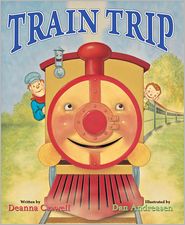
Today's Picture Book Roundup features older winners of the Caldecott Medal.
The Caldecott Medal was named in honor of nineteenth-century English illustrator Randolph Caldecott. It is awarded annually by the Association for Library Service to Children, a division of the American Library Association, to the artist of the most distinguished American picture book for children.I recently completed a class, "The Caldecott Medal: Understanding Distinguished Art in Picture Books," offered by the Association for Library Service to Children (ALSC), and taught by K.T. Horning.
In addition to learning much that I didn't know about art, I had the opportunity to encounter or revisit some Caldecott Medal winners that predate my career as a librarian. I have been working in a library since 2005, and received my masters degree and first professional librarian position in 2007. The Caldecott Medal has been awarded since 1938. Clearly, I had a lot of catching up to do.
Though I did not read them all, I did read many older winners. Here are some of my favorites from the years prior to 1990:
(In order by publication date - award dates are the January following the publication year)
- Langstaff, John. 1955. Frog Went A-Courtin'. New York: Harcourt Brace. Illustrated by Feodor Rojankovsky.
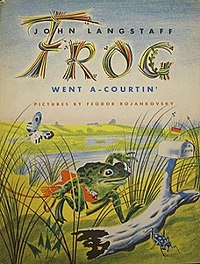
Richly detailed and expressive animals illustrate this favorite old folk song. (If you don't know the song, Frog Went A-Courtin', Burl Ives' rendition was a classic) This is my favorite of all the older Caldecotts.
- Mosel, Arlene. 1972. The Funny Little Woman. New York: Dutton. Illustrated by Blair Lent.
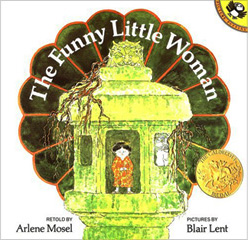
Humorous, with inventive illustrations, the funny little woman travels to a world beneath her simple home in Japan.
- Yorinks, Arthur. 1986. Hey. Al. New York: Farrar, Strauss, and Giroux. Illustrated by Richard Egielski.

Generally disliked by most of my classmates, this quirky, surreal story about a man and his dog really grows on you.
- Yolen, Jane. 1987. Owl Moon. New York: Philomel. Illustrated by John Schoenherr.
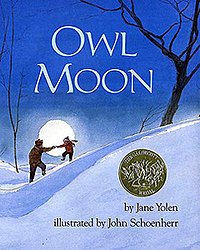
I have been fortunate enough to hear owls in the night many times, though the only ones I have been able to spot are the low-flying burrowing owls. In Owl Moon, the thrill of a night-time owling expedition is captured brilliantly in both illustration and prose.
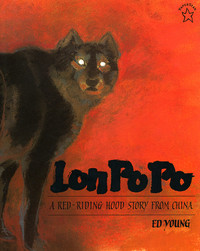
- Young, Ed. 1989. Lon Po Po:A Red-Riding Hood Story from China. New York: Philomel.
A complete list of Caldecott Medal winners 1938-present, may be found here.
I've left off many other wonderful old medal winners, I know. Feel free to chime in with your favorite Caldecott winners from the 1930s-1980s.