Pages

Showing posts with label folklore. Show all posts

Wednesday, September 19, 2018

A Big Mooncake for Little Star - a review


A Big Mooncake for Little Star
Little Brown, 2018

Here is an excerpt from my starred review of A Big Mooncake for Little Star.  You can read my entire review in the August, 2018 issue of School Library Journal.

Little Star’s mother admonishes her not to eat the giant mooncake, but Little Star has her own ideas. “Yum!”
The relationship between Little Star and her mother offers a message of empowerment and reassurance. Lin’s loving homage to the Mid-Autumn Moon Festival is sure to become a bedtime favorite.


Source: School Library Journal. Jul2018, Vol. 64 Issue 7, p45-45.

Tuesday, October 17, 2017

Rise of the Jumbies - a review


Rise of the Jumbies
by Tracey Baptiste
Algonquin Young Readers, 2017

Rise of the Jumbies is the second book in a new fantasy series,uniquely set within the culture of the Caribbean islands. It introduces the reader to the rich and sometimes frightening folk tales of the Caribbean islands and Africa.

      "There are more children missing," Mrs. Ramdeen said.  "Three of them, all of them lost by water.  The sea, the river, and now the well."  Her voice carried over the sounds of the market.  People dropped the produce they were buying to watch and listen.  Mrs. Chow tried unsuccessfully to hold back a sob.
     "Children fall into danger all the time," the witch said.  "Especially by the water."
     "But three in less than a day?" Mrs. Ramdeen asked.
     "Coincidence," the witch said, shrugging.  She looked pointedly at Corinne and pursed her lips as if she was waiting for something.
     Corinne swallowed.  "Could it be a jumbie?"
Through the adventures of  Corinne, the series' spunky protagonist who is half jumbie herself, the reader will meet the wily head of the mermaids, Mama D'Leau, and many more magical beings.  Some may be helpful if one is careful, like the land-loving, Papa Bois and the local white witch. Some will cause only evil.

Corinne and her friends travel with mermaids to Africa to unravel mysteries that may free the children of her village who have been trapped under the sea. They will meet danger and deception at every turn.


I suggest starting with the first book in the series, The Jumbies, to better familiarize yourself with the culture and the large cast of characters.

Can't get enough of jumbies?  Learn more.
Not having read the first book in the series, I wish I would have seen this first.  It, and the field guide below, would have been helpful.


Watch the trailer for the first book in the series, The Jumbies.


 My copy of Rise of the Jumbies was provided by the publisher at my request.

Tuesday, May 31, 2016

Merrow - a review


Merrow by Ananda Braxton-Smith
Candlewick Press, 2016

Everything turns into a story the moment it's done. The facts of things do not store well.  They rot and fall apart. But the stories we tell last and even grow.
 The Marrey family has long lived on a remote cove on a remote island in a Northern Sea.  Twelve-year-old Neen Marrey has lived there all her life with her sour Auntie Ushag whose appetite for hard work and subsistence living leaves no room for the distant townsfolk's talk of the Others and the Otherwise.  Besides, most of the talk centers on the Marreys anyway, especially since Neen's father drowned and her mam disappeared.  Townsfolk say her mother was a merrow and returned to the sea. Even the Marreys only friends, Ma Slevin and her blind son, Scully, gifted with the Othersight, are filled with stories of the kraken, merrows, water horses, and the like.  And what of Neen herself - afflicted with the Scales?  Could her mother's merrow blood be running in her veins?

     "All right?" asked Scully.
     "I suppose so," I said.  I wanted to be by myself.  "Thank you."
     I couldn't sleep that night.  The sun going down made no difference.  For a long while, there wasn't enough air to breathe.  The weird blood swarmed in my chest, and I longed for morning.  Not only that, the story stuck to every part of me: to my body with its scales, my mind with its waves and silver flashes, and my soul with its homesickness.
     Scully Slevin is a true seer, and a honey-tongue with it.  He has a word hoard bigger than any wrecker's haul, and he sees things nobody else does. That needs no proof.  You only have to see him and hear him to know what he says is true.
     Proof is for those with no eyes or ears in their heads.


Merrow is a coming-of-age story steeped in old world folklore and swimming in the atmosphere of a bygone time when Old Irish legends still held purchase in the hearts and minds of the island's people. The lines between truth and legend, dreams and reality, Catholicism and Celtic ways, are be blurred in this haunting, wistful story.  Whether it is fanciful or realistic is for the reader to decide.


 First published in Australia in 2010, as part of the Secrets of Carrick series, Merrow is coming to the U.S. this fall.

(Advance Reader Copy provided by the publisher at my request)

Wednesday, October 8, 2014

A bookish microcosm of Russia

My family often wonders about my propensity to jump from one seemingly unrelated topic to another, often within seconds.  What they usually don't realize is that in my mind, the topics are connected; I've merely forgotten to fill them in on the links.

With that in mind, I offer you three new books on Russia that in my mind, are dramatically different and yet completely complementary.  A young adult nonfiction book, a young adult fantasy, and a children's picture book a microcosm of Russia in history, magic and dance.

I recently had the pleasure of reviewing Candace Fleming's, The Family Romanov: Murder, Rebellion, and the Fall of the Imperial Russia (Random House Audio, 2014).  My review and an audio excerpt are linked here.

You can read my review or any number of stellar reviews, but I will sum up  by saying that whether you listen to the audio book or read the print copy, The Family Romanov is a fully immersive experience into the final years of tsarist Russia - the time, the place, and  the tragically doomed family.

I was happily mulling over this excellent book when I immediately received an opportunity to  review Egg & Spoon by Gregory Maguire (Brilliance Audio, 2014).  I had received a galley copy of Egg & Spoon in the spring.  I thought it looked intriguing, but hadn't had time to read it.  I was pleasantly surprised to find that it is a folklore fantasy that takes place - of all places - in tsarist Russia.  I couldn't believe my good fortune.  The book was enhanced by my recent reading of The Family Romanov.  With the history of modern tsarist Russia fresh in my mind, the location and historical setting was vivid, leaving me more time to ponder the story's underpinning of Russian folklore, of which I was mostly ignorant.  I knew little of the witch, Baba Yaga and her peculiar house that walks on chicken legs, and I knew nothing of the magical Russian firebird.

My reviews are linked here and here.  Again, you can read my review or any other, but I will sum up by saying that Egg & Spoon is grand and magical - a metaphoric epic for readers from twelve to adult.

I was so happy to have read these excellent books in tandem and was recommending them at every turn, when I happened to hear an interview with Misty Copeland on the radio speaking about her experience dancing in the Russian ballet, The Firebird. What a coincidence, I thought - the firebird flies again in my milieu. A greater coincidence ocurred at work when I received my new copy of Misty Copeland's, Firebird. (Putnam, 2014)  Reading Egg & Spoon gave me an historical context for The Firebird ballet, and Misty Copeland tied it all together - a modern and immediate manifestation of history's struggles and stories - all rising like the mystical firebird.

So there you have it, my serendipitous encounter with Russian history, folklore and culture.  As our two countries struggle with our relationship, may we always remember that there is more to a country than its leaders and politicians.  There is always us, the common people. And as Egg & Spoon and Firebird will show you, there is always hope.


Monday, September 22, 2014

Egg & Spoon - an audio book review

I can save you some time today. If you'd like the short review of Egg & Spoon, click here to read my review for AudioFile Magazine. However, if you want to hear more about this wonderful book, read on!

Maguire, Gregory. 2014. Egg & Spoon. Grand Haven, MI: Brilliance Audio.  Read by Michael Page.

Can what we want change who we are? 
Have patience and you will see.

Set in the tsarist Russia of the late 18th or early 19th century, Egg & Spoon is an enchanting mix of historical fiction and magical folklore, featuring switched and mistaken identities, adventurous quests, the witch Baba Yaga, and of course, an egg.

Narrator Michael Page is at his best as the self-proclaimed “unreliable scribe,” who tells the tale from his tower prison cell, claiming to have seen it all through his one blind eye. In a fashion similar to that of Scheherazade, spinning 1001 "Tales of the Arabian Nights," our narrator weaves fantastical stories together and wraps us in their spell.

Ekaterina and Elena are two young girls - one privileged, one peasant - yet so alike that their very lives can be exchanged. Page creates voices so similar that one can believe the subterfuge, yet the voices are also distinct - a necessity in a book written to respect the reader's (or listener's) ability to discern the flow of conversation without the constant insertion of "he said/she said."

One girl finds herself en route to see the tsar, a captive guest of  the haughty and imperious Aunt Sophia on a train to St. Petersburg.  The other finds herself a captive guest of the witch, Baba Yaga, and her curious home that walks on chicken legs. As Baba Yaga, Page is as wildly unpredictable as the witch herself, chortling, cackling, menacing, mothering.

Michael Page is wonderful.  He brings each of author Gregory Maguire's many characters to life with a distinct voice.  He never falls out of character, and his pacing is perfect - measured to keep the listener from being overwhelmed by the story's intricate plot.

Grand and magical, Egg & Spoon is a metaphoric epic for readers from twelve to adult.
Notes:
If you find the egg (or eggs) elusive, you will find the spoon even more so!
My copy of the book was supplied by the publisher. My copy of the audio book was supplied by AudioFile Magazine.  

Thursday, October 4, 2012

Picture Book Roundup - old favorites

Today's Picture Book Roundup features older winners of the Caldecott Medal. 

The Caldecott Medal was named in honor of nineteenth-century English illustrator Randolph Caldecott. It is awarded annually by the Association for Library Service to Children, a division of the American Library Association, to the artist of the most distinguished American picture book for children.
I recently completed a class, "The Caldecott Medal: Understanding Distinguished Art in Picture Books," offered by the Association for Library Service to Children (ALSC), and taught by K.T. Horning.

In addition to learning much that I didn't know about art, I had the opportunity to encounter or revisit some Caldecott Medal winners that predate my career as a librarian. I have been working in a library since 2005, and received my masters degree and first professional librarian position in 2007. The Caldecott Medal has been awarded since 1938. Clearly, I had a lot of catching up to do.

Though I did not read them all, I did read many older winners. Here are some of my favorites from the years prior to 1990:

(In order by publication date - award dates are the January following the publication year)

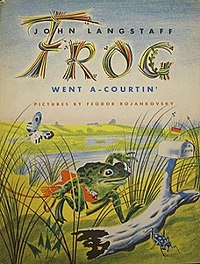
  • Langstaff, John. 1955. Frog Went A-Courtin'. New York: Harcourt Brace. Illustrated by Feodor Rojankovsky.

Richly detailed and expressive animals illustrate this favorite old folk song.  (If you don't know the song, Frog Went A-Courtin', Burl Ives' rendition was a classic)  This is my favorite of all the older Caldecotts.

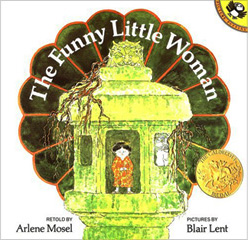
  • Mosel, Arlene. 1972. The Funny Little Woman. New York: Dutton. Illustrated by Blair Lent.

Humorous, with inventive illustrations, the funny little woman travels to a world beneath her simple home in Japan.


  • Yorinks, Arthur. 1986. Hey. Al. New York: Farrar, Strauss, and Giroux. Illustrated by Richard Egielski.

Generally disliked by most of my classmates, this quirky, surreal story about a man and his dog really grows on you.


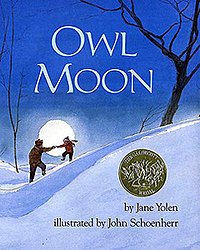
  • Yolen, Jane. 1987. Owl Moon. New York: Philomel. Illustrated by John Schoenherr.

I have been fortunate enough to hear owls in the night many times, though the only ones I have been able to spot are the low-flying burrowing owls.  In Owl Moon, the thrill of a night-time owling expedition is captured brilliantly in both illustration and prose.

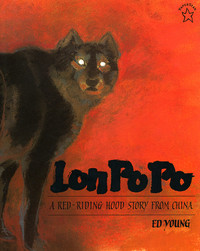
  • Young, Ed. 1989. Lon Po Po:A Red-Riding Hood Story from China.  New York: Philomel.

 
A masterpiece of danger, suspense and courage - a classic folktale. The only one of my picks written and illustrated by the same person, it's no surprise that it's a pitch-perfect pairing of text and art.

A complete list of Caldecott Medal winners 1938-present, may be found here.


I've left off many other wonderful old medal winners, I know.  Feel free to chime in with your favorite Caldecott winners from the 1930s-1980s.


Wednesday, January 5, 2011

Ol' Bloo's Boogie-Woogie Band and Blues Ensemble

Huling, Jan. 2010. Ol' Bloo's Boogie-Woogie Band and Blues Ensemble. Ill. by Henri Sørenson. Atlanta: Peachtree.

I don't normally like modernized re-tellings of classic folk or fairy tales, but today, I do. Perhaps it's the Old South feeling that Jan Huling has given to this bluesy rendition of the famous Brothers Grimm tale, The Town Musicians of Bremen, or perhaps it's the very appealing cover art and the endearing oil renditions of the rag-tag crew (I particularly like One-Eyed Lemony Cat. He wears a patch over one eye!),
Rusty Red Rooster - whose voice sounded like a player piano bein' hit with an ax - and One-Eyed Lemony Cat- whose voice sounded like a fiddle bein' played with a carvin' knife - and Gnarly Dog - whose voice sounded like a guit-tar bein' scraped with a washboard - and Ol' Bloo Donkey - whose voice sounded like an accordion fallin' down the stairs,
who head out from the fields with a notion to sing in a New Orleans honky-tonk.  Of course, just as in the original Grimm story, they end up scaring off some robbers, but in Ol' Bloo's Boogie-Woogie Band and Blues Ensemble, the robbers are not in the German forests, they are inside a cabin at a table filled with
gumbo and etouffee, muffaletta and po-boys, praline and bread puddin', and more besides.  And sittin' 'round that table were three rough, tough, ugly-lookin' thieves, jest glarin' at one another and pickin' their teeth with their knives.

And though they didn't look like music lovers, Ol' Bloo's band sets up and starts in singing - their very first gig!  And you know the rest of the story - the Blues Ensemble never did make it to the Big Easy, but they "sang in harmony for the rest of their days" in the old cabin.

The easy-going, laid-back language of the south adds some welcome down home American comfort to this old story that I actually remember disliking as a child.  However, in a nod to older versions, classic silhouettes of the troupe in the various stages of its journey appear under the text on the page facing the painted illustrations of the animals in their more colorful Southern habitat.

Fun and funny!

Interestingly, author Jan Huling's website lists her primary occupation as a "beadist."  If writing books is her hobby and her true calling is beading, then she must must certainly be a woman of many talents! The jacket flap lists her as a kazoo player as well - first chair!

This title has been nominated for an ALSC Notable Book in the Nonfiction - Folklore category. Click to see other nominees.

Review copy supplied by the publisher.

Another review @
Biblioreads


Share |

Thursday, August 6, 2009

The Jersey Devil


Redmond, Shirley Raye. 2009. The Jersey Devil. Detroit: Gale.
ISBN:978 0 7377 4407 1
The Jersey Devil once terrorized the large area spanning across New Jersey's Pine Barrens from the Atlantic Ocean to Philadelphia, frightening residents and killing pets and livestock. In 1909, schools and businesses in the area were closed, and posses were formed to hunt down the mysterious creature, said to have been born in 1735.
What New Jersey student can resist the legend of the Jersey Devil? This book, part of the Monsters series, will help kids sort fact from fiction, offering facts to keep the legend alive, balanced with facts to foster a healthy dose of skepticism.
Quoting from period sources, and offering documented eyewitness accounts (including those by Napoleon Bonaparte's brother and a 1951 sighting by a boy in Gibbstown), Raye offers whatever factual information is available. She balances these accounts with possible explanations (could it be a giant sand crane?), and known hoaxes.
Fun facts are also included. New Jersey's NHL team is named after the Jersey Devil, the devil appears in a Teenage Mutant Ninja Turtles movie, and there are several Devil-inspired foods - the Jersey Devil sundae (with Devil's food cake, of course!) and the Jersey Devil cocktail.
This is a perfect book for younger students to develop research skills. The Jersey Devil offers a balanced view accompanied by Notes, Glossary, For Further Exploration, Index, and Picture Credits. Great for young NJ researchers and others interested in our most famous cryptid.
Note: The accompanying image is not the cover art, but rather, an image that appeared in a January 1909 issue of the Philadelphia Bulletin during the heart of the Jersey Devil terror of the same year.

Beneath the Waves - a review

As we read disturbing news accounts of dying manatees , environmental disasters caused by toxic waste, and ocean pollution on the scale of ...