Pages

Thursday, June 14, 2012

SYNC free YA audiobooks

It starts today!  Don't miss SYNC's free audiobook downloads - two each week, a current book with a related classic. The pairings are inspired and the books are free. The following information is taken directly from SYNC's site.  Go there today without delay!

Pass it on!


SYNC YA Literature into Your Earphones


2 Free Audiobook Downloads Each Week

June 14 - August 22, 2012


Teens and other readers of Young Adult Literature will have the opportunity to listen to bestselling titles and required reading classics this summer.   Each week  from June 14 - August 22, 2012, SYNC will offer two free audiobook downloads.


The audiobook pairings will include a popular YA title and a classic that connects with the YA title's theme and is likely to show up on a student's summer reading lists.  For example, Laini Taylor's Daughter of Smoke and Bone, the first book in a new series about a girl who opens a door to two otherworldly cities at war, will be paired with Charles Dicken's A Tale of Two Cities.


To find out when you can download titles to listen to on the run this summer, visit www.AudiobookSync.com or text syncya to 25827. 


SYNC Titles

Summer 2012


06/14/12-06/20/12

The Eleventh Plague by Jeff Hirsch, Read by Dan Bittner (Scholastic Audiobooks)

The Grapes of Wrath by John Steinbeck, Frank Galati [Adapt.], Read by Shirley Knight, Jeffrey Donovan, and a Full Cast (L.A. Theatre Works)


06/21/12-06/27/12

Irises by Francisco X. Stork, Read by Carrington MacDuffie (Listening Library)

Sense and Sensibility by Jane Austen, Read by Wanda McCaddon (Tantor Media)


06/28/12-07/04/12

The Amulet of Samarkand by Jonathan Stroud, Read by Simon Jones

(Listening Library)

Tales from the Arabian Nights by Andrew Lang, Read by Toby Stephens

(Naxos AudioBooks)


07/05/12-07/11/12

Anna Dressed in Blood by Kendare Blake, Read by August Ross (AudioGO)

The Woman in White by Wilkie Collins, Read by Ian Holm (AudioGO)


07/12/12-07/18/12

Guys Read: Funny Business by Jon Scieszka [Ed.] et al., Read by Michael Boatman, Kate DiCamillo, John Keating, Jon Scieszka, Bronson Pinchot (Harper Audio)

The Notorious Jumping Frog of Calaveras County and Other Stories by Mark Twain, Read by Norman Dietz (Recorded Books)


07/19/12-07/25/12

Cleopatra's Moon by Vicky Alvear Shecter, Read by Kirsten Potter (Oasis Audio)

Antony and Cleopatra by William Shakespeare, Read by a Full Cast (AudioGO)


07/26/12-08/01/12

Pinned by Alfred C. Martino, Read by Mark Shanahan (Listen & Live Audio)

Locomotion by Jacqueline Woodson (Brilliance Audio)


08/02/12-08/08/12

Daughter of Smoke and Bone by Laini Taylor, Read by Khristine Hvam (Hachette Audio)

A Tale of Two Cities by Charles Dickens, Read by Simon Prebble (Blackstone Audio)


08/09/12-08/15/12

Skulduggery Pleasant by Derek Landy, Read by Rupert Degas (Harper Audio)

Dead Men Kill by L. Ron Hubbard, Read by Jennifer Aspen and a Full Cast

(Galaxy Press)


08/16/12-08/22/12

The Whale Rider by Witi Ihimaera, Read by Jay Laga'aia (Bolinda Audio)

The Call of the Wild by Jack London, Read by William Roberts (Naxos AudioBooks)

Monday, June 11, 2012

Nonfiction Monday is here! Featuring DK Pocket Genius

Welcome, everyone!  I'm happy to be today's host for Nonfiction Monday,
a weekly gathering of bloggers writing about nonfiction books for kids. 

DK Publishing. 2012. Pocket Genius series. New York: Dorling Kindersley.

I've always loved camping, hiking, plants and the outdoors, but was never much of a bird watcher.  My husband, however, is a bird lover and can tell the difference between similar waterfowl or shore birds at a great distance.  The Audubon Society Field Guide to North American Birds has been a fixture in our house for ages.  After the addition of curious kids, we added the Field Guide to Seashore Creatures, North American Trees, and North American Insects & Spiders.  There's something very satisfying about these little books - a modern, non-lethal form of hunting perhaps.  I love that "Aha, I've found it!" moment when I discover the unknown bird in the yard or the little critter crawling on the windowsill.  So, it was with pleasure that I received the set of DK Pocket Genius guides for my branch.
 
Now granted, kids won't be able to spot a shark or dinosaur in the neighborhood and rush home to identify it, but the books are designed in much the same manner as adult field guides and will teach the same classification skills.  For example, Sharks begins with an overview of sharks, their common attributes, habitats and features.  The guide is then divided into two sections: Sharks and Rays, skates, and chimaeras.  Sections are then subdivided into types (e.g. Frilled and cow sharks) and then into the neat little photographic plates with which any fan of field guides is familiar.

Differing from adult guides, the informative text is presented in the same box as the photograph (no flipping to tissue paper thin pages in the rear).  Similar to adult guides, icons appear in each box.  These icons, however, are much more fun than a silhouette of a tree-clinging bird or coniferous tree!  The shark icon depicts a swimmer with a proportionally sized shark swimming above.  The Rocks and Minerals guide shows a hand next to the average size of a found specimen.  Animals and Dinosaurs icons compare a human body to the featured creature.

Each book also contains fun facts, an index and a glossary. And while they don't have the flexible, textured covers of National Audubon Society guides, they are still a cozy and satisfying size, about 5.5" x 6.5" x .5".  The publisher's suggested age for Pocket Genius books is 8 and up.

I may be nerdy, but I like them!

Future additions to the series will include: Ancient Egypt, Earth, Space and Bugs.

 I look forward to reading your offerings.   Add your link below using InLinkz.  Thanks!

Friday, June 8, 2012

Poison Most Vial - a review

I've got a science-themed book review for you today, but if you're a teacher, I invite you to visit the ALSC blog today as well.  Let's talk.

Carey, Benedict. 2012. Poison Most Vial. New York: Amulet.
(Advance Reader Copy)


When the famed forensic scientist, Dr. Ramachandran, is found murdered in his office at DeWitt Polytechnic University, suspicion falls on Ruby Rose's father, the university's custodian.  Someone has planted empty vials of poison in Mr. Rose's locker.  With the help of her friend, T. Rex, and the reclusive "Window Lady" from apartment 925, Ruby and Rex attempt to clear her father's name before he is arrested.

 Although it's not specifically spelled out, Ruby and Rex appear to be in 7th or 8th grade.  They attend the Lab School, located on the university campus.  Using their proximity to the labs, and the knowledge of and familiarity with campus that is intrinsic to a custodian's daughter, Ruby and Rex begin to ferret out the whereabouts of everyone present on the evening of the murder, monitoring the comings and goings of employees and grad students through a labyrinth of access points. However, more difficult than discovering who may have had opportunity, the pair must learn the science behind toxicity, absorption and concentration.  Exactly what was it that killed Dr. Ramachandran?  When? and Why?

To truly enjoy Poison, readers should be prepared to think.  There is the science of forensics to ponder, as well as the internal musings of the three main characters - Ruby, Rex, and Mrs. Whitmore, the retired toxicologist in apartment 925,

"Why, hello," said Mrs. Whitmore, opening her door.
     The young faces looked so different up close, she thought, and it seemed that the boy was more then (sic) merely anxious.  He was searching her face so intently that she averted her eyes.
     "Welcome," she said, stepping aside. "Do come in."
     The untied sneakers, the shuffling way they walked, the shifting eyes; like no one had taught these children the proper way to carry themselves.
     "I made some cakes," Mrs. Whitmore said abruptly.
"Pudding cakes.  Would you like some?"
     She disappeared into the kitchen and overheard the boy whisper, "It's the left one.  See how it bulges a little?"
     "No more than your big bug-eyes right now," the girl replied. "Jimmy's pulling your chain. He's got no idea."
     Jimmy?
     "Ruby," the boy said, "Why do you think they call him the Minister of Information if -- Oh, hello."
     Mrs. Whitmore marched back in with a tray from the kitchen and nearly dropped it on the coffee table in front of the couch. A piece of cake, and the boy -- Tex, was it? made to lunge for it and then recoiled, glancing oddly at her face and turning away, moving back toward the window.
    "This is real nice," he said in an alto voice that surprised her. "You can see all the way past DeWitt through here."
     "Yes, it's quite a view," Mrs. Whitmore said.
     Silence held them in place until the girl -- Ruby, with that pile of golden hair -- said, "This is so much bigger than our little window. It's like there's a whole village down there."
     Mrs. Whitmore smiled and felt the air return to the room.
Though this passage contains the unspoken musings of Mrs. Whitmore, at other times, readers will be privy to the thoughts of Ruby and Rex.  This style of writing places the reader squarely in the moment, illuminating feelings and motivation, and underscoring the danger of the youngsters' clandestine forays into restricted areas of the university. Struggling readers, however, may have trouble with Benedict's free-flowing style.

Not strictly a science-themed murder mystery, the back story in Poison Most Vial is Ruby's adjustment to her new life. Originally from the rural south, Ruby's father brought her north in search of better employment. His modest wage has landed them in the Garden Terrace Apartments, a dilapidated housing project in a neighborhood of rival gangs, closed stores and wig shops. At first, Ruby's only friend is T. Rex, a good-natured Jamaican boy from the large family in apartment 1113, but in the quest to solve Dr. Ramachandran's murder, she and Rex make some surprising new friends.
  
With the current educational focus on S.T.E.M. topics, and a current popular interest in C.S.I., it's hard to see how this book could not be a hit.


Today is S.T.E.M. Friday.  Check it out.

Monday, June 4, 2012

Abraham Lincoln & Frederick Douglass: The Story Behind an American Friendship - a review

Freedman, Russell. 2012. Abraham Lincoln & Frederick Douglass: The Story Behind an American Friendship. Boston: Houghton Mifflin Harcourt.

The date is August 10, 1863. Frederick Douglass has arrived at the White House, taking a seat on the stairs, determined to speak with President Lincoln.  Many others are waiting as well.  Douglass stands out in the crowd, not just for his size.  All the other petitioners are White.  Douglass, a freed Black is an outspoken critic of Lincoln.  The two men have never met.  Douglass has no appointment.  He is prepared to wait.

He does not wait long, however.  The President does see Frederick Douglass on August 10, 1863; and in Abraham Lincoln & Frederick Douglass: The Story Behind an American Friendship, award-winning author, Russell Freedman tells us why.

Freedman is a master writer, and ingeniously sets up this story of friendship. Chapter One, "Waiting for Mr. Lincoln," sets the stage.  The next three chapters detail the life of Frederick Douglass before his meeting with Lincoln.  Three subsequent chapters do the same for the President.  The final three chapters highlight the collaboration of the two men in pursuit of their mutual interest, abolition.

The extensive use of period photographs and artwork, as well as images of period realia (election poster, paycheck, editorial cartoons and the like) add interest to an already compelling story.  The depth of Lincoln's regard for Douglass is cemented by the revelation that Mary Todd Lincoln sent Douglass a memento after Lincoln's death, knowing that Lincoln had "wanted to do something to express his warm personal regard" for Douglass.

Appendix: Dialogue Between a Master and Slave, Historic Sites, Selected Bibliography, Notes (on the sources of more than one hundred quotes) and Picture Credits (including many from the Newbery Medal-winning Russell Freedman book, Lincoln: A Photobiography) round out this extensively researched book.

The Contents page indicates an Index beginning on page 115, however, it was apparently not completed in time for the printing of the Advance Reading Copies.

Abraham Lincoln & Frederick Douglas is suggested for Grades 4-7, and is due on shelves June 19, 2012.  It is a fascinating look at two of the most influential men of their time by one of the great children's authors of our time.  Highly recommended.


Today's Nonfiction Monday roundup is at True Tales with a Cherry on Top.  Next week's roundup will be right here at Shelf-employed.

Thursday, May 31, 2012

Picture Book Roundup - May edition

So many great picture books have passed my desk lately.  Here are a few:

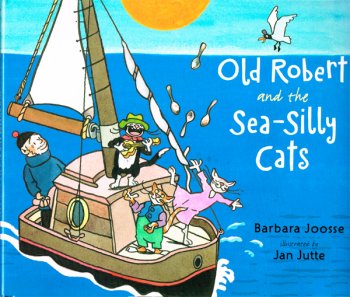
  • Joose, Barbara. 2012. Old Robert and the Sea-Silly Cats. Ill. by Jan Jutte. New York: Philomel.

Each night, Old Robert counts "his regular things in their regular place"

Clean socks
a clock
my ship in the slip at the dock.
One dish
one spoon
a slice of the silver moon.
Things are always the same until the night a cat asks to come in.  There was no room for a cat on Old Robert's boat,

And yet ...
        and yet ...
               Old Robert said yes ...
... and the cat came in.

This is a delightfully, quirky story about Old Robert, his boat, and how one small decision can change a life (or two, or three, or ...).  Illustrations by the Netherlands' Jan Jutte, give Old Robert and the Sea-Silly Cats a salty and silly air reminiscent of old comics (think Popeye or original Tin Tin) touched with whimsy.  Comforting, repetitive refrains make this a great read aloud. 

There is just something irresistible about Old Robert and the Sea-Silly Cats.

And there's apparently a song available, too,  "Old Roberts Jig" by the Happy Racers.

  • Elya, Susan Middleton. 2012. Fire! ¡Fuego! Brave Bomberos. Ill. by Dan Santat. New York: Bloomsbury.

My husband has had a long and wonderful career in the fire department, so I'll admit some partiality to firefighter books, even ones that feature firefighters rescuing cats from trees.  For the record, professional firefighters don't rescue cats from trees. They will, however, rescue animals from fires, and in Fire! ¡Fuego! Brave Bomberos, a house fire traps a poor kitty on an upper floor,

Climbing up la escalera,
KITTY, KITTY,
COME AFUERA.
Coaxed by food in small pedazos,
kitten jumps to outstretched brazos.
See how easy that was?  You're speaking Spanish. Even without the brightly colored double spread illustration of a firefighter on a ladder, hand extended with cat treats, you knew what it meant, and kids will too!  The story rhymes, the meter's fine, and if you need help with pronunciation, it's all in the Glossary.  All bias aside, I like it!

  • Kohuth, Jane. 2012. Duck Sock Hop. Ill. by Jane Porter. New York: Penguin. 

I've been waiting to see this one, ever since I saw it on Fuse #8's Librarian Preview.  As usual, Betsy Bird knows her stuff. 

Warm up, wiggle,
stretch your beak.
Duck Sock Hop
comes once a week.
Short, fun, and simple with colorful illustrations surrounded by white space with minimal text on each page.  Perfect for storytime, for toddlers, for reading aloud.

And another song!  This one comes with the free "Duck Sock Hop Bop," composed by Jeremy Stepansky, the author's cousin.  I'm always game for singing, so I'll give it a try.  Thankfully, children are such kind audiences.

And last but not least, a little beauty of a book,

  • Isadora, Rachel. 2012. Bea at Ballet. New York: Penguin.
Rachel Isadora's simple words are accompanied by pen and pencil sketches of an adorable mix of multicultural children.  All are highlighted by colorful clothing painted in oils. Another perfect book for very young listeners.

If you have or know a tiny ballerina, this book is a must!

Beneath the Waves - a review

As we read disturbing news accounts of dying manatees , environmental disasters caused by toxic waste, and ocean pollution on the scale of ...