Pages

Monday, February 4, 2013

Black History Month - fact and fiction

  • "Frederick Douglass appealing to President Lincoln and his cabinet to enlist Negroes," mural by William Edouard Scott, at the Recorder of Deeds building, built in 1943.
  •  Highsmith, Carol M., 1946-, photographer

Last year, I reviewed a copy of Russell Freedman's, Abraham Lincoln and Frederick Douglass: The Story Behind an American Friendship (Houghton Mifflin Harcourt, 2012).  The story of their friendship and the "back story," was so interesting, that I thought it might make a good topic for a Black History Month program for younger children.  I began searching for a way to communicate to a young library audience the connection between the history of African Americans and these two great men. In researching, I found that the founder of African American History Month (it was originally called Negro History Week), Dr. Carter G. Woodson, initiated this cultural celebration in 1926, and chose February because the birthdays of Abraham Lincoln and Frederick Douglass are both celebrated in February. (1)   I then discovered an earlier book, Lincoln and Douglass: An American Friendship (Henry Holt, 2008), that recounts the friendship but targets a younger audience.  Even better, it has a companion DVD.  So, I planned a Lincoln and Douglass birthday celebration, featuring the Lincoln and Douglass picture book and an explanation of the founding of Black History Month. Perfect, right?

Well, not quite.  In reading Lincoln and Douglass: An American Friendship, I found several discrepancies.  As it turns out, the timeline included in the picture book's back matter is correct, but some dates within the book's narrative are not. For example, Freedman's thoroughly researched book has the initial meeting of Lincoln and Douglass as a central theme. The picture book gets the date wrong.  Though the picture book still has merit and will be useful to introduce Douglass and Lincoln to a young audience, I can also use it as a teaching moment.  Always check to see that a book has been properly researched if you plan to use it as a representation of factual material.

Oddly, the same thing happened to me last year.  I sketch out my programs many months in advance to satisfy printing and publicity deadlines.  I fill the details in later.  Last year, I offered a Black History Month program on Follow the Drinking Gourd (Knopf, 1988).  While investigating resources, I found that the story, while well-known and generally accepted, is more folk legend than truth. (2)  Again, the story is not without merit and I was again able to use it as a teaching moment.  Besides the obvious lesson, we looked at ways in which to read the stars without a compass.

I understand narrative license.  I understand that it's particularly useful in treatments of difficult topics for younger children.  I also understand, however, that there is a concerted effort by our nation's leaders to raise a new generation of critical thinkers, and to achieve that end, the use of nonfiction books will rise dramatically.  It is up to us as librarians, teachers, caregivers and parents to discern fact from fiction, even when the line between them may be indistinct.  In doing so, we will help children to navigate a world where information is everywhere for the taking, but truth must be mined.


Today's Nonfiction Monday roundup is at Apples with Many Seeds.

And don't forget, February is a perfect time to head over to The Brown Bookshelf; each day in February will feature a different artist in this annual celebration of Black History Month and children's literature.


(1) Library of Congress, "African American History Month"http://www.loc.gov/law/help/commemorative-observations/african-american.php (Douglass' actual birthdate is not known conclusively)
(2) Follow the Drinking Gourd
http://www.followthedrinkinggourd.org/

Monday, January 28, 2013

Play Ball! Baseball books for the very young

"People ask me what I do in winter when there's no baseball. I'll tell you what I do. I stare out the window and wait for spring."
Jay Schyler Raadt CC-BY-SA-3.0
Baseball Hall of Fame baseball player, Rogers Hornsby
Source: Baseball Almanac

Yes, it's January and the temperatures have been in the teens, but soon catchers and pitchers will report to spring training, and on February 21, Spring Training games will begin.

Here are two new books for the littlest of fans:
  • Kawa, Katie. 2013. My First Trip to a Baseball Game. New York: Gareth Stevens.  (part of the My First Adventures series)
In three very simple chapters, this little book introduces children to a baseball game, offering information on the park, the food and the game.  From the chapter, "At the Baseball Park,"
My dad holds our tickets.  They tell us where to sit. We get food to eat. My mom and dad get hot dogs.
The illustrations are simple cartoon-style depictions of a family's trip to the game with a heavy focus on the family's activities.  If just a little bit of baseball is what you're seeking, this will do fine.
A Table of Contents, Index, and Words to Know make this one perfect for school use, however, it's also suitable for adding a little nonfiction to storytime.

Reading Level: Grade K 
Fountas & Pinell: C 
Dewey: 796.357 
Specifications: 7 5/8" x 7 1/8", 24 pages 
Lexile Level: 130

Less perfunctory and more enjoyable is Goodnight Baseball.

  • Dahl, Michael. 2013. Goodnight Baseball. N. Mankato, MN: Capstone. (Illustrated by Christina Forshay)
(Advance copy provided by NetGalley)

Beginning with a sing-song rhythm,
The great big stadium is outside of town.
Fans and friends come from miles around.
and ending with a nod to Margaret Wise Brown's Goodnight Moon,
Goodnight, popcorn boxes under the stands
Goodnight, mascot and goodnight, fans!
Goodnight, friends. Goodnight, cars.
Goodnight, stadium, under the stars ...
Goodnight Baseball takes the reader on a baseball outing with a small boy and his father. Snacks, caps, and even a foul ball are part of a winning day. Brightly colored full-bleed illustrations offer a broad view of the game, the fans, and the park with a focus not on the boy and his dad, but rather, on their place in the larger context of the day.  Expressive faces show the myriad expressions seen during a day at the park - excitement, determination, surprise (no sadness here - the home town wins). Creative endpapers evoke the Green Monster, the boy's favorite team, and tickets stuffed in the pocket of denim jeans.  Goodnight Baseball is a hit.
(Due on shelves March 1, 2013)


Today's Nonfiction Monday roundup is at author Laura Purdie Salas' blog, laurasalas.

Wednesday, January 23, 2013

Hard Gold - an audiobook review

My review of Hard Gold as it appeared in the January 2013, issue of School Library Journal.

Hard Gold: The Colorado Gold Rush of 1859 (I Witness Series). By Avi. 4 CDs. 4:00 hrs. AudioGo. 2012. ISBN 978-1-935430-84-1. $49.95.

Gr 5-8--Early Whitcomb's family is in danger of losing their farm. They're behind in their payments, and a local banker is working with the railroad company to force them into selling. Early's young uncle, Jesse, thinks he has the answer. Handbills from the West indicate that gold has been found in Pike's Peak, Nebraska Territory, and it's there for the taking. Early's parents and older brother discount the reports, but Jesse and Early have the itch. Jesse soon sneaks off (under a cloud of suspicion due to a coincidentally timed bank robbery) to strike gold and save the farm. Early's family forbids him to follow, but when word arrives that Jesse has found gold and is in danger, he strikes out alone, joining a wagon train as a hired hand for a barber, his ailing wife, and feisty daughter. The grueling journey, a budding romance, and the possible ill intentions of fellow travelers add suspense and intrigue as Early learns how desperation and circumstances can change the course of one's life. The historical focus of Avi's novel (Hyperion, 2008) is broad. The endless wagon trains are likened to advancing lines of tiny white ants, but individual hardships are presented with considerably less detail. Dialogue and behaviors ring true, and the narration by Alston Brown is clear and pleasing. The diary style is well-suited for audio format. Similar to the "My Name Is America" series, Hard Gold brings history alive, particularly for boys.

Copyright © 2013 Library Journals, LLC, a wholly owned subsidiary of Media Source, Inc. Reprinted with permission.

##
 

Monday, January 21, 2013

It's that time of year - biographies!

By In Helmolt, H.F., ed. History of the World.
New York: Dodd, Mead and Company, 1902.
Author unknown, [Public domain or Public domain],
via Wikimedia Commons
Whether you're a school media specialist, a public librarian, a parent or a teacher,

if you know children over the age of 7, you're familiar with "the biography assignment."  It comes around every year, and depending one's perspective, it may be a source of excitement, drudgery, irritation, disappointment, interest, or a mixture of all.

Some thoughts on "the biography assignment"

Children need to understand the difference between an autobiography and a biography.  Many students arrive at the library insistent that their teacher has assigned an autobiography and a biography will not suffice.  I always try to comply with their request, however, there are few autobiographies written for children, though if the child is slightly older, I will always recommend Jon Scieszka's, Knucklehead (hands down, the best and funniest autobiography for children). For older kids, Walter Dean Myers and Gary Paulsen have both written excellent memoirs.  In most cases, the teacher will accept either an autobiography or a biography, but children don't always realize that.

Graphic novels biographies are perfect in certain circumstances and I wish more people would give them a try.  A reluctant reader might love Terry Collins', King of Pop: The Story of Michael Jackson, or any title from the American Graphic Biography Collection, or other similar offerings. Just because they have panels, that doesn't make them less true, less valuable, less informative.
Picture book biographies are not just for very young children - in fact, seldom are.  There are so many wonderful and informative picture book biographies.  I urge teachers to read a few and give them a chance.  Demi's books are not only informative, but beautiful and evocative - Marco Polo, for example is simply stunning.  Or how about Bill The Boy Wonder by Marc Tyler Nobleman? Or Michelle Markel's, The Fantastic Jungles of Henri Rousseau?  I could go on for days ...

The most important thing to look for in a biography is veracity.  Are there source notes, back matter, photo credits, suggestions for additional reading - in short, all of the things that indicate the author has thoroughly researched the subject? Has the author taken "artistic license?"  That's not necessarily a bad thing, however, older students should be trained to look for it.

The point is, I understand the dictates of local, state and national policies on what must be taught to children, however, within the parameters of those dictates, there is, hopefully, some room for flexibility - some leeway for children to choose different formats, different topics, different means of delivery. To this day, I don't like the poetry of Percy Bysse Shelley.  Why?  Because when I was in grammar school, I wanted to do my "famous poet" report on Edgar Allen Poe. I was forced to choose Percy Bysse Shelley.  I've long forgotten that teacher's name, and I still don't like Shelley.   In another year, a wonderful teacher allowed me to choose Edgar Allen Poe.  Her name was Ms. Romano and I still read Poe from time to time.  See how it works?

When the biography assignment rolls around, keep your options open!

One more thing:

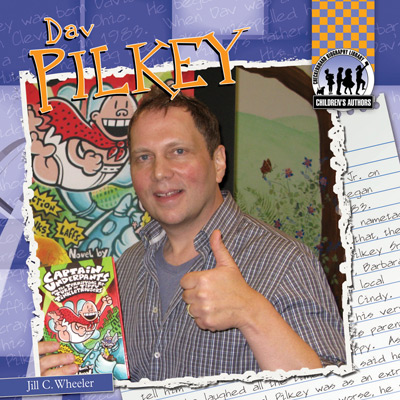
I haven't had one in hand yet, but Abdo Publishing has a new series of Children's Author biographies. Tell me what young boy given a biography assignment would not want to choose, Dav Pilkey?


Related posts:


Today's Nonfiction Monday roundup is at The LibrariYan.  Check it out.

Tuesday, January 15, 2013

The Mark of Athena - this and that

Riordan, Rick. 2012. The Heroes of Olympus: The Mark of Athena. New York: Disney Hyperion.

Usually, I listen to Rick Riordan's books, but I read this one instead.  I think I prefer this series in print.


US trailer

UK trailer

The Mark of Athena, in which:

Percy and Annabeth are finally reunited
We don't see nearly enough of Ella (I love that harpy!)
Seven demigods set forth on a quest
Leo is odd man out
The end is a real cliffhanger


Here's the plot, according to Ella,

Wisdom’s daughter walks alone
The Mark of Athena burns through Rome,
Twins snuff out the angel’s breath,
Who holds the key to endless death.
Giant’s bane stands cold and pale,
Won through pain from a woven jail.

Some odds and ends:

Next up: The House of Hades, due out in October 2013.

Beneath the Waves - a review

As we read disturbing news accounts of dying manatees , environmental disasters caused by toxic waste, and ocean pollution on the scale of ...