Pages

Wednesday, February 29, 2012

Mercy Watson to the Rescue - a review

Dicamillo, Kate. 2006. The Mercy Watson Collection: Volume 1. Read by Ron McLarty. Listening Library.
41 minutes

Last week, I was about ready to leave for work when I realized that I had nothing loaded on my mp3 player for the commute. (I have neglected to mention it here, but in January, I traded in my bicycle commute to return to my previous branch) In any case, I began frantically searching my library’s available downloads for something that would load quickly and keep me entertained during my drive to work.

My choice? Mercy Watson. Despite the book's irresistibly cute cover art, I’d never read a Mercy Watson book before.  I thought it was about time. And anyway, how can you go wrong with Kate Dicamillo? 

Answer:  You can't.

Despite the loss of Chris Van Dusen’s charmingly funny artwork featured in the print version, Mercy Watson still "clicks" as an audiobook.  Upbeat intro music sets the stage and Ron McLarty's narration is a perfect fit, with kind of a retro feel to it - as if you're listening to a favorite old story that you've heard a thousand times before.  (It's hard to believe that he's also the voice of books by David Baldacci, Danielle Steel and Stephen King!)

However, the best thing about Mercy Watson to the Rescue (the first book in the series), is Mercy herself.  She may be a pig, but she's an awful lot like most children - when sent to find help to rescue her parents, she quickly forgets her mission and goes instead, in search of buttered toast!  And when chased by mean neighbor, Eugenia, Mercy waits until Eugenia's good and close before she starts running.  After all, it's all about the chase, isn't it?  Mercy is simply delightful.  I'm sorry I waited so long to find her.

What else do I love about the book? 

- that calling the fire department is the solution of choice when one's bed has collapsed (I'm rather partial to firefighters, having married one and all)
- that Mercy's parents adore her unconditionally

Here's an excerpt.  Enjoy!

Note:
One thing I found particularly amusing is the choice of Eugenia as the name for the neighbor. When my children were little, the girls were very fond of Laura McGee Kvasnosky's Zelda and Ivy books. When their brother was old enough to read, they introduced him to the books, directing him to read the part of Eugene, the boy next door. Can any name other than Aloysius be more difficult to pronounce phonetically? My son promptly declared the name to be Ignoo, and could never be dissuaded from his chosen pronunciation. No telling what he might have made of Eugenia!

Monday, February 27, 2012

Women's History Month blog

March is Women's History Month!

Last year, fellow blogger, Margo, of The Fourth Musketeer, and I, initiated a month-long blog celebration, Kidlit Celebrates Women's History Month. Now in its second year, our commemorative blog features women's history through the lens of literature for children and young adults - joining authors, librarians and bloggers from across the Kidlitosphere to celebrate women's history.  Each day of Women's History Month (March 1-31), KidLit Celebrates Women's History Month features a new essay, commentary or review. Donna Jo Napoli, Jeanette Winter, Andrea Davis Pinkney and Karen Blumenthal are among the many authors slated to guest post in March. Numerous bloggers will participate as well, including SLJ bloggers Betsy Bird, Marc Aronson, and Diane Chen.
Beginning March 1, I invite you to visit our blog, Kidlit Celebrates Women's History Month. We've brought together, 31 talented children's authors and bloggers - one for each day in March, as well as a host of Internet resources on women's history. Last year's posts, by authors such as Candace Fleming, Marthe Jocelyn, and Ann Bausum (as well as many other wonderful authors and bloggers) were moving, inspiring, and educational.  This year's lineup is equally impressive.  Please join us in spreading the word about this great collaborative project. 

If you feature a Women's History related post in March, feel free to send the URL to me or Margo, of The Fourth Musketeer, and we will link your post to the blog.

Thanks!

Today's Nonfiction Monday roundup is at The Children's War.
(Alex, of The Children's War, was one of our KidLit Celebrates Women's History Month guest bloggers last year with her post, "Women Heroes of WWII.")

Wednesday, February 22, 2012

Picture Book Roundup - funny bone ticklers

It's been a while since I've done a picture book round-up.  Here are few guaranteed gigglers for a variety of ages.

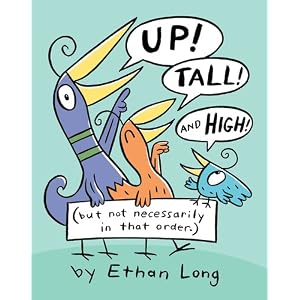
Long, Ethan. 2012. Up! Tall! and High!. New York: Penguin.

Featuring three simply drawn, brightly-colored birds, Up! Tall! and High! (but not necessarily in that order) is a hoot. With vocabulary simple enough for a very beginning reader or a book for toddlers, the three birds contemplate their sizes and abilities with a dry humor reminiscent of Ten Apples Up on Top.  Punchlines in the three 8-page "chapters," are delivered visually - with foldouts, facial expressions or sight gags. Cute!

Vail, Rachel. 2012. Piggy Bunny. Ill. by Jeremy Tankard. New York: Feiwel and Friends.

With an opening setup like this, how can Piggy Bunny not be funny?
Liam was just like all the other piglets except for one thing.  All the other piglets wanted to be pigs when they grew up.  Liam wanted to be the Easter Bunny.
  
Even though "salad remained a challenge," Liam believed in himself, and so did his grandpa, and so will you!  The story is hilarious, and Jeremy Tankard's "ink and digital media" illustrations are a perfectly droll complement to a very funny story.

Rosenthal, Amy Krouse. 2012. Chopsticks. Ill. by Scott Magoon. New York: Disney Hyperion.

If you were a fan of Spoon (and who wasn't?), you'll love Chopsticks,  "Not exactly a sequel to Spoon.  More like a change in place setting."

I'm a sucker for puns, and Amy Krouse Rosenthal knows how to set them in their place. With shocked utensils watching,  the unfortunate Chopstick snaps.  The stunned assemblage watched as Chopstick
was quickly whisked away. 
(Cue the earnest whisk, racing for the doctor with the snapped  utensil cradled in his wires.)
The others all waited quietly.  No one stirred, not even Spoon.
(Yes, our dear friend, Spoon, pictured here in the medicine chest being comforted by a bandage.)

But not to worry!  Things will work out for the best.  Perhaps there will even be a call for a toast (with butter!) before this story's ended.   Irresistible!


and to wrap things up, some laughs for a slightly older crowd ...
Catalanott, Peter. 2012. Question Boy Meets Little Miss Know-It-All.  New York: Simon & Schuster.

Question Boy - perhaps you've known one.  If so, you can imagine this conversation,

"What are you doing?" Question Boy asked.
"I'm filling a tank with oil so the people who live here will have hot water and heat when they need it."
"Can I see the tank?"
"There, my work here is finished," Oil Man said.  "What? No, you can't see the tank.  It's in the basement.  Even I've never seen it."
"How do you know it's there?  What if someone took the tank for a drive?"
"Ah!" Oil Man said.  "It's not an army tank!"
"How do you know if you've never seen it?"
And perhaps you've known a Little Miss Know-It-All as well,

"Kangaroos can't walk backward!" Ketchup was once sold as a medicine!  A giraffe can clean its ears with its tongue! Hummingbirds can weigh less than a penny! ..."
Now, imagine what happens in the park when Question Boy goes head-to-head with Little Miss Know-It-All!  It's the quest for knowledge vs. knowledge itself. Question mark vs. exclamation point. Boy vs. girl.  Which will win?  You'll have to read it to find out!

(just be sure to read the back jacket for an important footnote that should have been included within the book's pages)


Enjoy!

Monday, February 20, 2012

Can We Save the Tiger? a review

Here’s another review of a  Cybils Nonfiction Picture Book finalist …


Jenkins, Martin. 2011. Can We Save the Tiger? Ill. By Vicky White. Somerville, MA: Candlewick.

Martin Jenkins explains extinction and its causes in a manner that, while factual, is also conversational and thought provoking.  Consider his opening paragraphs that inspire an immediate sense of wonder combined with an easy familiarity,
The world’s quite a big place, you know.  But it’s not that big, when you consider how much there is to squeeze into it.
After all, it’s home not just to billions of people, but to the most amazing number of other kinds of living things, too.  And we’re all jostling for space.
After a cursory introduction to extinction, he offers the varying reasons for why creatures have become extinct – poaching, invasive non-native species, over-hunting, chemical poisoning.  Each time, he hints that problems are not so easily solved.  Take the tiger for example,
…they’re big, they need a lot of space.  But the countries where they live, like India and Indonesia, have huge numbers of people in them too, all trying to make a living and needing to be fed. …
So if you were a poor farmer trying to make a living with a couple of cows and a few goats, you might not be too happy if you found there was a hungry tiger living nearby.  And if you knew that someone might pay you more for a tiger skin and some bones than you earn in three whole months working in the fields, then you might find it very tempting to set a trap or two, even if you knew it was against the law.
Jenkins looks at failures (the Dodo, the Great Auk and others), successes (the Buffalo, the White Rhinoceros, the Kakapos, and more) and other works in progress.  In each case, he presents the conundrum of competing interests or unintended consequences in a manner easily understood by young readers.  Text size, too, is inviting to younger readers – smaller text is punctuated by sections of very large font print.

Similarly to Jim Arnosky’s Thunder Birds, field-style pencil sketches accompany many pages.  Vicky White’s larger illustrations are done in pencil and oil paint with lightly sketched backgrounds, or on plain cream-colored pages. The large and realistic illustrations are accompanied by basic facts including habitat, size, diet, life span, and existing population. An index and online resources complete the book.

A small final illustration of the rare Sander’s Slipper Orchid hints that not only creatures are in danger of extinction; or perhaps the illustration hints at a future book. The over sized book has sturdy pages that, although they have a matte finish, have a smooth and creamy texture - like icing on the cake.  A beautiful and affecting book.


Can We Save the Tiger? is a 2011 Cybils finalist in the Nonfiction Picture Book category.


Friday, February 17, 2012

Giants Beware! a review

Aguirre, Jorge and Rafael Rosado. 2012. Giants Beware! New York: First Second.
(Advance Reader Copy supplied by publisher)

Giant is a perfect descriptor for this new graphic novel.  What’s “giant” about it?

 
  • Claudette, the would-be giant slayer. Small in size, but with giant-sized ambition, personality and loyalty.
  • Gaston. Claudette’s little brother is a giant himself  - well, at least in culinary circles.
  • Marie, the Marquis’ daughter. She may lack a fighting nature, but she’s got a giant dose of cleverness.
  • The book. Its audience may be small readers (ages 7 and up), but it’s a much bigger size (10 x 7.5) than most graphic novels for this age group.  No squinting to see all the action in these big panels.
  • Color. Bam! Lots of it.
  • Humor. A giant helping of elementary school humor.
  • Fun.  202 quick-reading, action-packed pages of it.
  • The Baby-Feet-Eating Giant.  Of course.  You knew there had to be a giant!

Due on shelves in April, 2012.

Click for a sneak peek at pages 35-39 of Giants Beware!

Another review @
100 Scope Notes

Beneath the Waves - a review

As we read disturbing news accounts of dying manatees , environmental disasters caused by toxic waste, and ocean pollution on the scale of ...