Pages

Showing posts with label New Jersey. Show all posts

Monday, October 26, 2015

New Jersey - The 50 States Fun Fact Blog Extravaganza!

New Jersey knows that it's the butt of jokes throughout the nation, but we also know that we've got a great state with unique features that no other state can match.  From the mountains to the shore, from the cities to the Pines, we've got a wealth of natural beauty, history, and culture.  It's like a well-kept secret.  But now, The Fifty States: Explore the U.S.A. with 50 fact-filled maps, written by Gabrielle Balkin and illustrated by Sol Linero (Quarto, 2015) is bringing some of our secrets to light.


Take a peek at the New Jersey page, and then I'll share a few of my favorite NJ gems.


Three of my NJ favorites which are featured in The Fifty States: Explore the U.S.A. with 50 fact-filled maps:
 BRIGHT IDEA In West Orange you can visit inventor Thomas Edison’s lab and house.
Thomas Edison National Historical Park is a fascinating place to visit.  In my opinion it beats visiting Thomas Edison Center in Menlo Park, NJ and his winter estate in Fort Myers, Florida.  He didn't just invent the light bulb, he invented everything you need to use a light bulb - from the lamp to the power grid.  And of course, he invented much more than the light bulb.  Not a perfect man, by any means, but a perfectly brilliant inventor!
"Edison labs Main St Lakeside Av jeh" by Jim.henderson - Own work. Licensed under CC0 via Commons - https://commons.wikimedia.org/wiki/File:Edison_labs_Main_St_Lakeside_Av_jeh.jpg#/media/File:Edison_labs_Main_St_Lakeside_Av_jeh.jpg

LUCY THE ELEPHANT In 1881 the U.S. Patent Office granted inventor James Lafferty the right to make animal-shaped buildings for 17 years. His first creation, Lucy, still stands in Margate, Atlantic City.
She's a whopping 6-stories high and 134 years old, and she sits right next to the beach.  And what a view from inside!  I'm not positive but I do remember that her interior paint color is "stomach," or something similarly intestinal.
By Harriet Duncan (Own work) [CC BY-SA 3.0 (http://creativecommons.org/licenses/by-sa/3.0)], via Wikimedia Commons
FEBRUARY 1913: Silk workers in Paterson begin a six-month-long strike for better working conditions.
Paterson, NJ, may not be your first thought when seeking tourist sites, but it's well worth a visit.  Paterson Great Falls National Historical Park is one of the nation's newest National Parks. The falls (one of the largest in the nation) and park sit in the midst of an urban city of more than 145,000 people. The falls and the people of Paterson were powerhouses of the U.S. Industrial Revolution.
Photo by L Taylor (c)
If you want to know more great sites in NJ, you'll have to come see for yourself. (BTW, Come See For Yourself, was once our state slogan. I think they should have gone with the more popular, "New Jersey - You got a problem with that?")

Note:
Book images and quotes were provided by the publisher.  I have no publisher or bookseller affiliations and received no compensation.  I am participating for love of state.

Monday, June 24, 2013

Lena Blackburne Baseball Rubbing Mud

If you've read my blog for any length of time, you know that I'm a Phillies fan and hail from New Jersey - but did you know that New Jersey is home to Lena Blackburne Baseball Rubbing Mud, the mud discovered by one-time Phillies player, Lena Blackburne? The mud used to take the slick shine off balls used in major league baseball?

In fact, as readers will learn in Miracle Mud,

"Lena's mud is the only thing that's allowed on major-league balls.  Players can't use water or spit or shoe polish.  Just mud.  Lena's mud."

And it comes from South Jersey, but Miracle Mud won't tell you from where - that's a secret!

Oliver Dominguez' nostalgic, double-spread, painted illustrations are the perfect complement to this short and engaging biography of Lena Blackburne (1886-1968) and his famous mud. You may view eleven of the book's paintings at Oliver Dominguez' website.  The front and rear end papers are the best - clean baseballs up front, muddy ones in the back!

An Author's Note and Lena Blackburne's official stats round out this great introduction to Lena Blackburne. He never made it to the Hall of Fame, but his mud did! A great choice for baseball fans of all ages.

Kelly, David A. 2013. Miracle Mud: Lena Blackburne and the Secret Mud that Changed Baseball. Minneapolis, MN: Millbrook Press.

Don't believe it?  Want to learn more?
Check out:


It's Nonfiction Monday.  Today's roundup of nonfiction posts can be found at Playing by the book.

Monday, March 11, 2013

Hiding Out at the Pancake Palace - a booktalk

Marino, Nan. 2013. Hiding Out at the Pancake Palace. New York: Roaring Brook.
(Advance Review Copy provide by NetGalley)

Due on shelves April 16, 2013

Hiding Out at the Pancake Palace 
(a booktalk)


Cecilia has no rhythm, and not too many friends; but she has something special - a story. A story of a song that connects her to New Jersey's wild Pine Barrens as firmly as the roots of its Pygmy Pines and Atlantic Cedars. Everyone in Wares Grove knows the story of the song played by the forest on the night of Cecilia's birth. Only the story of the Pineland's most famous inhabitant, the Jersey Devil, is known more widely.

But two unexpected things occur as Cecilia's 12th birthday approaches. Cecilia's mother begins to doubt the song, and a young boy, a boy who has perhaps lost a song of his own, has arrived in the middle of the night under suspicious circumstances - and he's hiding out at Piney Pete's Pancake Palace.

A song, a secret, and the legendary tale of the Jersey Devil are entwined in this imaginative story of discovery set on the fringes of New Jersey's Pine Barrens, a natural wonder.

Find out who's Hiding Out at the Pancake Palace.

##


Note:
Lest you think that the Pine Barrens is a made-up place, or that New Jersey is nothing more than exits off the Turnpike or Parkway, be assured that the Pine Barrens are in fact, one of the world's most interesting places. The Pinelands cover 1.1 million acres, or 22 percent of New Jersey's land area. (from the official NJ tourism site - see below)

Learn more about the Pine Barrens and other locations in Nan Marino's new book at these sites:


If I didn't have a sore throat, this one would have been a podcast.  Look for a podcast or video booktalk for Hiding Out at the Pancake Palace soon.

Wednesday, November 21, 2012

Happy Thanksgiving - NJ edition

In spite of Hurricane Sandy, I have much to be thankful for. 
 I am thankful for the kindness of my family, friends, co-workers, library patrons, the library community at large, and even strangers.  

Wishing you a joyful and restful Thanksgiving. 

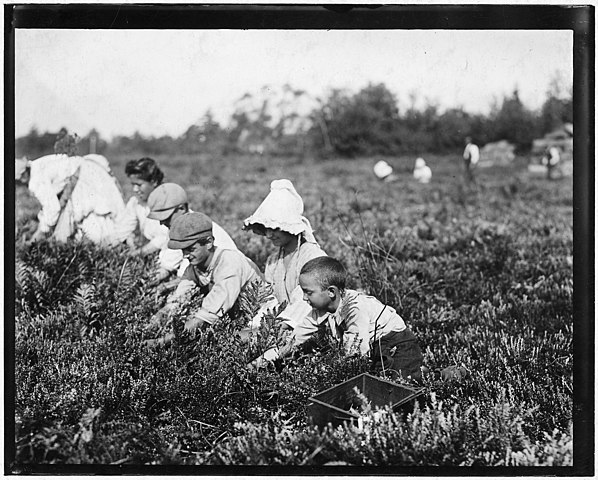
I'll leave you with some photos of New Jersey's cranberry bogs,    
Double Trouble cranberry bog
By Jennifer H. Kertis (Flickr) [CC-BY-SA-2.0
(http://creativecommons.org/licenses/by-sa/2.0)], via Wikimedia Commons

Richard Tevor, 8 years old. 5 years picking cranberries. Theodore Budd's Bog at Turkeytown, N.J.
This is the fourth week of school in Philadelphia and the people will stay here two weeks more.
(1912-1913)
By Lewis Hine (1874-1940)
U.S. National Archives and Records Administration


Monday, May 9, 2011

Meadowlands: A Wetlands Survival Story

It's Nonfiction Monday and I'm pleased to be today's host location!
Yezerski, Thomas F., 2011. Meadowlands: A Wetlands Survival Story. New York: Farrar, Straus & Giroux.
From the top of the Empire State Building in New York City, you can see a flat, wet place in New Jersey.  Some people think it's just smelly swamps.  Others think of it as where the airport or malls or stadiums are.  Most people think it's not much of a place at all.  This place is called the Meadowlands.
Though the word meadow conjures thoughts of an idyllic landscape, to many New Jerseyans and nearby New Yorkers, the word Meadowlands does not.  Instead, thoughts of Giants Stadium, Super Fund sites, and, according to the governor, the state's ugliest building come to mind.  But as New Jersey resident Thomas F. Yezerski points out in Meadowlands: A Wetlands Survival Story, the Meadowlands is and always has been a changing place.
Yezerski begins the Meadowlands' story several hundred years ago when the Meadowlands was "20,000 acres of marshes, swamps, and bogs that were home to many different plants and animals," as well as the native people, the Lenni Lenape. Throughout the 1960s, 70s, and 80s, the area went through various changes - most of them for the worse.  Landfills, chemical dumping, noxious smells, overcrowding, filthy water - the picture looked grim, and the Garden State's new reputation as a smelly place along the Turnpike was fixed in the nation's consciousness.
But even after being dug out, filled in, run over, and dumped on, the wetlands still showed signs of life.  The Hackensack River still flowed south.  The tide still rose north from the Atlantic Ocean.  The river and tide still met in the Meadowlands twice a day, as they had for 10,000 years.  Because they did, the ecosystem had a chance to recover.
Meadowlands is a hopeful story. A story of the return of fish, birds, and even the marshland itself.  It's a story of possibility, of the positive effect that people can have when they are so determined.  Yezerski's love for the area is apparent. His pen and watercolor illustrations show that he has spent many hours and days in the Meadowlands, capturing its essence. Realistic detailing is present throughout, particularly in the birds, which approach guide book quality.  Each double spread features a rectangular painting set in a frame of white space.  Related icon-sized images surround the main illustration. Text appears plainly at the bottom of each page - no more than 4 lines per page.
The final pages show the fragile combination of a now bird-filled marshland located within one of the nation's most densely populated urban areas. The cover art, featuring a snowy egret in this urban wilderness is stunning.

Meadowlands should be required reading for all New Jersey schoolchildren, but it has value beyond New Jersey as well. It spreads the hopeful message:  If we can do it, so can you. Where there is water flowing, there is life.

Highly recommended.
Author's Note, Selected Bibliography, and Selected Web Sites are included.
You can learn more about the Meadowlands at the New Jersey Meadowlands Commission site or the many sites devoted to the Meadowlands' varied commercial ventures.
Link your Nonfiction Monday post below.  If you're not posting today or just stopped by to read, please check out the other great nonfiction posts linked below.  In either case, thanks for stopping by.


Tuesday, September 1, 2009

If you're not a New Jerseyan, pardon my indulgence in this region-specific book. :-)

Noble, Trinka Hakes. 2009. The New Jersey Reader. Chelsea, MI: Sleeping Bear Press.

The New Jersey Reader is an attractively illustrated and inviting little book, created in the style of early American schoolhouse primers. As such, it is certainly true to form. Its small size, and engaging format of illustrations, poems, stories, history, (and even a play) is a delightful introduction to New Jersey standard 4th grade curriculum. We have, however, come a long way from colonial primers. In this day and age, the lack of a bibliography, source materials, or author's notes is a surprising and noteworthy omission. It mars an otherwise charming book.

The publisher's Teacher's Guide should be useful to 4th grade teachers.
http://www.gale.cengage.com/pdf/TeachersGuides/TheNewJerseyReaderGuide.pdf

Beneath the Waves - a review

As we read disturbing news accounts of dying manatees , environmental disasters caused by toxic waste, and ocean pollution on the scale of ...