Here are two #YAlit audiobooks that I recently reviewed for AudioFile Magazine. I am not permitted to reprint the reviews here, but have provided the links (which include audio excerpts). Both books offer a unique viewpoint of the adolescent male experience - Me and Earl and the Dying Girl through the medium of film making, and 100 Sideways Miles through the medium of abstract concepts. But now I've had my fill of angsty boys for a bit. Time for a change of pace. Up next: Sci-fi and a new picture book roundup.
Fleischman, Sid. 2010. Sir Charlie: Chaplin, The Funniest Man in the World. New York: Greenwillow.
For many, particularly the younger generation for whom this book is written, Charlie Chaplin is an icon, but not an icon in the sense of its earlier definition - as a symbolic star, an iconic idol of the silver screen, but an actual icon - a face with a ridiculously small mustache and bowler hat; a silhouette with bowed legs, a cane, and over sized shoes. Sid Fleischman's book, Sir Charlie Chaplin, The Funniest Man in the World, breathes new life into this icon, the genius of the silent screen.
From Chaplin's meager beginnings as the son of minor vaudevillian performers, a drunken father and a mother beginning to lose her voice - Chaplin fell still farther into the depths of London's Cockney slums. Already educated in the school of hard knocks, seven-year old Charlie and his older brother Sydney were sent to a workhouse in 1896, "owing to the absence of their father and the destitution and illness of their mother," according to the ledger entry at the "booby hatch." His mother, as she would many times throughout her life, was admitted to a ward for the mentally ill.
Using period quotes and engaging prose packed with personification and similes,
...Chaplin was losing confidence in his isolated and bullheaded judgment. Disaster holding aloft a mallet, as in one of his slapsticks, might be waiting for him in the theater. Silent films had become as out-of-date as the once-stylish spats he still wore over his shoes.
Fleischman gives a chronological account of Charlie's rise to fame with the creation of his signature character, The Little Tramp, his personal foibles (including paternity scandals), his wartime contributions, his fall from favor with the American people (including his investigation by the House Un-American Activities Committee and J. Edgar Hoover during the notorious "red scare" years), and his eventual arrival at the place of elevated regard that he finally held in his later years and beyond. He was belatedly honored with a star on the Hollywood Walk of Fame in 1972, and knighted by Queen Elizabeth in 1975.
In the book's preface, Fleischman reveals that he arrived in Hollywood in the 1950s to write movie screenplays only shortly after Chaplin had left for Switzerland, but "his (Chaplin's) footprints were everywhere." Fleischman credits Chaplin's films with tutoring him in the school of "spectator theater" and the gift "of the visual." Fleischman's interest in and connection with his subject is apparent throughout.
Fans of Chaplin will appreciate this intense look into the ups and downs of a life devoted to the entertainment of others; sometimes at great cost to Chaplin himself and those closest to him. Those who know Chaplin only as a bowler-wearing icon will (hopefully) scurry out to the public library in search of a Chaplin film on DVD.
Recommended for upper middle grades to adult. A thoroughly researched and referenced look at the diminutive film giant, Charlie Chaplin, from a giant of children's literature, Sid Fleischman.
Sid Fleischman passed away in March of this year at the age of 90, before this book was published, a great loss.
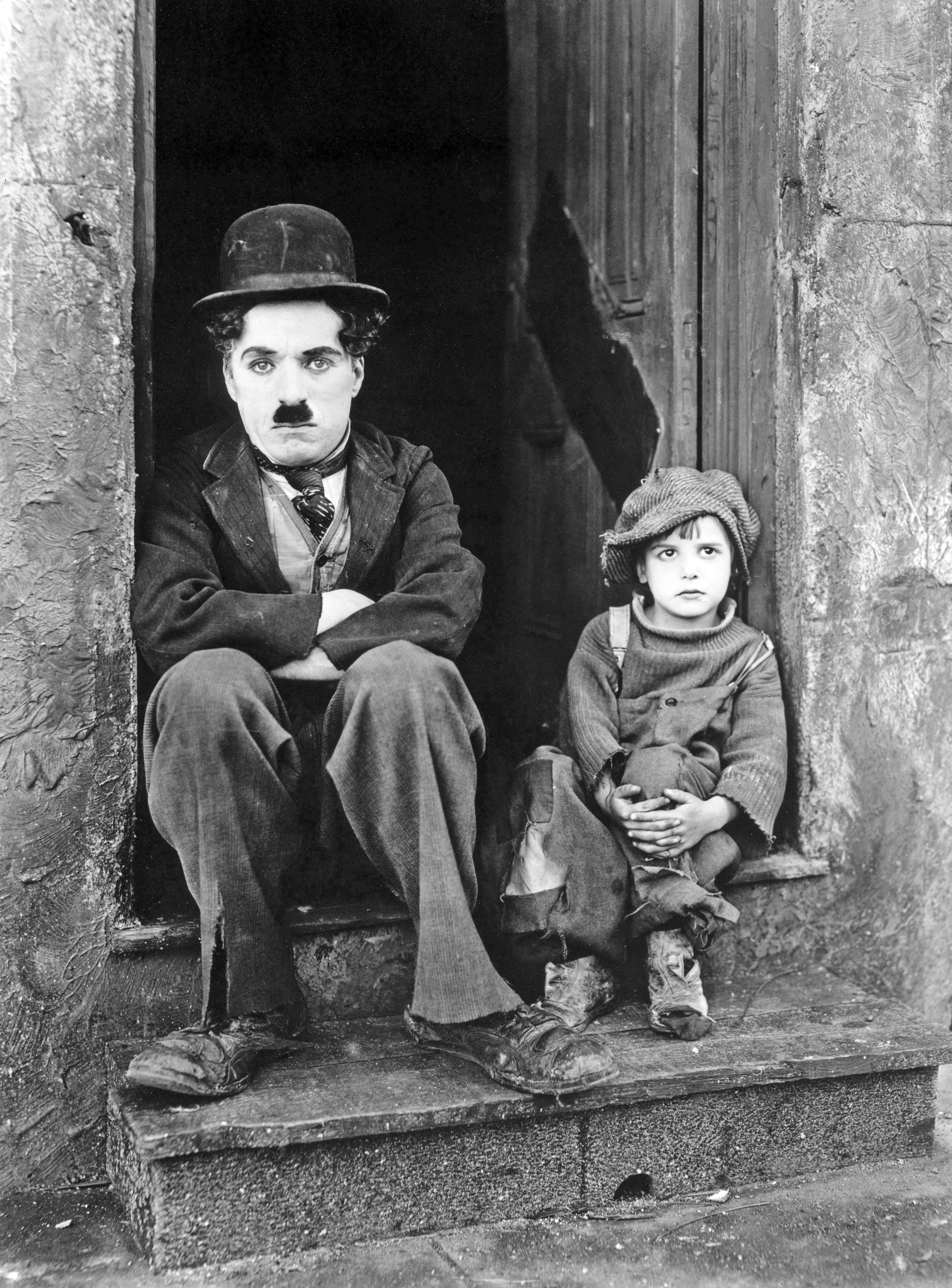
(A scene from Charlie Chaplin's 1921 movie "The Kid". Copyright has expired and the photo is in the public domain. Taken from en.wikipedia.org)
A personal aside: I once took a course, The History of Film. I'd pop the silent comedy classics into the DVD player, and my children would quickly dismiss or deride the grainy black and white images; but they would hear me laughing in the silence, and slowly wander in and take a seat on the couch, watching the antics of the Keystone Cops, Laurel and Hardy, or the Little Tramp. Soon, they were asking which films I would be borrowing next. Never underestimate the power of a pie in the face.
It's Non-Fiction Monday! Check out all of today's posts at Rasco from RIF.
Kinney, Jeff. 2010. The Wimpy Kid Movie Diary: How Greg Heffley Went Hollywood. New York: Amulet.
With the success of the wildly popular Diary of a Wimpy Kid series, it was only a matter of time before Greg Heffley went Hollywood. What's surprising is that he wasn't animated! Perhaps it's cheaper to make a live action film these days, or perhaps the talented Jeff Kinney simply didn't have the time to draw an entire movie. Whatever the case, Greg went to Hollywood (a.k.a Vancouver).
The producers searched for a place that looked like a typical American town. They considered Rhode Island, Michigan, and lots of other places in the United States. So it's weird that they ended up finding the perfect American town in Canada.
In short sections with titles like "A Wimp is Born," "Action!," and "Faking It", Jeff Kinney walks the reader through the complicated process of creating a movie. Of course, he does it with the humor that readers have come to expect. In the chapter "Double Trouble" detailing the casting of little brother Manny, Kinney writes,
One of the trickiest roles to cast was Greg's three-year-old little brother, Manny. You may have noticed that in the books, Manny looks sort of like a buck toothed alligator. Unfortunately, there aren't many kids who look like that in Vancouver - or anywhere else for that matter.
So the casting director looked for the next best thing, which was a cute kid with a memorable face. After a lot of searching, the perfect Manny was found. Two of them actually. The trouble with three-year-olds is that they don't always do exactly what you want them to do, so it's a good idea to have a backup in case one of them decides not to cooperate.
The Wimpy Kid Movie Diary is the same size and format of the previous books, a printing font on diary-style pages liberally accompanied by hilarious artwork (from The Diary of a Wimpy Kid as well as new drawings created especially for this book). The difference here is the addition of photographs, costume sketches, movie stills, actors' family photos and more.
This book will appeal to fans of Greg Heffley as well as those interested in the film making industry. Casting, directing, set design, costumes, acting and editing are explained in a manner that is both informative and funny - a great way to learn. The WK Movie Diary is a winner!
Selznick, Brian. 2007. The Invention of Hugo Cabret. New York: Scholastic.
This 526-page book is the unlikely winner of this year’s Caldecott Medal, awarded annually to “the most distinguished American Picture Book for Children published in the United States during the preceding year.” In most years, the Caldecott Medal is awarded to a picture book for young children. There was much discussion about whether or not a book of this type and length, “twenty-six thousand one hundred and fifty-nine words,” belonged in contention for the award. Its nearly 300 pictures, however, sealed the deal and it is a watershed book in children’s literature.
Most of the artwork consists of Selznick’s pencil drawings, but there are also several stills from early motion pictures, and a few drawings by the famous French filmmaker, George Méliès. Selznick’s pencil drawings are incredibly lifelike and detailed. Parts of the story (including a memorable chase scene) are told only through drawings, sometimes twenty or more pages running. The story is so captivating that if the pictures weren’t so wonderful, you would be tempted to race through the illustrated pages just to see what happens next.
Without giving too much away, The Invention of Hugo Cabret is mystery, history, suspense, friendship, and coming-of-age all at once. Life in 1931 Paris, clockworks, the history of film, and a wary but blossoming friendship are strong themes of the story. Hugo Cabret is a young street urchin living inside the walls of a Paris train station. Having learned the skill of horology (the art of measuring time) from his father, he carries on the job of the absent Timekeeper of the station, carefully maintaining and winding the clocks throughout, and living in a tiny hidden room within the walls.
In his solitude, his companion and his obsession is a broken automaton, that he inherited (in a fashion) from his father. He is determined to repair the broken automaton, and so repair himself. He steals small toy parts, gears, and springs from a toy shop in the station and thus begins an unlikely relationship with the secretive and cantankerous shopkeeper and the young girl, Isabelle, frequently found at the shop.
The text on each page is bordered by a large expanse of white space and a black border. Despite its length, this story reads quickly. Hugo is a likeable, if brooding, young man and the reader is immediately swept into the drama that is Hugo’s very existence.
The book’s website is a great resource. http://www.theinventionofhugocabret.com/about_hugo_intro.htm