Pages

Monday, May 30, 2011

We are America

Myers. Walter Dean. 2011. We are America: A tribute from the heart. Ill. by Christopher Myers. New York: Collins.

Due to the long holiday weekend and my scurrying back and forth between two library branches, on Friday afternoon at 4:55pm, I found myself scrambling to find an appropriate nonfiction book to bring home and share for nonfiction Monday.  I had missed this one when it first arrived, and thankfully found it on a cart full of returns.

In We are America, Walter Dean Myers traces the history of the nation.  With elegant poems, he begins the history with the Lakota in
"Before there was America."
Before the ships came
Their white sails ablaze
     against the clear blue sky
My Lakota heart pounded the rhythms
Of this sacred land ...
He continues, recounting in poetry the birth of the nation, the slave economy, the Civil War, the building of America,
"We were machines belching smoke"
Pushing carts, baking bricks, cleaning sewers
Inventing, daring, lifting our hopes to skies
     that suddenly seemed
Within reach
We were Irish muscle and Polish pride
Germans and Italians
Africans and Chinese
Mexican and English
We spoke a hundred languages
We were laborers building the hugeness
     of the fantasy that was
The Unites States of America ...
and America's future possibilities. His poems are accompanied by quotes that reflect great, decisive, or conflicted moments in American history -quotes from varied people and documents of great meaning to our country.
"Is life so dear, or peace so sweet, as to be purchased at the price of chains and slavery?  Forbid it, Almighty God!  I know not what course others may take; but as for me, give me liberty, or give me death!" Patrick Henry
"Give me your tired, your poor, your huddled masses yearning to breathe free." Emma Lazarus
"We have a positive vision of the future founded on the belief that the gap between the promise and reality of American can one day be finally closed."  Barbara Jordan
Each poem on a stark white page is accompanied by an oil painting representing the people and times that are or have been "America" - from John Smith to Jimi Hendrix, Amelia Earhart, textile workers, a Japanese internment camp, soldiers in Europe, Vietnam, and Iraq, Chinese railroad workers, Mark Twain, Gloria Steinem, and everything in between.


What better book to share for this solemn and reflective national holiday? Enjoy your Memorial Day and remember those who made it possible.

As I waited in line to meet Llama Llama Misses Mama author, Anna Dewdney, on Wednesday, I was less than 2 feet from Walter Dean Meyers as he was signing books in the next row. Unfortunately, after meeting the talented and friendly Ms. Dewdney, the line to meet Mr. Myers was too long for me to get through before he finished greeting librarians and other fans. He sure did look like a nice guy, though. It's comforting to find that famous authors and illustrators are such "regular" people.

Wednesday, May 25, 2011

BEA goodies!

It's great to get out of the library for the day and spend time with co-workers, colleagues, authors, illustrators and booksellers.  It's a good reminder of what makes librarianship a great profession!

Here's a peek at my goodies from BookExpo America!  I can't wait to spend some time looking them all over.  Books, I will read, review and give away to lucky children participating in my library's summer reading program.  Posters and other goodies will also be used in the library for decoration or prizes.  What am I keeping? A few good bags, a flash drive (I really need an extra one), and this lovely sketch from the lovely and talented Rebecca Guay.  Ms. Guay is the illustrator for the upcoming graphic novel by Jane Yolen, The Last Dragon (Dark Horse, Sep 2011). (If you can't wait for it, request it now from NetGalley.)
The Last Dragon by Jane Yolen, illustrated by Rebecca Guay.
oops! That circle of light is from my window.  It's a beautiful
day here in the East. 

Monday, May 23, 2011

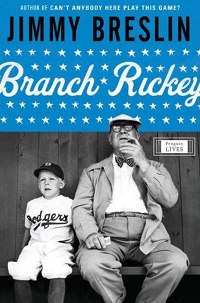
Branch Rickey

...an adult book today. Either indulge me in my annual adult nonfiction baseball read, or come back later in the week when I hope to have great things from BookExpo America in New York. Thanks!

Breslin, Jimmy. 2011. Branch Rickey. New York: Penguin . 
     The two men sat across from each other at Joe's Restaurant.  Breaking salt rolls into crumbs, Rickey immediately told Barber, "Mrs. Rickey and my family say I'm too old at sixty-four, and my health is not up to it.  They say I've gone through enough baseball and [taken enough] from the newspapers.  That every hand is baseball will be against me.  But I'm, going to do it."

     "He looked straight into my eyes," remembered [Red] Barber, fixing my attention."

     Rickey said, "I'm going to bring a Negro to the Brooklyn Dodgers."
 Barber remembered Branch Rickey speaking slowly as he said it.  "I'm going to bring a Negro to the Brooklyn Dodgers.

   Barber sat straight and silent.

    "I don't know who he is," continued Rickey, "or where he is, but he is coming."
Whatever one may think of the controversial Jimmy Breslin, it's difficult to deny that he's a great writer, and due to his long career and many connections to the sports world and New York in general, he was the perfect choice to write this book on Branch Rickey for the Penguin Lives series. Although he, himself, met Rickey only once, Breslin read extensively about him, and interviewed many people who still remembered the man who brought Jackie Robinson, the first African American, player into Major League Baseball.

What little I knew about Rickey came from watching Ken Burns' documentary, Baseball, and from reading books about Jackie Robinson; but I always wanted to know more about man who put the wheels of integration in motion.  What motivated Rickey?  Altruism?  Money? Religion? Baseball?
It was all of these, and yet it was none. In the simplest explanation, it was Rickey's sense of fairness that drove him to integrate Major League Baseball.  That he was the manager of the Brooklyn Dodgers gave him the opportunity to make his dream of equality take root in the game of baseball.  That he was a religious man, made him see the righteousness of his cause and allowed him to bring other like-minded individuals into the fold.  When faced with those who were neither fair nor religious, Rickey appealed to their sense of business acumen.  These talented young African Americans were the future of baseball.  He saw it as a good financial investment (although it was devastating to the Negro Leagues), and wasn't afraid to sell the concept on its business merits, and make money in the process, too.  In short, he was a clever, fair, and honest man with a dream of racial equality.  It took him years of planning and the ideal choice of Jackie Robinson to make it happen, but Branch Rickey, can be credited with the integration of Major League Baseball. Not bad for a poor boy "from the hills and swamps of Southern Ohio."

Told in a largely anecdotal style, Branch Rickey is a short, fascinating read for baseball and history fans, regaling the reader with little-known stories of baseball lore. At one point, the always opinionated Breslin (once a heavy drinker) inserts his own theory on alocohol, smoking, and cancer, opposing Rickey's ardent lifetime antipathy towards liquor. This is the one digression that detracts from the story, which otherwise reads like an old friend telling well-worn family lore. (perhaps old friends may be forgiven a digression or two)

And with long-practiced ease, Breslin artfully weaves the story of Branch Rickey into the context of today, pulling the ends of the story together in the middle, with people cheering the election of Barack Obama from their local polling place - Jackie Robinson High School.  How fitting.

I love baseball.

This is an adult nonfiction title, but get your glasses out, because its font is better suited for much younger eyes! (Centennial LT Std 45 Light, if you're interested)

Listen here to an interview with Jimmy Breslin about writing Branch Rickey.

Thursday, May 19, 2011

May picture book roundup

I am in the midst of transferring from one branch to another, and I now have two desks overflowing with great new books!  Here are a few:
Gibbs, Edward. 2011. I Spy with my Little Eye. Somerville, MA: Templar. (Candlewick)

That big (almost 2.5"), yellow, circular eye on the cover is actually a hole - an oh, the things we can spy through that hole!  On a predominantly white spread with an eye on the left page and a circle of blue on the right, we read,
I spy with my little eye  ... something that is blue. "I am the biggest animal in the world."
Turn the page to find a richly colored blue whale, which due to some artfully placed curlicues, manages to appear realistic and at the same time, fanciful.

I'm a BLUE WHALE.
Each featured animal unfolds in the same manner.  The rear cover of the book features a hole for your own little eye to go spying! Colors, animals, guessing - this book has it all!
Edward Gibbs is listed as a "debut artist."  What a debut! This one's dynamite!

Tusa, Tricia. 2011. Follow Me. Boston: Harcourt.

From the book jacket, here is the description of the art,
The illustrations in this book were done using an etching process with monoprinted color.  The text type was set in Prin.  The display type was set in Rats and Carrotflower.
(Rats and Carrotflower? - love that one!)  What this means to me is a softly-colored book with fanciful drawings outlined in etched brown lines.  The color sometimes spills out of its intended (?) perimeter in much the same way that the young protagonist spills out of her swing and floats and flies through the breezes, "lost in small, green, happy music."  She invites the reader to follow her through all of nature's colors, "deep into brown, into the bright white of yellow, into orange that slips into red."   From the illustrator of In a Blue Room, another beautiful book!


Johnson, Lindsay Lee. 2011. Ten Moonstruck Piglets. Ill. by Carll Cneut. Boston: Clarion.

All in a scramble,
all ready to gambol,
ten moonstruck piglets
on a midnight ramble.

Through the mud wallow,
beyond the wide hollow,
leapfrogging piglets
in turns lead and follow.
It's all fun and games until the moon goes behind a cloud!  But not to worry - Mama's coming.  These sleepy-eyed, wrinkly little runts are irresistible!

Where Ten Little Piglets is filled with amusing detail, this next book features uncomplicated simplicity ... (but in both books, you can count on mom to the rescue!)

Monday, May 16, 2011

What's the Difference?

I'm glad that I chose to review a book about the natural world, because today's Nonfiction Monday is at SimplyScience Blog.

This is a title from last year, but it just arrived in my library's bag o' books.

Koontz, Robin. 2010. What's the Difference Between a Butterfly and a Moth? Ill. by Bandelin-Dacey. Minneapolis: Picture Window.

I like this book for two, no, make that three, main reasons:
  • the minimal text makes it a book that you can slip in to a storytime session
  • the illustrations strike a perfect balance between realism and art (anatomically correct with close-up insets, but artfully and attractively presented with soft edges and complimentary backgrounds)
  • the book answers a question that interests kids
Opposing traits are presented on opposing pages,
Can you spot the difference between a butterfly and a moth by looking at the wings?  Many butterflies have wings that are covered with thousands of bright, colorful scales.  The colors help the insect blend in with its surroundings.  Spots on its wings can look like large eyes that scare away animals. 
Most moths have dull-colored scales that match their resting places.  Some moths look like wood or  a leaf.  This helps them blend into their surroundings.

Text box insets offer more technical information and terms,
Some animals and insects are camouflaged.  That means they are shaped or colored to match their surroundings.  Camouflage helps them hide from enemies.
What's the Difference between a Butterfly and a Moth? offers seven differences between the two insects.  A pictorial synopsis is included in the back matter, as well as Fun Facts,  Glossary, To Learn More, and Index.

I wanted to review What's the Difference Between an Alligator and Crocodile? (who doesn't want to know about 'gators and crocs?!)  but it was checked out.

A side note: I was curious about the named illustrator, "Bandelin-Dacey," so I checked it (him/her/them) out. After searching the website for MB Artists: Bandelin-Dacey Studios, I discovered that the artwork is a collaboration of Bob Dacey and Debra Bandelin.  I wonder how that works.  What can be the division of labor in a painting?  Something to ponder ...

See all of the titles in this series at Capstone's site.

Note: For those of you working with a hobbled version of Blogger (as I am!), you have my sympathy.
 It's been a very frustrating week!

Beneath the Waves - a review

As we read disturbing news accounts of dying manatees , environmental disasters caused by toxic waste, and ocean pollution on the scale of ...