Yolen, Jane. 2010. Elsie's Bird. Ill by David Small. New York: Philomel.
An uplifting story of a young girl and her newly widowed father who leave Boston with the girl's beloved canary to make a new life on the Nebraska frontier. At first lonely and depressed, Elise learns to appreciate the beauty, vastness and music of the prairie. A wide book with double-spread watercolor and ink paintings is the perfect format for evoking the beauty and solitude of the prairie in contrast with the hustle and bustle of Boston. A hopeful story in which the small, loving, well-tended family blooms in the rich Nebraska soil.
a selection from the three bags just received at my branch.
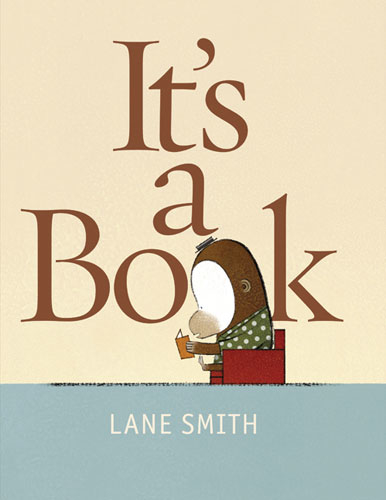
Smith, Lane. 2010. It's a Book. New York: Roaring Brook.
Can it text? Blog? Scroll? Wi-Fi? Tweet? No. It's a book.
Not quite appropriate for school visits (!) , but it may be the funniest picture book you'll read this year! I can't stop laughing!
Wright, Michael. 2010. Jake Goes Peanuts. New York: Feiwel.
This one was on hold and left the branch on the same day it arrived. I can see why some young peanut butter-loving child is anxious to read this one! Hilariously droll illustrations and a delightfully funny story about a boy who wants to eat nothing but peanut butter. Luckily (?) for him, his parents decide to oblige, making everything out of peanut butter,
They dipped peanut butter crackers in their peanut butter soup. Jake was eating so much peanut stuff, he made peanut butter poop.
A rhyming romp of peanuty fun! Allergies? No worries. There's a "Peanut-Free Zone" at the school!
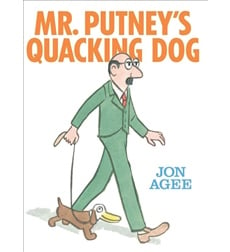
Agee, Jon. 2010. Mr. Putney's Quacking Dog. New York: Scholastic.
It's hard not to like Jon Agee. His illustrations are classic, and he's got a great sense of humor. Mr. Putney's Quacking Dog, however, may be just a little too difficult for most kids to "get." The reader is introduced to Mr. Putney's animal friends, and has to guess the animal's name based on the illustrations and a short question,
Which friend of Mr. Putney's has cold feet?
A SOCKTOPUS
The illustration does show Mr. Putney preparing to dive into the water carrying a large flower-sized box, and the chilly octopus is partially visible in the water, but I have to admit, I didn't guess "socktopus," before I turned the page (and that's one of the easier jokes). As a matter of fact, in a quick run-through of the book, I only "got" 6 of the 20 jokes. If you're planning to read this one at storytime, be prepared to give plenty of hints! Cute.
Frazee, Marla. 2010. The Boss Baby. New York: Beach Lane.
This baby is no little bundle of joy! He’s the boss, and Mom and Dad know it! He runs the home like a tyrant - no time off, plenty of meetings, and round-the-clock demands. He wants his perks too - time at the spa and the gym, drinks made to order. When Mom and Dad are finally too worn out to comply with boss’s orders, something very surprising occurs! The illustrations of the business-suited little tyrant (complete with diaper hatch!) add hilarity to an already funny book. Delightful!
and finally, a more thoughtful book ...
Raschka, Chris. 2010. Little Black Crow. New York: Atheneum.
A little boy sits on a fence and wonders about a passing crow,
Little black crow where do you go? Where do you go in the cold white snow? Where do you go?
Through the boy’s series of poetically repetitive questions, we learn about the little black crow, but ultimately, more about the boy who questions it,
Do you ever worry when you hop and you hurry? Are you ever afraid of mistakes you’ve made? Are you never afraid?
Raschka’s watercolor illustrations evoke the simplicity and wonder of childhood. Enchanting.
On September 8, I received an email from Toon Books announcing its upcoming partnership with Candlewick Press.
TOON Books Partners with
Candlewick Press
I read it with mixed emotions. Two great publishers joining together. That’s good, right? But I was (am) a bit apprehensive that Toon might be overshadowed by its new owner. And why my concern for Toon Books? Well, because they’re so darned good at easy readers. I attended a graphic novel webinar which included comments and booktalks from Toon’s director, Françoise Mouly. As you know if read my blog regularly, I am often frustrated by the nonconformity of easy reader leveling “systems.” I questioned Ms. Mouly about the readability levels of Toon Books. She contacted me after the webinar with complete, thorough, and accurate information about Toon’s graphic easy readers.
The “mystery" book
Can you guess its reading level?
Just take a look at how Toon books differentiates their easy reading graphic titles.
Like many beginning reader series, they’re divided into three levels. But here’s the difference - we’re not left to wonder what criteria was used to derive those levels. Surprise, surprise! Toon Books tells us! Each book has a listed Lexile Level, Guided Reading Level, and Reading Recovery Level. Now I’m not a teacher, so I don’t specifically need those items, but surely all librarians can appreciate having the tools needed to appropriately shelve, catalog, and recommend our easy reader collections! This is how it should be done, folks!
Let’s hope Candlewick follows the tune of Toon Books and begins a movement to make this basic (and much appreciated information) an industry standard in beginning readers. Kudos to Françoise Mouly for leading the way.
If you agree with me, please, leave a comment, start a discussion on your own blog, send an email to someone, tweet, digg, whatever. But this, I think, is a conversation that we should have.
Lin, Grace. 2010. Ling & Ting: Not Exactly the Same. New York: Little Brown.
Twins Ling and Ting are not exactly the same, but they're close - at least, that is, until you get to know them. Ting is more fanciful. Ling, more disciplined. In "Making Dumplings," Ling remarks that dumplings look like old Chinese money.
"We should make a lot of dumplings," Ting says. "Then we will have a lot of money." So, Ling rolls and Ting mixes. "I will close my dumplings tight," Ling says. "Then our money will not get away."
Ting stuffs her dumplings until they're fat and lumpy.
"I will put a lot of meat in my dumplings," Ting says. "So we will be very rich."
In the end, it doesn't matter. The girls laugh. They have made "dump-Lings" and "dump-Tings!"
The delightful illustrations have Grace Lin's distinctive combination of simplicity and joy. Each page of this easy reader contains a half-page illustration and minimal text. Each chapter is printed on different, complementary colored pages, helping newly independent readers to an easy transition between chapters. Also aiding the reader is the bad haircut that Ting receives in the first chapter! Her botched (but still cute) bangs make the twins easily distinguishable from one another throughout the rest of the book.
Readers of this early chapter book will be treated to six short stories in which they will get to know Ting and Ling, and receive a small taste of Chinese American culture. They will see that Chinese Americans are the same, but not exactly the same, as any other Americans. And they will see that though they are twins, Ling and Ting are as different as any other two sisters!
Ling & Ting - they're twins, they're sisters, and they're funny. I hope we see more of them.
Grace Lin's site offers a wealth of useful information - recipes, coloring pages, lesson plans and more. Her publisher's site offers a downloadable Educator's Guide specifically for Ling & Ting.
The only thing lacking for Ling & Ting? Leveling information - Lexile, Flesch-Kincaid, please, give us something to work with, Little Brown. Oh how I wish publishers would all get on the same page when it comes to Easy Readers!
A question I'd like to ask Grace Lin:
Is there any significance to the giant cupcake?
Grace Lin's jacket flap author photos are just plain fun. And here's a fun little trailer for Ling & Ting: Not Exactly the Same.
Today is Nonfiction Monday, and today’s host is Rasco from RIF. Be sure to stop by and read all of the great nonfiction posts from today’s contributors.
Yolen, Jane. 2010. Lost Boy: The Story of the Man Who Created Peter Pan. Illustrated by Steve Adams. New York: Dutton Children’s.
Here is another book whose cover begs the reader to pick it up. I wish there were explanatory remarks on Steve Adam’s illustrations. Unfortunately, I don’t know enough about art to discern the process. The results however, are priceless - full page, “framed” illustrations that appear to be aged paintings on wood, evoking J.M. Barrie’s bygone era, the images of Barrie, boyishly similar to those of Peter Pan. The text, as well, speaks of a simpler, bygone age. Here Yolen recounts the adult Jamie Barrie playing in the park with young boys,
Soon the boys were playing games with Jamie and his dog, the nanny sternly looking on. Jamie could wiggle his ears, do magic, tell wild stories just as he had as a boy in the upstairs room. He could make up plays as he had with Robb in the washhouse He led the boys in pirate games, just as he had with his childhood friend Stuart in the Dumfries Academy.
J.M. Barrie clearly placed a bit of himself in his famous character. It was interesting to learn that
he gifted the copyright for Peter Pan to the Great Ormond Hospital for Sick Children in London, which meant that any money made from the book, the play, and associated sales, went to the hospital.
Peppered throughout Lost Boy are quotes from Barrie’s works,
“(S)he was just slightly disappointed when he admitted that he came to the nursery window not to see her but to listen to stories.” From Peter Pan and Wendy,
accompanied by small “window” illustrations of each quote. A selected list of works and a list of famous actresses (yes, they’ve all been women) who have portrayed Peter Pan completes the book.
Booklist suggests Lost Boy for grades 2-4, SLJ for grades 3-5, Amazon for ages 4-8(!). I think SLJ has the best suggestion, although I would add sixth grade as well. Sadly, at only 40 pages, this book may not pass the minimum page requirement imposed by many teachers (a pet peeve of mine).
A detailed look at the man who created one of our most enduring literary characters. Share|