Pages

Thursday, November 11, 2010

Thanksgiving books for storytime

Thanksgiving is a wonderful (mostly) non-commercial holiday that we can all enjoy regardless of our ethnic and religious backgrounds. Following are some of my Thanksgiving favorites for sharing:


Anderson, Laurie Halse. 2002. Thank You, Sarah: The Woman Who Saved Thanksgiving. New York: Simon and Schuster.

The fascinating true story of the woman who convinced the President Lincoln (the 5th president she petitioned!) to make Thanksgiving a national holiday - a quest on which she spent 38 years!  Written in a witty and engaging style, this one's a pleasure to share with older kids. This story never gets old.
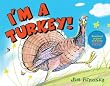
Arnosky, Jim. 2009. I'm a Turkey. New York: Scholastic. (click for review)

A singing look at the natural world of turkeys.  Not a Thanksgiving book, but timely (and fun!), nonetheless.
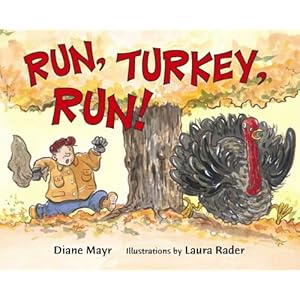
Mayr, Diane. 2007. Run, Turkey, Run!
A cumulative tale (reminiscent of We're Going on a Bear Hunt) of a turkey on the run.  For the faint of heart, you can even end the book at the point where the family sits down to enjoy a Thanksgiving dinner of grilled cheese while the turkey rejoices (and skip the final page when the turkey is spotted again when the family goes out to find a Christmas tree!).  Either way, it's a winner.


Anderson, Derek. 2005. Over the River: A Turkey's Tale. New York: Simon and Schuster. (Based on the song by Lydia Maria Child)
If you want to keep old songs alive, you've got to sing them - and children are the best audience.  They love to sing, they love you to sing with them, and they don't mind if you don't do it well! (I love kids for that)  Break out your singing voice and give "Over the River and Through the Woods" a go while you page through the delightful illustrations of this Thanksgiving classic.

Markes, Julie. 2004. Thanks for Thanksgiving. New York: Harper Collins.

This book's simple rhymes (one line per page)   
Thanks for Thanksgiving, for turkey and pie.
Thank you for fall and gold leaves floating by.
and warm illustrations make it perfect for sharing with your youngest listeners. (the "you" in thank you is left undefined and readers may draw from it what they wish)


Ruddell, Deborah. 2009. A whiff of pine, a hint of skunk: A forest of poems. (Ill. by Joan Rankin). New York: Margaret K. McElderry Books.


And if you're planning to have children create the classic hand print turkey this year, it simply begs for a reading of "A Wild Turkey Comments on his Portrait," from A Whiff of Pine, a Hint of Skunk: A Forest of Poems, if not for the kids, then read it for yourself!
I find it most insulting
that you traced around your hand
and colored all my feathers
either plain old brown or tan.

Where's the copper? Where's the gold
that a turkey should expect?
Where on earth is raw sienna,
and where is the respect?

Finally, I'm baffled
that you've made me look so dumb.
My head is quite distinguished
and it's nothing like your thumb.
The rest of the collection is great as well! Don't miss this one.


Finally, If you're thinking of choosing a book that tells the "traditional" "Thanksgiving story," check out the resources at Oyate first.  Oyate, a Native organization that works to promote honest depictions of Native history and stories, offers Recommended Books about Thanksgiving  and a guide, How to Tell the Difference. I'm thankful that they have decided to discontinue their page on "Books to Avoid."  A list of suggested books is more helpful and affirming than a list of offensive ones.  In the future, I hope that more culturally-correct, Thanksgiving inspired titles are written for preschoolers. In the meantime, I'll be sharing the ones above.

And that's Thanksgiving in a pie shell.  Enjoy!
Share |

Tuesday, November 9, 2010

A Long Walk to Water

Park, Linda Sue. 2010. A Long Walk to Water. New York: Clarion.

A Long Walk to Water begins as the parallel stories of Salva, a young boy in the Southern Sudan of 1985 and Nya, a young Sudanese girl in the year 2008. 

Salva once had the life of a well-to-do villager's son.  His father owned many cows.  He attended school. He herded the cows.  But when the rebels arrived, shooting at everyone in the village, his life changed in an instant.  Now he is alone.  Get to the next hill, the next watering hole, the next day.  This is the mantra that keeps him going, one painful step at a time, searching for years for a safe haven - across deserts, war zones and countries.

Nya's life consists of providing water for her family.  When the brackish pond is full, she walks hours each day - first to the pond to collect water, then  home, carrying a full container upon her head.  After a quick meal of thin gruel, she has enough time for a second trip.  During the months when the pond is dry, her family relocates to a temporary shelter near a dry lake bed.  The work is easier there.  Nya spends all day digging in the mud, waiting for subterranean water to fill the hole she has dug with her bare hands.  She scoops out the water, one gourd full at a time and waits for the hole to refill.  It is tedious work and takes all day, but at least she does not have to walk for miles in the heat with the heavy water atop her head.

Park's minimal use of dialogue fits the stark landscape and mood of the story,
The nurse, a white woman, was talking to Nya's mother. "Her sickness came from the water," the nurse explained.  "She should drink only good clean water.  If the water is dirty, you should boil it for a count of two hundred before she drinks it."

Nya's mother nodded that she understood, but Nya could see the worry in her eyes.

The water from the holes in the lakebed could be collected only in tiny amounts.  If her mother tried to boil such a small amount, the pot would be dry long before they could count to two hundred.
Nothing else needs to be said.  How can a mother choose between dehydration and cholera for her children? 

As Salva's arduous journey continues, the years add on until Park has woven his story from the Sudanese Civil War years into the modern day Sudan of Nyla's time, of our time.  Sudan is Africa's largest country, full of wildlife and riches and oil and beauty and war and poverty and genocide and starvation. The reader can sense that the two stories will intertwine, but is at first, unsure how. When it becomes apparent how the lives of Salva and Nyla will intersect, it almost unbelievable, considering the circumstances.  And yet, their stories are true. Despite the overwhelming odds against Salva's survival, and Nyla's fragile subsistence existence, they do survive.

Salva, after more than ten years of wandering becomes one of the Lost Boys of Sudan, miraculously chosen from the untold tens of thousands of people in Kenyan refugee camps- chosen to start a new life in the United States.  And with his new life, he returns to repair his old one.

In an interview, author Linda Sue Park says that this was an easy book to write because she let Salva's story speak for itself.  Linda Sue Park gave Salva's powerful story a voice. Brief and straightforward, A Long Walk to Water is inspiring for its truth and simplicity.  Park eschews sentimentalism and allows Salva's understated dignity, perseverance and virtue to awe the reader.  No embellishment is necessary. This is a compelling story.  Highly recommended.

Review copy provided by NetGalley. Due on shelves, November 15, 2010.

 Linda Sue Park talks about A Long Walk to Water.


Watch Salva and see the work of his creation, the non-profit, Water for Sudan.


The November 2010 edition of National Geographic Magazine offers two feature articles on Sudan, "Sudan's Shaky Peace" and "The Lost Herds are Found."  Both are well worth reading.
Share |

Monday, November 8, 2010

Rags and Riches: Kids in the Time of Charles Dickens

Welcome to Shelf-employed! I am today's Nonfiction Monday host!
Bloggers, please add your link below. Readers, I hope you visit all of today's posters.
Thanks!

Osborne, Mary Pope and Natalie Pope Boyce. 2010. Rags and Riches: Kids in the Time of Charles Dickens. (Magic Tree House Research Guide series #22)New York: Random House.

This is the companion book to A Ghost Tale for Christmas Time, a historical fantasy romp through Dickens' A Christmas Carol,which is why it has the subtitle, Kids in the Time of Charles Dickens, when "Kids in the Victorian Era" might seem more logical.

Charles Dickens lived from 1812 - 1870, largely in the Victoria Era.  Queen Victoria reigned from 1837- 1901. Rich or poor, life was difficult for Britain's children in those days.  Rich children suffered from serious diseases and were raised largely apart from their parents. Boys were sent away to strict schools while girls studied at home with a governess those subjects which were thought most likely to win them a suitable husband - French, dancing, drawing, music.  Of course, they were still much better off than the poor children and street children who filled the streets of London. They slept outside in rags or lived in debtors' prisons or squalid housing. They often worked in dangerous factories for long hours with little or no pay - beginning as young as five years old! Cholera and typhoid were epidemic. Life for a poor child in the time of Charles Dickens was wretched.  Rags to Riches explains all these facets of Victorian Era life and more, with liberal use of sketches and period photographs.

 It is doubtful that any child can read the accounts in the chapter, "Jobs for Poor Kids," and not be affected.  Imagine life as a climbing boy, often only five or six years old,
Since they were small, they could squeeze through narrow parts of the chimney.
     Climbing boys climbed to the top of the chimney and swept the coal dust out on their way back down. They got cuts and bruises from the jagged bricks.  To toughen up their skin, salt water was rubbed into it.
     If the boys got scared and stopped climbing, the chimney sweeps jabbed their feet with pins or lit fires to keep them moving.  At times climbing boys got burned or stuck in the chimneys and suffocated.
Quite a different reality from the friendly, Bert, of Mary Poppins fame!

A children's highlight from the Victoria Era?  The birth of the modern children's picture book - Beatrix Potter's illustrated Tales of Peter Rabbit.  Of course, without money, poor children likely only glimpsed the tiny little books through shop windows.

This is not an easy topic for which to create a research guide.  A chronological approach does not work well, and the many aspects of a child's life are almost too large in scope for a book of this small scale. Still, Pope has created a semblance of order, dividing the topic into six chapters: 'Hard Times for Kids," "What Charles Dickens Saw," "The London of Dickens," "Jobs for Poor Kids," Rich Kids," and "How Things Changed."

Avenues for further research and an index complete this guide book.


Share |

Sunday, November 7, 2010

Packing for Mars

So, yes, sometimes I read adult books, too.  I heard Mary Roach interviewed on NPR and couldn’t wait to read Packing for Mars.  You can hear the interview here.  I began reading the print volume, but switched to the audiobook.  Below are reviews of both.

Roach, Mary. 2010. Packing for Mars: The Curious Science of Life in the Void. New York: W.W. Norton.

Audiobook version read by Sandra Burr.  Brilliance Audio. (about 10.5 hours)

In Packing for Mars, Mary Roach proves that it is possible to be both reverent and irreverent at the same time.

Wednesday, November 3, 2010

Spork

Maclear, Kyo. 2010. Spork. Ill. by Isabelle Arsenault.Tonawanda, NY: Kids Can Press.

Spork - a touching book that tells the happy story of how a Spork who didn't fit in, found his true place and purpose in life - a positive message with illustrations to charm your heart.


Using minimal colors (the silver tones of cutlery and toasters, the green of cooked peas, and the tomatoey hue of pasta sauce), Aresenault has crafted the darling denizens of the silverware drawer and one Gerber inspired human. "The artwork in this book was rendered in mixed media and assembled digitally."  I'm not sure exactly how that's accomplished, but the finished result is wonderfully, happily, sporkishly delightful!

Don't take my word for it. View a slideshow off the artwork at Isabelle Arsenault's website. You'll fall in love with Spork, too!

And here is author, Kyo Mclear's introduction to Spork.


(I think I'm a fan of cutlery in general. I'm also fond of Spoon.)

Share |

Beneath the Waves - a review

As we read disturbing news accounts of dying manatees , environmental disasters caused by toxic waste, and ocean pollution on the scale of ...