Pages

Friday, September 16, 2011

STEM Friday

There a new meme in the kidlit blogosphere and it's S.T.E.M. Friday. 
(Science. Technology. Engineering. Mathematics.) 
Although I won't be participating each week, if you're a teacher, you'll definitely want to check out the weekly gathering of STEM Friday bloggers.  I'll be hosting the group on October 14, and the rest of the roundup may be found here. 
The STEM Friday group is just getting started and, given the fact that the US trails other countries in math and science education, this new group deserves some attention.

Today's roundup may be found at Archimedes Notebook

Wednesday, September 14, 2011

Picture Book Roundup - Toddler style

The perfect combination of simple text and engaging illustrations for toddlers is more elusive than it would seem.  I am in the midst of a weekly toddler storytime series, and thought it would be fun to highlight toddler-friendly books today - one new and one old, both by prolific writers.

First up - Cynthia Rylant's newest series, Brownie & Pearl.  Although today I used Brownie & Pearl Step Out, I'll feature her latest, Brownie & Pearl Grab a Bite.
 
  • Rylant, Cynthia. 2011. Brownie & Pearl Grab a Bite. Ill. by Brian Biggs. New York: Beach Lane.
 Listed by the publisher as appropriate for ages 3-5, this title is nonetheless suited for toddlers as well.  Simple words and bright illustrations make this a perfect series for little listeners.  Grab a Bite is an especially good choice because everyone likes to eat!


Personally, I love that Brownie eats string cheese (enjoying the peeling as much as the eating) and that she bites her Saltines into shapes.

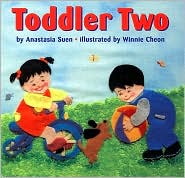
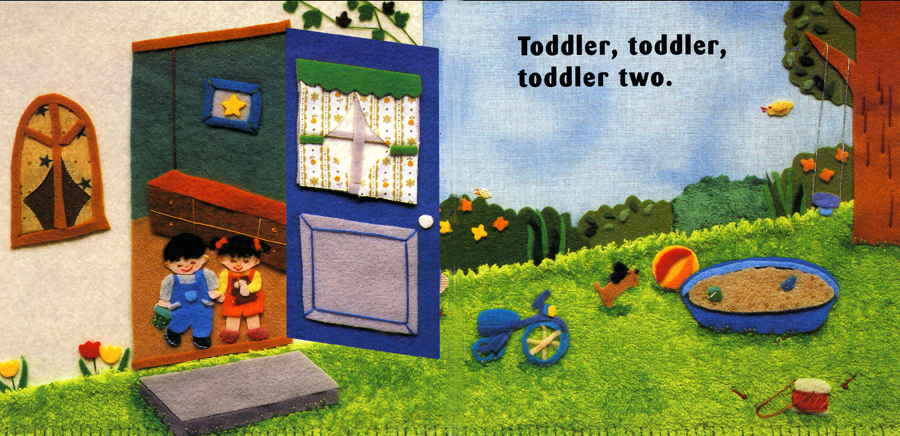
Since I was loosely basing my storytime on the number two, I used an older title that we had in our storytime collection.  I'd never used this board book before (we have multiple copies so that each child and caregiver can follow along in their own copy), but I certainly will again!  Toddler Two is by the very kind and friendly, Anastasia Suen - author, teacher, consultant, and organizer of our weekly Nonfiction Monday roundups.

The simple words, beautifully detailed felt art, and collection of commonplace items (tricycle, dog, ball, sandbox) make this a picture-perfect picture book for sharing with toddlers.


Q: Can it be that Cynthia Rylant doesn't have a website? 

Monday, September 12, 2011

Big Wig: A Little History of Hair

Krull, Kathleen. 2011. Big Wig: A little history of hair. Ill. by Peter Malone. New York: Arthur A. Levine.

From prehistoric times in Africa to England, 2007, Kathleen Krull presents a paragraph on many hair-related milestones in the history of the world,

2,400 Years Ago, Greece
Rubbing goat pee on his head.  That's how the wise philosopher Aristotle thinks he will cure his baldness.  But Hippocrates, known as the Father of Medicine, prefers his own brews, which include opium, wine, green olive oil, horseradish, and pigeon poop.


Each event is featured on a single or double spread page, accompanied by the amusingly detailed watercolors of Peter Malone. (Dorothy Hamill skating in front of an audience of Dorothy Hamill look-alikes; Cleopatra weaving horse teeth and roasted mice into Caesar's receding locks; a blue-faced, punk Celt, sporting a kilt and white spiked hair, they're all here in Big Wig)

The reader learns a bit of history while enjoying the ridiculousness that is mankind's never-ending obsession with hair.

Back matter includes a source list, and "Hair Extensions," which expands on each of the periods introduced in the book.  (Who knew that our current term for the extra bathroom, "powder room," came from 1624, France? Not me.)
As wig styles developed after Louis XIII, white became the favorite color.  The wealthy had their servants powder their wigs by blowing wheat flour with a bellows from the fireplace.  With flour going every which way, the French invented a new room - a powder room ... so they would have a place to powder without worrying about the mess.
The only milestone that I found missing in Big Wig was the wildly popular and risque "bobbed" haircut of the 1920s flapper girls.
Regardless of whether she chooses to present facts with humor or seriousness, Kathleen Krull always delivers education with entertainment.

Big Wig: A (highly styled) Little History of Hair. Comb your shelves for it today!

(sorry, couldn't resist the hair buns puns!)

Another review @ The Fourth Musketeer
Read BWI's recent interview with Kathleen Krull.

Today's Nonfiction Monday roundup is at Wrapped in Foil.

Thursday, September 8, 2011

Wonderstruck: a review

Selznick, Brian. 2011. Wonderstruck.  New York: Scholastic.
 (Advance Reader Copy)

During the course of reading Wonderstruck, I misplaced the book.  When I asked my family if anyone had seen it, my daughter answered, "Which book?  The one with two different covers?"  I hadn't thought of it that way, but yes, the book with two different covers.
*minor spoiler alert*
(though I'm not giving any more away than Brian Selznick does in his Wonderstruck video - see below)

Wonderstruck's cover is a preview of its contents - two stories, two eras, two modes of storytelling. One would think that after his ground-breaking, Caldecott Winner, The Invention of Hugo Cabret, Brian Selznick could not have any more surprises up his sleeve, but  in Wonderstruck, he again inspires us with this singular story of two mysterious and wonder-filled journeys.

Ben's story begins in Gunflint Lake, Minnesota, in June, 1977; Rose's, in Hoboken, New Jersey, 1927.  Though 50 years divide their stories, the children embark on parallel journeys fraught with uncertainty and risk, and guided by purpose - a need to know.  Ben's story is told in third person prose, while Rose's is told in Selznick's incredibly detailed, unmistakable pencil drawings.  The two stories are woven together, sometimes almost touching, other times gathering distance until at last, in a single drawing, with a simple turn of the page, Selznick seamlessly binds the two stories together, where they stay, until Wonderstruck's conclusion.

It is clear that Selznick's fascination with silent film and early cinema did not end with Hugo Cabret.  Silent film is featured in Wonderstruck, not in the same capacity as in Hugo, but rather as a vehicle for introducing deaf culture. It is museums, not film or mechanics, that take center stage in Wonderstruck.  Both Rose and Ben are seeking something, and both find themselves, a half century apart, at the same location, the American Museum of Natural History, where they are fascinated by museum dioramas and early museum collections, or "cabinets of wonder."

Readers will be fascinated as well, by Wonderstruck's story, artwork, and the offered glimpse into another time and another culture.
A page from Brian Selznick's, Wonderstruck. © 2011
Rose can be seen ducking behind a "cabinet of wonders."

This drawing (not from Selznick's book) of an early "wonder room"
 or "curiosity cabinet," comes from the Smithsonian Institution's collection.
 It appeared in a 1599 book entitled, Dell'historia Naturale by Ferrante Imperato.
I've tried to be purposefully vague, because I enjoyed reading Wonderstruck with no preconceived notion or direction, trustingly following wherever it led. If you'd like more details, read another more revealing review @ Jen Robinson's Book Page.  And by all means, watch Brian Selznick's video.


I hope you enjoy Wonderstruck as much as I did.  It's due on shelves next week.  And remember, Hugo, the movie inspired by The Invention of Hugo Cabret, and directed by Martin Scorsese, is due in theaters in November. (Trailer here) Much to look forward to.

I'm also blogging at ALSC today.  If you've the time, hop over.

Monday, September 5, 2011

America is Under Attack: A review

Brown, Don. 2011. America is under Attack: September 11, 2001: The day the towers fell. New York: Roaring Brook Press.

It's difficult to believe that the tenth anniversary of the 9/11 attacks is almost upon us, and there are now legions of schoolchildren across our country that have no recollection of that day.  With his customary exactitude, employing direct quotes when appropriate, and featuring a bibliography, source notes, and author's notes, Don Brown has made this horrific day in American history accessible to children of elementary school age.

The writing is simple and factual, without embellishment and is accompanied by Brown's pen and watercolor illustrations which are sufficiently vague to mask the absolute horror of the day (faces are often obscured and the terrorists are not depicted), yet with enough detail and gravity to convey the mood of determination despite desperation.

Several stories of individual exploits or heroism are woven into the narrative.  Most striking is the story of survivor Chris Young.  Early in the book, we read that

in the North Tower, another elevator sat stalled and locked closed at the lobby.  It had come to a halt when the plane struck.  Chris Young, its lone occupant, knew nothing of the catastrophe around him.  Firefighters going up couldn't hear his shouts and marched past him, unaware of his predicament.
Near the story's conclusion, the reader is confronted with an eerie, two-page spread in shades of yellowed grays.  A man in a suit is dwarfed by an enormous space littered with debris,


In the North Tower lobby, the doors of a stalled elevator opened. The collapse of the South Tower had cut the power to the elevator's door locks.  From the car emerged Chris Young, the trapped passenger who'd been overlooked by rescue workers.  Earlier he had boarded the elevator from a polished, modern lobby.  Now he shuffled through clouds of dust, over rubble and debris. 

Alone.

The use of the word "overlooked," is somewhat unfortunate in this case, as it implies negligence, however, the story of Chris Young completely captures the surreal nature of September 11, 2011.

America is Under Attack is Volume Four in the Actual Times series, which feature the events of a particular day and cover art mimicking a newspaper masthead.

Like Brown's earlier book on the Titanic, All Station Distress! or Let it Begin Here!, which retells the start of the American Revolution, Don Brown has once again made history readable and accessible to children in the elementary school grades.

For teen readers seeking information on the September 11, attacks, I highly recommend The 9/11 Report: A Graphic Adaptation by Sid Jacobson and Ernie Colon (Hill and Wang, 2006), with a foreword by 9/11 Commission Chair, Thomas H. Keane.
For young listeners, Carmen Agra Deedy's, 14 Cows for America (Peachtree 2009), is the best book I have seen on the topic.

Today's Nonfiction Monday roundup is at Playing by the Book. Be sure to stop by.

Beneath the Waves - a review

As we read disturbing news accounts of dying manatees , environmental disasters caused by toxic waste, and ocean pollution on the scale of ...