Pages

Monday, October 4, 2010

All Aboard! Elijah McCoy’s Steam Engine

Kulling, Monica. 2010. All Aboard! Elijah McCoy’s Steam Engine. Ill. by Bill Slavin. Ontario, CA: Tundra.

One of the things that I love about reviewing children’s nonfiction is the number of new things that I learn every day.  Today I learned a little-known, but interesting and inspirational life story, as well as an interesting tidbit of etymology, the origin of the phrase “the real McCoy.”
Get on Board!

we hear our conductor
singing low
the song she uses
to let us know
now is the time
to get on board...

the midnight train
runs underground
we hide and pray
not to be found
we risk our lives
to stay on board...
So begins All Aboard! But All Aboard! is not the story of the Underground Railroad, rather it is the culmination of the Underground Railroad's greater purpose - a self-determined, productive life, lived out in  freedom.  Elijah McCoy was the son of slaves who escaped to Canada on the Underground Railroad. His determined and hardworking parents saved enough money to send Elijah to school overseas, where he studied to become a mechanical engineer. 

He returned in 1866 to join his family in Michigan.  Though he may have been free, his opportunities were not equal.  Despite his education, he was only able to secure work as an "ashcat," feeding coal into the firebox of a steam engine for the Michigan Central Railroad,
What a letdown! Elijah knew engines inside and out.  He knew how to design them.  He knew how to build them.  He also knew the boss didn't think much of him because he was Black.  But Elijah needed work, so he took the job. 
Still, Elijah persevered in his job while his mind, trained in engineering, sought to find a solution to the miserable job of "grease monkey," the boys (including Elijah) who oiled all of a train's gears when they frequently seized up due to friction and lack of lubrication.  Trains of the time were typically stopped every half hour or so for greasing.  After several years, Elijah invented (and patented) an oil cup, which was used successfully  to keep the trains running.  Travel by train became faster, safer, and more efficient.  He continued to invent throughout his life, eventually filing 57 patents!  Others tried to copy Elijah McCoy's oil cup, but none were able to match his success. 
When engineers wanted to make sure they got the best oil cup, they asked for the real McCoy.
All Aboard! Elijah McCoy's Steam Engine is an obscure but inspiring story, made particularly poignant by the juxtaposition of his parents' Underground Railroad experience, and his own experience working for the Michigan Central Railroad.  The dialogue is invented and there are no references cited, however, the engaging story is simply told in a manner that makes complex topics like the inventive process and racism accessible to young readers.  All Aboard! is short enough that it can easily be read aloud to a classroom or storytime for older children.

 The book's pen and watercolor illustrations are colorful, and full of life and expression; the reverse side of the dust jacket doubles as poster. The cover design, however, does not showcase the Slavin’s work in the most favorable manner and gives the book a rather dated appearance. The design was likely chosen to match the series format.  Don't judge this book by its cover. All Aboard! Elijah McCoy’s Steam Engine is the second book in the Great Idea series.

All Aboard has been nominated for the Cybils, Children's and Young Adult Bloggers' Literary Awards,  in the nonfiction, picture book category.  You can nominate books in many categories until Oct. 15th.  (Be sure to read the eligibility rules first!)

Review copy received from publisher. 
It's Nonfiction Monday and today's host is Madigan Reads.
Check out all of today's posts.
(I'll be hosting again on Nov 8)
Share |
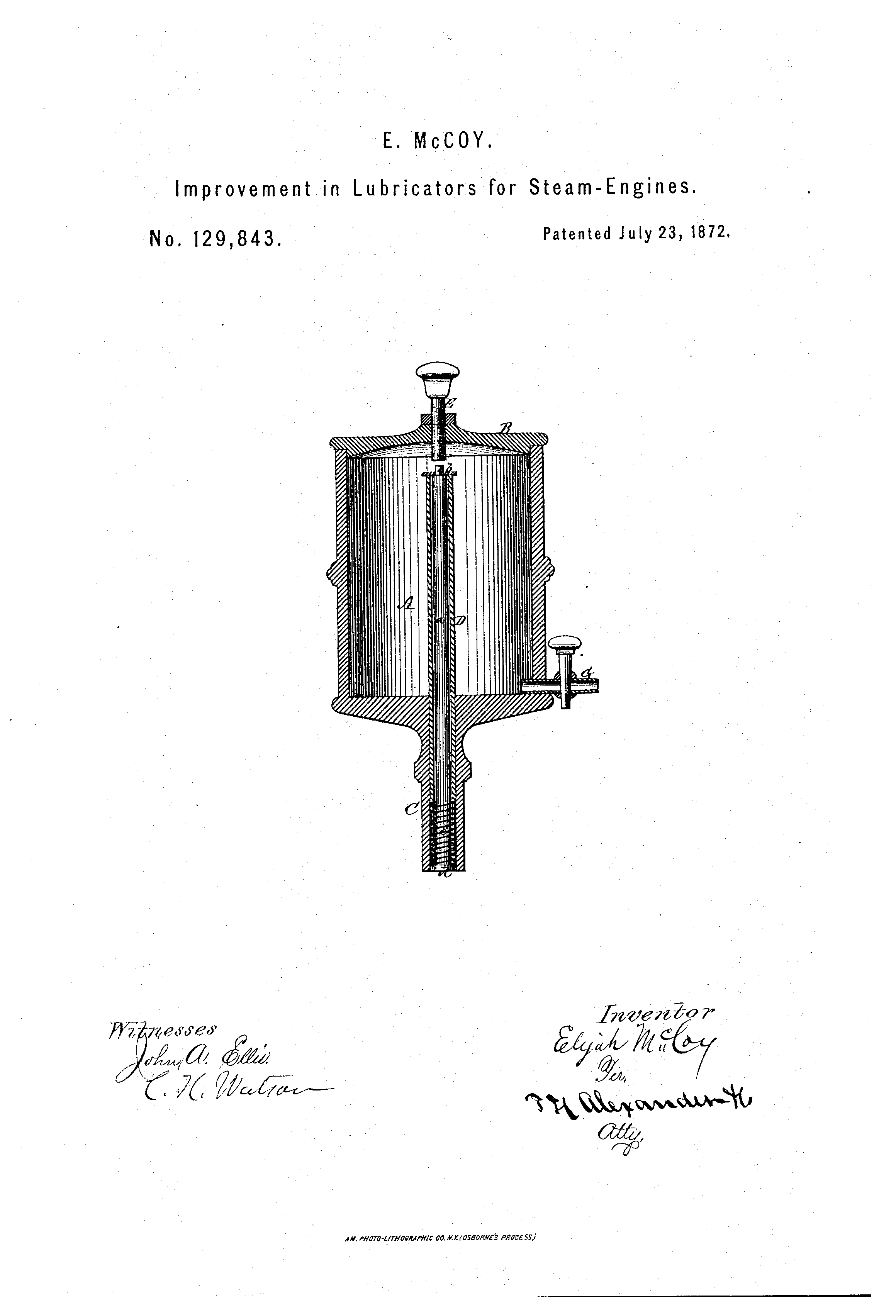


First page of US patent 129,843 for Improvement in Lubricators for Steam-Engines
(from Wikimedia Commons)
 

Thursday, September 30, 2010

Countdown

Wiles, Deborah. 2010. Countdown. New York: Scholastic.

Countdown.   The story is one of a girl named Franny - a nondescript, middle child with a beautiful older sister and a "perfect" younger brother.  Her father is in the 89th Air Force Division; her mother is a dutiful military wife.  Her neighbors are nosy, her "crazy" uncle is suffering flashbacks from the war. She is having a major fight with her best friend; she has a crush on her neighbor.

And as if that were not enough, it's October, 1962.  The Soviet Union has placed missiles in Cuba and the world as she knows it may end at any minute. Duck and cover!

 Interspersed between the pages of Franny's story are photos, advertisements, song lyrics, headlines and other depictions of realia from the "Camelot" years.

According to the author, Countdown is based on her own life, which accounts for the honesty and authenticity of it's protagonist.  The collected depictions add to the story and in some instances (the bomb shelter instruction pull-out that appeared in Life magazine, the "duck and cover" photos of young children at their desks) add a palpable sense of the fear felt by Americans during those tense October weeks. Young readers will relate to Franny and gain a greater understanding of the period, however many of the song lyrics and photos will be unfamiliar to them, and are presented scrapbook style, without caption, in the body of the novel. This format adds dramatic impact at the expense of context.  Will children recognize the smiling Nikita Khrushchev or the silhouetted figures of JFK and his brother deep in thought? Probably not, but it's a minor complaint.

There's a lot of Newbery Award buzz about this ground-breaking "documentary novel."  It is the first in a planned trilogy about the 1960s.  Well-worth reading!

The author and Scholastic offer great resources.  Links are below. Be sure to check out the trailer!

An excerpt from Countdown.
Scholastic's Countdown booktalk.
Scholastic's Countdown Discussion Guide.


100 Scope Notes offers a "toon" review of Countdown.

Share |

Monday, September 27, 2010

An interview with Janice Weaver

Today I have a real treat! An interview with Janice Weaver, author of Hudson, the new middle grade biography of Henry Hudson.  Ms. Weaver graciously agreed to a VoiceThread interview, which means that you can participate and ask questions as well! The interview "thread" will remain open for a week or so, and Janice will answer any added questions, so please, dive right in! (Click "Play" to start and enable sound)  To see it in "full-screen," click this link. http://voicethread.com/share/1290692/
  I reviewed Hudson last month.

Other books by Ms. Weaver include:


Today's host for Nonfiction Monday is Wendy's Wanderings. Be sure to click on over.
Share |

Thursday, September 23, 2010

Elsie's Bird

Yolen, Jane. 2010. Elsie's Bird. Ill by David Small.  New York: Philomel.

An uplifting story of a young girl and her newly widowed father who leave Boston with the girl's beloved canary to make a new life on the Nebraska frontier. At first lonely and depressed, Elise learns to appreciate the beauty, vastness and music of the prairie. A wide book with double-spread watercolor and ink paintings is the perfect format for evoking the beauty and solitude of the prairie in contrast with the hustle and bustle of Boston. A hopeful story in which the small, loving, well-tended family blooms in the rich Nebraska soil.


More Elsie's Bird reviews @

Share |

Friday, September 17, 2010

September Picture Book Roundup

Here we go with another picture book roundup - 
a selection from the three bags just received at my branch.

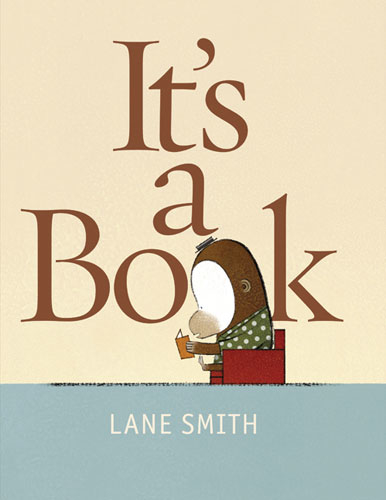
Smith, Lane. 2010. It's a Book. New York: Roaring Brook.
Can it text? Blog? Scroll? Wi-Fi? Tweet?  No. It's a book.
Not quite appropriate for school visits (!) , but it may be the funniest picture book you'll read this year!  I can't stop laughing!


Wright, Michael. 2010. Jake Goes Peanuts. New York: Feiwel.


This one was on hold and left the branch on the same day it arrived.  I can see why some young peanut butter-loving child is anxious to read this one! Hilariously droll illustrations and a delightfully funny story about a boy who wants to eat nothing but peanut butter.  Luckily (?) for him, his parents decide to oblige, making everything out of peanut butter,
They dipped peanut butter crackers in their peanut butter soup.  Jake was eating so much peanut stuff, he made peanut butter poop.
A rhyming romp of peanuty fun!  Allergies?  No worries.  There's a "Peanut-Free Zone" at the school!

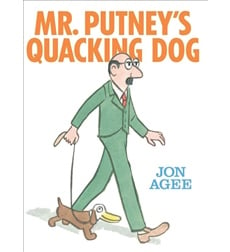
Agee, Jon. 2010. Mr. Putney's Quacking Dog. New York: Scholastic.


It's hard not to like Jon Agee.  His illustrations are classic, and he's got a great sense of humor.  Mr. Putney's Quacking Dog, however, may be just a little too difficult for most kids to "get."  The reader is introduced to Mr. Putney's animal friends, and has to guess the animal's name based on the illustrations and a short question,
Which friend of Mr. Putney's has cold feet?
A SOCKTOPUS
The illustration does show Mr. Putney preparing to dive into the water carrying a large flower-sized box, and the chilly octopus is partially visible in the water, but I have to admit, I didn't guess "socktopus," before I turned the page (and that's one of the easier jokes).  As a matter of fact, in a quick run-through of the book, I only "got" 6 of the 20 jokes.  If you're planning to read this one at storytime, be prepared to give plenty of hints! Cute.

Frazee, Marla. 2010. The Boss Baby. New York: Beach Lane.

This baby is no little bundle of joy!  He’s the boss, and Mom and Dad know it! He runs the home like a tyrant - no time off, plenty of meetings, and round-the-clock demands.  He wants his perks too - time at the spa and the gym, drinks made to order.  When Mom and Dad are finally too worn out to comply with boss’s orders, something very surprising occurs!  The illustrations of the business-suited little tyrant (complete with diaper hatch!) add hilarity to an already funny book. Delightful!

and finally, a more thoughtful book ...

Raschka, Chris. 2010. Little Black Crow. New York: Atheneum.

A little boy sits on a fence and wonders about a passing crow,
Little black crow where do you go? Where do you go in the cold white snow?  Where do you go?
Through the boy’s series of poetically repetitive questions, we learn about the little black crow, but ultimately, more about the boy who questions it,
Do you ever worry when you hop and you hurry?  Are you ever afraid of mistakes you’ve made?  Are you never afraid?
Raschka’s watercolor illustrations evoke the simplicity and wonder of childhood.  Enchanting.


Share |

Beneath the Waves - a review

As we read disturbing news accounts of dying manatees , environmental disasters caused by toxic waste, and ocean pollution on the scale of ...