Pages

Monday, May 14, 2012

Buried Alive! How 33 Miners Survived 69 Days Deep Under the Chilean Desert - a review

Scott, Elaine. 2012. Buried Alive! How 33 Miners Survived 69 Days Deep Under the Chilean Desert. New York: Clarion.

Though it may seem as if it were only yesterday, it's been nearly two years since the San José mine collapse in Chile's Atacama Desert. The first collapse occurred on August 5, 2010. For two days, an escape route remained open, however, the escape ladder was only 690 feet long. The distance to the surface was 2,300 feet. A subsequent and more devastating collapse occurred two days later on August 7, effectively sealing thirty-three miners underground. It was 9:55pm, October 13, 2010, when the last miner, foreman Luis Urzúa, finally emerged.

Buried Alive! offers a chronological story that is contextual and multi-faceted. Using a theme of cooperation (chapters are titled "Surviving Together," "Working Together," "Planning Together," "Living Together," and "Rejoicing Together"), Elaine Scott begins with an introduction of the various factors that draw men into the mine, including poverty, tradition, and national pride. Other chapters recount the extraordinary way that the miners, under the direction of Urzúa, known affectionately as Don Lucho, organized themselves fairly and purposefully to survive the ordeal, never knowing until they surfaced if they would survive.

Not covered much in televised accounts, was the real meaningful work that the men did to help themselves. They dug sanitary trenches, aided the drillers with useful information, and dug drainage and holding pools for the 18,421 gallons of water that were necessary to cool and lubricate the drill bits as they ground down to the mens' refuge, a 14-day project.

Scott also follows the cooperative scene at Camp Hope, the makeshift town including a school and medical facility, that sprung up to house the thousands of people living in tents above the mine - family members, would-be rescuers, Chilean military members, and more - all awaiting news of "los 33." And journalists were there to provide it,

an estimated 1,700 of them, representing thirty-three countries on five continents. The world had its eye, its ear, and most important, its heart on Camp Hope and the thirty-three men who were buried alive.

The cooperative (and, in the case of the drillers, competitive) spirit of the rescuers is chronicled as well. Rescue plans and offers of assistance arrived from around the globe.  The logistics of drilling so far down into the ground without mishap is explained in fascinating detail.

Most people will be familiar with the jubilant scenes of rescue, but it does not feel as "old news," rather, Scott's writing rekindles the emotions of the day.

An afterword tells the somewhat saddening stories of what has happened in the miners' lives since the rescue, but the overarching message of Buried Alive! is one of togetherness - for 69 days, the trapped miners, their families and the rest of the world were together in hopefulness.

 Buried Alive! How 33 Miners Survived 69 Days Deep Under the Chilean Desert is dedicated "To the thirty-three miners and those who worked, waited, and worried until they were finally free." I count myself among the millions of people who worried about the fate of these amazing men. This is a story that will live on for many, many years to come. Elaine Scott has done a superb job in telling it.

Extensively researched, sourced and indexed with detailed author's notes. Contains numerous photographs.


Reuters news article, slide show and video of the rescue.

Today's Nonfiction Monday roundup is hosted by Ms. Yingling Reads.

Wednesday, May 9, 2012

This and that - 3 reviews

A little of this and a little of that, as I'm ahead in reading and behind in writing!

(short stories, novel, audiobook)

Kibuishi, Kazu. 2012.  Explorer: The Mystery Boxes. New York: Amulet.

This book is an unexpected little gem, something of a mystery itself. From the cover, I was expecting a graphic novel mystery, a la The Box Car Children infused with a bit of magic.  What I found instead, was a themed, graphic, short story collection.  Mystery Boxes contains seven stories by noted graphic artists including Raina Telgemeier (Smile).  What ties these disparate illustrators and authors together is that each story features a mysterious box, contents unknown.  The stories range from amusing ("Spring Cleaning by Dave Roman and Telgemeier) to profound (Jason Caffoe's, "The Keeper's Treasure") to social commentary on war (Stuart Livingston and Stephanie Ramirez', "The Soldier's Daughter").

Judging from the way  my Advance Reader Copy was scooped up by a child in my book club, I'd guess this will be popular if it can find the right audience.  I'm also assuming that we can look forward to more collections in the Explorer series. I, for one, would like to see more interest in short stories.  They don't seem to be required reading for middle schoolers - a pity.  (Another good short story series, though not in graphic novel format, is Jon Scieszka's Guys Read Library)

Doyle, Roddy. 2012. A Greyhound of a Girl. New York: Amulet.

Advance Reader Copy

I chose to read this one because it features a multi-generational Irish family.  It's hard not to like Ireland - a beautiful country full of "lovely" people.  In fact, you will hear people in Ireland describe nearly anything as "lovely" --friendly people they are in general, but I digress.

This is the first Roddy Doyle book that I've read and I wasn't sure what to expect. I thoroughly enjoyed it once I stopped looking for some artificial contrivance or tricky plot twist and settled in to enjoy a simple yet touching story of 12-year-old Mary O'Hara, and three of her female relatives, one of whom happens to be dead.  A Greyhound of a Girl covers a short span of time in a short book (208 small pages)  about life and death and family. Being of Ireland, of course it is not without humor.

Riordan, Rick. 2011. The Son of Neptune, The Heroes of Olympus Series, Book 2. Read by Joshua Swanson. Listening Library.
12 hours, 27 minutes.

As much as I enjoyed The Lost Hero, I'd be lying if I didn't say that it's good to have Percy back in the story.  Lost no more, but without his memories, Percy finds himself in the midst of the Roman demigod stronghold, Camp Jupiter.  In this installment, the listener learns little of Camp Half-Blood's activities, but is thrust into the militaristic world of the Roman demigods.  Before the story ends on a culture-colliding cliffhanger, a clear picture of the identities of "the seven" is unfolding,

Seven half-bloods shall answer the call,
To storm or fire the world must fall.
An oath to keep with a final breath,
And foes bear arms to the Doors of Death.
 
 The narration by Joshua Swanson is beginning to grow on me (but perhaps that's because Leo doesn't appear much in The Son of Neptune).  My favorite new character in the series?  Hands down, it's Bella the Harpy, voiced perfectly by Mr. Swanson.

Sadly, we've got to wait until the fall for The Mark of Athena (book 3).

Enjoy an audio excerpt.

Monday, May 7, 2012

Minette's Feast - an interview with Chad Beckerman

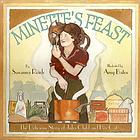
Today I have the pleasure of welcoming Chad Beckerman. He is here in his capacity as Creative Director for Abrams Books for Young Readers, to talk about the newly released Minette's Feast: The Delicious Story of Julia Child and Her Cat, written by Susanna Reich, and illustrated by Amy Bates.


Lisa: Although I did ask to interview the editor of Minette’s Feast, I did not anticipate interviewing the Creative Director for Abrams books.  When I looked you up online, I admit to being more than slightly intimidated by your very impressive resume.  I’m interviewing the art director behind the wildly successful Diary of a Wimpy Kid and Origami Yoda series? Peter Nimble and His Fantastic Eyes? The artistic muse behind Escape! and my new favorite, Huff & Puff?   Be still, my nervous heart.  Please forgive me in advance for my lack of knowledge in your area of expertise and allow me to quote one of my favorite lines from Mary Rose Woods', The Mysterious Howling, "all books are judged by their covers until they are read."

So, on we go …

Chad: Wow, you really have done your Designer research!  I am the evil design mastermind behind all of those books!

Lisa: Minette’s Feast– a superbly written narrative by Susanna Reich paired with the pencil and watercolor paintings of Amy Bates that exude the aura (and aroma!) of a 1950s French kitchen.   Was it you who brought these two talents together?  How do you choose an illustrator for a manuscript?  Was there ever a case where you’ve found artwork that sent you in search of a writer?

Chad: Tamar Brazis, editorial director, and I had worked with Amy Bates on two other picture books, The Dog who Belonged to No One and A Bear in the Air. We had been on the search for a picture book for Amy. When Susanna's Minette's Feast came across Tamar's desk, we knew without question this was a book for Amy. In most cases we have a manuscript and will search for just the right illustrator. Thankfully we had Amy stowed away for a rainy day.


Lisa: I understand that you have designed all of Amy Bates’ books for Abrams. You must be quite familiar with her and her work.  Does that make your job easier?

Chad: Being familiar with an illustrator's work definitely makes an art director's job easier. You know what their strengths and weaknesses are. You know where and when to push them to get better work from them. In the case of working with Amy, our first book we worked on together was The Dog who Belonged to No One. I had seen Amy's work on a few other pictures from our houses so I had an idea of what she could do. I wanted to make the books that she did with ABRAMS different than her other work. To solve that idea, we pushed Amy into creating designs and patterns that fit the content of the story; in turn giving the viewer more to look at than just full bleed or spot illustrations.  These border designs helped bring you into the time period of the story.

Lisa: Your job is to create an overall  “vision” for the book, to give it a particular “feel,” how do you affect that vision?  Within the pages of the book itself, is it primarily a matter of space and placement, typeface and font,  or is there more that you can do to achieve a particular effect? 

Chad: The first way a designer helps create his or her vision on the book is through his font choice. I feel this helps set the mood or time period for the story. Designers need to ask themselves, is this book wacky and deserves a more fun take on the typography, or does the typography need to be played down to let the art be the main star? Is this an historical book where a typeface from that time period or region might be the best choice?  This is the question I asked myself for Minette's Feast. I searched mainly for fonts that said "Paris" to me. This choice helped set the stage of where the story takes place, perhaps hinting at the atmosphere of the text.


The second way a designer or an editor helps create a vision for a particular book is working with the illustrator to shape the look of the book. For example we spent a lot of time working with Amy getting a few spreads to work exactly right.


As you can see we had to reshape the sketches so they worked better with the text and told the story better.

Lisa: How involved are you in the early sketches or color studies?  I saw the many transformations that occurred in the making of Peter Nimble and His Fantastic Eyes.  How do artists feel about going “back to the drawing board" for so many iterations? Are most cooperative?

Chad: I am very involved in the early stages. In a cover like Peter Nimble and His Fantastic Eyes, I had a idea of what I wanted the cover to be before hiring Gilbert Ford; but I also knew it might not be the right idea so I wanted to see what ideas Gilbert had.  This was definitely a long process - one that Gilbert stuck by me with.  No one likes to have to go "back to the drawing board." It helps to be very transparent about what is going on. Artists are not in the office with you; they don't hear the reasons why a cover or illustration is not working for someone. Not being part of that process can be hard since an illustrator can feel on the outside of the process. It's my job to make sure they don't feel that way.

Minette sketches
Julia sketches


Lisa: Why choose different artwork for the book’s cover and its dust jacket?  I love them both, but I am curious. Don’t picture books usually have the same cover art and dust jacket?

Chad: I find that you are correct that picture books tend to have the same case as the front jacket image. I find this a bit lazy from the designer's point of view. I say this because I am guilty of just placing the cover on the case as well. More and more, I find that designing the case with new art offers up a little something extra to help the book feel more special.

Lisa: Were the endpapers your idea?  I love the tablecloth motif.

Chad: Amy had made the end paper art for the copyright spread, I believe. The art that is now on the copyright spread was originally intended as the cover illustration. During the process of working out the pagination of the text/illustrations, we moved the tablecloth pattern to the end papers. It was just too good not to use.


Lisa: What do you feel is your greatest contribution to Minette’s Feast?

Chad: My greatest contribution is working alongside Tamar Brazis. Our teamwork is an accomplishment. We sit down, go over the sketches, and shoot ideas off each other, helping the book to grow into what it wants to be. This relationship adds to the quality of our books and Minette's Feast. But, if you are asking what is my favorite part of the book, I am quite fond of the case and endpapers, but you have already pointed those out.


Lisa: Finally, I’m curious – are those “brass knuckles” on your coffee cup?


Chad: Those are indeed brass knuckles attached to, yes, my coffee cup. Oddly, there has never been any coffee in that cup.

Lisa: Thanks so much! I've truly learned a great deal - about Julia Child, of course, and about picture books in general.  Until this interview, I never gave much thought to the art director's contribution, being more of a wordsmith than an artist, myself.  Writer, artist, editor and art director - together you've created a delicious offering in Minette's Feast,

Ooh-la-la! Magnifique!

The blog tour wraps up tomorrow at Readerkidz.

Today's Nonfiction Monday roundup is at The Swimmer Writer.

Wednesday, May 2, 2012

The Book of Wonders - a review

Richards, Jasmine. 2012. The Book of Wonders. New York: Harper Collins.
The combination of exotic cover art and the promise of Sinbad the Sailor and other characters from One Thousand and One Nights drew me to this one like a moth to a flame. A magical adventure story from the East, The Book of Wonders is loosely based on the original tales of the Arabian Nights and features a teenaged version of the character Scheherazade.  Together, "Zardi" and her best friend, Ridhan, a boy mysteriously endowed with violet eyes and silver hair, must save Zardi’s sister, escape from Desolation Island, and free their people from the evil sultan's rule. Filled with action, magic and suspense, there’s sure to be a sequel.  This one should be popular with middle-schoolers.


Monday, April 30, 2012

Monday Morning Miscellany v.3

It's Nonfiction Monday again (where do the weeks go?) and because I'm busily working on several projects, it will be a Monday Morning Miscellany edition.

    First up, the Nonfiction Monday roundup is at Gathering Books today.  If you're a fan of nonfiction or want to be, stop by and check out the great posts. 

Next on my agenda, the Minette's Feast blog tour begins today at Anastasia Suen's Booktalking.  Minette's Feast: The Delicious Story of Julia Child and Her Cat, due next month on a shelf near you, tells the story of Julia Child vis-à-vis her cat, Minette. (I'm sure that throwing French around is de rigueur in a discussion of Julia Child)   The blog tour will feature reviews, interviews and guest posts.  I am most excited that the blog tour will stop here next Monday, when I will get to interview Chad Beckerman, art director for Abrams Books, publisher of Minette's Feast, and all-around creative genius or "evil design mastermind," depending on whom one asks! ;)

The Hobbit - I'm thrilled that a (hopefully) good version of The Hobbit is finally in production. The Hobbit and the LOTR trilogy have been on my list of favorites since I was a teenager. The movie trailer looks great -


but as a purist who still bemoans the fact that Tom Bombadil was left out of the movie version of LOTR, here's what I'm wondering: Why does the IMDB cast list include Cate Blanchett as Galadriel and Evangeline Lilly as Tauriel?  First of all, there are no women characters in The Hobbit - zilch, nada.  And Tauriel?  Who the heck is that?  Just venting.

And finally, if you haven't heard the "dirt" on The Dirty Cowboy, or specifically on Adam Rex's illustrations for The Dirty Cowboy, check out the brouhaha here, and here and here.
"The Dirty Cowboy by Amy Timberlake A filthy cowboy, a bath, and a wrestling match with a dog. This one has it all."
From the book's description on Adam Rex's site.

Oh, c'mon, school board, where's your sense of humor?


That's it for today.  Have a great week!

Beneath the Waves - a review

As we read disturbing news accounts of dying manatees , environmental disasters caused by toxic waste, and ocean pollution on the scale of ...