Pages

Monday, July 7, 2014

Above the Dreamless Dead - a review


Duffy, Chris, ed. 2014. Above the Dreamless Dead: World War I in Poetry and Comics. New York: First Second.
(Advance Reader Copy)

Above the Dreamless Dead is an illustrated anthology of poetry by English soldier-poets, who served in WWI.  They are known collectively as the "Trench Poets."

Poems by famous writers such as Wilfred Owen and Rudyard Kipling are illustrated by equally talented comic artists, including Hannah Berry and George Pratt. The comic-style renderings (most spanning many pages), offer complementary interpretations of these century-old poems. The benefit of hindsight and perspective give the artists a broader angle in which to work.  The result is a very personal, haunting, and moving look at The Great War.

This is the "case" for Above the Dreamless Dead.
This, and many other interior photos at 00:01 First Second.

Look for Above the Dreamless Dead in September, 2014. Thanks to First Second, who provided this review copy at my request.
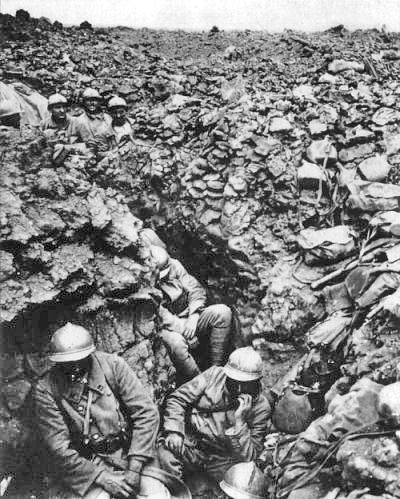
French soldiers of the 87th Regiment, 6th Division,
at Côte 304, (Hill 304), northwest of Verdun, 1916.
Public Domain image.
Note: Although this is not an anthology for children, it should be of interest to teens and teachers.  It could be particularly useful in meeting Common Core State Standards by combining art, poetry, history, and nonfiction.
Today is Nonfiction Monday.
See all of today's nonfiction posts at the Nonfiction Monday blog.

Wednesday, July 2, 2014

Captain Underpants- the Eleventh Epic Novel!

Pilkey, Dav. 2014. Captain Underpants and the Tyrannical Retaliation of the Turbo Toilet 2000. New York: Scholastic.
(Advance Reader Copy)

Captain Underpants fans can rejoice.  The "Eleventh Epic Novel" is coming this summer with everything kids expect - time travel, fiendish villains, a plot with more twists than a bag of pretzels, and of course - Flip-O-Rama, "the world-famous cheesy animation."

In Captain Underpants and the Tyrannical Retaliation of the Turbo Toilet 2000, readers will be brought up to speed on past adventures, as George and Harold re-live (and change) a previous adventure involving the Turbo Toilet 2000.  Super Diaper Baby will make a cameo appearance in a comic by George and Harold, and readers will be introduced to Yesterday George and Yesterday Harold.  There's even a 3-panel Flip-O-Rama.

It's ridiculous, preposterous, and downright silly - kids will love it.


On shelves August 26, 2014.

What's next? Captain Underpants and the Sensational Saga of Sir Stinks-a-Lot.

Monday, June 30, 2014

What's New? The Zoo! - a review

Krull, Kathleen. 2014. What's New? The Zoo!: A Zippy History of Zoos. New York: Scholastic.  Illustrated by Marcellus Hall.


What's New? The Zoo? is an illustrated overview of zoos that combines history with hard science and social science.  Kathleen Krull outlines the history of zoos, and offers insight into what compels us to keep animals, what we've learned from them, and what has changed in zoos since the founding of the first known zoo,

4,400 Years Ago, The Sumerian City of Ur, in Present-Day Iraq
The king of beasts lunges and roars.  The King of Ur roars right back, feeling like the ruler of all nature.  How delicious to wield his power over dangerous animals!  It's the world's first known zoo, and all we're sure about (from clay tablets in libraries) is that is has lions.
From this beginning, Krull highlights transitional moments in zoos throughout the ages and across the globe.  Just a few examples include:

  • Ancient Egypt and Rome where zoos were created to impress
  • Ancient China where the zoo was a contemplative and sacred place
  • Sweden where the science of zoology was established in 1735
  • The U.S. National Zoo where the concept of zoos protecting threatened species was introduced
  • South Africa's Kruger National Park where the protection of rhinos was so successful that rhinos were delivered to other zoos
  • Germany, 1907, where the "cageless zoo" concept is introduced
(Did you know that Aristotle wrote the first encyclopedia of animals?)

On most pages, humorous, watercolor illustrations nestle around paragraphs of simple font against white space.  Several pages, however (including one depiction of fifteen buffalo waiting for a train at Grand Central Station, 1907), are double-spreads with many amusing details.

The very talented Kathleen Krull never disappoints!  If you like your science accessible and entertaining, this is the book for you.

A SLJ interview with Kathleen Krull on the history of zoos.

Wednesday, June 25, 2014

Loot: How to Steal a Fortune - a review


Watson, Jude. 2014. Loot: How to Steal a Fortune. New York: Scholastic.
(Advance Reader Copy)

After my book club meets tomorrow, my Loot will be long gone. Here's a quick preview before it's snatched up.

It begins with a foreboding prophecy regarding stolen semiprecious moonstones:

You will be caught tonight and made to pay.
Death by water, before the moon is set.
Before the passage of thirteen years, the two birthed together will die together.

Two of the prophecies have already come true. Two thieves are dead.

Now, 12-year-old March, son of a thief, must figure out the mystery with no other assets than a getaway bag, some cryptic clues, and remembered advice from his deceased father,

Never trust a guy who says, "Trust me."
Never give your real name to a cop.
Never let someone steal your getaway car.
If you think nothing can go wrong, you'd better think again.

March, his twin sister, and fellow foster home escapees, Izzy and Darius, will match wits with jewel thieves, fences, cops, and millionaires in a desperate search for answers and the mysterious moonstones. This is a fast-paced, action-packed thriller with plenty of plot twists and intrigue—a globe-trotting trek with its roots in the underbelly of New York City.


Due on a shelf near you June 24, 2014.
For grades 3-7
272 pages

Tuesday, June 24, 2014

A 2% Effort is not Sufficient for a 100% Life

A 2% Effort is not Sufficient for a 100% Life
or
In public schools throughout the country, a student is taught to read in Grades K-3. Beginning in Grade 4, there is a fundamental switch.  A student is no longer learning to read, but instead is reading to learn. 

A school year in my state of New Jersey consists of 180 days. Kindergarten through Grade 3 is 4 years of schooling, or 720 days (assuming 100% attendance). The approximate average life span is 78 years or 28,470 days.  
Roughly stated, those 720 days amount to only 2% of a child's lifetime. Think about that.  Only two percent of a lifetime is allotted to impart the fundamental reading skills which positively or negatively impact the remaining 98% of a life!

A student who cannot read or read well upon entering Grade 4 will be at a distinct disadvantage, possibly for the rest of her life. (see related articles below)


Public libraries around the country stand ready and able to help children attain reading success.  In New Jersey, as in many states, librarians are licensed professionals with a Master of Library (or Information) Science degree.  We are trained to assess the needs of those in our community and provide opportunities for early and lifetime learning.  During the year we typically offer story time programs which promote early literacy skills, as well as book clubs, computer classes, and a host of other educational fare.  In the summer, youth services librarians turn our attention to preventing the "summer slide," the loss of reading skills that occurs during the summer break from school.  We do everything short of standing on our heads to encourage kids to read, and have fun doing it!


Summer reading clubs at the public library are fun, they're free, and they pay lifetime benefits. 


Related articles:


Thanks to school superintendent Peter Morris, for helping me to frame this conversation.


Beneath the Waves - a review

As we read disturbing news accounts of dying manatees , environmental disasters caused by toxic waste, and ocean pollution on the scale of ...