Pages

Monday, January 31, 2011

A Nation's Hope: The Story of Boxing Legend Joe Louis


Peña, Matt de la. 2011. A Nation's Hope: The story of boxing legend Joe Louis. Ill. by Kadir Nelson. New York: Dial.

A Nation's Hope begins at the end -  at the historic rematch between Joe Louis and Max Schmeling, the German boxer, the only man ever to have put Joe Louis on his back.

Matt de la Peña's words have a poetic quality,
The world waits for Joe Louis to take the ring,
take center stage
White men wait standing beside black men,
but standing apart
Jim Crow America.
Kadir Nelson's artwork is a stunning complement. In realistic style, the story begins with a two-page spread of Yankee Stadium in 1938.  The text is in simple black font, mixing in with the darkening sky. The crowd awaits entrance to the stadium in the gathering dusk, a sliver of daylight low on the horizon.  One side of Yankee Stadium is bathed in a the last bright light of day, the other in shadow. Jim Crow America.

As the fighters climb into the ring, Peña flashes back to a young Joe Louis, a powerful boy with large hands and persistent stammer. The reader learns of Louis' determination to box, his rise to the top, his graceful behavior as a competitor, and his stunning defeat at the hands of one Max Schmeling, a favorite of Hitler.  Realistic paintings of period photos and newspaper headlines, dark gyms,  and sinewy arms with poised gloves take center stage.  The text lives within the illustrations, never detracting from them.  The faces of Black America wait and hope and pray for their hero.  And in the end, when all of America dances for Joe Louis' victory over Schmeling, the page is no longer split between light and dark.  The country dances together, in the dark.

This is Matt de la Peña's first picture book.  The pairing of de la Peña and Nelson results in pure emotion.  I wouldn't be surprised to see this book on many short lists at the end of the year.  Highly recommended.

Larry Schwartz, of ESPN, wrote an interesting article, "Brown Bomber was a Hero to All," as part of ESPN's Sports Century Athletes list - good reading.

It's Nonfiction Monday again. Today's roundup is at The Miss Rumphius Effect.

Thursday, January 27, 2011

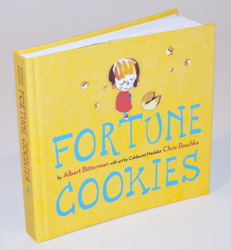
Just in time for Chinese New Year: The Runaway Wok and Fortune Cookies

February 3, 2011 will usher in the Year of the Rabbit.  Chinese New Year is the first day of the first month in the lunar calendar.  The celebration lasts 15 days and includes the Lantern Festival.  If you were born in 1939, 1951, 1963, 1975, 1987, 1999, or 2011, you were born in the Year of the Rabbit.

Here are two timely new books that just crossed my desk: 

Compestine, Ying Chang. 2011. The Runaway Wok. Ill. by Sebastia Serra. New York: Dutton.

Based on the Danish folktale, The Talking Pot, The Runaway Wok is a new Chinese folktale about old Beijing and a magic wok,  a wok determined to right the wrongs committed by the greedy Mr. Li and his family.  It is the eve of the Chinese New Year and the poor Zhang family sends its son, Ming, to trade eggs for rice at the market.  In a move reminiscent of Jack and the Beanstalk, Ming trades his eggs not for rice, but for a wok that sings out to him,
Boy, Boy, trade for me, I am more than what you see!
And so it is!  But this wok has greater plans than residing with the Zhangs.  Ming's mother barely gets the wok cleaned up before it rolls out the door singing,
Skippity-hoppity-ho! To the rich man's wife I go,
And so the wok, like an Asian Robin Hood, travels back and forth, taking from the rich and delivering to the poor,
Skippity-hoppity-ho! To the poor man's house I go,
much to the delight of the Zhangs and all their friends. The Runaway Wok pays tribute to classic tales in a manner that is still wholly original. Kids will love hearing the wok's rhyming songs and exploring the book's detailed, folk art illustrations full of colorful parasols, foods, flowers, lanterns, and brocade garments. 

An author’s note explains the Chinese New Year holiday (with an emphasis on the culinary aspects), and concludes with a recipe for Festive Stir-Fried Rice. Yum!


Bitterman, Albert. 2011. Fortune Cookies. Ill. by Chris Raschka. New York: Simon & Schuster.

Fortune Cookies isn't a Chinese New Year book, but it's a

Monday, January 24, 2011

Sarah Emma Edmonds Was a Great Pretender

Jones, Carrie. 2011. Sarah Emma Edmonds was a Great Pretender. Minneapolis: Lerner.

Author, Carrie Jones, probably best known for her Need series, is not be the first author who comes to  mind when thinking of picture book biographies, however, in Sarah Emma Edmonds, she has clearly found a subject that sparks her interest.
Sarah Emma Edmonds was born in Canada to a cruel father who wished she were a boy.  Unhappy and unable to please him, she eventually fled to the United States and began a new life on her own. She began by selling Bibles, door-to-door, and soon discovered that she sold more and was more readily accepted when dressed as a man. When her adopted country began recruiting soldiers for the Union Army, Sarah joined up, disguised as a man, and giving the name of Frank Thompson.  This would be remarkable enough, but Sarah Emma Edmonds went on to become a successful Union spy. She darkened her skin with silver nitrate and posed as a Southern slave, stealing information on Southern positions and fortifications.  Two months later, she returned to the Confederacy. 
This time she pretended to be Bridget O'Shea, a chubby Irish peddler. She was a woman (Sarah) pretending to be a man (Frank) pretending to be a woman (Bridget).  This would be confusing for most people, but not for Sarah.
Jones does a fine job of distilling the life of this complex woman into a hero story that can be easily understood by younger readers.  The basics of the war are explained, but the war is not the story here.  Sarah Emma Edmonds is the story; children should find her bravery and cunning fascinating.

Although the Author's Note reveals that Sarah Emma Edmonds later revealed her Civil War exploits in a memoir and was belatedly accepted by her fellow soldiers (even the federal government eventually granted her a pension), the book ends with the following, 
She pretended that she was never Frank Thompson, never a spy, never rode a horse named Rebel, and never stole Confederate secrets. Sarah Emma Edmonds was a fantastic pretender.  No one had a clue.
Hopefully, readers will persevere through the fine print author's note and discover the successful resolution of Sarah Emma Edmonds' dual life. Leaving the reader with the impression that her valor and determination went unappreciated is a bit disheartening. Overall, though, this is an inspiring story of a young woman who took a bad beginning and turned it into a grand and honorable adventure.

Sarah Emma Edmonds bookmark available as a PDF download.


Digital Advance Reader copy supplied by Netgalley.

Because I do not own a Color Nook, I will again refrain from commenting the double-spread, painted illustrations by Mark Oldroyd.  In the future, I will be sure not to request picture book review copies in digital format.  My apologies to Mr. Oldroyd.


Photograph of Emma Edmonds in women's clothing
Photo from Library Archives Canada
Emma Edmonds in women's clothing

Source: Frank Thompson : her Civil War story
by Bryna Stevens 1st ed. -- New York : Macmillan Pub. Co. ; Toronto :
 Maxwell Macmillan Canada ; New York : Maxwell Macmillan International,
 c1992. -- 144 p. : ill., map, ports. ; 22 cm. -- ISBN 0027881857. -- P. 124
© Public Domain
nlc-10242

 Today's Nonfiction Monday is at Great Kid Books.

Wednesday, January 19, 2011

Hereville: How Mirka Got Her Sword

Deutsch, Barry. 2010. Hereville: How Mirka Got Her Sword. New York: Amulet.

I wasn't sure what to expect when I placed a hold on Hereville:  How Mirka Got Her Sword (tagline: "Yet Another Troll-Fighting 11-Year-Old Orthodox Jewish Girl") in anticipation of hosting an author or illustrator on the Sydney Taylor Book Awards blog tour. (I don't know yet whom it will be, but I'm excited and trying to be prepared!)

Hereville is the 2011 gold medal winner in the Sydney Taylor Awards "older readers" (think middle school) category, and it is anything but what I thought it might be.  I expected a heavy, perhaps historical fiction, story of the Jewish experience.  What I found instead, was a modern, graphic novel,  fairytale adventure, offering a prolonged peek into a very insular community - that of the Orthodox Jew.  Through Mirka, the book's lively and determined protagonist, the reader sees a young girl who, despite the tenets of her faith that keep her apart from secular and non-Orthodox society, is much like any other young girl - willful and curious, tempered with love for her family and friends, and a grudging respect for her elders.

Of course, the fact that Mirka is an Orthodox Jewish girl cannot be missed.  The clothing,  religious observances, frequent use of Yiddish words (defined in footnotes), gender segregation, large families and dietary restrictions of the faith are all on display in Hereville, an apropos name, as "here," within the community, is the only place that an Orthodox child is likely to be.  But Mirka longs to fight dragons and isn't afraid to occasionally disobey her stepmother, Fruma, in search of adventure.  Mirka doesn't ever find dragons, but she does find a witch, a talking pig, and eventually, a way to win her sword - even if it doesn't involve slaying dragons.

Most of the interactions take place between Mirka and her younger brother Zindel, her closest companion in the family, and Fruma, a very wise woman, well-versed in turning both sides of any argument to her own favor, much to Mirka's consternation. The pig serves as a bridge of sorts between the Orthodox world and the world-at-large. It is unclear whether the witch is a fairy tale convention or a metaphor for the larger world, a sometimes dangerous place full of the strange and unfamiliar. Mirka must navigate the magical world of the witch in the wood while managing the growing discontent of  family and friends with her occasional decidedly unorthodox behavior.

The illustrations are easy to follow, usually in neatly-defined rectangular panels. Dialogue and text are in white bubbles or boxes in an easy-to-read font.  The artwork was created in pen and ink by the author; a colorist later added a tan palette for daytime scenes, and purple hues for Mirka's forays into the night. The faces are simple, yet expressive. There is enough action to satisfy regular graphic novel fans.

In my state of New Jersey, Orthodox Jews are not uncommon.  Knowing anyone who truly understands much about their lifestyle is. Hereville: How Mirka Got Her Sword, has opened a window into the Orthodox culture.  In Hereville, Barry Deutsch manages to promote cultural understanding (and knitting!) in a graphic novel adventure.  It's no wonder that Hereville is this year's winner. A truly unique concept.


A fifteen-page preview of Hereville, the graphic novel, is available here.  Hereville began as a web comic in 2008, and may still be found online at Hereville.com.

Think you've got what it takes to be a graphic artist?  Check out this video of author/artist, Barry Deutsch, drawing Mirka at 20x normal speed.


About the Sydney Taylor Book Awards:
The Sydney Taylor Book Award is presented annually to outstanding books for children and teens that authentically portray the Jewish experience. Presented by the Association of Jewish Libraries (AJL) since 1968, the Award encourages the publication and widespread use of quality Judaic literature. Gold medals are presented in three categories: Younger Readers, Older Readers, and Teen Readers. Honor Books are awarded silver medals, and Notable Books are named in each category.

Tuesday, January 18, 2011

The Crossing: How George Washington Saved the American Revolution

Murphy, Jim.2010. The Crossing: How George Washington Saved the American Revolution. New York: Scholastic.

The brave young men who first enlisted as soldiers under General George Washington's command were promised
a few happy years in viewing the different parts of this beautiful continent, in the honourable and truly reputable character of a soldier, after which, he may, if he pleases return home to his friends, with his pockets FULL of money and his head COVERED with laurels.
Of course, anyone familiar with the Revolution knows that nothing could have been further from the truth, which is why the choice of this 1775 recruiting poster makes such an excellent place to begin The Crossing: How George Washington Saved the American Revolution. After the victories at Lexington and Concord, Congress and soldiers were feeling brave and confident.  It seemed that only George Washington understood the gravity of the situation and the enormity of the task ahead. 

Jim Murphy's latest book is not a chronicle of the American Revolution, but rather a close look at the period between June 15, 1775, when Washington was appointed commander-in-chief of the Continental army, and January 3, 1777, when the Continental army defeated the British troops at Princeton, following the famous victory at Trenton on December 26, 1777.  This was, Murphy contends, the most crucial period in the American Revolution, the period when the very survival of the nation hung in the balance.

In seven chronological chapters, Murphy carefully recounts the strategy, battles, and general mood of the soldiers and citizens during this period.  Maps, period artwork and quotations help to set the desperate mood of the times. At one point, after George Washington's "humiliating retreat through New Jersey,"
even a signer of the Declaration of Independence, Richard Stockton, gave "his word of honor that he would not meddle in ... American affairs" and swore allegiance to King George III.
(Here I am left to wonder why one of New Jersey's colleges is named after Mr. Stockton, though he apparently did, at a later date, again swear allegiance to the United States.)

During a retreat from Fort Lee in November of 1776, just barely ahead of advancing British troops, Murphy writes that Washington's
desperate soldiers abandoned cooking kettles, muskets, ammunition pouches, and unnecessary clothing as they staggered along.  A New Jersey citizen recalled that these soldiers "looked ragged, some without a shoe to their feet, and most of them wrapped in their blankets."
As always, Jim Murphy's book is thoroughly researched, highly engaging, and exhaustively indexed.   A timeline, list of Revolutionary war sites, and notes and sources are also included.

As a New Jerseyan, an undergrad history major, and  mother who has accompanied the annual 4th graders' class trip to Trenton, I am quite familiar with New Jersey's Revolutionary history, but still found The Crossing to be enlightening and engrossing.  Particularly interesting to me is the lengthy explanation following the final chapter, of the famously inaccurate painting, "Washington Crossing the Delaware." Murphy has given me new insight into, and appreciation for artist Emanual Gottlieb Leutze's iconic painting, depicting the standing George Washington crossing the Delaware River.  Art (and history) teachers would do well to use Murphy's text to introduce this painting. I plan to take a fresh look at it myself, as unfortunately, in keeping with the book's sepia-tones on white pages, only the back of the book jacket shows the painting in color in its entirety.

Highly recommended.

Enjoy this virtual visit to the present-day site of the famous landing spot,
 Washington Crossing State Park in NJ, where a reenactment is held each Christmas.


Share |

Beneath the Waves - a review

As we read disturbing news accounts of dying manatees , environmental disasters caused by toxic waste, and ocean pollution on the scale of ...